
Some of the women most vulnerable to burnout do not look like they are struggling.
They are disciplined.
Reliable.
Smart.
Productive.
They lead teams, build businesses, care for families, solve problems, manage responsibilities, and keep going long after other people would have stopped.
From the outside, everything may look fine.
Yet something inside feels increasingly disconnected.
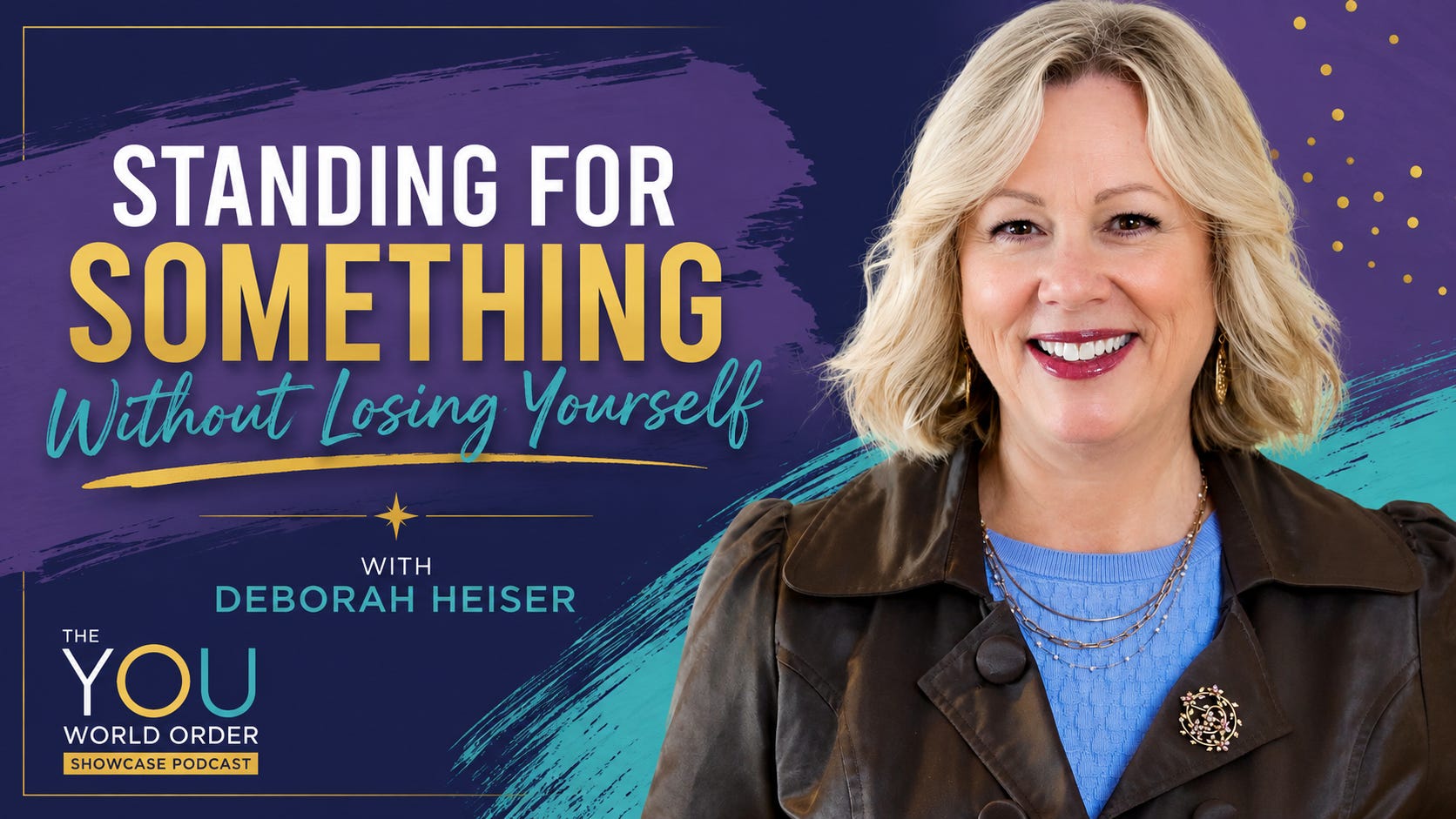
That tension sits at the center of my conversation with Debbie Heiser, founder of Lit Up Life.
Debbie works with purpose-driven women who want meaningful success without sacrificing themselves to create it. Her approach brings together more than 25 years of leadership experience across corporate life, entrepreneurship, and academia with neuroscience, nervous system regulation, self-awareness, and strategic execution.
And her perspective on burnout begins somewhere many conversations about productivity never go.
Who are you being, while you are doing everything you do?

Women learn to carry a remarkable number of identities.
Mother.
Partner.
Daughter.
Leader.
Employee.
Founder.
Coach.
Caregiver.
Friend.
Volunteer.
The roles themselves are not necessarily the problem.
The problem begins when the roles become so dominant that the person underneath them becomes difficult to find.
Debbie describes meeting women who have spent years meeting expectations without asking a much more fundamental question:
Who am I when I am not performing a role for someone else?
That question can feel uncomfortable.
It can also be liberating.
Because once you begin separating your identity from everyone else’s expectations, you can make choices from a different place.
Not from fear.
Not from obligation.
Not from the need to prove your worth.
From yourself.

Explore the Perks of Subscription
One theme surfaced repeatedly throughout our conversation: women often minimize what they have accomplished. Someone earns an extraordinary position and barely mentions it. Someone builds decades of expertise and describes herself as though she is merely lucky to be in the room. Someone spends years raising children and says she is “just” a stay-at-home mom. Someone knows she can help a potential client but still feels uncomfortable saying so because she does not want to sound promotional.
Debbie sees this pattern constantly. There is a difference between humility and erasing yourself. Owning your experience does not mean believing you are better than anyone else, and sharing your expertise does not require pretending you know everything. Standing for something also does not mean everyone who disagrees with you is wrong.
Sometimes it is enough to simply say, this is who I am, this is what I have experienced, this is what I know, this is how I help, and these are the people I am here to serve. When you do that, the right people are free to recognize themselves in your work.
That is especially important for coaches and transformational entrepreneurs. Visibility is not about convincing everyone. It is about becoming recognizable to the people who need what you know.
Debbie shared an observation after spending time around highly successful female entrepreneurs. Their businesses were different, their stories were different, and their personalities were different, but one pattern connected them: they were willing to stand for something.
What stood out was not that these women had the loudest opinions or the most polished personal brands. It was that they were clear about their own experience. They were willing to say, in essence, “This was my journey. This is what worked for me. If this resonates with you, come with me. If it doesn’t, find someone whose work does.”
That distinction matters. Standing for something does not require making everyone else wrong. It creates a kind of authority that comes from specificity rather than performance. You are no longer trying to earn universal approval. You are making it easier for the right people to recognize whether your perspective is for them.
For coaches, wellness professionals, and spiritual entrepreneurs, that kind of clarity is especially important. Visibility becomes much less about trying to appeal to everyone and much more about becoming recognizable to the people who are already looking for the kind of transformation you help create.
One of the more distinctive parts of Debbie’s work is the way she talks about burnout through the lens of transactional analysis.
She describes different internal roles that can shape how we think and behave: the playful child, the adolescent, the critical parent, and the mature adult. The point is not to label yourself permanently as one of these roles. It is to notice which voice is running the show.
For many high-achieving women, Debbie sees the critical parent becoming especially dominant. It is the voice that says you should be further ahead, you should have done better, you should not have made that mistake, everyone else seems to have this figured out, or you need to work harder before you are allowed to rest.
When that voice has been present for years, it can stop sounding like criticism and start sounding like truth.
Debbie often asks clients a simple question: would you speak to a five-year-old child the way you speak to yourself?
That question matters because many women who are highly compassionate toward everyone around them use a completely different standard internally. They correct, push, and criticize themselves in ways they would never use with someone they loved.
Over time, that relentless internal pressure can organize a life around proving, performing, and protecting. You may become exceptionally good at handling responsibility while quietly losing trust in your own feelings, instincts, and decisions.
Debbie’s mature adult operates differently. The mature adult can look at what happened without turning it into a character indictment. She can make a decision without polling everyone else first. She can take responsibility for a mistake without using it as evidence that she is inadequate.
Most importantly, she can trust herself.
That is why Debbie sees self-trust as such an important part of reclaiming sovereignty. Burnout is not always just a time-management problem or a workload problem. Sometimes it is what happens when your life is being run by internal pressure instead of grounded self-trust.
Debbie uses the phrase “Instant Pot world” to describe the pace many people are living in now.
Everything is immediate. Messages arrive instantly. Notifications demand attention. Clients want responses. Algorithms reward constant activity. There are launches, deadlines, family responsibilities, business responsibilities, metrics, news, email, and an endless stream of things that appear to need an answer right now.
The problem is not simply that there is a lot to do. The deeper problem is that the body can begin responding as though all of it is urgent.
That changes the way you make decisions.
When everything feels urgent, it becomes harder to distinguish between what actually matters and what is simply loud. It becomes harder to think strategically. It becomes harder to hear your own instincts. Even rest can start to feel like something you have to justify.
This is where Debbie’s focus on nervous system regulation becomes practical rather than abstract.
Sometimes the next business move is not another funnel, another offer, or another productivity system. Sometimes it is giving your system enough room to come out of emergency mode.
That can look surprisingly ordinary. Taking a walk. Sitting outside without your phone. Reading fiction instead of another business book. Growing something. Looking at a mountain. Playing. Allowing yourself to have an experience that does not need to become content, revenue, or a measurable outcome.
Those moments are not the opposite of productivity. They can be what restores your ability to make clear decisions in the first place.
For purpose-driven entrepreneurs, that distinction matters. A business built entirely from urgency will eventually ask your nervous system to carry more than strategy ever can.
One of Debbie’s strongest ideas in the conversation is her belief that what looks like a money problem can sometimes be a receiving problem.
That shifts the conversation away from money as a purely tactical issue.
If someone is uncomfortable receiving support, compliments, opportunities, visibility, help, or love, it is worth asking whether the same pattern shows up around money.
Can you receive without minimizing?
Can you let someone help you without immediately feeling indebted?
Can you accept a compliment without explaining it away?
Can you allow an opportunity to be good without immediately searching for the catch?
Can you experience success without bracing for something to go wrong?
For entrepreneurs, receiving also shows up in business. It can look like undercharging, avoiding sales conversations, refusing support, dismissing praise, or feeling uncomfortable when someone is genuinely ready to work with you.
That is what makes Debbie’s framing more interesting than a generic conversation about abundance. She is not simply saying to “think positively” about money. She is pointing toward a broader pattern of openness and contraction.
Scarcity narrows attention. It makes us grip more tightly. It tells us there will not be enough, so we need to control more, protect more, and trust less.
Debbie’s own practice of noticing abundance is very concrete. She talks about driving across a bridge near her home and seeing eagles, wild swans, mountains, and the natural world around her. Those experiences reconnect her with a felt sense that life contains more than what is currently demanding her attention.
That is a different relationship with abundance.
It is not pretending challenges do not exist. It is training yourself to notice that scarcity is not the only information available.
Another thread running through Debbie’s perspective is the freedom that comes from accepting that not everyone is your person.
She puts it in memorable language: some people will love your kind of crazy, and others will not.
That does not make either person wrong.
For coaches and transformational entrepreneurs, this is where visibility starts to become much simpler. You do not have to dilute yourself until nobody could possibly disagree with you. You do not have to become louder just to compete for attention. And you do not have to build a polished online identity that bears little resemblance to the person behind the screen.
You can be specific about what you believe, how you work, what you have lived through, and who you are equipped to help.
That specificity creates useful friction.
Some people will hear your message and realize you are not for them. That is not necessarily a failure of visibility. It may be evidence that your message is finally clear enough to sort for alignment.
The people who do resonate can come closer because they recognize something.
They recognize the problem.
They recognize the language.
They recognize the worldview.
They recognize themselves in the way you describe the transformation.
That is what visibility is supposed to do.
It is not about convincing strangers to like you. It is about becoming easier for the right people to identify.
The deeper invitation in this conversation is not to become a more optimized version of yourself.
It is to become more available to yourself.
To notice when the critical parent is making decisions for you.
To recognize when urgency has become your default state.
To rebuild trust in your own judgment.
To become more comfortable receiving.
To stop erasing your accomplishments in the name of humility.
To let your message become specific enough that some people can say yes and others can confidently say no.
That is very different from trying to become impressive.
It is about becoming congruent.
For coaches and spiritual entrepreneurs, congruence is what makes authority sustainable. Your visibility, your message, your offers, and your way of working begin to point in the same direction.
That creates a different kind of business.
One where authority does not require pretending to know everything.
One where visibility does not require performing for everyone.
One where success can include financial abundance without reducing abundance to money.
And one where growth does not require abandoning yourself in the process.
When one person begins showing up that way, it also gives other people permission to do the same.
That is where visibility becomes more than marketing.
It becomes impact.
Debbie Heiser is the founder of Lit Up Life, where she works with purpose-driven women who want to reconnect with themselves while creating meaningful, financially abundant lives and businesses. Her work includes private coaching, a women’s mastermind, workshops, retreats, and the free Build Her community for female business owners and leaders who are ready for a different relationship with success and hustle culture.
Learn more about Debbie and Lit Up Life at:
https://thelituplife.com
Join the free Build Her community:
https://thelituplife.com/buildher
If you are a coach or transformational entrepreneur ready to become more visible, strengthen your authority, and attract aligned clients without constantly chasing them, apply for your Client Acquisition Audit:
https://coachsalchemist.com
With love & clarity,
Jill Hart💜The Coach’s Alchemist

Amplify Your Voice • Monetize Your Mission • Get Visible

Hi, I’m Jill Hart, The Coach’s Alchemist. I help spiritual entrepreneurs and coaches amplify their voice, attract aligned clients, and monetize their mission through Substack and podcasting.
If you’ve been creating content but not seeing it turn into conversations, clients, or consistent income, Client Acquisition For Coaches is for you.
It’s where we simplify visibility, build authority, and create a clear path from your content to your offers without chasing algorithms or trying to be everywhere.
Comments
Nothing yet. Say the first thing.
Sign in to join the conversation.