
A review and critique of this article:
New York Times, 8/23/26:
Bigger, Hotter Fires Are Slowly Erasing America’s Great Forests
Issues to be addressed:
Are wildfires “erasing” our national forests?
Why does the New York Times focus on wildfire and climate change as threats to our forests but does not mention logging or spraying?
Can we cool temperatures in California by turning the landscape into a sponge, e.g., by letting forests grow and reintroducing beavers?
Given that snowmelt is declining, can we compensate for it by turning the landscape into a sponge?
If we protect the habitat of the black-backed woodpecker, will that help cool California’s climate?
The article features the Sierra National Forest, which is 1.3 million acres, on the western slope of the Sierra Nevada mountain range.
The article tells us that our biggest national forests are being “erased” by wildfire.
This is sensationalistic, hyperbolic and inaccurate. It plays to people’s fears of fire and fear of climate change. But it is a stretch to say that any fire has the ability to “erase” a forest.
Here is a Guardian article from January that used similar language: Mapped: how the world is losing its forests to wildfires | Wildfires | The Guardian
You also see news outlets say that a fire “destroys” a forest or “decimates” a forest or “consumes” a forest. We are “losing” our forests to wildfire. Forests are “going up in flames.”
The lowdown on wildfires
Fire, including severe fire, has a renewing effect. It is a necessary part of natural cycles.
Many birds depend on natural wildfires.
This includes the black backed woodpecker, which lives mostly in Canada, but its range extends southward into the Sierra Nevada mountain range, in California.
The black-backed woodpecker favors a cooler environment, which is available in the upper altitudes of the Sierra Nevada.
The primary threat to the black-backed woodpecker is logging, both pre-fire and post-fire logging. It thrives in old growth forests that have not been logged, either before or after a big fire.
I cannot prove that logging is a bigger threat to the black-backed woodpecker than warming temperatures, but I know that cessation of logging in their habitat is the quickest, easiest way to help this species.
Black-backed woodpecker habitat
The black-backed woodpecker is one of numerous species that absolutely depend on a severely burned forest.
Contrary to popular mythology, low-intensity fire is not a substitute for the high-intensity fire that creates the black-backed woodpecker’s habitat. And frequent fire (e.g., prescribed fire) is not a substitute for the infrequent fires that create the black-backed woodpecker’s habitat.
****
The NYT does not mention logging or spraying
This New York Times article points to 1) climate change and 2) wildfires as “erasing” forests, such as those in the Sierra Nevada. But, curiously, it omits any reference to logging and the spraying of herbicides.
Unlike National Parks, our National Forests are open for exploitation, mainly industrial logging. The priorities and practices of industrial logging run counter to the ecological health of our forests.
The government increasingly pushes logging industry priorities, as evidenced by pending repeal of the Roadless Rule and the likely passage of the Fix Our Forests Act.
Nor is this the first administration to prioritize logging interests, as evidence by the 2021 Infrastructure & Budget Reconciliation Bill. This report from the John Muir Project explains key provisions and why they opposed it: Version 2.0 JMP Report
Here is a letter from scientists opposing the bill, which ultimately passed.
Scientist Letter Opposing Logging Provisions In BBB_BIF4Nov21.pdf
As bad as this administration is, if we want change, it needs to occur on both sides of the aisle.
****
Our forests don’t need protection from wildfire. They need protection from logging and spraying.
The New York Times gets this wrong by talking like wildfires and “climate change” are the primary threat to our forests, without a single mention of logging or spraying.
Why the mainstream thinking about climate change is bankrupt
Climate change is a complex topic. I think it’s a mistake to think solar and wind are going to lower our temperatures, so long as the economy is doubling every generation. Because when the economy doubles, so does energy consumption and so does materials throughput, the total amount of materials extracted from the farms, forests, mines and oceans of the world and processed into finished goods.
If true, then it would be a mistake to allow the New York Times or Big Green to inspire false hope in some big energy transition that will magically lower temperatures.
See here:
The Unpopular Reality about Energy Transitions with Jean-Baptiste Fressoz | TGS 162
Michael Moore Presents: Planet of the Humans | A Film by Jeff Gibbs | Full Documentary
Fossil fuels are a problem, but it’s hard to imagine a scenario whereby fossil fuel consumption goes down while energy consumption doubles every generation. I don’t think there’s any evidence that this could happen or will happen. You see examples of this or that country, e.g., Great Britain that somehow is on a path to “decarbonization.” But there’s a lot of creative accounting that can mask the carbon emissions inherent in the supply chains that produce the products they consume, when they are outsourcing their manufacturing.
If we are concerned with the climate of California, then let’s start by calling a halt to logging in the Sierra Nevada mountain range.
This will go far to turn the mountains into a sponge that captures the rainfall, to compensate for the diminishing snowmelt.
And let’s make sure to restore beaver populations. North America once had 350 million beavers and the continent might have been 8% wetlands, behind beaver dams. We killed the beavers because we wanted the pelts and coveted the land underneath their ponds. Beaver populations went down to about 10 million, and the surface freshwater in North America declined to about 1%.
These numbers are approximate, but not far off the mark.
One last point.
Restoring vegetation and water cycles has a cooling effect that MIGHT be quicker than lowering carbon emissions
When we restore water cycles by revegetating the landscape (in our farms and forests), then we will go far to restore our water cycles and cool the environment. We neglect to discuss the damage done by denuding and desiccating the landscape.
The good news is that nature will do most of the work. Photosynthesis grows plants. Our job is to refrain from cutting too many plants down, by logging and also by practicing conventional farming methods which remove vegetation, whereas regenerative farming will restore much of the vegetation to the landscapes.
Three California regenerative farms include Singing Frogs Farm, Apricot Lane Farm and the Be Love Farm.
In conclusion
Fires don’t destroy forests
The primary threat to our forests are logging and spraying, not wildfires or climate change
Snowmelt is declining with warming temperatures, so we need to figure out other ways to capture the rainfall, by turning the landscape into a sponge.
If we restore vegetation, this will have a cooling effect. We need to do this anyway, in addition to trying to lower carbon emissions, which is a decades-long project by any estimation, so will not yield quick results.
Protecting the habitat of the black-backed woodpecker will let trees regrow and help capture rainfall and slow the snowmelt
****
Webinar this week
Join us for:
Saving Our Forests from the Wildfire Industrial Complex
Friday, August 28 @ 3:00-4:30 Eastern Time (via Zoom)
Register here:
https://harthagan.kit.com/cf98ecbe19
Upcoming course:
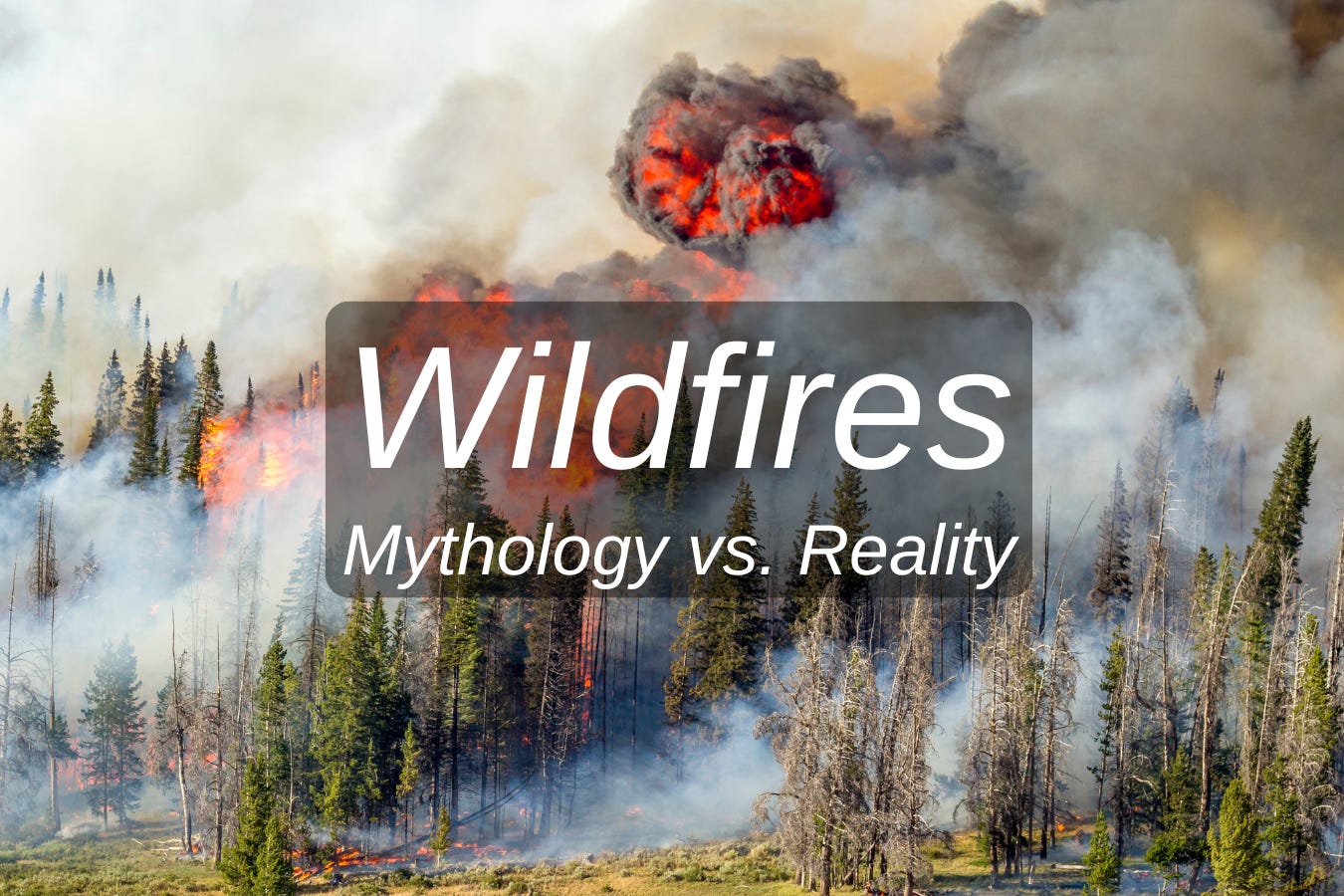
Wildfires Mythology vs. Reality – Fall 2026 - Biodiversity for a Livable Climate
https://bio4climate.org/course-offerings/wildfires-fact-fiction-fall-2026/
This course features North America’s leading experts on wildfire ecology, including these three great ecologists:
Chad Hanson
George Wuerthner
Richard Hutto
… who are the authors of these Recommended Books:
Smokescreen, Debunking Wildfire Myths to Save Our Forests and our Climate, by Chad Hanson
A Beautifully Burned Forest, by Richard L. Hutto
Wild Fire, A Century of Failed Policy, by George Wuerthner
… and are featured in these Great Videos:
A Beautifully Burned Forest (with Richard Hutto, Wildlife Biologist)
“Smokescreen: Debunking Wildfire Myths” Event with Chad Hanson, PhD
Fire Suppression and Climate Change: A Conversation with George Wuerthner
No posts
Comments
Nothing yet. Say the first thing.
Sign in to join the conversation.