
These models come from this talk by Mohnish Pabrai. They are focused on starting and running a business. Pursued fanatically, and in parallel, they can give you a huge edge. 1+1+1+1 become 1111.
Take a simple idea and take it seriously. Go all-in or it just doesn’t work.
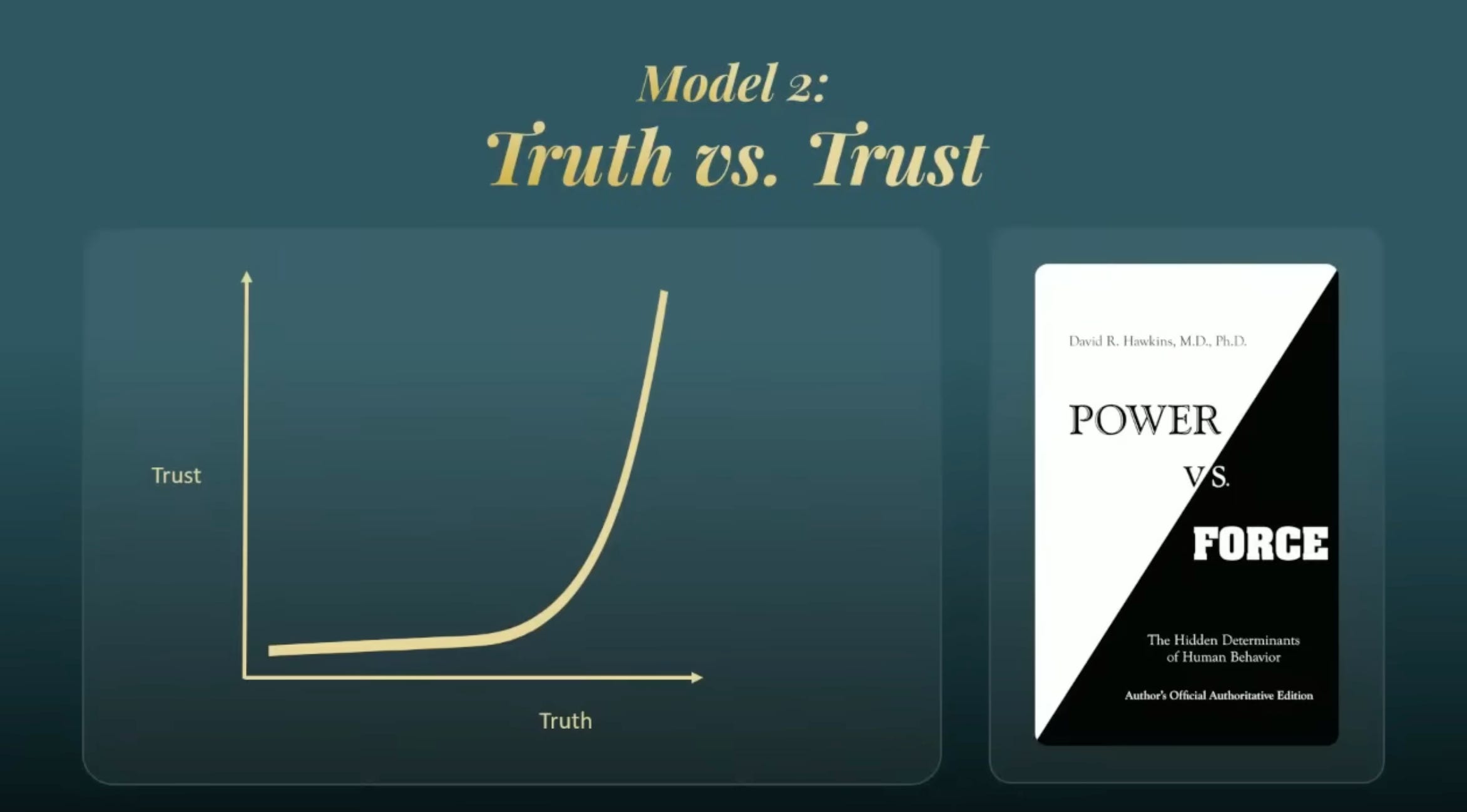
At the tight end of the graph you have extreme truth leading to extreme trust. This is where Jesus and Buddha hang out. Thats aspirational. Life is more convenient with the white lies. Get rid of them.
A personal example of what this means:
Your partner asks you - How do I look?
You don’t think the dress is great.
If you tell her a white lie all is well and date night continues as planned.
But if you stick to this model then you may upset her and date night may get canceled.
Stick to the truth. It may upset her now, but she will always trust you to tell the truth in the future.
A business example of what this means:
Costco never marks up anything more than 15%.
Once Costco got a great deal from Levis. Costco could have made a lot of money but Jim Siegel stuck to the 15% rule because that is what their customers trust is based on.
This is why so many are fanatical about Costco. That trust has taken decades to build. Costco pay their people more than all the other people. They have very low turnover. Their current CEO started as a fork life operator.
It’s just a great ecosystem of trust.
This is a very important model to keep in mind when you are embarking on something new. If you really want something, it doesn’t matter what you know or what your expertise is, you got to first believe that it’s going to happen.
“The world is a very malleable place. If you know what you want, and you go for it with maximum energy and drive and passion, the world will often reconfigure itself around you much more quickly and easily than you would think.” - Marc Andreesen
“As is your desire, so is your will.
As is your will, so is your deed.
As is your deed, so is your destiny.
Your deepest desire is your destiny.”
– Brihadaranyaka Upanishad, 2700 years ago
Jeff Bezos defines asymmetric bets as high-upside, low-downside opportunities where potential gains exponentially outweighs risks, allowing for 1000-run returns compared to the 4-run maximum in baseball. Look for such opportunities where you either win big or you don’t lose much.
Cloning is a very powerful mental model. You do not need to come up with anything new. The world can accommodate multiples of the same thing. Just copy!
Walmart - is a company which was built with no original ideas. Everything in Walmart was copied from someone else. Sam Walton did not come up with anything new. There is no one who visited more stores than Sam Walton. He could learn and extract lessons from the worst operators.
Microsoft - Everything that worked at Microsoft was stolen from someplace else. Word from Wordperfect. Excel from Lotus. Windows from the Mac. MS Dos was bought. Microsoft spends a lot of money on research but nothing has come out of that. Everything has come out of cloning. Even the AI is not coming from the inside.
”Hang out with people better than you and you will get better. Hang out with people worse than you and you will get worse.” – Warren Buffett
Make a list of your friends and categorize them on who is better than you and who is worse than you. Then delete everyone on the worse category from your life.
Don’t care about loyalties. This model is difficult because you got to be a harsh grader. But when you delete someone, you have room for someone else who can make you better.
Hire Slow. Fire Fast.
Hire for capability, not skill.
Overdose on fresh grads.
Look for all three - Integrity. Intelligence. Energy.
Humans are very heavily driven by incentives.
Book recommendations:
You don’t need money to start, run or be successful in business. Out of 1 million businesses that start in the US every year, only 1% get funding. The economy runs on the remaining 99%.
Book recommendation: Zen and the Art of Motorcycle Maintenance
This book will show you the power of bringing extreme quality into everything you are doing, which will give you a big leg up in life.
A great business is easier to build than a shoddy one.
Do what’s harder upfront by playing the long game, never thinking of an exit and making it your life’s work.
The purpose of business is to deliver a great product or service to humanity. If you do that, then money is a natural side effect.
If you start with the notion that I am going to become an entrepreneur so that I can get rich, you are not going to get rich. And it’s not going to be such a fun journey. Instead start with the idea that you’re going to serve humanity.
Put a value on your own time. Almost everything you want done can be done for $100 or less.
Only try to work on things that you are intensely excited about.
Try to have a team that can work on the rest.
Whatever you tell your customers you want to do, will not be correct. But if you listen, they will educate you on what their real pain is.
It doesn’t matter whether the industry is paperclips or airplanes.
If it is a $10 billion market, if you say that you will take 2% of it, you will fail. It shows that you haven’t done the segmentation.
But if you say that your offer is so good that you can take 70% market share, then you have a chance.
For example - If a 1 hour podcast gives you better insights than a 20-hour book read, then go all-in and listen to as many podcasts as you can. It’s a highly efficient way to learn.
We sensor what we do. It narrows what data we take in. Introducing randomness broadens our perspective.
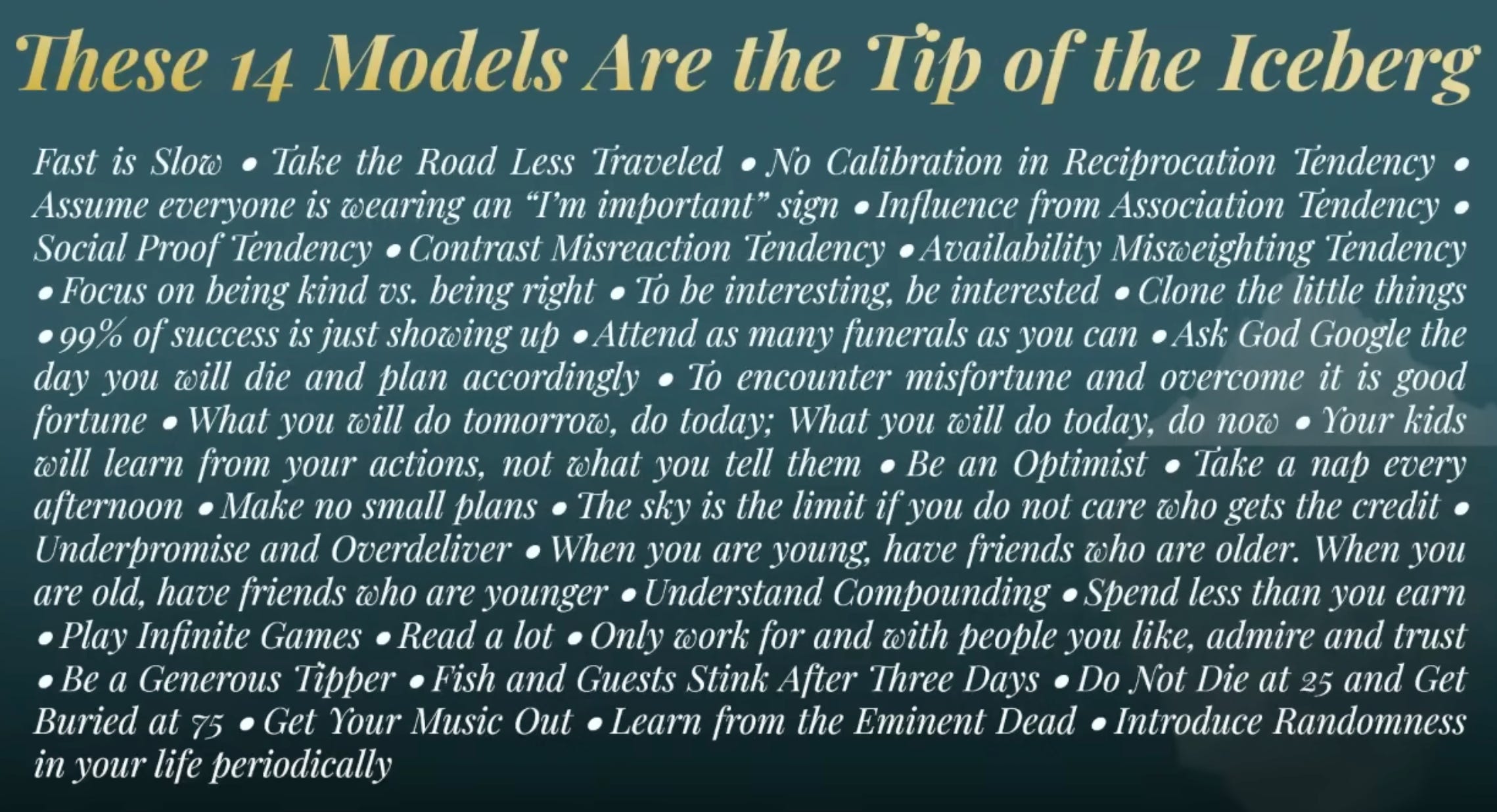
Fast is Slow
Take the Road Less Traveled
No Calibration in Reciprocation Tendency
Assume everyone is wearing an “I’m Important” sign
Influence from Association Tendency
Social Proof Tendency
Contrast Misreaction Tendency
Availability Misweighting Tendency
Focus on Being Kind vs. Being Right
To Be Interesting, Be Interested
Clone The Little Things
99% of Success Is Just Showing Up
Attend As Many Funerals As You Can
Ask God Google The Day You Will Die And Plan Accordingly
To Encounter Misfortune and Overcome It Is Good Fortune
What you will do tomorrow, do today; What you will do today, do now
Your kids will learn from your actions, not what you tell them
Be an optimist
Take a nap every afternoon
Make no small plans
The sky is the limit if you do not care who gets the credit
Underpromise and Overdeliver
When you are young, have friends who are older. When you are old, have friends who are younger
Understand compounding
Spend less than you earn
Play infinite games
Read a lot
Only work for and with people you like, admire and trust
Be a generous tipper
Fish and Guests stink after Three Days
Do not die at 25 and get buried at 75
Get your music out
Learn from the Eminent Dead
Poor Charlie’s Almanack: The Wit and Wisdom of Charles T. Munger
Excellent Advice for Living: Wisdom I Wish I’d Known Earlier
Your spouse is the single most important business decision of your life. Nothing else comes close.
Everything is sales. The sooner you accept it, the better your career becomes.
See you next Sunday.
Harsh

I share my learnings as a business builder, daily on my WhatsApp Community and LinkedIn, and weekly on my Sunday Email.
No posts
Comments
Nothing yet. Say the first thing.
Sign in to join the conversation.