
Many of the ideas we present to students in the mathematics classroom must seem to come from nowhere. A full turn is 360, just because it is. We use letters in maths sometimes, just because… we can? We use coordinates, written as (x, y), to describe position because... we do.
My thought is that if we dive straight into measuring angles, writing algebraic expressions, or working with coordinates, students often either switch off or see these important concepts as rules or processes to remember rather than as important and useful ideas. For some students, this is fine for ‘learning’ maths, but for most, it makes the subject difficult to grasp and enjoy.
More than this, I feel that it tells students that Maths is a set of rules to learn, or that it is something that ‘just is’. Angles around a point sum to 360 because they just do. ‘x’ represents an unknown because it just does, and always has.
Instead, how about we start a Year 7 unit on angles by talking about how, if you stand in a spot and turn all the way back to where you started, that is a full turn. We know a full turn is 360 degrees from primary school, but why?
Instead of diving straight into algebraic expressions, like “I lose two sweets, I now have n - 2 sweets”, let’s talk about how, the first time problems with unknowns were written, mathematicians were writing sentences to describe them.
We can provide important and useful context for the maths we are learning, and refer back to it when actually doing the Maths. I like the idea of telling a story to engage students with these ideas.
I use a mix of my own research, facts I know, and artificial intelligence to create these. More on the process around this at the end.
An Introduction to Algebra
In the early days, mathematicians like Muhammad ibn Musa al-Khwarizmi (the father of Algebra) wrote everything in full sentences. If they wanted to write x + 5 = 10, they had to write:
“A thing plus five units is equal to ten units.”
They called the unknown value shay (Arabic for “thing”). Imagine doing your homework if every single problem was a paragraph! This is what we call Rhetorical Algebra.
When we begin to write expressions in a lesson, we can refer back to this idea to explain why we use letters instead. It’s far easier to write “x +5” rather than, “an unknown quantity, plus 5”.
We could also talk about other notation, such as the equals sign, when we get to solving equations, and how, before it was invented, mathematicians would have to write “is equal to”.
A longer story I made using Gemini at the start of this academic year is linked here. It’s far from perfect, but I found it gave some interesting real-world context to how algebra has developed over time - and helped students to see algebra is not just “something we do in maths lessons”.
Another Example: Why 360?
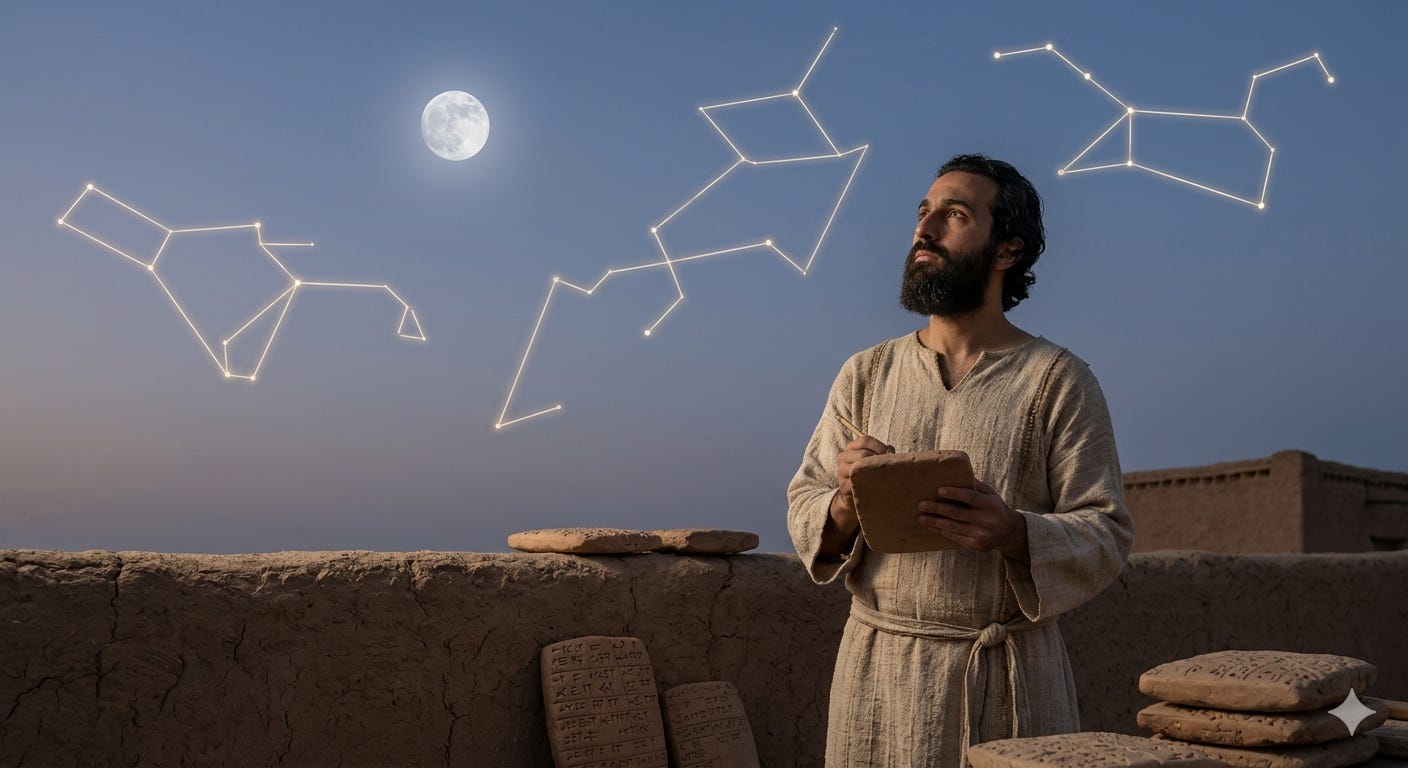
Imagine you are standing in the middle of a vast, flat desert in Mesopotamia (modern-day Iraq) about 4,000 years ago. You are a Babylonian astronomer. Every night, you look up. The stars move, but they move in a predictable way.
You notice that the Sun seems to take about 360 days to travel in a full circle around the Earth and return to its starting point. (They were off by about 5 days, but 360 was a much “friendlier” number for maths!) Because of this, the Babylonians decided that a full turn—a circle—should be divided into 360 small steps. They called these steps “degrees.”
We can talk about the idea that a full turn could be any number. In fact, after the French Revolution, there was an attempt to make a full turn 400 degrees.
When we are learning how to use a protractor, this story helps convey that an angle is a measure of turn and that each mark on the protractor represents a full turn split into 360 equal parts. We can talk about the idea that you don’t even need numbers written on the protractor to measure an angle; we could just count how many divisions the turn is.
It takes away the idea that measuring an angle is just a “procedure” to follow. It helps students understand that a “half turn” is 180 degrees within this context. It gives us a basis to build on when we move on to more abstract ideas.
The Ancient Egyptian “Rope Stretchers”
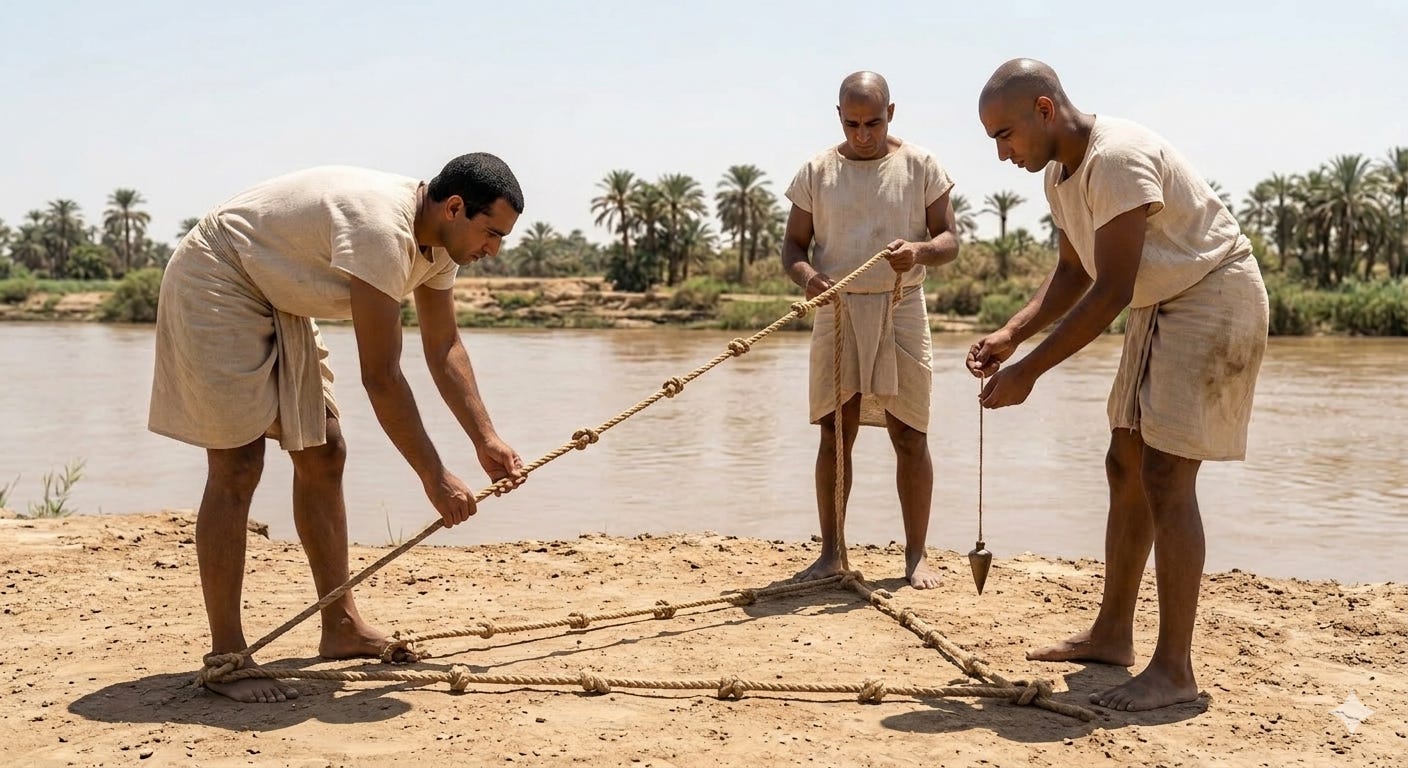
While the Babylonians were looking at the stars, the Ancient Egyptians were dealing with a more grounded problem: the Nile River. Every year, the Nile would flood, wiping out the boundaries of everyone’s farms. When the water receded, they had to redraw the squares and rectangles of the fields.
They needed perfect “square corners” (what we call Right Angles). But they didn’t have plastic set-squares. Instead, they used “Rope Stretchers.” They took a long loop of rope with 12 equally spaced knots. By pulling it into a triangle with sides of 3, 4, and 5 knots, a miracle happened: the corner was always perfectly square.
I like this real-world historical context because it helps students understand that some angle facts were discovered and used in the real world without being formalised in the classroom, and that it’s not just something we deal with on a square grid in a maths book. They have real-world utility and have throughout history.
The Greek Discovery: Angles Have Rules
Fast forward to Ancient Greece. A man named Thales began to realize that angles weren’t just random shapes—they followed “laws.” He noticed that if two straight paths crossed each other, the angles opposite one another were always identical twins.
He also realized that if you stood on a perfectly flat road and looked from one horizon to the other, you had turned exactly half of the Babylonian circle.
This idea can be extended to many areas of mathematics. I recently found it interesting to talk about the history of metric and imperial units before a lesson on converting metric units, for example.
I hope this has given you some ideas on how you might use real-world context to help engage students in Mathematics, which is often seen as abstract and detached from the real world.
I generally use facts I have picked up and interrogate Gemini to gain a picture of a topic, if I want to present this kind of thing to students. AI generally doesn’t provide a well-structured, fully informed story without prompting you for what you want. E.g. what key developments do you want to include, what is the aim of your story? It’s definitely worth playing around with, if you are at all interested.
No posts
Comments
Nothing yet. Say the first thing.
Sign in to join the conversation.