
In the issue: Erin Somers charts the rise and fall of cultivated meat, Barrett Swanson reports on the Ugly People Festival in Italy, Kyle Berlin on the French bestseller whose controversy divided the country, a pseudonymous memoir of a government official in Beijing, Finn Brunton on prediction markets and crypto-anarchism, Thomas Frank on the Obama Center, Kasia Boddy reviews William Kennedy’s Albany Trilogy, five stories from Diane Williams, and more. Read the full table of contents here.
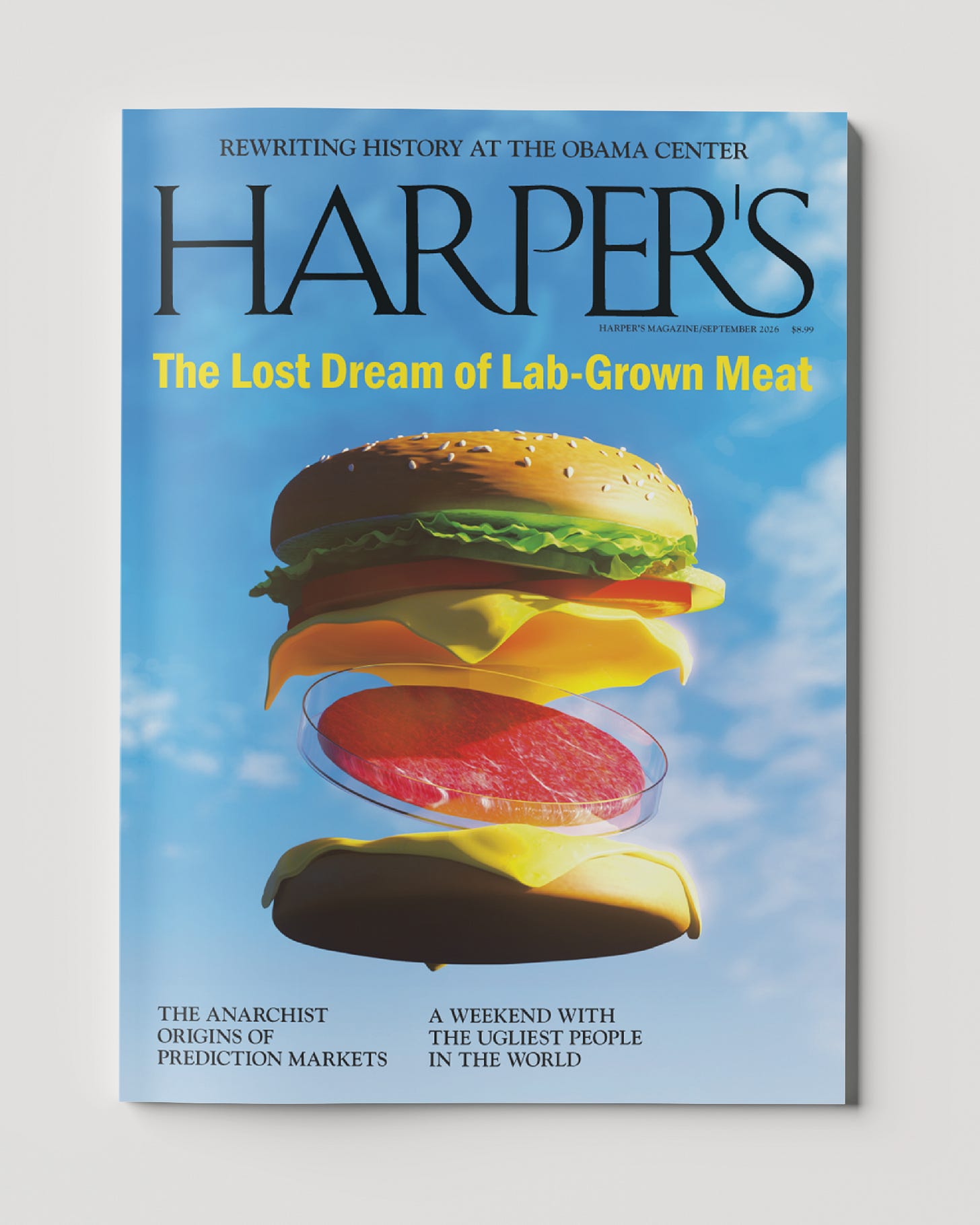
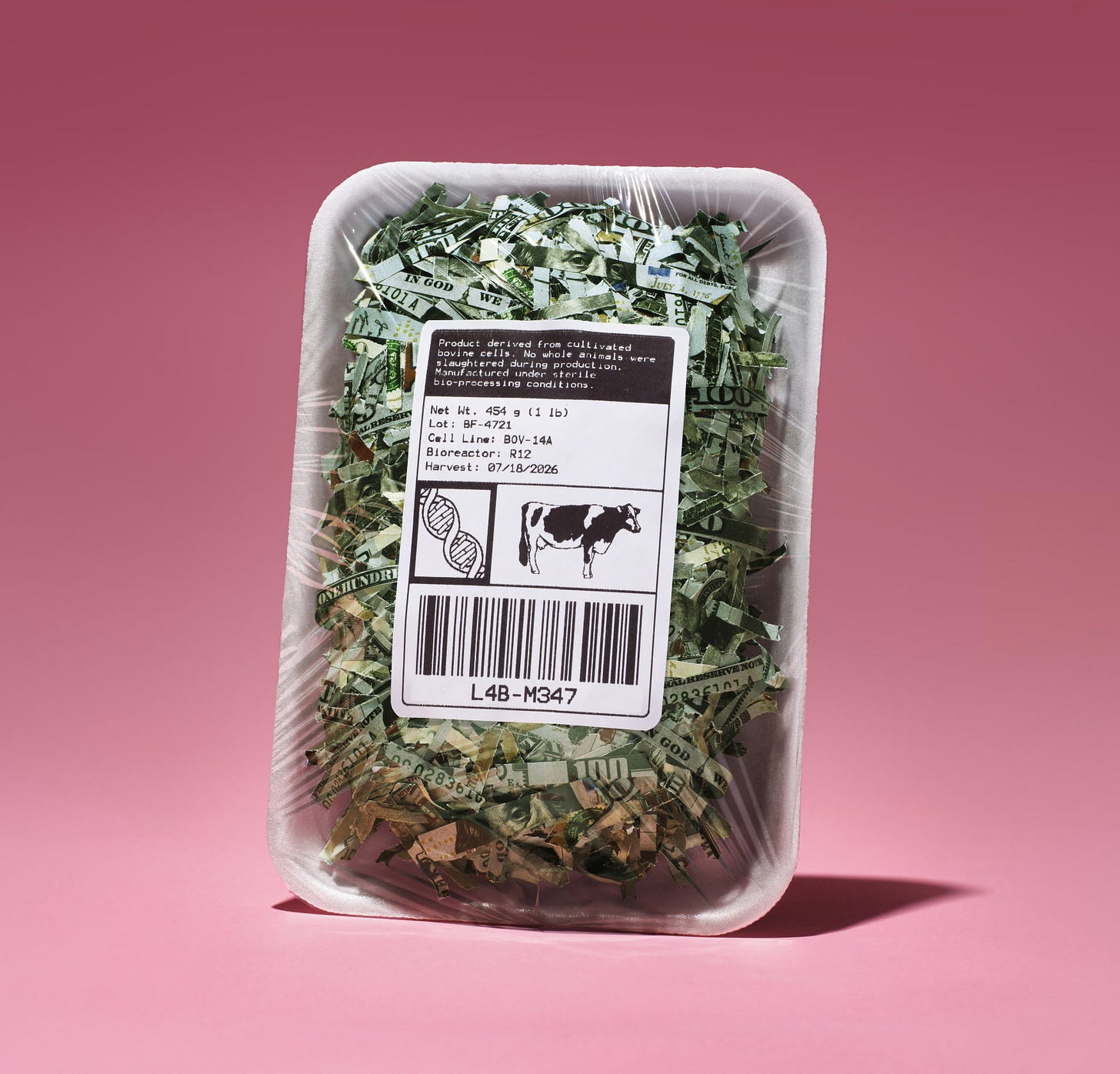
The lab-grown-meat revolution that wasn’t
By Erin Somers
On August 5, 2013, a man and a woman ate a burger. Not just any burger: a world-historical burger, made from cattle cells grown in a lab by Mark Post, a professor of vascular physiology at Maastricht University in the Netherlands. The burger had taken two years to produce and cost $330,000, money furnished by the Google co-founder Sergey Brin. Now it was being tasted in public for the first time at Riverside Studios in London, at an event attended by two hundred members of the press and livestreamed to thousands.
To make this particular burger, Post had extracted stem cells from the shoulder muscle of a living cow, then cultivated them in plastic containers filled with a nutrient-rich supplement called fetal bovine serum, which is derived from cow fetuses. The cells eventually became twenty thousand strands of tissue, which in turn became a single, five-ounce patty. Post believed that beef produced this way had the potential to dramatically reduce greenhouse-gas emissions and slow climate change. Raising cattle for consumption requires massive amounts of land and water—and massive amounts of feed grown at a high environmental cost. He projected that global demand for meat would soon outstrip our ability to produce it the old-fashioned way, at which point our food systems would become unsustainable. But that didn’t have to mean a mass recalibration of our consumption habits or a global shift away from red meat. Post and his team had found another way.
Standing at a blond-wood island on an otherwise empty soundstage, Post lifted the kind of stainless-steel cloche usually found on a room-service cart to reveal his creation. The raw patty sat in a petri dish on a bare plate, where it shone wetly under the studio lights. With the ITV London anchor Nina Hossain presiding, a Cornish chef named Richard McGeown pan-fried the burger in sunflower oil and butter for two volunteer tasters: Josh Schonwald, the Chicago-based author of The Taste of Tomorrow: Dispatches from the Future of Food, and Hanni Rützler, an Austrian nutrition scientist. So precious was this meat that they were given just the one burger to share between them. It was served deconstructed, alongside a sesame-seed bun, lettuce, and tomato—showmanship to sell the burger a bit, give it context. The patty itself was reddish brown, flat, and perfectly circular. When Schonwald and Rützler cut it, the burger did not bleed.
The two of them ate with forks and knives, passing the plate, sawing off thoughtful bites. Chewing slowly. Afterward they rendered their verdicts. “I would say it is somewhere on the spectrum between a Boca Burger and McDonald’s,” Schonwald told a reporter from NBC. “The absence of fat makes a big difference. It has the texture, which I was not expecting. It was like an animal-protein cake.” Rützler noted the burger’s blandness to a reporter from Science. “There is room for improvement here,” she said. At the end of the event, roughly $150,000 worth of burger remained uneaten. But none of this stopped Post from predicting that meat cultivated in a lab would become a consumer product within the decade.
The event—the theatrical reveal, the PR spectacle—triggered a kind of gold rush. One hundred and forty companies sprang up in six continents, trying to replicate what Post had done with beef across a range of other species: chicken, pork, fish, even quail. Investment to the tune of $3 billion flooded into the sector. True believers claimed that cellular agriculture would not only fight climate change and global food insecurity but also slow the spread of zoonotic disease and antibiotic resistance. A company called Upside Foods touted its plans to “set the new standard for meat” and to “make meat a force of good in the world.” A company called Vow created an enormous woolly-mammoth meatball, though no one was allowed to eat it, since the DNA came from a fossil and the company didn’t know whether it was actually fit for human consumption. The think tank RethinkX predicted that cultivated meat would decimate the U.S. beef industry by 2030, reducing demand for the conventional variety by a whopping 70 percent. As the organization wrote, “We are already on the cusp of the deepest, fastest, most consequential disruption in food and agricultural production since the first domestication of plants and animals 10,000 years ago.”
And yet, despite the frenzy, the meat itself never arrived. The challenges were numerous. There was the exorbitant up-front cost of building manufacturing facilities and the daunting amounts of energy required to run them. There was the difficulty of producing sufficient quantities of the stuff, at a price point low enough for people to buy. There was the lack of a highly skilled workforce trained to operate the new technology. There were rounds and rounds of inspections by the Food and Drug Administration and the U.S. Department of Agriculture. There was even, occasionally, the unwanted appearance of rodent DNA in product samples, which happened to the companies Upside and Eat Just. After peaking in 2021, investment began to fall off. In 2023, the industry raised a measly $177 million.

[Letter from Italy]
Regarding the Pain of Uggos
A weekend at the Ugly People Festival
By Barrett Swanson
[Revision]
The Chaos Machine
Prediction markets and the triumph of crypto-anarchy
By Finn Brunton
[Criticism]
Borrowed Wounds
Prediction markets and the triumph of crypto-anarchy
By Kyle Berlin
[Easy Chair]
All the Change in the World
By Thomas Frank
[Memoir]
Silkworms
Reincarnation in Beijing
By Long Ling, Translated by Jonathan Flint
[Fiction]
Five Stories
By Diane Williams
[Reviews]
Albany’s Homer
How William Kennedy found his beat
By Kasia Boddy

“In our post-Freudian, postmodern, post-truth era, the idea of hagiography might seem preposterous, but I think the time may be ripe for anything that provides an inspiring example of the forgotten virtues of sacrifice, duty, love, care.”
—Ian Penman, author of “All She Dreamed”


Comments
Nothing yet. Say the first thing.
Sign in to join the conversation.