
Hi, I’m Claire, an interior designer. My newsletter, Interior Design for Anyone Who’d Rather Be Told What to Do, shares design tips to simplify the decision-making process so that you can design your home yourself, with confidence and without the overwhelm. Make sure you start at the beginning here, then here.
I don’t actually tell you what to do. I look to interiors that have stood the test of time and offer advice to help reduce your search, freeing up your time for the fun stuff instead.

Choosing flooring is a big decision for your home. It’s completely understandable if you’re unsure where to start and feel a little overwhelmed. I’m going to keep this post as simple and clear as possible to help reduce your search and build your confidence so you can make a decision that won’t leave you doubting yourself afterwards.
Flooring is expensive to buy and install, and the extra costs that catch most of us out: grout, adhesive, underlay, and rubbish removal, which is why I advise choosing for life. Don’t do what I did and avoid the flooring of the moment. Because removal and replacement are difficult, expensive, time-consuming, disruptive and pretty terrible for the planet.
Flooring is a high-cost part of a renovation, and I wouldn’t recommend blowing your budget and going for it, as I did, because you can’t take your floor with you if you move. It’s about finding the balance between timeless, hardwearing and affordability.
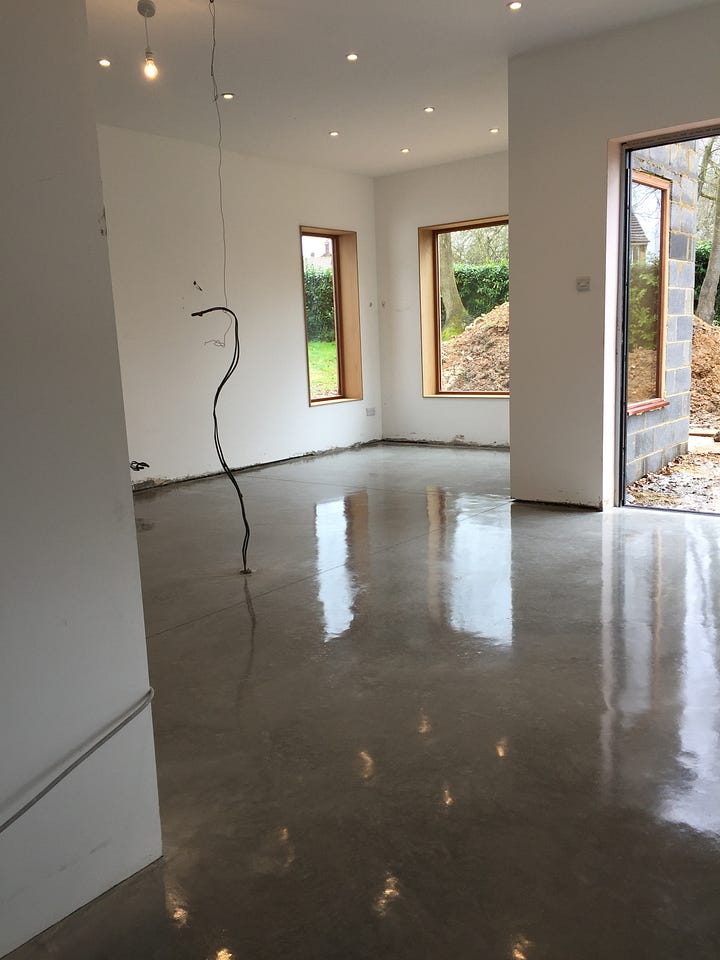
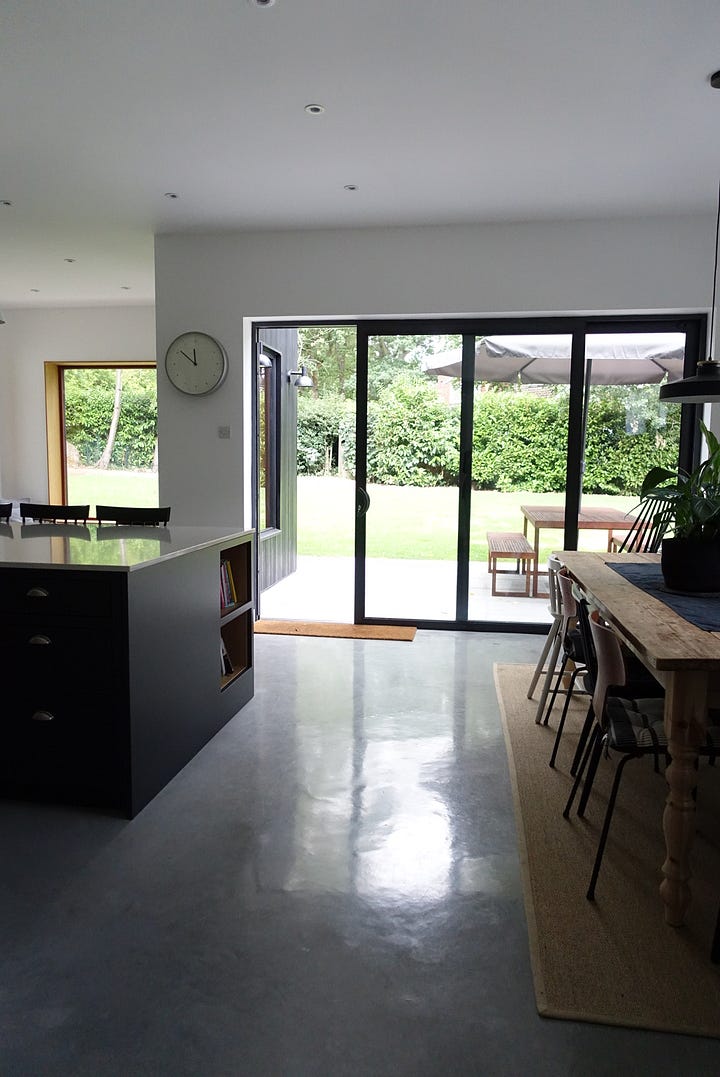
A few years ago I renovated a 1950s modern bungalow, and I was determined to have polished concrete flooring. I didn’t take my own advice or even the kind words of warning from a friend whose friend had it, and hated it.
Polished concrete flooring takes weeks to prep, then to dry out. It costs an eye-watering amount of money and is so porous that everything that splashes on it stays visible. I knew all of this, but still went ahead.
I didn’t care. I could be patient, convinced I could save money elsewhere, and I thought the marks wouldn’t be too bad and I could deal with it. But having two smallish children at the time, I learnt that I could most definitely not get over the spilt ketchup, apple juice, ice lollies and milk.
The floor stained really quickly; kids drop a lot, as did my husband and I! To try and hide and prevent any further damage, I would dot rugs, runners, and mats in potential splash zones.
The really sad thing is that approximately six months later we moved house and the concrete floor didn’t… maybe that was a good thing? All the hours, days, and weeks lost, planning, installing and cleaning it, along with the cost, were all for no real benefit, as the new owner had planned to put herringbone tiles down on top of it. I learnt my lesson in hindsight.
Spend your time, energy and money wisely.
It can be very tempting to choose interesting flooring: patterned tiles, terrazzo tiles, painted checkerboard, checkerboard tiles, fancy floorboard layout, herringbone brick tiles, or dark carpets. Tiles are very on trend, and the small glimpse of the styled room looks gorgeous on social media, but from experience, a bold floor choice can make rooms look imbalanced and shout a little too loudly, and when furniture is then placed on top, it can all look busy and feel a bit wrong.
My advice is to keep things as simple as possible by making the shell of your home - your fixtures- really timeless and hard-wearing so they can support your life, not take you away from it, because you’re too busy worrying about or cleaning the floor.
A quick recap
Before you start, look at the building’s architecture and character for guidance. What flooring would have been used originally?
I refer to the home as two parts:
Fixtures are the things ‘fixed’ to your home; you won’t be taking them with you if you move. Flooring is a fixture.
Fittings are removable, the things that come with you. Furniture are fittings.
I refer to the style of the home as two categories:
Traditional: Decorative and detailed.
Modern: Simple and clean-lined.
The aim is to help you choose a floor that will keep your home feeling good for as long as possible, ideally the length of your lifetime in the home. Which is why choosing something you love now and still will for years to come is really important. Which is why I always look back for inspiration. A home that looks good and relevant from fifty or a hundred years ago is most likely to do so for another fifty or a hundred more.
For both traditional and modern homes, I recommend choosing only one of each of the following materials and repeating throughout your entire home:
Comments
Nothing yet. Say the first thing.
Sign in to join the conversation.