
Topics worth your time: what the early IoT boom actually proved about crowdfunding as a business model, the original Oculus and Formlabs product campaigns, demystifying the math behind the Smith chart, and the true cost behind smooth surface finishes.
P.S. We’re back in SF for another happy hour on August 11! Register here.
For a few years in the 2010s, “connected” devices were treated as the next obvious product requirement. Kickstarter campaigns existed for nearly every household object that could plausibly carry a BLE/Wi-Fi chip, and perhaps the best embodiment of the era was Quirky, a crowd-funded startup best known for a connected egg tray that raised $185M in subsequent financing rounds.
The premise behind most startups at the time was that an ordinary product could become a software business if you connected it, just as smartphones were becoming common enough to make the interface possible. “IoT everything” was as much a rallying cry as it was the central investment thesis for a new generation of companies.
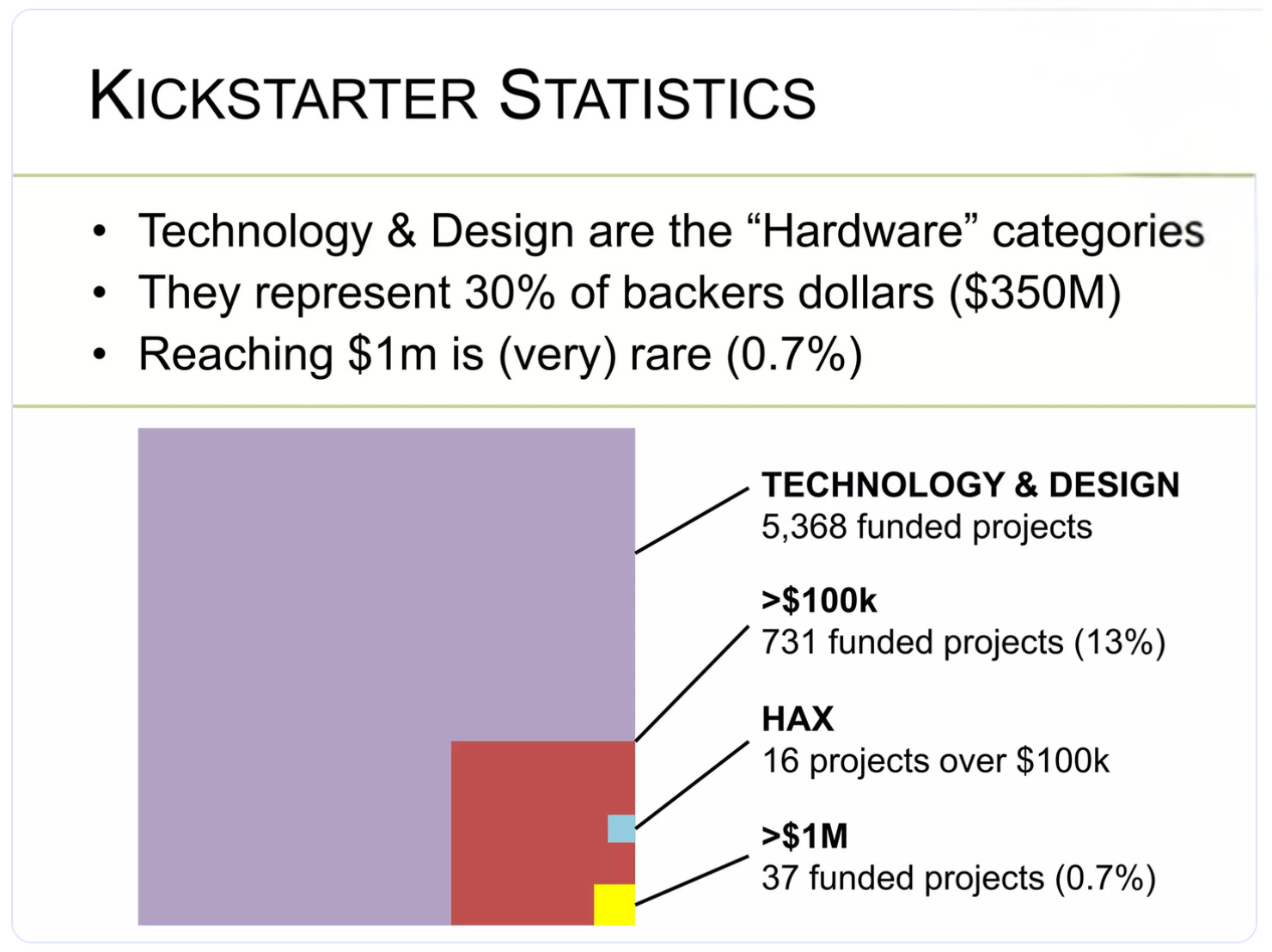
8 Things About Hardware Crowdfunding from HAX is a useful field report from inside that moment, and while its lessons are nominally about crowdfunding, most apply broadly to any company trying to turn early attention into a real business. Some nuggets of knowledge:
Crowdfunding validates an audience, not a company. It can prove people want the product, but does not prove the scale, defensibility, or market size required for a venture-backed company.
Funded != profitable. Work backward from cost and target a 3–4x multiple, including fixed costs like tooling, certification, fulfillment, and the production surprises that show up after launch.
A successful campaign can be the whole story! Campaigns can be commercially meaningful without becoming a venture-scale business, nor does it need to be.
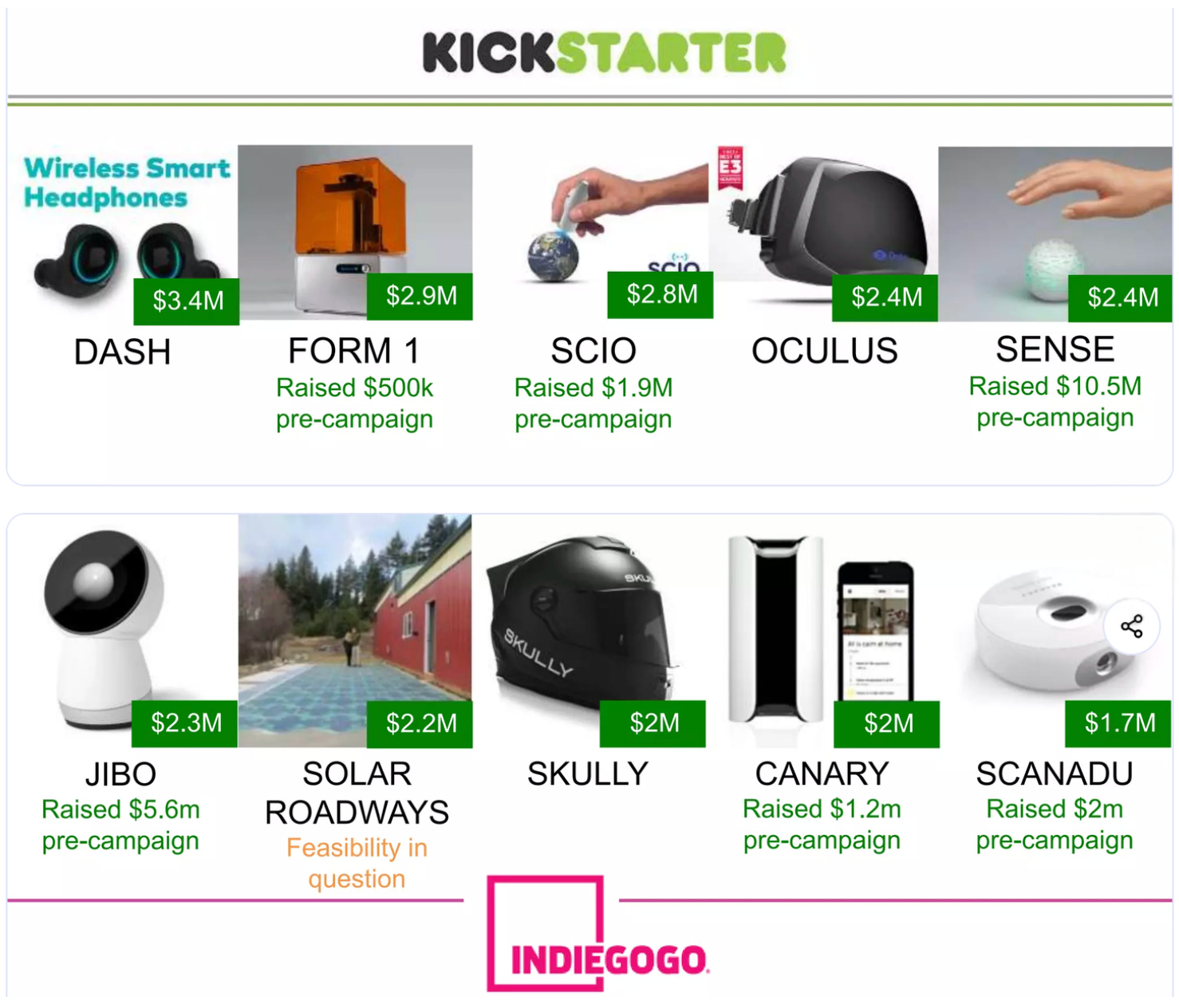
Many of the original campaigns and connected-device companies are now gone, but a few did use crowdfunding well; not as the business, but as the first financing mechanism for something larger. Click below for the original campaigns.
Formlabs: one of the few enduring 3D-printer companies from the era. Professional machines, recurring resin, now expanding to consumer SLS printers.
Oculus: crowdfunded first, then acquired by Facebook two years later.
Ring: started as Doorbot, created the video-doorbell category and sold to Amazon for ~$1B.
Tile: crowdfunded before AirTag existed, acquired by Life360 for $205M.
Your hardware tech stack starts here. Duro Design PLM is AI-native, API-first, and fully programmable—built to meet the present and leap into the future. Duro centralizes part data, manages change orders, and connects your stack so your team can focus on innovation, not administration.
From out-of-the-box CAD integrations to seamless connections with ERP and MES, make sure your data is accurate at every stage of the product development lifecycle. Whether it’s Altium 365 or Solidworks, Duro’s integrations make integrating PLM into your workflow easy.
Take a tour of Duro for free and see if our PLM solution is right for you. 👇
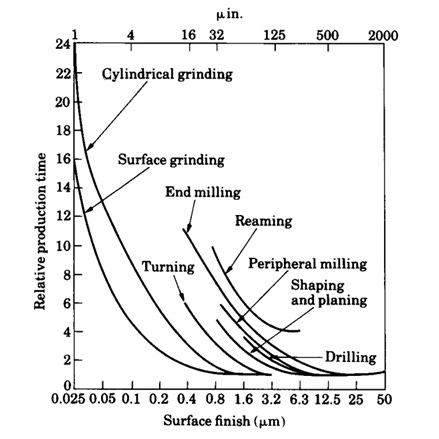
Finer surface finish specifications tend to increase manufacturing time exponentially - use the coarsest spec (or no specification at all) when possible.
A great walkthrough of where the Smith chart comes from, the impedance matching chart many EEs first encounter in academia. Candidly, the only useful summary is to watch the full video!
Neros landed a five-year Army contract worth up to $500M for its Archer FPV drones, with the company aiming for a 100,000 annual production rate by year end.
ProvenMetal is a new YC S26 startup assembling quick-turn circuit boards out of a garage in San Francisco, hinging on the simple pitch that domestic board assembly should take days not years.
Machina Labs received a Lockheed Martin qualification contract for a JASSM missile assembly produced with its robotic metal-forming process.
Agility Robotics is opening a 60k sq. ft robot training facility in Fremont, CA, as it prepares to go public and scale Digit beyond pilot deployments.
Aris Machina Proto – Design & validate anything, with the AI-native workspace for industrial science and hardware R&D.
Jiga – Custom parts at digital speed, with trusted shop access.
SolidWorks for Startups – Full access to SolidWorks’ product development tools, free for early-stage startups.
Zoo – AI-native CAD for generating fully editable B-rep models from natural language or direct manipulation.
Refer three friends to Hardware FYI and unlock our full archive.
Missed an issue? Hunting for that one link? Every tool, guide, and article we’ve ever shared is in here.
P.S. If you find something interesting—an article, tool, funding round, project, really anything—send it our way!
P.P.S. 20,000+ engineers, founders, and operators read this newsletter. If you want to reach them, get in touch.
Comments
Nothing yet. Say the first thing.
Sign in to join the conversation.