
Topics worth your time: the fascinating aircraft competing in DARPA’s heavy-lift drone challenge, an explosive approach to peeling vegetables, and Waymo’s case for multi-modal sensing in autonomous vehicles.
P.S. Last chance to register for our happy hour on 8/11! We have a few more tables left for teams with demos or other work they’d like to bring into the room. If that’s you, send us an email.
One of the familiar critiques of institutional bodies is that they are bureaucratic, burdened by red tape, and slow to innovate. All of that can be true, and more. Yet there’s an interesting dichotomy where some of the most consequential technical leaps of the last century emerged from institutions like DARPA, which paved an early path for self-driving cars with the DARPA Grand Challenge in 2004 and funded ARPANET, the internet’s direct ancestor.
Perhaps the better answer to the contradiction is that the institution doesn’t need to innovate itself. It just needs to create the conditions for everyone else to do so. Define an almost unreasonable goal, then distribute the R&D across everyone willing to try.
The modern reincarnation is the DARPA Lift Challenge - a competition to build a sub-55-pound drone that can take off vertically and carry a payload of at least 110 pounds over 5 nautical miles. $6.5M in total prize money, including $2.5M for first place.
It sounds relatively straightforward until you consider that the primary metric is payload-to-aircraft weight ratio, not payload itself. DARPA set the target at 4:1, meaning a 55-pound aircraft would need to carry 220 pounds! For reference, the best aircraft on the market are agricultural drones like the DJI Agras T50, which has a ratio of ~0.75:1 and weighs 115 pounds with an 85-pound payload. DARPA requires 2:1 just to qualify.
The competition is running right now (Aug. 6–9), and the entrants are fascinating to watch in real time.
RotoWings: two RC planes tethered together to create a giant virtual rotor.

Hunter Weiss@Hunter_Weiss
I laughed when I watched this one. Amazing that someone made this, and it flies

malignantone @LT0771
@Hunter_Weiss I hope that drones that’s just 2 rc planes stuck together on a pole spinning like a helicopter wins lol
8:11 PM · Aug 5, 2026 · 3.78M Views
197 Replies · 1.43K Reposts · 22.1K Likes
Phoenix Drone LLC: a tandem-rotor design.
Hunter Weiss@Hunter_Weiss
Excited to see how this Chinook style does once they add more weight

Ben Schulz @schulzb589
@Hunter_Weiss I think the Chinook/KMAX twin rotors are probably going to be the default next year.
4:13 PM · Aug 7, 2026 · 88.8K Views
10 Replies · 12 Reposts · 357 Likes
Avidrone, currently in first place: a conventional single-rotor helicopter.
Hunter Weiss@Hunter_Weiss
Avidrone is now in 1st place 29.3 lb drone, 112.4 lb payload (3.84:1) Course completed in 19 minutes 17 seconds

Hunter Weiss @Hunter_Weiss
Anyone else following the DARPA Lift Challenge? $6.5M in prize money to build a drone that can: - Stay under 55 lbs - Take off with a 110 lb minimum payload (4x its weight) - Fly 4 nautical miles loaded (12 laps) - Drop the payload - Fly 1 more nautical mile empty (3 laps) -
2:00 PM · Aug 6, 2026 · 538K Views
84 Replies · 181 Reposts · 5.4K Likes
If you’re interested in following the competition, check out DARPA TV or Hunter Weiss’s feed. And for aerodynamic theory, Principles of Helicopter Aerodynamics is the classic reference.
This Youtuber also has a great set of videos documenting his build for the challenge and the broader competition landscape.
On the topic of autonomous vehicles, Waymo’s defense of a multi-modal sensor architecture. Before becoming the company we know today, Waymo grew out of Stanford and Carnegie Mellon’s public proof at the original DARPA Grand Challenge.
Structural components in a KitchenAid mixer.
Patrick Collison on going fast - a catalog of ambitious projects completed on short timelines.
Testing Claude Fable 5 on recreating an adjustable wrench from a picture.
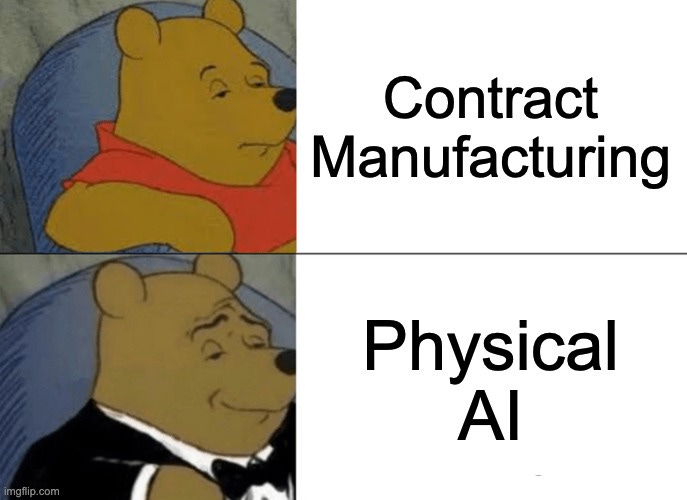
And a funny meme about changing times.
Source custom parts with direct access to the manufacturers making them. No middleman, no black box. Jiga gives you a vetted network and one accountable partner standing behind every order. You know who's building your parts and communicate with them directly. AI-assisted operations handle supplier matching, quoting, quality verification, and production tracking, so the relationships stay human while the operations run at speed.

StuffMadeHere’s latest contraption for automated vegetable and fruit peeling, derived from R.H. Winter’s original design in 1945 (US Patent 2490112).
Senra Systems raised $65M in Series B funding to expand its wire-harness manufacturing capacity, including a planned third factory and a goal of growing from ~1k to 10k harnesses per month next year.
Avatar Robotics raised $6.5M in seed funding to deploy teleoperated warehouse robots and use the resulting data to train more autonomous systems.
Mousterian and Samsung Heavy Industries signed an engineering contract for a 50 MW floating data center in Texas.
NavVis raised $85M in new funding to expand the mobile-scanning hardware and software it uses to build digital twins of industrial facilities.
Aris Machina Protos – Design & validate anything, with the AI-native workspace for industrial science and hardware R&D.
Jiga – Custom parts at digital speed, with trusted shop access.
SolidWorks for Startups – Full access to SolidWorks’ product development tools, free for early-stage startups.
Zoo – AI-native CAD with a modern geometry engine, readable code, and editable feature trees for precise, editable models.
Refer three friends to Hardware FYI and unlock our full archive.
Missed an issue? Hunting for that one link? Every tool, guide, and article we’ve ever shared is in here.
P.S. If you find something interesting—an article, tool, funding round, project, really anything—send it our way!
P.P.S. 20,000+ engineers, founders, and operators read this newsletter. If you want to reach them, get in touch.
Comments
Nothing yet. Say the first thing.
Sign in to join the conversation.