
This week brought another reminder of just how quickly AI is becoming physical — from shipyards and semiconductor fabs to humanoids finding their first real jobs on factory floors. The demos are still fun, but I’m increasingly obsessed with what happens after the demo: deployment, reliability, scale, and actual economics.
And speaking of getting closer to the action… next week’s issue will be a little special. 👀
I’m heading to Hong Kong and Shenzhen 🙂 to explore one of the most fascinating HardTech ecosystems in the world right now — robots, manufacturing, hardware, supply chains, and hopefully a few things I don’t even know I should be looking for yet. 🤖🇭🇰🇨🇳 I’m ridiculously excited🔥
So enjoy this week’s dose of HardTech — and stay tuned for the next one. I have a feeling there will be plenty to report from the ground 🚀😉
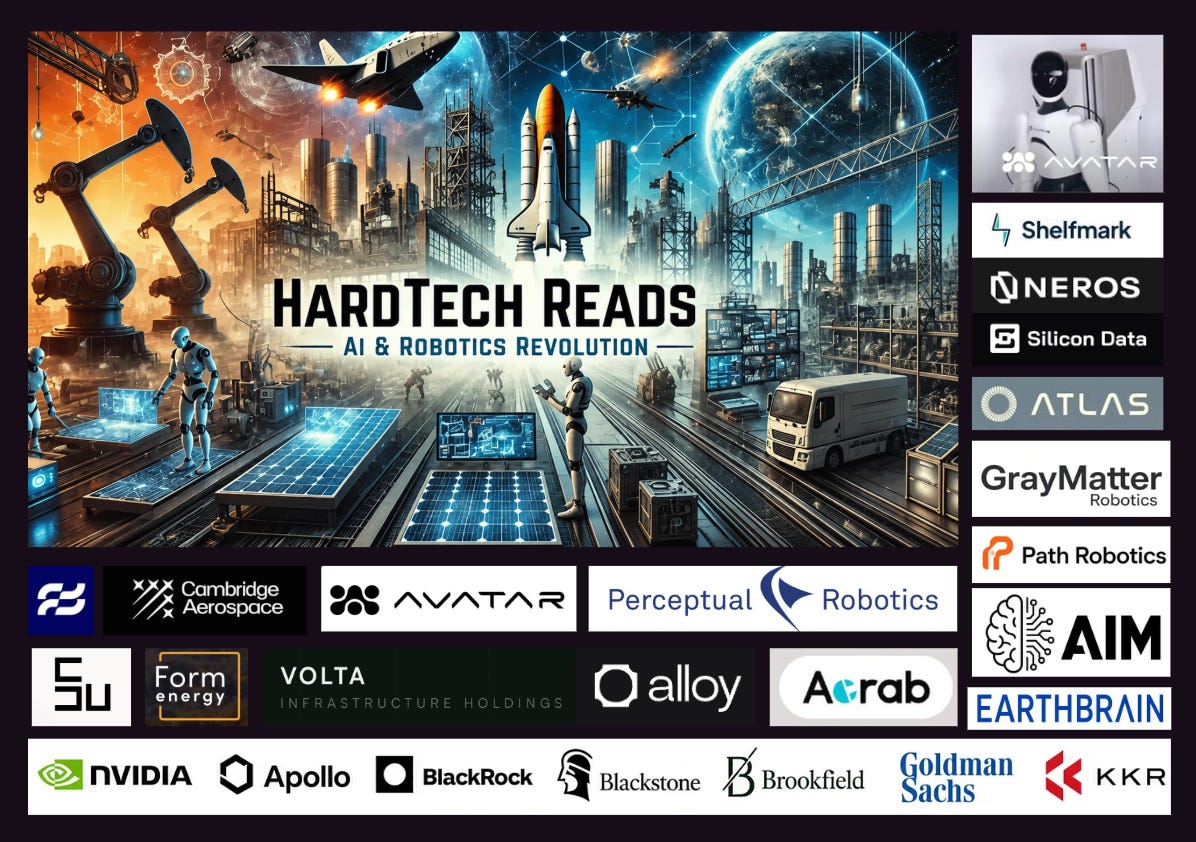
👉 Add your company to the next issue of HardTech Reads
⚓ Physical AI is entering the shipyard: HII is putting up to $900M behind automation with GrayMatter Robotics and Path Robotics as the U.S. Navy tries to expand shipbuilding capacity.
🏭 The AI boom keeps becoming an industrial boom: Tesla and SpaceX confirmed a massive $16.8B Terafab semiconductor project in Texas, while NVIDIA is working with Wall Street to mobilize as much as $500B for AI infrastructure.
🤖 Robotics is scaling beyond automotive: North American robot orders rose again in Q2, AMD launched processors aimed directly at robotics, and Chinese humanoids are moving deeper and deepper into actual factory work every week.
📈 The signal I keep seeing: the Physical AI opportunity is broadening from “who builds the best robot?” to who owns the infrastructure, compute, factories, data, tooling, and deployment layer around the robot.
This is one of the strongest industrial robotics signals of the week. Huntington Ingalls Industries—the largest U.S. military shipbuilder—is expanding the HYPR automation program it launched with GrayMatter Robotics and Path Robotics, bringing Physical AI into welding, surface preparation, coating, inspection, and other highly manual shipbuilding processes.
The number is what caught my attention: up to $900M tied to production automation. When the customer is trying to solve a strategic national shipbuilding bottleneck, automation stops being a “nice efficiency project” and becomes infrastructure and it required big money!
Elon is not really slowing down! SpaceX IPO seems to be just another beginning of new projects! Together with Tesla confirmed Terafab, a vertically integrated semiconductor manufacturing complex planned for Grimes County, Texas. The first phase alone represents approximately $16.8B of investment, with plans for thousands of jobs and an enormous manufacturing footprint.
The AI discussion is increasingly about chips—but the much bigger story may be who can actually manufacture enough of them. Vertical integration across compute, robotics, vehicles, rockets, and AI is starting to look less like an Elon quirk and more like a strategic advantage.
Share HardTech Reads: AI & Robotics Revolution
NVIDIA signed agreements with Apollo, BlackRock, Blackstone, Brookfield, Goldman Sachs, and KKR to create new compute-financing platforms targeting more than $500B in third-party capital. NVIDIA itself could backstop as much as $125B.
This is fascinating. GPUs are beginning to look less like electronics and more like infrastructure assets—financed almost like power plants, aircraft, or real estate. If AI factories require trillions of dollars, traditional venture capital was never going to finance the physical buildout alone.
A3’s latest data showed robot orders expanding beyond automotive, with broader adoption across general industries. This is particularly interesting because the next wave of automation increasingly comes from companies that historically did not have giant internal robotics teams.
The big question isn’t whether automotive remains important—it obviously does. It’s whether robotics becomes normal capex for thousands of mid-sized manufacturers. That is where the market becomes truly enormous.
This was one of the stories I bookmarked this week because it really captures where the humanoid market actually is right now.
Chinese manufacturers are deploying humanoids into real production environments for jobs such as fabric handling, electronics assembly, logistics sorting, inspection, and machine tending. One garment-automation company reports approximately 97% success on specific fabric-handling tasks, while other deployments are already operating full shifts.
I increasingly think this is how humanoids will scale: not “replace the factory worker,” but win one workstation, prove ROI, then replicate.
👉 Learn more
Unitree was already in last week’s issue when it priced its Shanghai offering, but this week’s development is worth updating: retail demand reportedly exceeded available shares by more than 8,000× ahead of its STAR Market debut.
I don’t read that as proof that humanoids are already a mature business. Quite the opposite. It shows just how enormous investor expectations around the category have become—and how little public-market exposure investors currently have to it.
A new research paper highlights a surprisingly fundamental problem: conventional industrial safety systems assume that removing power creates a safe state. With a balancing humanoid, cutting power can make the robot fall, potentially creating a new hazard.
This sounds technical, but it matters commercially. Humanoids eventually need to work beside humans without cages. Certification, fail-safe behavior, and functional safety could become some of the most underestimated pieces of the deployment stack.
Another new study introduced a perception-and-action system that converts human construction movements into mechanically feasible humanoid actions. The robot successfully reproduced eight construction-related tasks.
Still early research, but I love the direction: rather than manually programming every construction workflow, imagine experienced tradespeople showing robots how the work is actually done.
👉 Add your company to the next issue of HardTech Reads
➡️ River AI — founded by xAI co-founder Igor Babuschkin, River AI is building infrastructure that lets companies develop customized AI models using their own proprietary data. Raised $1.1B, led by General Catalyst and AMP PBC, with strategic participation from NVIDIA and AMD Ventures and additional backing from Y Combinator and Temasek. Location: USA.
➡️ Cambridge Aerospace — develops lower-cost counter-drone interceptors designed to defend against the rapidly growing threat of inexpensive autonomous aircraft. Raised $300M in Series C at a $3.4B post-money valuation, led by DFJ Growth with participation from Lux Capital, Accel, Lakestar, Never Lift, Ora Global, and Elad Gil. Location: United Kingdom.
➡️ Avatar Robotics — develops industrial labor robots designed to automate physically demanding work. Raised $6.5M in seed funding, led by AlleyCorp with participation from Defy VC and Headline. Location: USA.
➡️ Perceptual Robotics — develops autonomous robotic inspection systems for wind turbines, helping operators identify blade damage and reduce maintenance costs. Raised more than £4M, backed by Investing for Purpose, Loggerhead Ventures, One Planet Capital, and Innovate UK. Location: United Kingdom.
➡️ Shelfmark — builds manufacturing-monitoring technology designed to give factories better real-time visibility into production operations. Raised $3.5M in seed funding, led by Armory Square Ventures with participation from Grand Ventures, Hyde Park Angels, Argon Ventures, and Cultivation. Location: Pittsburgh, USA.
➡️ 5U AI — develops AI infrastructure for freight logistics and transportation operations. Raised $3.2M in pre-seed funding, led by Emerge Capital. Location: Germany.
➡️ Form Energy — develops iron-air batteries capable of providing multi-day grid storage, targeting applications where conventional lithium-ion becomes too expensive. Raised $750M in Series G funding. Location: Massachusetts / West Virginia, USA.
➡️ Volta Infrastructure — finances, develops and operates the physical infrastructure behind GPU data centers, including power, land and deployment-ready compute campuses. Raised $300M across Seed and Series A financing. Location: Singapore / India.
➡️ Alloy Robotics — builds an intelligence layer for physical automation and tools that help robotics teams identify, diagnose and resolve robot failures. Raised $8M, led by Square Peg with participation from Blackbird, Airtree, Skip Capital and others. Location: Sydney, Australia.
➡️ Neros Technologies — manufactures small autonomous drones and counter-UAS systems designed for deployment at defense-scale volumes. Raised $250M in Series C funding. Location: USA.
➡️ Acrab — develops purpose-built silicon and edge-compute infrastructure for autonomous and agentic AI systems. Raised $130M in Series B funding. Location: USA.
➡️ Silicon Data — provides market intelligence, pricing data and benchmarks for the rapidly emerging AI-compute economy. Raised $30.5M in Series A funding, led by Valor Atreides AI Fund with participation from CME Group, DRW, Samsung and VanEck. Location: New York, USA.
➡️ Princeton Critical Minerals — develops modular, solar-powered systems for extracting lithium from brines, addressing a strategic bottleneck in battery and critical-mineral supply chains. Raised $16M in Series A funding. Location: USA.
➡️ Atlas Motion — develops high-performance electric motors and actuators for defense platforms and other demanding mobility systems. Raised $11.5M in funding. Location: USA.

HII × GrayMatter Robotics × Path Robotics — HII is scaling Physical AI across U.S. Navy shipbuilding through an automation agreement worth up to $900M, targeting some of the most labor-intensive fabrication and finishing workflows in ship production.

NVIDIA × Apollo × BlackRock × Blackstone × Brookfield × Goldman Sachs × KKR — a new financing structure aims to unlock more than $500B for AI factories and compute infrastructure. This may be one of the clearest examples yet of AI infrastructure moving into the institutional-asset class.

AIM Intelligent Machines × Komatsu × EARTHBRAIN — the companies are combining AIM’s Physical AI autonomy with Komatsu’s equipment and EARTHBRAIN’s Smart Construction platform to enable autonomous bulldozers and excavators in Japan and the U.S. I especially like that the machines are intended not simply to follow predetermined paths, but to reason about project objectives, terrain, and execution plans.
1. Industrial robotics is moving into strategic infrastructure.
A $900M shipbuilding automation agreement isn’t another robotics pilot. Governments and prime contractors are beginning to view Physical AI as industrial capacity.
2. AI infrastructure is becoming a HardTech market of its own.
The opportunity is expanding far beyond chips into fabs, power, cooling, construction, robotics, grid infrastructure, and financing.
3. The humanoid ROI debate is moving to the workstation.
The most interesting Chinese deployments aren’t general-purpose humanoids wandering around factories—they’re robots proving they can perform one economically meaningful job consistently. It’s still early, but I can’t wait to see more and more ‘real’ use cases.
4. Robotics needs an ecosystem, not just better models.
Compute, certification, training data, safety systems, deployment tooling, maintenance, and financing are emerging as standalone markets around the robot itself. It’s very complex platform.
5. “Industrial AI” increasingly means physical assets.
Factories, grids, data centers, semiconductor fabs, warehouses, construction sites, and shipyards are becoming the places where AI capital expenditure actually lands.
I keep thinking about how dramatically the definition of an “AI company” is changing.
Two years ago, the conversation was mostly models, applications, and software.
Now look at where the money and urgency are moving.
➡️A $16.8B semiconductor factory.
➡️Potentially $500B of compute financing.
➡️A $900M shipbuilding automation agreement.
➡️Humanoids proving themselves one workstation at a time.
➡️Robotics processors, robot-safety standards, grid infrastructure, and autonomous construction.
AI is becoming physical.
And once intelligence moves into the physical world, everything becomes harder: manufacturing, safety, reliability, energy, supply chains, certification, deployment, maintenance.
But that difficulty is exactly why I find this next phase so exciting🤔
Software can scale overnight.
The physical world has to be built.
And we’re only at the beginning.
➡️ Building a Home Robot With Zero Robot Data
➡️ Three Fingers or Six Arms? — my latest HardTech Deep Dive asks a deceptively simple question: if we’re designing machines from scratch, why should the most efficient robot look like us? Can't wait to hear your thoughts!
Actuate 2026 — August 18–19, Fort Mason, San Francisco. The robotics developer conference, with speakers from Physical Intelligence, Wayve, Zipline, Shield AI, Google DeepMind, and NVIDIA. Next week! - See you there!
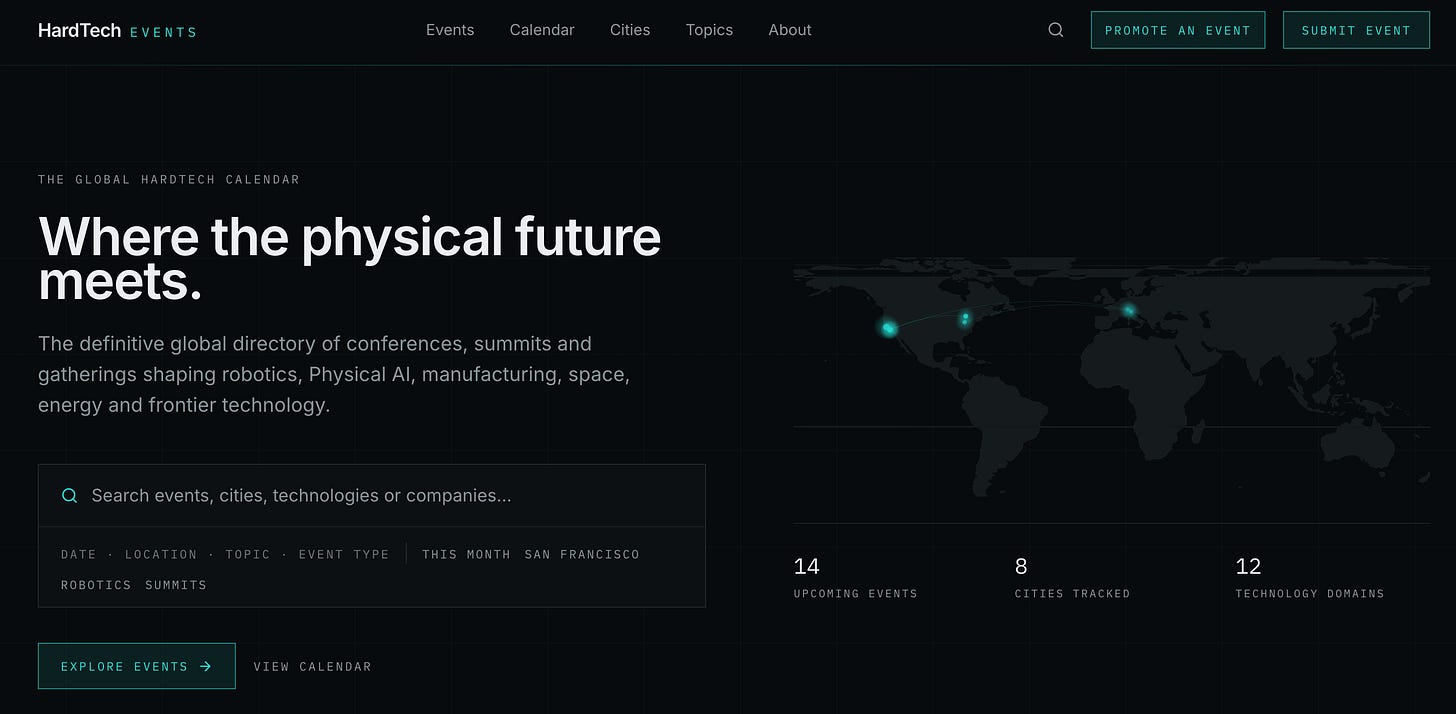
🌍 Global Hard Tech Events: hardtechnews.com
🤝 Passionate about HardTech? Have comments, want to share some thoughts or ask about sponsorships? Let’s connect!
📩 Want to feature your company in HardTech Reads? Apply Here
🗓️ Want to schedule a meeting directly, check my schedule
#AI #Robotics #Humanoids #HardTechReads #Startups #DeepTech #Automation #PhysicalAI
No posts
Comments
Nothing yet. Say the first thing.
Sign in to join the conversation.