
Exactly twenty years ago today, I evacuated my hometown in Southeastern, Louisiana with just a weekend’s worth of clothes. Hurricane Katrina turned those few days into months of displacement, loss, and a lifetime of climate anxiety. The storm split my life into a “before” and “after,” shaping my work today at the intersection of climate and mental health.
20th Anniversary Reflections: How Katrina Shaped a life, a city, and the urgency for climate action
My climate journey began 20 years ago today, when my family packed a weekend's worth of clothes for a routine hurricane evacuation, assuming - naively - we’d be home in a few days. What began as a routine evacuation turned into months of displacement, loss, and a permanent shift in how I see the world.
I was a high school sophomore when Hurricane Katrina's eye tore through my hometown of Slidell, La. Katrina left its mark in countless ways: a lost family member, family property swallowed by flood water, family separation - but I still carry survivor's guilt, grateful for my childhood photos and family keepsakes, while knowing so many lost everything.
On Friday, August 26, 2005, I was just another teenager attending our high school’s football scrimmage, not a care in the world, blissfully unaware of the storm brewing. By Saturday morning, my parents' tone had shifted as they grew increasingly concerned about a Gulf storm. We started bringing in outdoor plants and furniture, shuttering windows, piling sandbags, and stocking up on water and canned food. We kept watching the local news as the path of the hurricane seemed to be coming more clearly directly for us. By Sunday morning, a mandatory evacuation had been put in place, we’d packed a weekend’s worth of leisure wear, essential documents, and drove north to Jackson, MS, to ride out the storm with family.
At that point, I was still delusionally unfazed. Evacuating was practically a yearly ritual, typically resulting in a few fun days off school. With my parents and brother, we drove 4 hours north to Jackson, MS, to wait out the storm with family. From there, we spent the evening watching and waiting. The storm grew stronger and stronger. From a category 3 to a category 4 to a category 5. We went to bed that night, grateful to have decided to leave, but fearful for the life we knew. I remember lying in bed watching the rain slap against the windowpanes, wondering how the hurricane could be so intense this far from the coast. We woke in the morning to flooded streets, fallen trees, and downed power lines. Even over 160 miles from the Gulf Coast, we experienced heavy rains and destructive winds, resulting in a two-week-long power outage.
For me, the storm’s aftermath was more harrowing than the storm itself. With just a radio, we had no idea what was happening back home. With down power lines, there was no way to connect with friends and family members who rode out the storm. I was crippled with anxiety for weeks, waiting for word-of-mouth confirmation if my friends who stayed behind were ok.
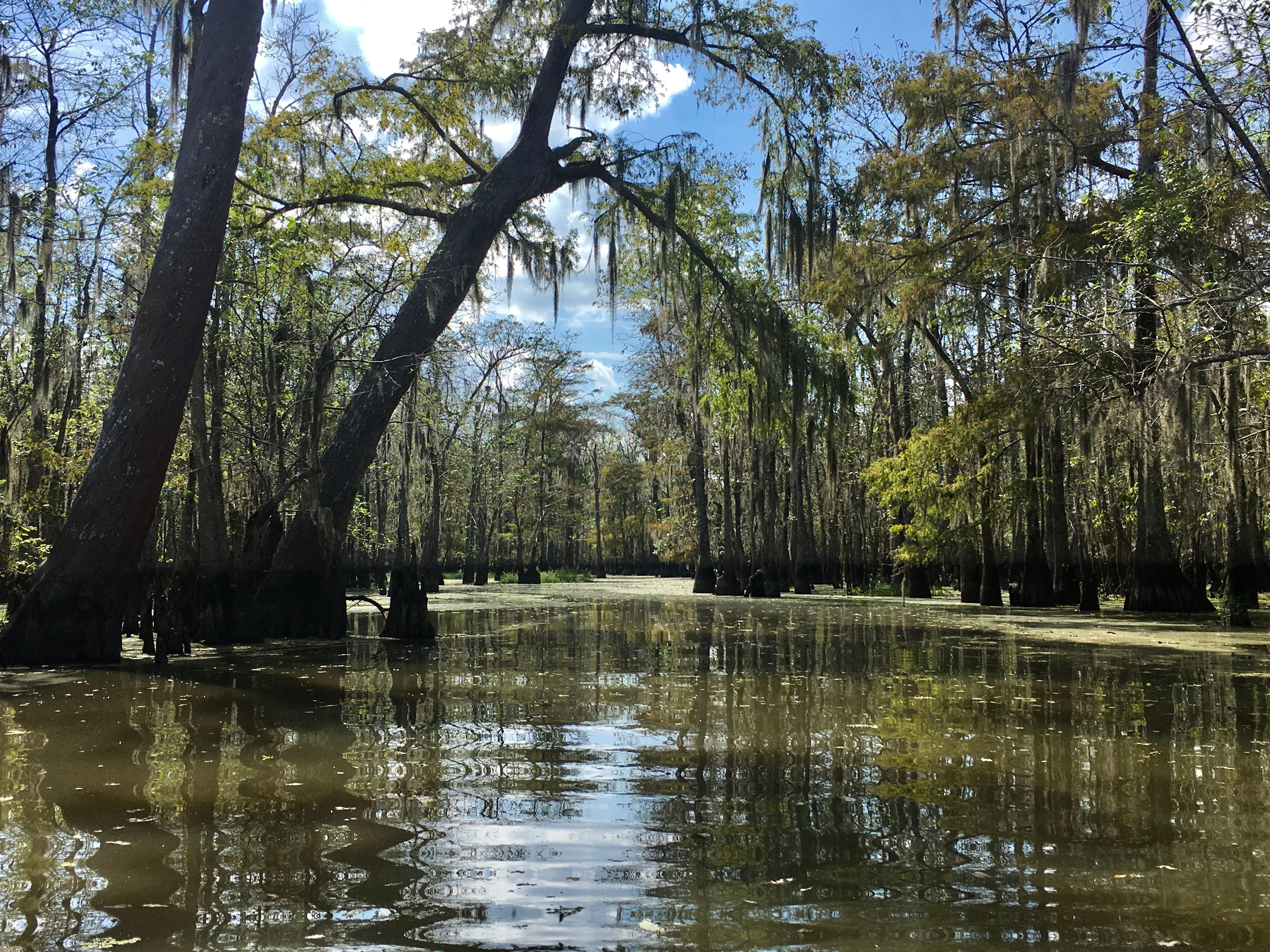
We listened to radio broadcasts about how our town had gotten 12+ feet of water. When the highways opened to cars, my aunt, who was further east on the coast and rode out the storm, drove to our home to assess the damage. We all cried in relief as she relayed that our property got six feet of water, but because our house was on a riser, no water had entered our home. We lived deeply nestled in a swamp and lost over 100 trees. They fell into a wreath formation around our house, not one touching our home. We might have been the only home in our neighborhood spared. I am forever grateful for this miracle. I still have my childhood photographs, which more than many people can say.
Few people in Southeastern, Louisiana, got out of Katrina unscathed, and ultimately neither did we. We lost a family member to the flood, and had flooding over the roof of other family properties.
At that point, my high school was shut down indefinitely - thus beginning my stint as a climate refugee. My parents made the hard choice of sending my brother and me to live with my aunt and uncle in Indiana so as not to disrupt our schooling any more than it already had been, while they went back to New Orleans to begin rebuilding. Being separated from my parents during this time was the most challenging part. I missed them and worried endlessly about their well-being while they traversed the devastation, while carrying the heavy uncertainty of when (or if) life would return to normal.
The folks of West Lafayette, Indiana. Showed extraordinary kindness. They showered us with clothing, food, school supplies, and everything we needed to get on our feet. I recognize the immense privilege of being able to show up in a new place because your home is unsafe, with almost nothing, and being graciously accommodated. I wish that all displaced families, regardless of their backgrounds, were met with such welcome.
Returning to Louisiana months later was gut-wrenching. There were cars, houses, and boats lying strewn in the streets. We ate dehydrated military style MREs (meals ready to eat) delivered by Army tanks. I spent the rest of my sophomore year of high school in a platoon system, attending class from 6 am to 12 pm while we shared our campus with another school facing complete devastation.
Because so much of the Greater New Orleans area was not deemed a flood zone, my family was entangled in lawsuits and insurance disputes that took 15 years to resolve.
On this 20th anniversary of Hurricane Katrina, I pay honor to the memory of those we lost, the people, the homes, and the history. I also take a moment to revere my home and happy place - this beautiful city and state with the most resilient, strong, and lively people. New Orleans as a place, a people, and a culture should be cherished, celebrated, and protected.
I also take this opportunity to remind people of the toll on mental health that climate change has and will have on our society. The narrative around Hurricane Katrina 20 years ago was not one of climate change. But any good Gulf Coast kid knows, the hotter the water in the Gulf, the worse the hurricane season. We now know unequivocally that the catastrophic nature of that storm was due to climate change. There is so much more than a monetary price tag on the destruction of climate change: The aftermath of these storms, navigating grief and loss, and the anxiety of impending storms.
My life was split into ‘before’ and ‘after’ the storm, and to this day, the trauma lives on in my body. The crippling notion of impermanence weighs into my every decision. I struggle to talk openly about this experience. I get offended when acquaintances offhandedly ask me about it. But most of all, every year from late August to early November, climate anxiety sets in. My heart rate elevates and my muscles tense. From New York City, I desperately watch storm trackers and I pray and pray (via meta meditation) for those living on the coast - for my parents, for my friends, for my family. I fear that my most recent trip home might have been my last. These may sound like over-dramatizations, but seeing footage year after year of your city underwater can evoke that fear. This is why you won’t catch me watching any Hurricane Katrina anniversary documentaries or news coverage.
Thank you for allotting me this space in your inbox to process my climate trauma. My work with Happy Place, the climate movement, and the mental health field is rooted in this experience - an experience I wish upon no one and work tirelessly to mitigate for others and future generations.
If you’re feeling emboldened by this Anniversary to help support the Gulf Coast this hurricane season, here are a few organizations and advocacy projects I recommend:
Comments
Nothing yet. Say the first thing.
Sign in to join the conversation.