
The standard acne explanation is saturated fat, dairy, IGF-1, lipogenesis, and skin bacteria. All of those play a role sometimes. None of them hold up as the root cause.
Someone with very low IGF-1 can still have acne. Someone with very dry skin can still have acne. Someone with sky-high IGF-1 can have completely clear skin. My own skin runs oily and I don’t break out. If the standard model were actually the mechanism, these people wouldn’t exist.
This is the same pattern as hair loss. The standard fix there is finasteride, a drug with a long list of side effects for a meaningful chunk of people who take it. Acne has its own version of that same story: isotretinoin, a vitamin A analog, prescribed as the default heavy-duty fix. It works for a lot of people in the short term and it also causes serious gut issues in some, along with dry eyes that can persist for years, sometimes decades, after stopping. When the standard explanation for a condition is incomplete, the standard fix tends to be a blunt instrument, and blunt instruments have a cost.
This article is the alternative explanation. Acne is systemic inflammation showing up on your face, driven by your gut, not a simple oil, hygiene, or hormone problem. The same food can be harmless in a healthy gut and a breakout trigger in a compromised one. That’s the actual mechanism worth chasing.
TL;DR
Acne isn’t caused by oil, hygiene, or any single food, it’s systemic inflammation from a compromised gut showing up on your face.
Histamine, insulin resistance, and hormonal fluctuations act as amplifiers, not root causes.
Standard fixes like isotretinoin and blanket food elimination treat the symptom while ignoring the terrain.
Fix digestion, bile flow, transit, and the gut ecosystem first, most “hormonal” or “genetic” acne resolves on its own.
In this article I discuss exactly how to address the root cause.
Dysbiosis, a leaky barrier, and low secretory IgA let LPS (endotoxin) cross into circulation. That LPS activates keratinocytes and sebocytes before you’ve even reacted to a “trigger” food. Low IgA means less mucosal defense, so more of what’s in your gut ends up talking directly to your immune system, and your immune system talks back through your skin.
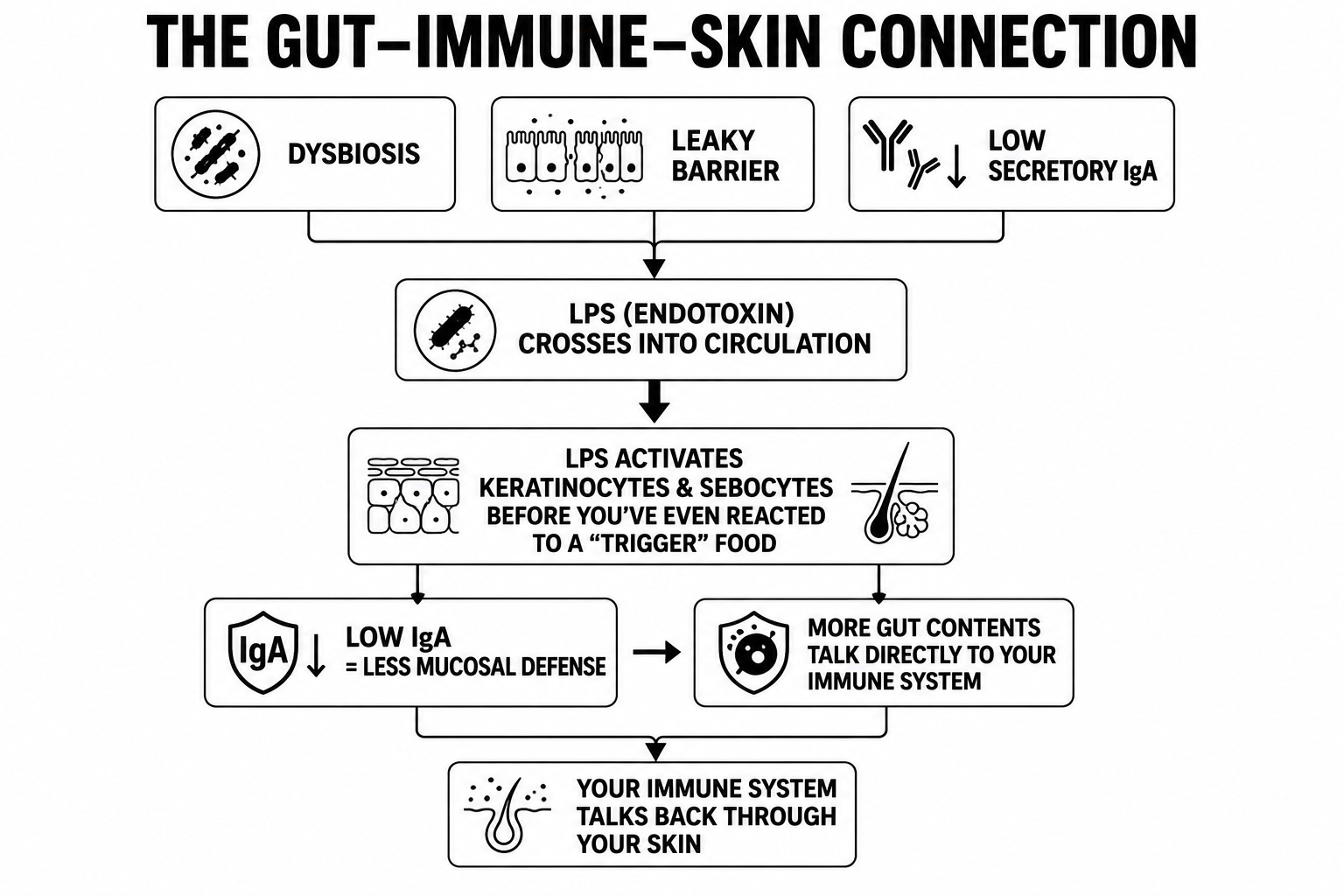
One more thing worth saying early: leaky gut is the result, not the cause. It’s what happens when digestion breaks down upstream (acid, enzymes, bile, transit) and inflammation stacks on top. Sealing the barrier without fixing what’s tearing it open is a patch, not a fix. Keep that in mind as you read the rest of this.
Histamine isn’t the root problem. It’s the volume dial.
High DAO/HNMT clearance = small triggers stay small. Low clearance = minor foods turn into flare days.
The histaminic acne phenotype looks like: red, itchy borders, flushing, flares from alcohol, leftovers, and aged or fermented foods. And most chronic histamine reactivity traces back to overgrowth and intestinal inflammation degrading DAO, not the food itself.
If you start itching (skin, scalp) when you exercise or start to get warm, that’s partly driven by histamine.
kill histamine-producing bacteria,
Starve them by following a low fiber diet, consisting mostly of animal foods
Avoid high FODMAP foods that trigger your symptoms like garlic and onion
seal the gut so histamine isn’t absorbed,
By eating non-inflammatory foods
Using compounds like zinc carnosine, vitamin C and BPC-157
lower intestinal inflammation so that DAO expression increases,
stabilize mast cells so they release less in the first place, and
600-1200mg PEA +1-2g quercetin (depending on the severity)
Ketotifen is a very good mast cell stabilizer, but can cause a lot of fatigue due to it also being a histamine blocker
support methylation (HNMT uses SAMe).
B-vitamin rich diet
Supplementing TMG (trimethylglycine aka betaine anhydrous)
Food generally isn’t a direct problem, but it can be a trigger depending on your state of health. If gluten causes leaky gut, more histamine will be absorbed. If you have histamine-producing bacterial overgrowth, eating high-fiber will feed them and make them grow. If your digestion is “weak”, then eating hard to digest complex meals can create intestinal inflammation due to incomplete digestion.
Milk is a common trigger for some people, but it’s due to a variety of reasons. It can be due to:
excess fat releasing too much bile → switch to low fat
lactose intolerance feeding histamine producing bacteria → switch to lactose free or cheese
A1 casein sensitivity causing intestinal inflammation → switch to A2 or goat milk
Same food, different gut, different outcome. In an intact gut, foods cause small ripples. In a damaged one, the same foods generate endotoxin, histamine, and cytokine waves that show up as flares. Judge any food on three axes: inflammatory load, digestive workload, and histamine/mast-cell potential. Nothing is universally “acne-safe” or “acne-causing.” Context is everything.
Frequency matters as much as the food itself. Eating a trigger once might not cause problems. But eating the same trigger daily, or even a few times a week, compounds. Each exposure adds inflammation on top of inflammation that hasn’t fully cleared from the last one, and the gut and skin never get a clean window to reset. This is why symptoms can take 4+ weeks to fully clear even after the trigger is removed entirely.
You’re not just waiting out the last meal, you’re waiting out weeks of stacked inflammatory load finally draining down. If you test a food once and feel fine, that doesn’t mean it’s safe on repeat exposure, and if you cut something and don’t see improvement in a few days, that’s not proof it wasn’t the problem, it may just mean the backlog hasn’t cleared yet.
Still on the fence? We're #1 in male optimization on Substack and Top 10 in Health & Wellness globally, built on one rule: never insult your intelligence. Data-first, nuance-always, no fluff. Ever. The 1,000+ premium readers inside know exactly what that's worth.

Which specific food categories actually drive flares, and why fiber, FODMAPs, and lectins aren’t the villains everyone assumes
Why high fat and high carb eaten together is a bigger oily-skin trigger than either alone
The metabolic side: insulin resistance, hormonal fluctuations
Antibiotics vs. natural compounds
The stool-based diagnostic that tells you which direction your bile is broken, and why that matters specifically for oily skin
Which probiotic strains actually calm inflammation, plus the topical actives worth using
A full stress-to-cortisol protocol, in the right order, not just “reduce stress”
The most nutrient-dense, easy-to-digest foods to prioritize before reaching for any supplement
The mechanical and environmental triggers most people never think to check, pillow, laundry detergent, hair products, and more
The exact tiered protocol and step-by-step sequence to start fixing this today
Let’s get into it!
Comments
Nothing yet. Say the first thing.
Sign in to join the conversation.