
Your fasted morning cortisol blood test is misleading millions right now.
Most people who test cortisol are testing:
the wrong thing,
at the wrong time,
in the wrong medium,
…and drawing conclusions the data was never built to support.
Cortisol is made in the zona fasciculata of the adrenal cortex from cholesterol via the usual pregnenolone → 17‑hydroxyprogesterone → cortisol pathway.
Cortisol is created on demand and not stored. Cortisol is the highest in the mornings and peaks about 30 minutes after waking; the waking cortisol response. This is meant to help you feel more alert and awake. If morning cortisol is blunted, people often experience morning fatigue and need lots of coffee to wake them up.
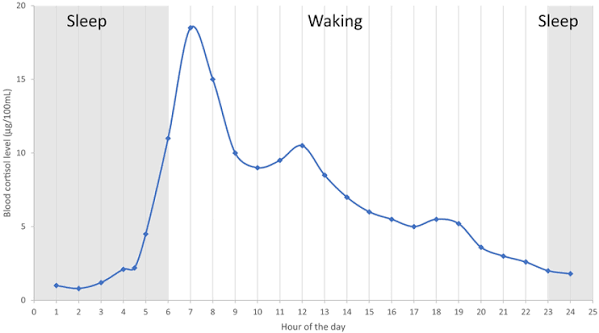
So just testing first thing in the morning tells you nothing about:
your daily rhythm
free cortisol
how your body is metabolizing and excreting it
So I’m going to explain to you blood tests, salivary testing and urinary testing of cortisol and the pros and cons of them all.
A standard serum cortisol draw is almost always ordered first thing in the morning, timed to catch the cortisol awakening response 30 to 60 minutes after you get up. That’s the peak of your entire daily curve. It’s the single easiest moment to get a high number, and it’s the only moment most labs ever look at.
Two problems with this.
It’s one data point on a curve that matters as a curve. Cortisol isn’t supposed to sit at one level. It should spike on waking and decline steadily through the day into a low trough at night. A blood draw tells you where you were at 8am. It tells you nothing about whether you crash by noon, spike again in the evening, or never come down at all. Two people can have an identical morning number and completely opposite daily rhythms, and blood testing cannot tell them apart.
It doesn’t separate free from bound cortisol. Roughly 90 to 95% of circulating cortisol is bound to corticosteroid-binding globulin (CBG) and, to a lesser extent, albumin. Bound cortisol is inactive. It’s cargo, not signal. Only the free fraction is biologically active at the tissue level. A standard serum test measures total cortisol, bound and free together, so it cannot tell you whether your active cortisol is actually high, or whether CBG levels (which shift with estrogen status, inflammation, and liver function) are just carrying more inactive hormone around. You can have high total cortisol with normal free cortisol, and a blood test will not distinguish them.
This is why blood cortisol is useful for ruling out extremes (frank Addison’s or Cushing’s) but close to useless for the kind of dysregulation most people actually have.
Symptoms commonly attributed to high cortisol, for reference, since this is what usually sends people looking for a test in the first place:
Abdominal fat gain disproportionate to overall weight
Face and neck fat redistribution (”moon face,” fat pad at the back of the neck)
Muscle loss and thinning skin, especially on the arms
Poor sleep, especially waking at 2-4am and not falling back asleep
Anxiety, irritability, and a wired-but-tired feeling
Elevated resting heart rate and blood pressure
Blood sugar dysregulation and increased sugar cravings
Poor wound healing and easy bruising
Suppressed libido and reproductive hormone output
Reduced immune function, frequent illness
Notice that almost every one of these is also a symptom of low cortisol, thyroid dysfunction, or a dozen other things. Symptoms alone tell you to test. They don’t tell you what the test will show.
Salivary cortisol fixes the biggest problem with blood testing. Because saliva only contains the free, unbound fraction of cortisol (bound cortisol doesn’t cross into salivary glands), a salivary panel is a much closer proxy for biologically active cortisol than a serum total.
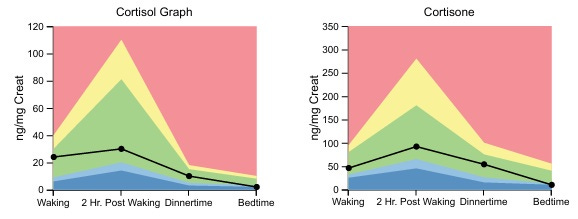
And because you collect multiple samples across the day, typically waking, mid-morning, afternoon, and bedtime, you actually get the diurnal curve instead of one point on it. This is the test that can show you a flat curve, a delayed peak, a blunted awakening response, or a cortisol level that refuses to drop at night.
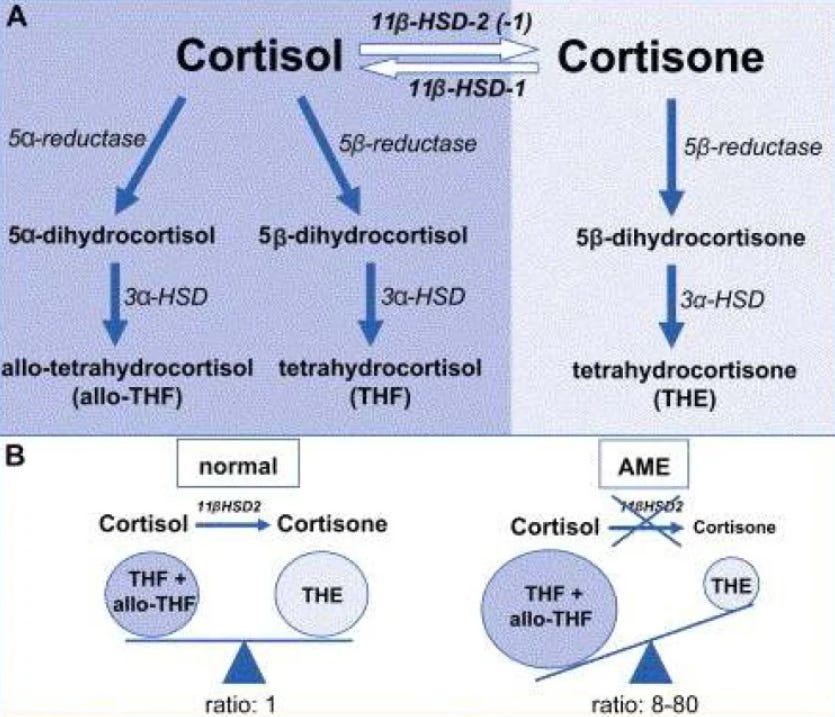
Cortisone-to-cortisol ratio. Some salivary cortisol tests will include the cortisone (inactive) to cortisol (active) ratio. This reflects 11-beta-HSD2 enzyme activity, which converts active cortisol into inactive cortisone. That enzyme runs on NAD as a cofactor, which makes this ratio a usable proxy for cellular NAD/NADH redox status. A skewed ratio isn’t necessarily an adrenal problem. It can be a mitochondrial and redox problem. And NAD can be low due to chronic inflammation and DNA damage.
However, salivary cortisol is still not the full picture. Saliva only shows you what makes it into saliva. It doesn’t tell you anything about total cortisol production, how much cortisol your body is actually clearing, or what happens to cortisol after it’s been secreted. You get the shape of the curve. You don’t get anything about downstream metabolism.
If you can only run one test, this is the one I’d pick. Best cost-to-insight ratio, easiest to run at home, and it directly answers the question most people actually care about: is my rhythm doing what it’s supposed to do.
This is where it gets genuinely interesting, and where most people’s understanding of cortisol testing stops entirely.
A comprehensive urinary panel, collected across four to five points over 24 hours, gives you the diurnal free cortisol rhythm just like saliva does. But it adds an entirely different layer: metabolism and clearance.
Cortisone-to-cortisol ratio. Same as salivary, but this time in urine, so processing is a bit different. It’s good to compare the two, but they should be relatively similar.
5-alpha and 5-beta reductase metabolites of cortisol (5A-THF and 5B-THF). 5AR doesn’t just convert testosterone to DHT. It also deactivates cortisol.
These numbers tell you which enzymatic pathway your liver is using to clear cortisol into its terminal metabolites, and how efficiently it’s doing it. This is clearance information that blood and saliva simply cannot provide, because clearance happens downstream of secretion, in the liver, and only shows up in what gets excreted.
And this is why when people tend to use finasteride, they end up with higher cortisol, due to impaired clearance of cortisol.
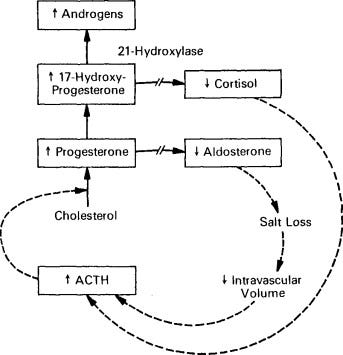
DHEA, DHEA-S, and 17-OHP is included because they are also created in the adrenals. Pregnenolone feeds both the cortisol pathway and the DHEA/androgen pathway, and 17-OHP sits at the branch point between them. You cannot properly interpret cortisol output in isolation from these, because a shift in one changes substrate availability for the others.
The practical upshot: urinary testing tells you not just how much cortisol you’re making and when, but how well you’re clearing it, and what that says about liver function, redox status, and the shared hormonal pathways cortisol doesn’t operate in isolation from.
If you’re going to run one comprehensive test, a HuMAP-style multi-point urinary panel is the one to pick, because it puts cortisol in context with the rest of the steroid tree rather than testing it as an island. The pregnenolone → progesterone → allopregnanolone pathway can help to offset elevated cortisol. Your androgens (testosterone, DHT, androstenedione, and their 5-alpha/5-beta metabolites) are the main cortisol blockers. 5-alpha reductase is just as important at clearing cortisol as it as creating allopregnanolone, androsterone and DHT.
This matters because the ratios between these pathways are often more informative than any single absolute value. A cortisol number in isolation tells you cortisol is high or low at the specific point in time. The same number in the context of your androgen pool, your progesterone metabolites, and your 5-alpha:5-beta split across all three steroid classes tells you which specific enzymatic step is upregulated or downregulated, and therefore what to actually do about it. That’s the difference between “your cortisol is off” and “your hepatic 5-alpha reductase capacity is being consumed by something else, and here’s what.”
I’ve run several HuMAP panels on myself over the past year, and my own cortisol picture is a good illustration of why this matters.
My free cortisol daily rhythm is genuinely textbook. It peaks on waking at 35 ng/mg creatinine and declines appropriately through the day down to 2 at bedtime. If you only looked at the rhythm, you’d call it optimal, and you’d be right.
My cortisone-to-cortisol ratio sits at 0.37, comfortably inside the 0.18 to 0.60 reference interval, which reflects healthy 11-beta-HSD2 activity and, by extension, decent cellular NAD/NADH redox status.
But my total metabolized cortisol came back at 1910, against a reference interval of 2600 to 7200. Below range.
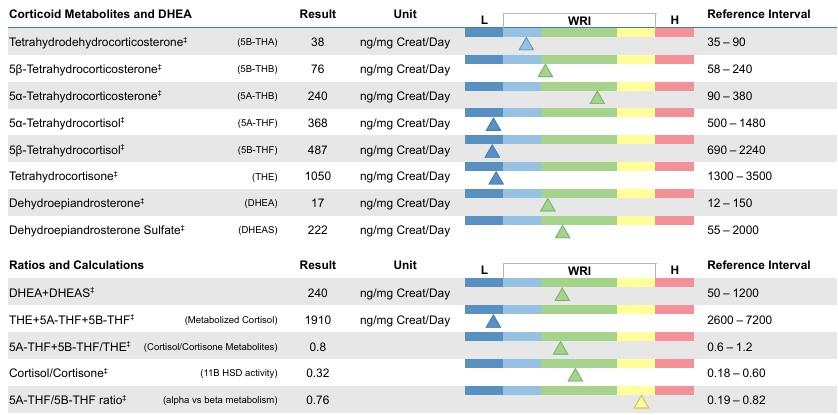
Taken together, my cortisone is broken down adequately, but my cortisol’s metabolism by 5AR and 5BR is low. This puts my overall metabolized cortisol under the reference range.
On a lesser panel, that number alone would read as adrenal underperformance, and someone might reach for adrenal support or hydrocortisone. The rhythm and the ratio data say otherwise. Adrenal output and rhythm are intact. What’s actually happening is that I’m using 500-600mg of testosterone enanthate per week, and cortisol shares hepatic 5-alpha and 5-beta reductase capacity with the “big-ish” androgen load my liver is processing. The enzymes are busy. Cortisol is competing for clearance capacity, not failing to be produced. My 5A-THF:5B-THF ratio came back at 0.76, upper third of the 0.19 to 0.82 reference range, which is optimal. This is competitive substrate inhibition at the liver, not a cortisol production problem, not thyroid, not pathological reductase activity.
None of that distinction is visible on a blood test. A single morning serum draw would have caught my cortisol at or near peak, looked completely normal, and told me nothing about the hepatic throughput problem sitting underneath it.
The pregnenolone-to-allopregnanolone side of the same panel made a similar point. Allopregnanolone started at the floor of its reference range, a predictable consequence of exogenous testosterone suppressing pregnenolone → progesterone synthesis. After adding 300mg of pregnenolone to my protocol specifically to restore that pathway, allopregnanolone came back at 5.0 on a follow-up panel, against a reference interval of 0.8 to 6.4.
And to have to take 300mg of pregnenolone just to have high-normal allopregnanolone is also not right. So it’s likely again that testosterone is saturating the 5AR enzyme and not a lot of progesterone and cortisol can be metabolized through it.
If you can run all three, do it. Blood rules out the extremes and is often what your doctor will order anyway. Saliva gives you the rhythm cheaply and repeatably, which is useful for tracking change over time. Urinary, ideally a comprehensive HuMAP-style panel, gives you the full metabolic and cross-pathway picture that actually explains why a number is where it is.
If you can only run one, run salivary. It’s the best single upgrade over standard blood work for the least cost and effort, and it directly answers the question most people actually have, which is whether their daily rhythm is intact.
If you want the whole picture, the one that tells you which specific enzyme or pathway to actually address rather than just confirming a number is off, HuMAP is the test. It’s the only one of the three that will tell you the difference between “your cortisol is low” and “your cortisol is fine and something else entirely is eating your clearance capacity.”
Knowing your number is only half the job. Below, I break down what's actually driving cortisol up in the first place, from the specific micronutrient deficiencies most people never test for, to the metabolic, hormonal, gut, and lifestyle factors that keep the HPA axis stuck "on."
Then I walk through exactly how to bring it back down, mechanism by mechanism: the supplement stack I use to restore the GABAergic pathway your HuMAP can actually measure, the circadian and training interventions that move the needle without another supplement, which adaptogens are worth using short-term and why, and the small, unusual levers (carbs with salt, aspirin, caffeine timing) that most people never hear about because nobody explains the mechanism behind them.
Want to know what your symptoms (and labs) are actually telling you? A personalized Health Report takes your existing symptoms (and labs) and turns them into a clear, prioritized action plan, built on your data, not population averages. Get it here.
Ask Hans is trained on everything I’ve tested, written, and protocolled → mechanism first, no fluff. Available 24/7 for members. Check it out here.
Comments
Nothing yet. Say the first thing.
Sign in to join the conversation.