
Last week I asked my network what questions you’d like to see answered in the newsletter since I’m between projects. Almost unanimously, you asked for more posts diving into the nitty-gritty of the query trenches.
So we’re jumping right in with a compiled list of:
Important Note: Please remember to research and verify for yourself any information you learn from articles. Querying articles are often anecdotal, meaning that what they share hinges largely on the author’s own unique experiences. Make sure to diversify your reading. Learn from authors, learn from agents, learn from editors, and narrow in on what works for you.

Traditional publishing is a very unique and complex business model. If it’s our goal to see our book on the shelves one day, we need to be doing our due diligence in learning about each step of the process.
Knowledge allows us to be more flexible, to better anticipate agent questions, and to present ourselves alongside our projects in the best possible light.
We’re living in the Age of Information; don’t go in blind. (If you’re reading articles like this, you’re probably doing just fine!)
Some of us might be lucky enough to nab an offer of representation and a book deal with our first-ever novel, but a writing career isn’t built on one release. It’s built brick by brick (read: book by book) over the span of a lifetime.
Writers who take the time to learn their voice and who are always building on what they know will be prepared to face that ‘Second Book Syndrome.’ They’ll not only know how to write a book that sells, but how to do it again and again and again.
As an added bonus, approaching our projects with intention allows us ample time to build consistent writing habits and develop a sense of our drafting/revising speed, which is crucial for when you’re working with a hard and fast deadline.
The first time I queried, my manuscript was only ‘mostly’ done. I expected to be sitting quietly in the backlog of agent emails for weeks to months before hearing anything.
Spoiler: I got several full requests in the first two weeks, with no time to revise. I panicked, and I never sent the manuscript, effectively destroying those opportunities before my book ever had a chance.
It’s tempting to switch things up when you feel like you’ve been in the drafting/revising stages forever, but please give your book the due diligence so that it’s ready for agents. Take the time to draft, revise, and share it with early readers first. (Hiring a professional editor is not required.)
Standard Manuscript Formatting for Agents when it’s revised and ready:
Paper: Letter Size
Margins: 1”
Spacing: Double, with a 0.5” indent on paragraphs (not a tab)
Title Page: Centered Title, Author name, Genre, Approximate word count
Font: Size 12; Times New Roman, Arial, or Courier
Page Numbers: In the margin (I center them at the bottom with my name & title)
Chapters start on a new page
Scene Breaks indicated with a centered “#” symbol
If we aren’t mature enough to accept feedback graciously, we aren’t ready to sign with an agent.
Working with an agent is a collaborative process in a partnership that aims to improve the book’s marketability while maintaining a distinct author voice—and that collaborative effort requires both parties to be passionate about the work while also seeing its weaknesses objectively, then working to make them stronger.
If we’re constantly trying to explain our on-page choices to critique partners, there isn’t enough on-page context to convince them. We won’t be there to explain our background logic to the readers.
As writers, we need to be able to balance the confidence required in order to advocate for our voice (another reason why Mistake #2 is so crucial to avoid) while also viewing feedback objectively and admitting when some changes or omissions would create a better reader experience.
It’s one skillset to open a document, another to draft a whole book, and yet another to implement constructive feedback on said book.
I struggled with the transition between drafting and editing for a long time (since I have a tendency to overthink things). Here’s the magic sauce that finally helped me learn how to do self-edits:
Take a break to forget all those tiny plot details.
Come back with fresh eyes and read through from the beginning.
Ask yourself questions about what each chapter might be missing.
Look at your list of editorial questions and identify patterns.
Chapter by chapter, address each question with tweaks in the draft.
Send it to alpha/beta readers and get outside feedback.
Chapter by chapter, make adjustments based on their feedback.
We need to keep in mind that professional editors will be going through a similar process of reading your manuscript and evaluating the pieces of the story. However, there’s a key difference in their process and the one I outlined above: Editors do not tweak the manuscript itself. They only make suggestions.
Authors are ultimately responsible for implementing editorial feedback and should feel very comfortable doing so.
While we might hope our story is “one of a kind” in the storytelling sense, we also need to be educated on genre and its purpose in marketing our books. Genre helps industry professionals categorize the book appropriately and market it to the right group of readers.
(If you get it to the right readers, you get better reviews and visibility, your book sales improve, and you’re more likely to sell your next book.)
Genre-blending is becoming more common, but printing costs remain a pretty rigid reality for the industry. Pay close attention to genre limitations on word counts so your potential sales aren’t compromised by a manuscript too costly to print.
Wise writers also read a lot in their genre to identify strong comp titles and to be aware of conventions that readers in their genre will expect (for example: writing a cozy romance with a sudden dark, scary scene will catch readers off-guard and may create an unpleasant reading experience).
Connotation matters in our language. The way we think and speak about—and especially the way we post about—individuals within the publishing industry should be respectful and intentional.
Online discourse in some circles have labeled literary agents as “gatekeepers” in publishing, using vitriol to paint them in a negative light, and this discourse often appears in public posts from authors who are still in the middle of querying.
Literary agents (with nuanced space saved for the few exceptions) are not the predatory, discriminatory gatekeepers those viral posts would like you to believe. Each agent is just one individual with a passion for stories and a desire to find great books and great clients. They are on the writer’s side as the acting champion for that client’s stories before the book has sold, before the reviews come in, before anyone else reads it. They help us navigate the quieter side of publishing and pave the way for our careers in writing.
Not to mention, if and until they sell that book, they’re doing all of that for free.
Querying is a difficult process, and being disappointed or angry about rejection is completely normal. Express your frustrations with private, trusted connections so you aren’t sitting on those emotions, and keep in mind that publishing is a small world when posting on your public-facing platforms. The agents are on your side.
Most in the query trenches do not have pre-existing publishing contacts, which means the query letter can make or break our first impression. We should be as intentional toward our query letter as we are in our storytelling, building that marketing muscle so that our story is as eye-catching as possible.
When approaching query materials, I try to prioritize these things:
Clarity in my language (avoiding filler words as much as possible)
Succinct, unique descriptions (avoiding ambiguous language)
Making manuscript information easy to find (since most look for that first)
Connecting each element to the others for better cohesion
Here’s the viral post breaking down my query letter:
The query letter that got me 22 full requests
·
Feb 21

Welcome back to my newsletter, On Paper & Light. Here I chat about writing, language, art, design, and the psychology of each (especially when they intersect or fuse together). I also share regular updates on my novels-in-progress.
Novels and advertisements aim for similar objectives: they’re an invitation to the viewer. The primary difference is that a novel invites you to become immersed in a paperbound world, while an advertisement invites you to buy a service, product, or experience.
NARRATIVE PROSE
Imagery-rich prose and lexicon that waxes poetic are absolutely critical in the realm of storytelling, but to be received as intended, they rely on two things to properly immerse us: context and scope.
Holding a physical book offers unspoken context. It provides that first invitation to crack open the cover and be transported. Readers open to the pages expecting poetic prose. Similarly, an author that has built an online community around their writing has built appropriate context. When they share imagery-rich storytelling prose, it connects to the audience. Genre categories also provide context. Each of these tools and strategies create an atmosphere for creative writing to thrive.
Audiences primed for narrative prose are prepared to embrace the scope of a book, which is far broader and more intellectually immersive than scrolling on social media. For readers to experience the story as the author intended, the author is asking them to spend time in a book hundreds of pages long. If we try to pitch our book to readers by rambling on and on, running verbal circles around the plot, we’re going to lose them. Start with small, concise, and focused marketing, then gradually introduce them into your world.
MARKETING LANGUAGE
Modern authors are sometimes blindsided by the realities of shrinking attention spans in the Age of Information. To stand out in the slush piles, online, or on the shelf, we have to come up with creative ways to hook readers before they’ve been given that proper context and before they’ve committed to that larger scope.
This means we have to first give ourselves a private space to refine our stories, and then move into the analytical mindset that pulls the most marketable pieces of our work forward to the broader public. Those marketable pieces, and that simplification of our story into a “one-line pitch,” is the consumer-facing side of the publishing business. The better we understand that, the more likely we are to connect with readers who will love the book as much as we do.
It’s not easy. We’re learning to promote ourselves and our stories in ways that no generation of writer has seen before, and I suspect it will only continue to change. But let us commit to being curious, flexible, and always challenging our skillset.
I hope this one goes without saying.
Creative writing has always been a “shoot for the stars” career, and aside from the lucky few, this path is not known to be especially lucrative. Advances are wide-ranging, split across months or years, and slow-moving. Many authors never earn out and never get to the point of receiving royalties.
There’s also no guarantee you’ll sell your next book, even if your first was a success.
Determining “success” in the career is also fickle. There’s no sure way to predict what book will be a bestseller or how the market will shift in the coming years. If we’re motivated by prestige, that candle will be snuffed out quick.
I would argue that the best books of our time have come from the multi-passionate, obsessive, lyrical, slightly-unhinged writers who love stories more than anything we measure in dollar bills. They are those who challenge our beliefs and expectations, asking questions, and pulling from the deepest part of our shared human roots.
These are the storytellers, the history-makers, the record keepers who shed light on the corners of the common mind we might otherwise shy away from.
As we prepare to jump into queries, let’s take care to remind ourselves that this is the history we follow. These are the storytellers who inspired us as children. Money and fame will come and go—but good stories stay with us for a lifetime.
And I believe there is remedy for all of them, whether that’s education or experience. Research. Trial and error. Fail, fail again, fail better. That’s how I’m learning.
You shouldn’t have to pay a professional to learn these skills and to glean these insights. Just keep doing what you’re doing: paying attention to conversations in the industry and prioritizing your books to make them the best they can possibly be.
At the end of the day, it’s not the query materials that sell your book—they just open the door. Show up to the trenches prepared and let the manuscript speak for you.
You can do this.

For the first time in a while, I’m back in active story-planning mode. Villain Theory is currently out of my hands, and after brainstorming with my agent, I’m in the very early stages of developing my next story.
This involves a lot of reading, listening to music, and going down research rabbit holes. I’m reviewing my master document of feverish late-night notes—the commonplace record where I keep my sparks of inspiration until I can gradually arrange them into concrete plot lines—and I’m trying to expose myself to as much creativity as possible.

My video-editing bucket is completely drained. I finally finished and uploaded my querying vlog, which has been met with so much kind and positive commentary! I’m very grateful. It was a whirlwind few weeks and I’m glad I recorded it, even if it was a little messy and unpolished. Here’s the video:
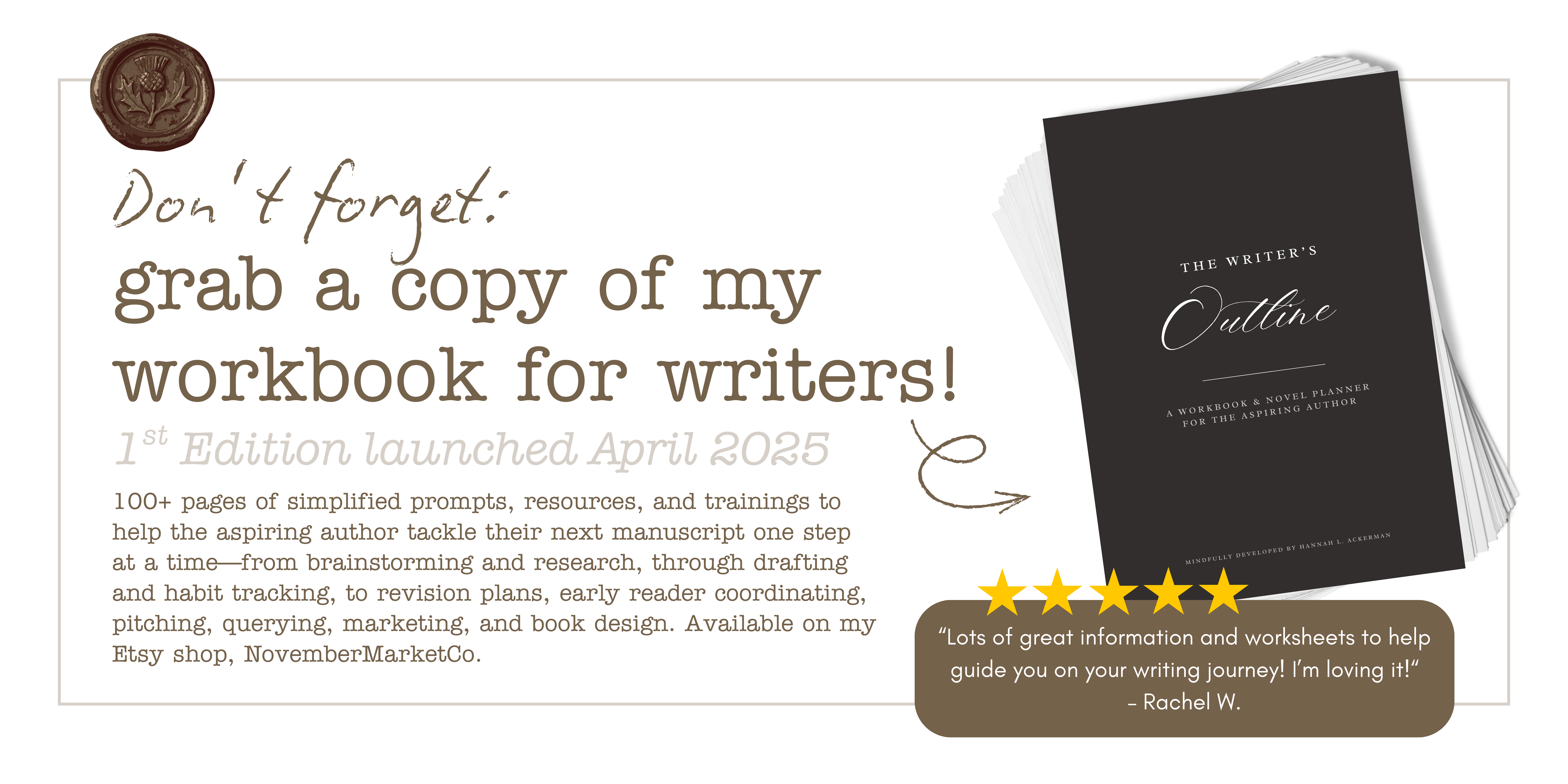
And of course, my newsletter wouldn’t be a newsletter without one more reminder encouraging you to check out the workbook I built for writers:

A quick, curated list of things I’ve been enjoying.
Fiction Reads: The Night Ends with Fire by K.X. Song (physical book) and The Everlasting by Alix E. Harrow (audio)
Nonfiction Reads: 101 Essays that will Change the Way You Think (picking back up on a few of my favorite essays)
Listening: Plot Twist with Victoria Aveyard and Soman Chainani
Exploring: I’m trying my hand at meal prepping so I don’t catch myself subsisting on Ritz crackers and yogurt again. I successfully made a breakfast casserole on Sunday that was to last us all week—but it was so tasty we had it for every meal. It was gone by Monday night. Better luck next week!
Thanks for reading my words On Paper & Light this week; this was a long one! Your support means the world. Drop more querying questions in the comments; I’ll pop by your inbox again soon.

Keep reading:
One writing habit to become more eloquent
·
November 3, 2025
I’ve yet to meet a person who doesn’t want to be well-spoken—and the most well-spoken, deeply introspective people I’ve met all have two things in common. They read, and they write. A lot.
Comments
Nothing yet. Say the first thing.
Sign in to join the conversation.