
Hi. Handstamp is a weekly music newsletter created by me, Josh Coyne. In each edition, I talk to a creative person about live performances that have meant something to them. Previous guests include Anna B Savage, Cassandra Jenkins, Chastity Belt, Chet Faker, Christian Lee Hutson, Courtney Marie Andrews, Craig Finn, Gold Panda, Holy Fuck, Idlewild, Jasmine.4.t, Jason Stewart, Madi Diaz, Mat Baynton, NoSo, Public Service Broadcasting, Richard Dawson, Rio Kosta, Searows, Uwade and We Are Scientists.
I’ll hold my hands up. It’s been too long and I’m big enough to admit it. I abandoned you. Between a new job, planning a major life event and consuming a relentless diet of sport broadcasting, I haven’t found the time to bash these out at quite the rate you deserve.
What I have found the time to do, however, is attend a weird amount of mega shows. Two trips to the nosebleeds of Wembley Stadium and a boujee evening in O2 Arena hospitality later, here I am to talk live music.
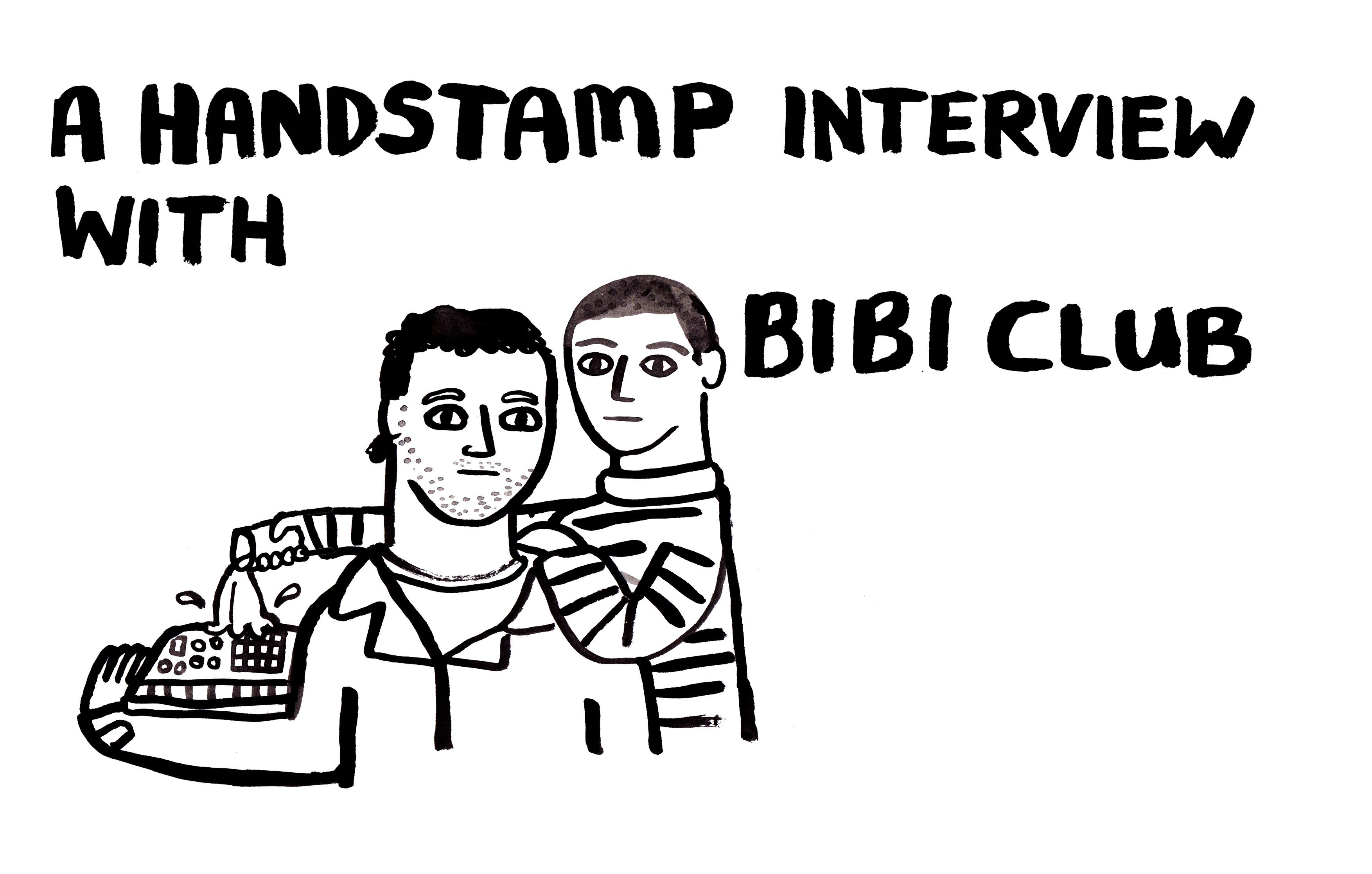
Together, Adèle Trottier-Rivard and Nicolas Basque form Bibi Club – a Canadian alternative indie pop duo, whose most recent album Amaro was shortlisted for the 2026 Polaris Music Prize.
A few months ago, the couple lent me some time to talk about the record, but first shared their respective musical upbringing.
Nicolas: “I grew up in the suburbs of Montreal. Adèle grew up in the city. I was in the less exciting part.”
Handstamp: Adèle, I know your father is a musician of note, so did you grow up with music consuming your household?
Adèle: “Yes, it was all around me. My parents had a giant library in our house, just a wall of CDs, music everywhere. So, at some point, I started to explore and listen to some of it. I discovered so much music that way. Big part of my childhood, for sure.”
Handstamp: What about you, Nicolas?
Nicolas: “My father was also a big music fan and his range of taste was wide. So, I would listen to so much music. We would also have DIY punk bands play locally and if there was an event, I’d go to see those groups.”
Handstamp: Would you venture into the city?
Nicolas: “I would. Montreal was starting to become a bigger place for bands to stop at that time. I used to go and sleep at the ticket stand, to make sure I could get tickets. I even saw Nirvana in Montreal, before Kurt Cobain died. I saw them at a time when they’d become known as slightly less cool, so people were giving tickets away outside the venue, which is crazy.”
Handstamp: It’s incredible to even imagine a time when they were considered less cool, given their legacy. Do you remember any of the other shows you slept outside for?
Nicolas: “I remember sleeping for Pearl Jam, which is slightly less my world now, but still cool. I slept for Primus, which I probably didn’t need to do, to be honest.”
Handstamp: That’s an incredible level of commitment to live shows.
Nicolas: “Right, now you just have to wake up and open your computer to wait.”
Handstamp: Exactly, now you have to wait a year in an online queue just to see the outrageous ticket price, before deciding you’re not going to pay it.
Nicolas: “I even remember that when we slept there, there would sometimes be a bigger dude that would show up in the morning, take our spot and buy 100 tickets. Those scalpers would just tell us to move down and we’d be scared of them.”
Handstamp: Wow, law of the jungle stuff. The big guys win again. Don’t love that. Adèle, I guess you had more direct access to the live scene, given your life in the city. What was your connection to gigs growing up?
Adèle: “Well, I would go to a lot of shows but I would never sleep the whole night outside, I would arrive at like 5am to get in line. I had my little metal phase, which is something I share with Nico. I was going to see a lot of metal shows with my friend. I was also touring with my parents and sister at the time, so I would travel a lot, discovering a lot of venues, especially here in Quebec. I would help my dad clear up after shows, rolling cables and everything. I loved it.”
Handstamp: Ok, so you developed your cable management skills early. It’s very important, it can get messy.
Adèle: “Oh, I love it when it’s nice and clean.”
Handstamp: Very satisfying. I took a Music Technology course in my teens and we spent weeks on cable management. Everybody in the class was so desperate to move on, they were so sick of it. Do you remember what your first experience seeing a live show was?
Adèle: “I can’t tell you exactly, but I do have some amazing early memories. I remember going to see Neil Young with my sister and we were the youngest people there, singing every lyric. Metallica was memorable too, but I can’t remember the first one. Maybe it was my dad, to be honest.”
“It was very complicated in my head at the time, I wasn’t comfortable. But on the other hand, I was still living it, touring with him and accepting it.”
Handstamp: It’s quite unique to be introduced to live music through your family performing, as you have skin in the game. What was it like watching your parent perform live in front of crowds from young?
Adèle: “I was always comfortable with the experience, playing around backstage with my sister while my father played. It started so early in my life, so I felt comfortable with it as part of my childhood, but when I started going to school, I was really shy about it. I didn’t want people to talk to me about my father’s career. It was very complicated in my head at the time, I wasn’t comfortable. But on the other hand, I was still living it, touring with him and accepting it.”
Handstamp: I would imagine that’s quite common in your situation. At that age, I think you sort of shrink and minimise the things that are actually worth celebrating, just because they make you different in a way you don’t appreciate at the time. As you’ve gotten older, I suspect you’ve started to appreciate how cool it was. Nico, do you remember what your first show was?
Nico: “I would have gone with my parents. One thing that is really weird is that I remember seeing Adèle’s dad when I was really young. My parents took me to a show at a venue in Montreal that has now been shut down, which is a shame because we need that type of venue right now. Anyway, it wasn’t my kind of music at the time, but I remember being so impressed by the amount of guitars on stage and the musicianship. I remember liking the feeling of being in a room with a bunch of people and being amazed by the mise-en-scene of it all. Soon after that, I went to see some weirder musical theatre and I was into all the theatrics of it all.”
Handstamp: I can relate. For the first 10 shows of my life, the music was maybe in fifth place, in terms of importance to me. The environment, the dynamic between crowd and artist, the spectacle and the sheer logistics behind putting something that impressive on, that’s what blew me away. I’ve now played a fair share of live shows myself and I have come to realise that artists probably overestimate just how much the audience cares about the levels of their personal performance, it’s just one part of it.
“The vulnerability of the artist on stage is what is the most important thing for the crowd to see. It allows them to see that even when things are broken, you can get through it and survive it.”
Adèle: “For me, it’s about the presence of the artist on stage. I’ve been to shows where the artist isn’t even looking at the crowd but it works somehow. It feels quite mystical, some people just have natural presence.”
Handstamp: Artists being comfortable with their own presence is key. How many times have we all been to a show and a performer has made a mistake, then the most entertaining part is how they recover from it, even having a little bit of fun with the audience? We spend so much time scrutinising ourselves, but sometimes the fuck ups are the best part.
Nico: “I think about that all the time. When I’m really tired on tour or have an extremely stressful moment before a show, I realise that it’s probably more entertaining if I fall unconscious on stage, or if I break a string then have to change it really fast.’
“One time, we were on tour in Europe and a good friend of ours died in an accident. We kept going as we had 3 shows left. We played in Brighton and I felt totally disconnected. Then the next day we played in London, which we love because it’s such a music city. The show went really well, but then at the end Adele took her water bottle and poured water all over her synth. It wasn’t even a crazy, punky thing or anything...”
Adèle: “It was a glitch, I think. I don’t know what happened. I took a sip, then just poured it out for a few seconds, before realising what I was doing. It fried my synth.”
Nico: “We had our management in the room and they were like ‘uh oh’..’
Adèle: “Yeah, I turned the synth off and Nico told me everything was going to be fine.”
Nico: “Well, it threw me, but we had two songs left and I just told her I had it under control. I played Adele’s parts on guitar, even though I don’t really know what she plays, but it went well. Somehow, it worked and it made it even more special. When we analysed it, we felt like it was our friend visiting us and telling us to just have fun with it, because that’s what is important. The vulnerability of the artist on stage is what is the most important thing for the crowd to see. It allows them to see that even when things are broken, you can get through it and survive it. That vulnerability is how we build community with the people who come to our shows, because they enjoy the catharsis of it.”
Handstamp: Incredible story. A one-off, out-of-body experience.
Adèle: “Absolutely.”
Nico: “The night before, I had a bit of meltdown and we were determined not to go down that hole again.”
Handstamp: That’s another interesting thing about the performer-audience dynamic though. If you do anything that seems like it has intent behind it, they may have perceived it as an avant-garde act of artistic expression, like performance art. They may have thought it was an anti-synth statement of sorts.
Nico: “[laughs] right!”
Handstamp: Where are the best places to see live music in Montreal now?
Nico: “There is a group of venues, owned by Mauro from the band Godspeed You! Black Emperor and a group of others. One is called Casa del Popolo, which is around 100-capacity but is well-built and puts on great shows. It’s one of the last places small artists can make money. Then, across the street, there’s a bigger venue called La Sala Rossa and that’s a different format, with maybe a 500 capacity.”
Adèle: “Yeah, there are a few different venues so close to each other. So, you can have three shows at the same time and everyone will go for a beer together after. It’s a great spot.”
Handstamp: Can each of you pinpoint a show that has had the biggest impact on you?
Adèle: “I have three. Gillian Welch from Nashville performed with her partner in Montreal at Le National. I cried the whole show, because their two voices blended in such a magical way that I’ve never experienced before. It moved me, it was really, really special.’
“Second is Nick Cave, more recently. Nico and I went together. It was an incredible lesson of filling the stage. About a week before that, I saw PJ Harvey, which was so empowering and real. We, as an audience, really felt like we were sharing the moment with her.”
Handstamp: What a week of music. Two legends, also connected to each other. What about you, Nico?
Nico: “I remember when I was at school, starting to study music, to please my parents, I did two degrees at the same time, Music and Science, which was tricky. I went alone to see a musical theatre show at Theatre Rialto, which is an iconic venue in Montreal. There was a crazy play, with a live band that was really musically interesting. It was a show about becoming yourself. It was by a guy called Dominic Champagne, who went on to do The Beatles’ LOVE at Cirque Du Soleil. I loved that show and it made me cancel a load of my science classes, as I decided to practice guitar for eight hours a day because I wanted to fully pursue music. It changed my life. I actually have met that director a few times since then, but I never told him, I don’t know why…”
Handstamp: Well, indirectly, you’ve told him now!
Nico: “Well, I coached his son at a school that I teach composition at sometimes. He was not interested in talking about it, because he doesn’t want to talk about his celebrity dad.”
Handstamp: …and there it is, the full circle!
The latest Bibi Club record Amaro was released in February 2026 via Secret City Recordings. Subscribe to Handstamp Substack for future interviews. Follow @itshandstamp on social media and just bloody listen to Chief Springs on your chosen platform, will you? Illustrations by Alice Bowsher.
No posts
Comments
Nothing yet. Say the first thing.
Sign in to join the conversation.