
It’s a beautiful spring day, the first spring of the rest of my life. Slowly I cycle through my alma mater the University of Toronto. It’s a ride I like to take every so often in the nicer weather. I cruise past the ivy-covered façade of the Hart House student centre where W. used to run mini-marathons with a group twice her age, most them already half crippled by their years of circling the small track. Then I head over to Front Campus, leisurely peddling while letting myself drift back to those fast-moving days when I was young and eager to learn and possibly certifiable and certainly uncertain and about to meet the girl I would eventually make a life with. A forty-minute bike ride, round-trip, that brings up, you know, just a few memories.
Front Campus is a large circle of grass overlooked by the ornate 19th century-built University College. With its imposing central clock tower, stained glass windows and wood-paneled classrooms, this is the building where I attended many of my classes. It’s where I first read Chaucer and Plato, McLuhan and Donne. It’s where I edited my first newspaper articles and went to my first ever fancy-dress ball, The Fire Ball, named after the great fire of 1890, that burnt down the first iteration of the imposing building.
On this day, however, Front Campus is barely recognizable, barely accessible. The large grass circle that leads to UC is surrounded by temporary fencing. Inside the fence there are scraggly tents and an equally scraggly group of maybe thirty or so people. Faces obscured by kaffiyehs, the penned-in occupants wander aimlessly around, some of them holding signs, others sipping from plastic water bottles while sunning themselves next to various banners. “From the River to the Sea,” I read. “Glory to Marytrs.” “This is the Intifada.”
I stare blankly at the spectacle, too numb to even feel rage. “Zionism = Racism” is chalked on the road in big colourful letters. I pedal over the words, feeling the stare of the cadre of security guards who flank the wide stone steps of University College. Arms crossed, earpieces in, they conjure a sudden image— the decorative wood-carved gryphon that sits restively by the building’s grand east stairs. A protestor, his face covered by a black mask, raises a sign: “If not now, when?”
At Daughter #2’s downtown Jewish day school it is announced that the kids will henceforth be surreptitiously dismissed into a side alley instead of the usual exuberant dismissal out the main front entrance of the Jewish Community Centre (JCC) and onto prominent Bloor Street.
After October 7, there are concerns: protestors, crazy people, even terrorists. I ask my daughter, “How was it, dismissing through the alley?” She shrugs wordlessly.
My brother calls. He wants to know if I’m considering my exit plan. He tells me that he’s going to call an immigration lawyer to see about getting his wife a US passport, since he already has one.
“I thought you were moving to Israel?” I ask him. He has three kids in their twenties living in Tel Aviv.
“I am,” he tells me. When he retires. Eventually. As soon as possible. When he can afford it. But in the meantime, what if he can’t get there? he wants to know. What if we Jews need to get out of Canada in a hurry? It’s a lot easier to get over the border than to a country on the other side of the planet.
“Forget it,” I tell him. “I’m staying.”
Will we really be forced out of the country we were born in? Could it really come to that? It has before.
A Friday night, I hit the Monarch with my pal RB to see Tsushimamire, a Japanese punk-pop trio made up of three women rockers. The band has been together since 1999, and Bob assures me they are a very tight act.1 That’s my kind of Shabbat!
The opening local band is on when we arrive so Bob grabs us a couple of pints and we tune in. They’re not bad, kinda metal with punk and goth influences. Between songs the lead singer announces that everyone should be working to “Free Palestine”. The crowd claps politely reciting it like a land acknowledgement, something people say without even knowing why or what exactly they are saying.
After a few more songs the opening act leaves the stage. I quickly drink two pints to calm myself. Fortunately, the Japanese trio is awesome. If they pay lip-service to the activist cause du jour, I have no idea. Aside from a few words here and there the whole set is in blissfully ecstatic Japanese.
Walking home around 2am, I stumble and have to steady myself. I regain my bearings and realize I’m on Dundas, three blocks from home, standing in front of the LCBO, the Ontario government run liquor store. It’s a place I’ve visited far too many times. Yet here I stand, barely recognizing this neighborhood stalwart. I am frozen here for a moment. I feel a bit like I’m going to have a panic attack. I don’t really get them anymore. Lately, though, I’ve been having dizzy spells followed by spots of lights flashing in my eyes. It doesn’t last long and usually goes away with deep breathing, a lie down, mental reminders that I’m fine, happily medicated going on twenty years. You’re fine, I tell myself. Lay off the whiskey. Go home.
Kid #2 has been preparing for her Bat Mitzvah in the spring. She must chant a section the Torah, written in biblical Hebrew with no vowels. She must give a speech about the experience. There will be a luncheon. There will be a party. No one feels much like partying. There are many dead. Young women who look so much like my younger daughter. I tell myself: There were Bar Mitzvahs held in the worst of times. Kid #2 seems unbothered. She revises the guest list as her school girl alliances fluctuate. “Be kind,” her mother tells her. The shul calls to tell us that there will be an extra charge, for armed security.
W. and I run into the other Jewish couple that lives on our street in downtown west Toronto. We all stop to talk. Daniel and Sarah both have bushy, curly hair and the pale skin of the Ashkenazim.
Daniel wears a large Magen David outside a floppy t-shirt concealing his dad belly. The couple, parents of a 14-year-old just finishing his first year at the local public high school, are shaken. They’ve just been harassed on nearby Queen Street outside of a bakery called Mabel’s. At Mabel’s you can buy a challa for $8.99 and twelve frozen heat-and-eat cinnamon buns with a side of cream cheese icing for $54.99.
As they were coming out of the store, rearranging their purchases, a woman with a young child in a stroller stopped and screamed at them.
“Zionists!” she screeched! “Zionists!”
I’m getting more and more worried about the brother. He’s depressed and anxious. He’s stopped exercising, claiming he doesn’t have time. His youngest son is finishing military service in the IDF. It’s relatively quiet on the Lebanese border, where the kids take turns manning the lookout station. I tell him not to worry so much. My brother is not assuaged.
Each time he calls, he is more upset than the last time. He warns me that these are the early days of the gathering storm. He references Hitler, Munich, the beer hall putsch. He’s been telling me this stuff for years and years.
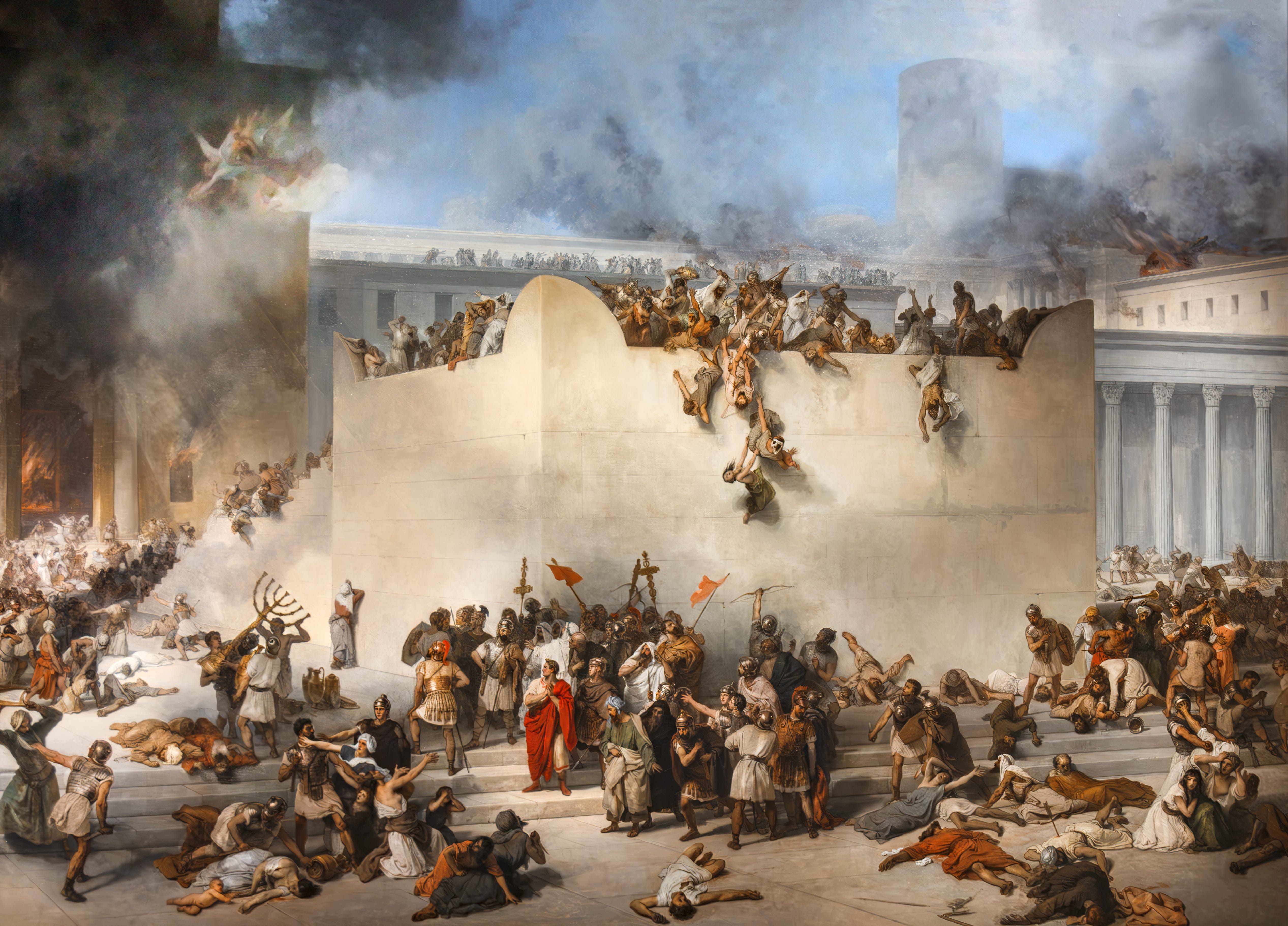
Remember that internet trend about menfolk who thought about the greatness of the Roman Empire three times a day? (WWCD – What Would Caeser Do?) Substitute Jewish history for Rome and you have my brother. Speaking of the Romans, it was my brother who schooled me at length on how the Romans started Jew hatred. After they conquered Judea—the first incarnation of the state of Israel—they excommunicated the rebellious Jews to various parts of the empire.2 At the same time, the Romans went out of their way to label the Jews they were forcibly spreading out around the Roman Empire as apostates and troublemakers. The goal was to end Judaism, thus preventing Jews from returning to re-consolidate their control over Judea. That goal failed, as did the Roman Empire, but the idea that Jews were a pernicious, dubious presence persisted; the Christians quickly took it up and, eventually, the Muslims. So it is that the Romans effectively planted the seeds of antisemitism that would come to yield many long-limbed, deep-rooted offspring bountiful with poisoned fruit.
This was Jewish history according to my brother. I always brushed off his doom mongering. All that stuff was a long time ago. Even the Holocaust was starting to feel like a long time ago. We were Canadian Jews. What could possibly happen to us? But now, I was starting to circle back to all the times my brother warned that the tree hadn’t died. It just lay in dormancy, a waiting for fresh blood to fertilize it’s long, long roots.
After I hang up, I dissolutely open a beer and consider the problem. How to lift my mottled, soused soul out of that swamp of Netflix, Twitter, craft beer and all-you-can-eat bacon wrapped scallops and provide succor to my brother? What do I know? Feeling helpless, I decide to remain vigilant, aka do nothing. I tell myself that once the hostages are returned and the war ends, the broader war against the Jews, the one that has been going on for several thousand years, will also, somehow, abate. In the meantime, my brother’s way of looking at the world makes inroads into my psyche: the Roman Empire, several times a day.
Coming Next Week: Part 2: Am I My Brother’s Keeper? Plus: Bat Mitzvah Tzedakah! Bonus material: the Vegan NAZI!
No posts
Comments
Nothing yet. Say the first thing.
Sign in to join the conversation.