
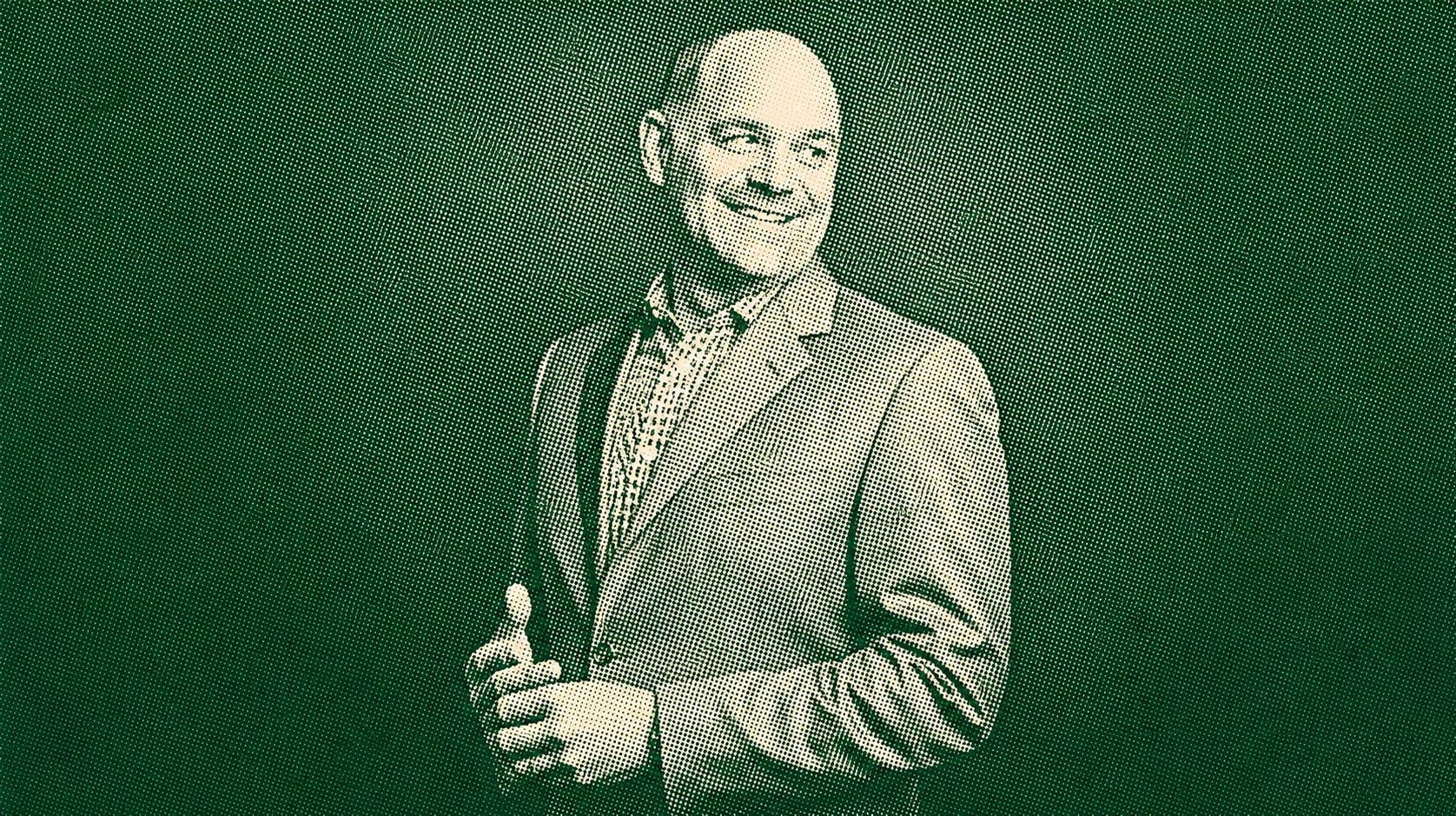
Jerry Durham has spent more than three decades inside Physical Therapy, from treating patients to building and selling a practice and going out of network before the profession thought it was viable. That lead to a breakthrough: outcomes are decided before the patient ever shows up. After spending a full year answering intake calls himself, he saw that most clinics are solving the wrong problem, asking therapists to carry work that should happen upstream while measuring visits instead of completed care.
I got this email from Jerry Durham last week in response to the playbook I put out for how to capitalize in 2026.
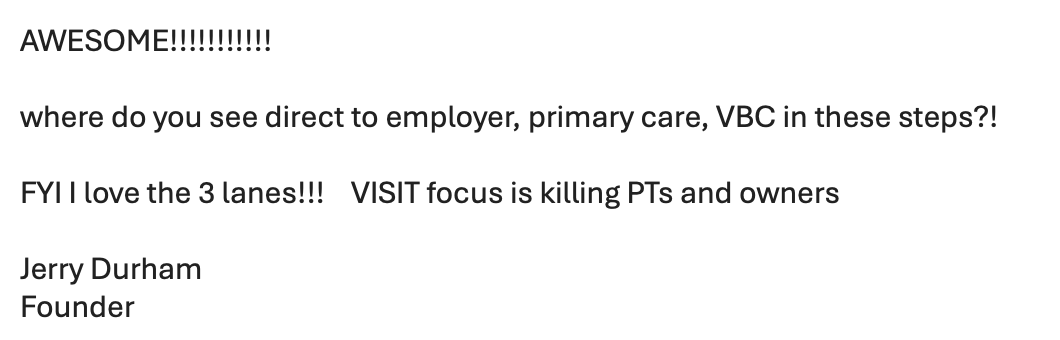
I replied, but it was clear we needed this longer conversation. We sat down to talk about why the first phone call sets the entire plan of care and how practices need to rethink the front end to keep patients moving through it.
ben.barron: Jerry, welcome. Before we get into it, I just want to say I really appreciated your email. It picked up on exactly the kind of questions we all should be wrestling with right now.
jerry.durham: I appreciate that. And I loved your piece, so I think we’re building off the right foundation here.
ben.barron: That feels like the right place to start. I always like to begin with “The Pull”. I love hearing people’s story about why they’re actually in this industry, because there are a lot of ways we could all spend our time.
ben.barron: Not the resume version of how you got here, but the deeper reason. What was the moment, or the problem, that pulled you into Physical Therapy in the first place?
jerry.durham: It’s interesting. I want to go all the way back for this. I got out of high school, went into undergrad, and didn’t know what I wanted to do. So I signed up for my general ed classes, then thought, I’ll check out a couple of business courses.
jerry.durham: By the end of that first semester, I hated them. I remember thinking, I can’t do this for the rest of my life. So I started asking myself what I actually wanted to do.
jerry.durham: I remembered this trainer we had when I played sports in high school. He was both a physical therapist and an athletic trainer. And the funny part is, I never got injured. I was never in a PT office. I never needed athletic training. But I do remember thinking, Ed always seems so happy doing what he does.
jerry.durham: That was literally it. I thought, I should talk to Ed and see whether this is something I’d be interested in.
jerry.durham: I was in the CSU system, and Ed had gone through it too. I showed up with that giant book of majors and course requirements, the kind of thing that made a phone book look short. During our meeting, while he explained what he did on the Physical Therapy side and the athletic training side, he also walked me through the course path under what was, at the time, the pre-physical therapy major. He laid out the map for me.
jerry.durham: I left thinking two things. One, this sounds like a great profession. Two, now I know the path.
jerry.durham: So I signed up for the classes. I started taking the sciences and liked them. Then I began volunteering in just about every setting I could, because I understood pretty early that Physical Therapy was a lot of different things. The more I saw, the more I liked it.
jerry.durham: And the truth is simple. I thought it was cool that you got to talk to people and help people. That’s how I got into Physical Therapy.
jerry.durham: By my third year, I was all in. Back then I only got my master’s. I never got a DPT. The longer programs were two years, and I was dead set on getting out of undergrad, getting into PT school, getting out of PT school, and getting a job. So I put my head down and went.
jerry.durham: PT school was 24 months. I graduated on December 19 and showed up to work on January 3. That was 34 years ago. I started my own business in the middle of all of it and worked in every setting except peds and neuro rehab in my first five years.
ben.barron: What great exposure.
ben.barron: What really stands out to me is something Julianne Brandt from Spooner and I talked about in another interview. She always talks about the agency we have over the profession. The more we talk to students, clinicians, and future PTs about the negative side of the field, the more we help create a negative perception of it.
ben.barron: But we can also talk about the tailwinds. More people need, want, and pursue Physical Therapy today than ever before. And we are the only profession in the MSK continuum that everyone else in that continuum is saying we need more of.
ben.barron: No one is saying that about injections. No one is saying that about surgery. No one is saying that about opioids.
ben.barron: So when I think about your story, I think about the impact of one conversation with Ed. What was his last name again?
jerry.durham: Ghiringhelli.
ben.barron: Right. Your conversation with Ed 34 years ago had an impact on you. Then you went on to impact patients, practice owners, and the profession. At some point it becomes a flywheel.
ben.barron: And it reminds me that every profession has headwinds. Nothing is perfect. But there is also a lot of good happening in PT, and we need to remember that. We need to frame the profession in our own minds through those tailwinds sometimes, because it is easy to get lost in the weeds.
jerry.durham: I want to add two numbers to what you just said, because I think it matters that we timestamp this. We are sitting here in March 2026, and at no other point in my journey has physical therapy been talked about as the solution the way it is right now.
jerry.durham: I watched a webinar last week with four non-PTs and one PT. Everybody had credentials, MDs, DOs, all of it. And everybody on that webinar deferred to the PT.
jerry.durham: The webinar was put on by the MDs, and it was about where PT fits and the role physical therapists are going to play in the bigger picture. That was amazing to me. Dana Strauss was on it, and she handled it beautifully. She talked about PT’s role on the team and in the future of MSK care without diminishing anybody else.
jerry.durham: The other thing I constantly use, and it’s on one of the first three slides in almost every presentation I give, is this. Only 10 percent of the people who could benefit from physical therapy ever get to physical therapy. Which means 90 percent of the people who could use us never do. And 80 percent of people who start a plan of care never complete it.
jerry.durham: As long as those numbers are true, you are not allowed to tell people they should not come into the profession. You are not allowed to say this is not a good profession until you start acknowledging those numbers, looking at the why behind them, and making the conversation about that.
ben.barron: I look at those numbers and the only thing I see is opportunity.
ben.barron: You can talk to me about administrative burden and compressed margins and decreasing rates. But you know what you do have? Agency over yourself, your business, and your practice.
ben.barron: I had a conversation recently with an owner who said, “Ben, everything you’re saying is all well and good, but UnitedHealthcare is 30 percent of my payer mix. I can’t do anything about that.” I said, I don’t understand why you can’t do something about that.
ben.barron: He said, “What am I supposed to do?” I said, well, you can choose. I’m not telling you what to do, but you decide who you do business with. You are the business owner. That’s the nature of it.
ben.barron: Then he said, “Yeah, but I have this number of PTs, this number of support staff, this number of clinics.” And I said, those are hard decisions, but they’re separate decisions. If you want to make decision A, it may force you to look at whether you have the right number of PTs or the right number of clinics. But that does not mean you cannot make a decision.
ben.barron: It means you need to decide based on your value system. If you want 10 clinics and 50 PTs, and the only way to do that is to take all comers on the insurance side, that’s your decision. That’s fine. It’s your business.
ben.barron: But then you can’t be upset if your revenue per visit is $75, because that’s what you agreed to contractually.
ben.barron: That word, agency, matters so much. We get to decide. I think, too often, we get fatalistic and act like this has happened to me, here I am, I have to take what I’ve been given.
jerry.durham: Exactly.
ben.barron: Okay. So you built the practice, sold it, and then spent years helping owners and operators work through these same industry problems. What keeps you doing it? Because you are solving a lot of the same problems over and over. What’s “The Stay”?
jerry.durham: I tell people all the time that what I offer and what I do has not really changed in 15 years. The way I present it has probably changed. But what you just said about agency is the perfect transition into why I stay.
jerry.durham: My partner and I decided to go out of network in 2007 or 2008, before it was cool. I like to say that. And the profession told me you can’t do that. The profession said nobody will pay. My own colleagues said it won’t work.
jerry.durham: And we made the decision anyway. It is funny how people react when you actually take control.
jerry.durham: That matters to why I stay, because here’s what I found. I was having a hard time managing people, which meant I was having a hard time managing plans of care. I was starting to lose my desire to keep treating patients. I had already started getting more involved in the marketing side of the business, even before we went out of network. Then going out of network became the tipping point for where I am now, in March 2026.
jerry.durham: I remember that decision clearly. It took us less than five minutes to make, because we had been building toward it. We got the last notice, said fine, we’re going out of network, and that was it.
jerry.durham: And I remember my gut reaction. I thought, we are going to have to start talking to people differently on the phone when they call to schedule.
jerry.durham: That’s where this whole journey started. And that’s where what I do today really started to build.
jerry.durham: What I found was that physical therapy truly was what people needed in MSK, but we were putting too much burden on the physical therapist. We were over-leveraging our PTs.
jerry.durham: We were asking them, in one hour, to build trust, do motivational interviewing, do an objective exam, do a subjective exam, learn about the patient’s grandkids, do treatment, give a home exercise program, go through the plan of care, get the patient to agree to the plan of care, and get them scheduled out.
jerry.durham: Then when that didn’t happen, I would go to my PTs and say, why didn’t you convert this patient? Over and over and over.
jerry.durham: Then I had this idea that we had to change the first phone call. I didn’t change the first phone call because I thought it would increase provider success. I changed it because I knew we had to get people to show up. That was it.
jerry.durham: I didn’t realize how much else that phone call affected. Over time, what I learned was this: the better someone was managed before they arrived, the better the first visit went, and the greater the likelihood of a completed plan of care.
jerry.durham: That’s why I still do this. I realized I could have a huge impact on patients by getting them to the right place. And when we were the right place, I increased the likelihood that my providers could get agreement on a plan of care.
jerry.durham: I thought, if I sit in a treatment room, I can only impact so many people a day. But if I change the front-end phone call for a clinic with 10 or 50 PTs, I can impact a boatload of people, both patients and providers. And ultimately the business too. Let’s not lie. Patient success leads to business success.
jerry.durham: That’s why I keep doing the same thing. Because I keep seeing the results reproduced. It doesn’t matter whether it’s in-network, out-of-network, or hybrid. It doesn’t matter whether it’s a peds clinic. If it’s an MSK clinic, this approach helps everybody involved. And that’s what gets me out of bed in the morning at 6:00 to talk to somebody about where AI fits at the front desk.
jerry.durham: Thirty-four years ago, when I got out of school, I sat around thinking, why are we waiting for people to get hurt?
jerry.durham: I’ll never forget the first time I stood in front of a group of business owners and said, you know, you shouldn’t be scheduling every single person who calls your clinic.
jerry.durham: Things like that are really starting to make sense in 2026. I stood in front of a student conclave a year and a half ago and said, I’m going to go out on a limb here. If we could check a couple boxes, I would trade places with you today.
jerry.durham: You hear all this doom and gloom, and people telling you not to do this. I’m telling you the opposite. Because of the opportunity, I would switch places with you.
jerry.durham: We have more opportunity now to get paid what we deserve. If we deliver what we know we can deliver, and we document it, the opportunity gets much bigger.
ben.barron: Stephen Clark from Confluent said PT is the greenest pasture in healthcare. He’s the one who said everybody else needs to do less of what they’re doing to contain costs, while PT needs to do more.
ben.barron: Normally the way I’d wrap this section is by asking, what do you believe and know now that you didn’t know then? But it sounds like we already covered it.
ben.barron: That first interaction on the phone, how you handle people before they even come in, affects not just arrival rates for the first visit, but the tone of the entire plan of care and the likelihood of completion. Is that fair?
jerry.durham: Yeah. And let me add to that. Going forward, the key is upstream contact and upstream triage, making sure it is the right person, right place, right time. That’s what I’d say I’ve really been doing all along.
ben.barron: I want to talk about the front desk. You spent a year just answering phones. You took every new patient call for all these offices. What were you trying to figure out? What did you learn? What was the goal?
jerry.durham: Great question. There were two goals.
jerry.durham: We go out of network. I’m struggling to find guidance or leadership on how to do this. And I will still claim to this day that I hired the first legitimate salesperson to answer intake calls for a physical therapy clinic almost 20 years ago.
jerry.durham: I hired a sales guy who was a real sales guy. We fired him three months later. I said, fine, we’ll hire another one. We fired that person too.
jerry.durham: And then I finally thought, wait a minute. These are not bad salespeople. I think this is me.
jerry.durham: So goal number one was short term. I had to figure out how to get these calls managed and get people to show up so we could continue to exist.
jerry.durham: Long term, I knew I had to learn. What I realized was that the failure was on me. I had not given these people systems and processes. I had not made sure they understood the product. I did not understand the sales cycle myself.
jerry.durham: So I said, I’m going to answer the phones for three months. I’ll make sure people are getting scheduled, but at the same time I’m going to learn the systems and processes so we can hire the right person and make this scalable.
jerry.durham: Because as much as I loved doing it, it was neither scalable nor the best use of me. I ended up doing it for a year, because of what I learned, and because I loved it.
ben.barron: The email you sent me was about the 2026 practice playbook. In that piece, I argued that I don’t think we have a hiring problem at the front desk. I think we have a deployment problem.
ben.barron: Meaning we are asking the wrong people to do the wrong things at the wrong time. A lot of practices probably already have the right people, but those people are buried under so much other stuff that no one even knows it.
ben.barron: Given how many practices you’ve been in and out of, and how much time you’ve spent on the phone, how quickly can you tell whether it’s the right person at the front desk?
jerry.durham: Very quickly. If I can talk to them, I know within 10 seconds.
jerry.durham: I ask, what are your accountabilities? And do you know what they usually tell me? Their responsibilities and tasks.
jerry.durham: I’m like, no. What are you accountable for? What does your role actually deliver to the company?
ben.barron: Spell that out for readers for a second. What is the difference between accountability and responsibility?
jerry.durham: Accountability is the KPI. It’s conversion rate. It’s co-pay collection rate. It’s the metric.
jerry.durham: Responsibility is the work that delivers that metric. If the accountability is conversion rate, then the responsibility is answering the phone and executing the script.
ben.barron: So said another way, responsibilities are the activities and behaviors that drive the outcome, while accountability is the actual outcome.
jerry.durham: One hundred percent.
jerry.durham: And I want to put a huge caveat on this. I have never blamed a front desk person for the answer they give me. Because who is actually responsible for that? Their manager and the person above them.
jerry.durham: At this point people probably think, Jerry must fire a lot of people. I have literally recommended one time in all these years that somebody be let go.
jerry.durham: If you understand what the KPIs are, and you understand how the front desk plays into delivering a completed course of care, then you can start dividing responsibilities based on the accountabilities that matter at different phases.
jerry.durham: What usually happens is owners default to hiring the best customer service person.
jerry.durham: During that journey I couldn’t find PTs to help me, which was both good and bad. It was good because it pushed me into EO, Entrepreneurs’ Organization. At the time, we were one of a hundred businesses and the only healthcare company there, and I wanted to be in a room without other healthcare people.
ben.barron: This was during your private practice days.
jerry.durham: Yeah, private practice.
jerry.durham: Through that I met a brilliant entrepreneur named Christina Harbridge, and I’m still friends with her today. She bought a collections agency and completely flipped it.
jerry.durham: You hear collections agency and think, what did she change? The answer is the conversation. That’s all she changed.
jerry.durham: Her collections people were getting Christmas gifts. Think about that. And they were still collecting the money.
jerry.durham: She is a communicator. She was the first person who ever said this to me. She said, “Jerry, you keep asking customer service people to do sales.”
jerry.durham: And I was like, holy shit.
jerry.durham: She said, “Customer service people are yes people. Salespeople want to understand the problem. You can’t just flip one into the other.”
jerry.durham: That was the day I started looking at the front desk differently. I thought, oh my God. We hire customer service people, then ask them to manage cancellation fees, talk about money, and handle all this front-end work that actually requires sales skills.
jerry.durham: Then what do we do? We go on LinkedIn and complain that we can’t find a good front desk person, that people quit, that nobody wants to work. I’m like, if you hired someone and they quit, that is probably on you.
jerry.durham: If I can’t talk to the front desk directly, I go to the clinic manager and owner and ask, what different skill sets do you actually have on this team?
jerry.durham: I once ran into a clinic with 11 front desk people, and every one of them had been hired for the same skill set. That is setting people up to fail.
jerry.durham: The front desk is really three different jobs. It is sales. It is customer service. And it is back-office admin, especially billing.
jerry.durham: Those are three different job descriptions, three different interview processes, and three different types of people. Yet we keep hiring one person and asking them to do all three.
jerry.durham: By the way, I always ask people this. Have you ever secret-called your own clinic? Almost nobody has. I didn’t do it in my own years either.
jerry.durham: But I tell people all the time, I know your culture within 30 seconds of that first phone call.
jerry.durham: If the person answers distracted, and you can tell they were doing something else, and they ask your name three times, that is your culture.
jerry.durham: Compare that to someone who says, “Hi Jerry, so glad you called. Sorry to hear about the low back pain. You called the right place. Here’s what I’d like to do next.” Those are two different cultures.
jerry.durham: I did a secret call about a month ago. It was brutal. And I wasn’t frustrated because the call went badly in a professional sense. I was frustrated because I was playing Jerry the patient, and I thought, my God, if I were actually a patient, what just happened to me?
jerry.durham: And by the way, it was not the person. It was the training. Most of what I do is move people into different seats on the bus.
ben.barron: When do you think a patient actually decides whether or not they’re going to complete the course of care? And how much of that decision belongs to the clinical side versus the non-clinical side?
jerry.durham: I break the patient journey into three phases. Pre-arrival, arrival, which is the evaluation, and then course of care. I treat those as three separate sales cycles.
jerry.durham: And I work by reverse-engineering success. If I want a completed course of care, what has to happen one step before that, then one step before that, then one step before that?
jerry.durham: That process led me to a simple realization. If all these things have to happen during the evaluation, then the pre-arrival process has to set both the patient and the provider up for success.
jerry.durham: That means the patient needs to walk into the room with trust and with the right expectations already set.
jerry.durham: The therapeutic alliance research, the Bishop and Bialosky expectations research, all of that was done in the clinical space. I didn’t invent that. I just moved it upstream. They did the heavy lifting. Maxi Miciak was huge in my journey on that too.
jerry.durham: So I started asking, if I need these things delivered in the evaluation, what can I start building before the patient ever shows up?
jerry.durham: What I want when somebody hangs up the phone is very simple. I want them to think, I called the right place.
jerry.durham: And what that means is they know they are scheduled with an expert. The research tells us patients want an expert. And the simplest definition of an expert is somebody who has helped people just like you.
jerry.durham: Patients want an expert who can tell them what’s going on and give them a plan. That’s in the medical research, not just PT research. The first time I read that, I thought, that’s PT.
jerry.durham: So if I can check those boxes, I’ve already increased the likelihood of arrival, payment, and retention. My goal is to reduce the risk of the negative outcomes and increase the likelihood of the positive ones.
jerry.durham: And once those things are in place, I think you can predict arrival rate, drop-offs, no-shows, and completed courses of care.
jerry.durham: And I don’t care what the delivery model is. It could be a 15-minute eval for all I care. What matters is that expectations are built and the patient knows what they’re showing up for.
ben.barron: That connects to another line from the playbook. I’m going to quote you directly: “Visit focus is killing PTs and owners.” What does that mean?
jerry.durham: You get what you reward. A visit is just one step in a completed course of care. We’re rewarding the wrong step in the process.
jerry.durham: I have a bunch of Beastie Boys posters in my office, and one quote taped up on the wall: You control the process, not the outcome.
jerry.durham: I think that’s part of why I burned out on treating patients. I was owning the outcome instead of the process.
ben.barron: If you look at high-performance coaches and sports psychology, that’s exactly what they say. Be obsessed with the process and let go of the outcome. Train the process every day. Then when it’s time to take the shot, you take it. The second it leaves your hands, it’s no longer yours.
jerry.durham: Exactly. And visits are part of the process.
jerry.durham: I refuse to let clients hold team members accountable for visits. We hold people accountable for completed courses of care.
jerry.durham: Think about the difference. If I hire you as a PT and tell you that you are accountable for visits and units billed, your whole brain starts organizing around volume.
jerry.durham: But if I tell you that you are responsible for managing your active caseload and moving people toward their desired outcome, and that your accountability is a completed course of care, that changes the frame completely.
ben.barron: In that model, what counts as a completed course of care? How do you define it?
jerry.durham: I leave that to the clinic, because everybody always asks.
jerry.durham: Here are two examples. If Ben comes in for an evaluation with neck pain and arm pain, and I work through it and the red flags and yellow flags tell me he needs to go back to the doctor, that can still be a completed course of care.
jerry.durham: On the other extreme, if Ben comes in in January and says he wants to run a marathon in December, he should not be discharged in June. I’m not saying he has to come three times a week all year, but his last visit should probably be after the marathon, not six months before it.
jerry.durham: Both of those are completed courses of care. They just look different.
ben.barron: I love that. It ties back to creating different lanes of care.
ben.barron: We cannot keep pretending, as owners, operators, therapists, or patients, that all care should look the same. That every patient needs two to three in-person visits a week, and that the business should just crank out 10 to 12 visits per eval on repeat. That model breaks for a million reasons.
jerry.durham: And that comes back to visit obsession.
ben.barron: Some of it is diagnosis-driven. Some of it is access. Some people have to drive an hour and a half to get to a clinic. Some are rural. There are a lot of variables.
ben.barron: One of the big things I would love to see this profession do in my career is stop measuring pure volume and start measuring human impact. How many people did we actually get to their finish line during a given period?
ben.barron: If it took one visit, great. If it took 100, fine. If part of the care was remote, telehealth, or self-management, that still counts. What matters is that we helped the person get from where they started to where they wanted to be.
jerry.durham: Everything you just said captures this whole conversation.
jerry.durham: Because to make that work, you need a front desk that is properly hired, properly trained, properly onboarded, and actually empowered to say, based on what you just told me, here’s what’s going to work best for you.
jerry.durham: And that might be telehealth. It might be a phone follow-up. It might be an in-clinic visit. It could be a lot of things.
jerry.durham: A lot of people hear that and freak out because they do not want to take agency, or they want to blame someone else. But if we really want to impact people, we have to meet them where they are.
jerry.durham: I do not care whether you are in a rural market or Los Angeles. Driving five miles in Los Angeles can be its own access problem.
jerry.durham: So let’s say your front desk takes Ben through a conversation and says, “You know what, Ben, we can help you. When would you like to get started?”
jerry.durham: That question matters. Do not tell people when your next opening is. Ask them when they would like to get started.
jerry.durham: If you want people to show up, meet them where they are.
ben.barron: That’s a great takeaway. Very simple, but very sharp.
jerry.durham: It changes everything.
jerry.durham: Ben says, my kids are back in school, or my wife and I just got divorced, or I’m handling the kids right now. And what do most clinics do? They jam him into the first available slot anyway.
jerry.durham: Then he no-shows, and they say, I knew that guy wasn’t going to show up.
jerry.durham: Instead, a trained front desk says, “Ben, I hear you. We have options here. I want to make sure you get the help you need so you can get active again. Since you’re juggling small kids right now, let’s make the first visit telehealth.”
jerry.durham: Ben says yes. Ben shows up. Now we actually have a shot to help Ben.
jerry.durham: That is completely different from saying, “Well, Ben, all I’ve got is 3:00,” right after he told you he picks his kids up at 3:30.
jerry.durham: This is not rocket science. It is about tying the whole thing together and meeting people where they are.
jerry.durham: I remember going to my partner 15 years ago and saying, why are we making everybody show up in the clinic? I wanted to build a hybrid telehealth and in-clinic plan of care. We were out of network at the time. We could have baked the price in.
jerry.durham: And people would say, “Well, I can’t charge for telehealth.” I’m like, really? After everything we just talked about, that’s your only response? Bake it in somewhere.
jerry.durham: But nobody wanted to do it. So yes, we have to meet people where they are. Right person, right place, right time.
ben.barron: How much of the therapeutic alliance you talk about, between patient and therapist but also extending to the front desk and the rest of the team, is trainable versus innate?
jerry.durham: Fifty-one percent trainable. It’s hard. Very hard to train.
ben.barron: So we need to screen for it, and we need people who have a lot of it naturally. But even then, they still need constant training.
jerry.durham: Exactly. And accountability.
jerry.durham: At the front desk, I hold people accountable to a process. Did you move this person through the five-step process? Did you do it in a way that built trust, managed expectations, and set expectations? That is the point of the process. And it takes constant work.
ben.barron: Whose job is it to fix the narrative around physical therapy and the negative storytelling inside the profession? Owners? Trade associations like APTA? Professors? Someone else? Who owns that?
jerry.durham: Since you mentioned professors, I’ll say this. There is enormous inconsistency in what students hear in school, what they hear in interviews, and what they read once they get out.
jerry.durham: So I’m going to say it belongs to everybody equally.
jerry.durham: Everybody has to do their part. It’s team alignment. If I want to increase the likelihood of a completed course of care, everybody has to be rowing in the same direction.
jerry.durham: So yes, I think it is on all of us to understand our role, take agency over it, and share information that is more consistent.
jerry.durham: I don’t know if perfect consistency is possible. That may be a moonshot. But whenever I see a post saying APTA should do this or that, my first thought is always, OK, what are you doing?
jerry.durham: It took me a long time to get there. I tell people I’ve burned more bridges than they’ve crossed in their lifetime. But I do think responsibility is shared.
ben.barron: Shared benefit, shared responsibility.
ben.barron: So if you’re a practice owner and you know your care completion rate is 65 percent, what’s the one thing you would tell them to do tomorrow to start fixing it?
jerry.durham: Get your front desk better at setting and managing expectations so that when people arrive, they already know they are in the right place.
jerry.durham: That one thing alone will increase completed plans of care.
jerry.durham: And it starts with better questions.
jerry.durham: Not, have you had physical therapy before? I get asked that all the time.
jerry.durham: Ask, what have you done in the past that helped? What didn’t help? And what are you hoping to get from your physical therapist on the first visit?
jerry.durham: If you can align those answers, write them down, actually listen, and get that information to the provider five minutes before the appointment, your completed course-of-care rate will go up. I guarantee it.
ben.barron: Anything we haven’t covered, or anything you want to plug before we wrap? Where should people find you?
jerry.durham: I’ve got a YouTube channel with more than 200 videos on front-desk training, and it is all free. Everything I get paid to teach is free on YouTube. Jerry Durham, PT.
jerry.durham: LinkedIn is probably my second-favorite place. The conversations there are great, and they cut across the healthcare spectrum.
jerry.durham: And if you’re on Instagram, it’s a little more visual because of the videos.
jerry.durham: But the main thing I want people to understand going forward is that patient success is a team effort.
ben.barron: Patient success is a team effort.
jerry.durham: A team effort.
jerry.durham: My name is on a research paper pushing people to think about this differently. And by the way, I don’t even call it therapeutic alliance anymore. I call it team alliance.
jerry.durham: And it’s measurable. You can see it in the results.
jerry.durham: If you own that process, you will leverage your front desk differently. You will look harder at what they are doing. You will also leverage your billing team differently.
jerry.durham: I won’t do a lot of these talks unless clients bring everybody into the room, including billing. Because if anybody thinks billing doesn’t shape the patient experience, go read the reviews. Most of my negative reviews were about billing.
jerry.durham: So why on earth would you not bring billing into the room and talk about their role in completed courses of care?
Ben Barron | SVP @ Net Health | LinkedIn
Jerry Durham | Founder @ Client Experience Company| LinkedIn
No posts
Comments
Nothing yet. Say the first thing.
Sign in to join the conversation.