
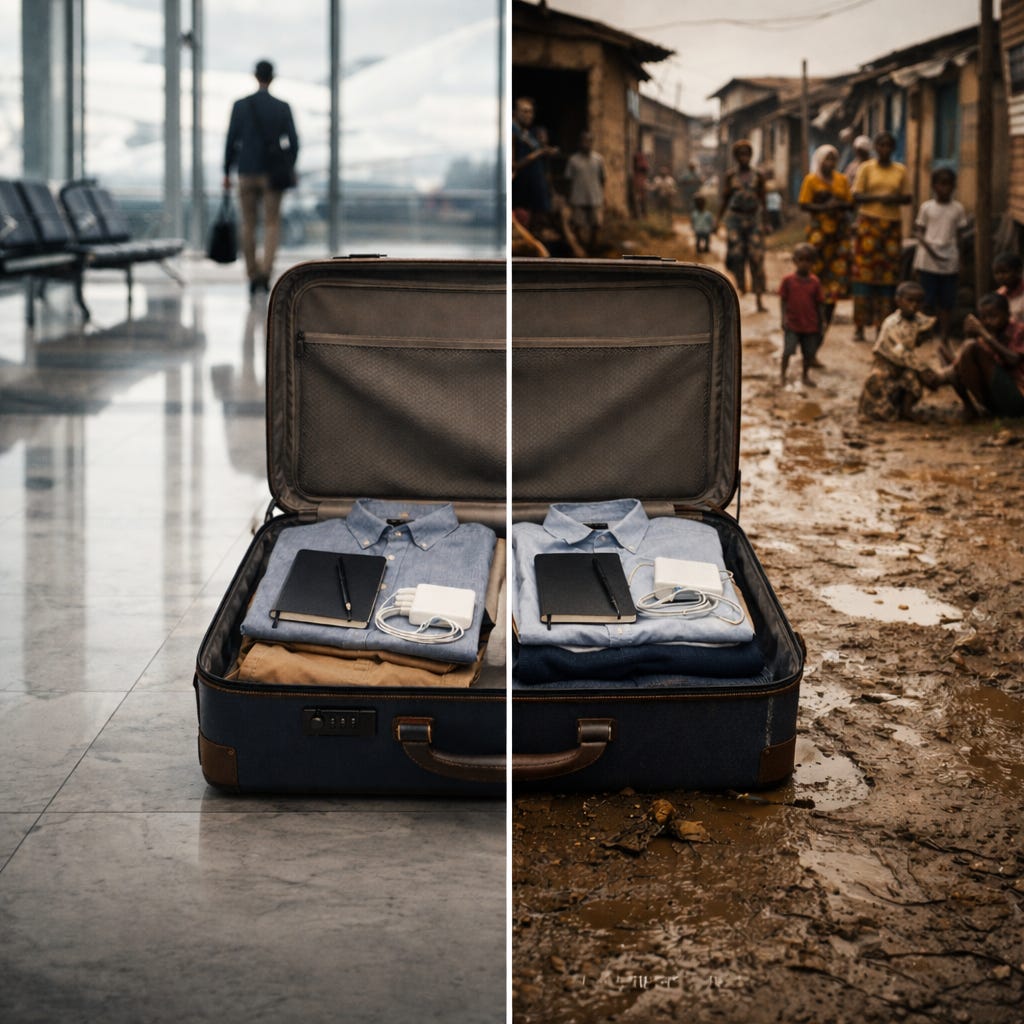
There is a French word that has no real real equivalent in English: le dépaysement. The Petit Robert Dictionary defines it as both a state and an impression, being removed from one’s familiar surroundings and experiencing the strangeness that follows. The Collins-Robert French Dictionary translates it more gently as a “change of scenery” or “disorientation.“
Dépaysement describes the feeling of being somewhere entirely unfamiliar, a new country, a new language, a different rhythm of life. Certainly not being homesick, but something quieter and more expansive. A lightness that comes from not fully understanding, from being released, if only briefly, from the need to interpret everything through the categories you carry with you. Some describe it as the pleasure of being out of place, not because confusion is generally an enjoyable state of mind, but because it sharpens attention. It forces you to look again and interrupts the ease with which you usually move through the world.
Global health is built on the assumption that this kind of experience matters. That stepping outside one’s own system and comfort zone does more than provide information. That it alters perception. That exposure to different ways of organising care, different relationships between patients and providers, different constraints and trade-offs produces insight that cannot be fully captured in data or reports. This is part of the field’s self-understanding. It travels in order to see. But there is a problem. We travel, but we rarely unpack the assumptions we carry with us.
We arrive with models of how systems should function, expectations about coherence and efficiency, and habits of interpretation shaped by our own training and institutions. They help us navigate unfamiliar settings. But they also shape what we notice, what we dismiss, and what we think requires fixing.
It is now entirely possible to participate in global health without encountering those moments through personal travel. Data travel easily, frameworks even more so. Policy templates, indicators, and comparative analyses move across contexts with little friction. You can map systems, identify gaps, and design interventions without leaving your desk. This work is rigorous and necessary. It brings clarity, enables comparison, and allows coordination at scale. In many ways, it is what makes the field function.
But whether we travel or not, we rarely unpack what we carry with us.
What tends to disappear in this mode of working is not knowledge, but interruption. Up close, health systems rarely behave as they are described. Policies are interpreted, adapted, or quietly set aside. Patients move through systems in ways that do not align with formal pathways. Language shifts meaning depending on who is speaking and who is listening. These dynamics are not hidden, yet they are easy to miss unless something draws your attention to them. That often takes the form of a small rupture. A moment where what you expected does not align with what is in front of you. A hesitation. A recognition that your model does not fully explain what is happening. That is dépaysement in practice. Not a dramatic disorientation, but a subtle loss of certainty.
From a distance, these moments are easy to smooth over. The categories hold. The system appears more coherent than it is. Ambiguity is reduced as information is aggregated and translated into comparable formats. The result is not necessarily wrong, but it is cleaner than reality and easier to act on. It is also, almost by design, insulated from the kinds of experiences that would challenge its assumptions.
Travel, however, is not a simple corrective. As Alain de Botton has observed, we do not arrive as blank observers. We bring our habits of interpretation with us. We tend to see what we are prepared to see. The unfamiliar is quickly organised into familiar patterns. A short visit rarely disrupts this unless there is a willingness to remain with what does not immediately make sense. Without that, exposure becomes superficial.
Short-term medical missions, brief trips by clinicians or volunteers to provide care in unfamiliar settings, offer a concentrated version of this dynamic. They are particularly common in academic training, especially in the United States, where they often serve as the most visible expression of “global health” engagement. They promise transformative exposure to unfamiliar settings, but their brevity limits the possibility of sustained engagement. Encounters are compressed, systems only partially visible, and relationships necessarily transient. What remains is often a strong impression of difference, but one that is quickly organised into familiar narratives rather than allowed to unsettle them. This form of curated exposure is not limited to short-term missions. It extends across much of global health practice.
I am not outside this dynamic. Much of my own work depends on a form of mobility that is relatively frictionless. Airports, visas, conferences, institutions that recognise my credentials. The world adjusts more easily to me than to many others. What presents itself as exposure often comes with a quiet guarantee that I will remain oriented, and that I can leave without consequence. This is not simply personal privilege. It is structural.
This feature of global health shapes who sees, who speaks, and whose interpretations travel. For many professionals in high-income settings, mobility is assumed. For many colleagues in low- and middle-income countries, it is uncertain, time-consuming, and often denied. The result is a field in which those closest to the realities under discussion are often least able to move within the spaces where those realities are interpreted.
This asymmetry matters for how we understand dépaysement. The concept assumes that being out of place is temporary and reversible. That one can leave, experience unfamiliarity, and return. But for many, being out of place is neither chosen nor easily reversed. It is embedded in the negotiation of borders, languages, and systems that were not designed to accommodate them.
It is worth being precise. Dépaysement is not migration or displacement. Those conditions carry a different weight. The stakes are higher, the logistics are harder, the friction constant rather than episodic. To collapse these experiences into a single idea of “being out of place” would be to misunderstand both.
And yet, global health often operates as if a limited version of this experience were sufficient. It values exposure, but in a form that is controlled and reversible. It celebrates the perceptual shift that comes from being elsewhere, while largely ignoring the conditions that shape who can move and how.
Critiques of the foreign gaze, articulated by scholars such as Seye Abimbola, have shown how easily global health converts observation into authority. The unfamiliar is translated into categories that can be measured and acted upon. The observer remains oriented. The encounter produces knowledge, but not necessarily transformation.
Dépaysement points to a different problem. Not that global health sees too much from the outside, but that it rarely allows itself to be unsettled by what it sees. The moment where understanding might deepen is shortened. The unfamiliar is translated quickly into something that fits.
What remains is a curated version of dépaysement. It captures the lightness of being elsewhere, but not the weight of staying there. It values difference, but not the conditions that make that experience possible for some and difficult for others.
You can work in global health without traveling. Many do, often out of necessity rather than choice. Travel, in itself, guarantees very little in terms of insight or disruption. Yet the important question is what happens to understanding when it encounters difference. A field that moves easily across contexts has perhaps learned to stabilise them just as quickly. It produces knowledge that travels well and interventions that fit. Global health encounters difference constantly. It rarely allows that difference to change how it thinks.
What it risks losing is less visible but more consequential: the capacity to remain with what does not fit. To unpack is to suspend these assumptions, even temporarily. To allow what we encounter to challenge how we interpret, rather than to be quickly absorbed into what we already know.
Dépaysement is valuable because it interrupts certainty. It creates a pause between observation and interpretation, opening the possibility that what we see may not align with how we think. A field that no longer allows itself to feel out of place may be comfortable. But it may also be wrong.
Comments
Nothing yet. Say the first thing.
Sign in to join the conversation.