
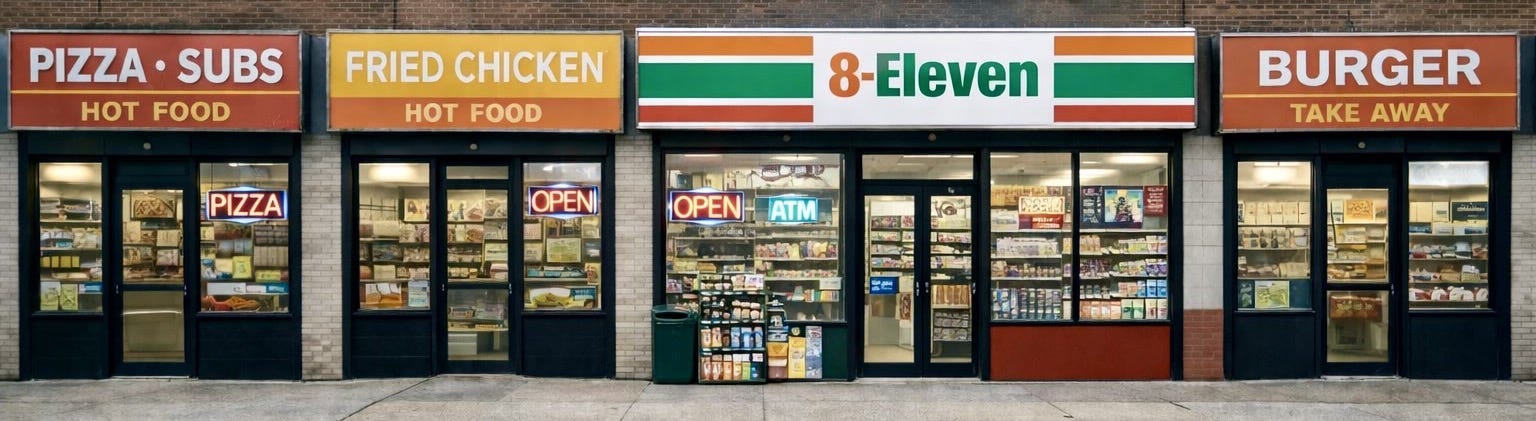
Let’s take a walk.
Not to a distant city invoked in a global health report, and not into a dataset that requires specialist tools to interpret. Just down your own street. The one you pass every day, usually without thinking about it.
The first thing you notice is not health. It is commerce. The rhythm of shopfronts and signs. What opens early and what stays open late. What has survived over the years and what quietly disappeared. A pharmacy, perhaps. Several places selling food that is cheap, filling, and fast. A betting shop. A vape store. Maybe a clinic, although often tucked away, overstretched, hard to access without planning weeks ahead.
Sometimes the change is more specific than that. The small fruit and vegetable shop that once anchored the corner is gone, replaced by a convenience store selling alcohol, ultra-processed snacks, and reheated food behind fogged glass. The public restroom that used to sit next to the bus stop has been locked, then closed, then quietly removed altogether. None of this happened overnight, and none of it felt dramatic at the time.
You do not need an index to tell you that this street is unequal. You can see it in what clusters and what vanishes. In what feels abundant and what feels fragile. In how choice presents itself not as variety, but as repetition.
This is what inequality looks like once it becomes ordinary.
Public health has trained us to look elsewhere. To zoom out. To aggregate. To compare cities, regions, countries. Inequality is rendered distant and abstract, visible only once it has been translated into indicators and gradients. Yet work examining how everyday commercial environments evolve over time shows that these patterns are neither random nor benign: neighbourhoods with fewer resources systematically lose health-supporting amenities and gain health-harming ones, while the opposite happens elsewhere. The street resists abstraction. It shows how policy, planning, markets, and neglect settle into space. How decisions made far upstream harden into everyday reality.
No single shop is the problem. No individual licensing decision looks unreasonable. Each actor is responding rationally to incentives, constraints, and risks as they encounter them. Small businesses follow viability. Local authorities prioritise occupancy over vacancy. Regulators apply rules one application at a time. Health services respond to need once it arrives. Seen in isolation, none of this looks like failure. Seen together, it produces a pattern that is anything but neutral.
This is the first uncomfortable insight of the walk: inequality does not require bad faith. It requires fragmentation.
Responsibility is spread across systems that rarely see themselves as co-producing the same outcome. Planning governs space, licensing governs legality, economic policy governs survival, health policy governs consequences. Each does its job. Together, they generate streets where risk concentrates predictably, and where the same neighbourhoods absorb exposure year after year.
This is where the language of “choice” begins to unravel. Of course, people choose. But they choose within an environment that has already done much of the sorting for them. When unhealthy options multiply and healthier ones thin out, behaviour follows availability. The street nudges continuously, quietly, without consent.
At this point, the argument is often mistaken for a call for gentrification. It is not. Healthier streets are frequently conflated with wealthier streets, as if the only way to improve environments were to replace poorer residents with richer ones. That logic treats harm as a natural consequence of low income rather than as a policy choice about what risks are permitted to concentrate where. People do not need boutique groceries or artisanal cafés to be healthier. They need affordable, viable options that do not systematically trade short-term commercial survival against long-term health.
The question, then, is no longer whether health was considered. It is whether health was ever treated as a limit.
We accept boundary conditions in many domains without controversy. We do not ask whether fire safety was weighed against architectural freedom. We do not allow food hygiene to be balanced against commercial convenience. We do not negotiate whether bridges may collapse occasionally if the economic case is strong enough. Safety, legality, and basic environmental protection define the space within which choice operates. Health does not enjoy that status.
On the street, health appears downstream, as an outcome to be measured rather than a condition to be respected. Risk is permitted to accumulate spatially in ways we would never tolerate for toxic waste, faulty wiring, or structural instability. Inequality becomes an externality rather than a design failure.
This asymmetry matters because it explains why so much good intention delivers so little change. Knowledge is not the problem. Cities know what shapes health. Public health has documented the gradients in extraordinary detail. What is missing is authority over the systems that shape everyday environments, and accountability for the cumulative effects of ordinary decisions. By the time poor health shows up in clinics and statistics, the street has already done its work.
This is worrying. Because it reveals a deeper issue, one that polite policy language often obscures. We have become very good at considering health, and much less willing to treat it as non-negotiable. We invite health into conversations about planning and development, while allowing systems to remain optimised for short-term returns, administrative simplicity, and fragmented responsibility.
This logic has a name. For decades, it has been described as putting health into all policies. On paper, the concept of Health in All Policies is hard to disagree with. In practice, it often stops at awareness rather than authority. Health is acknowledged, consulted, assessed, and then traded off.
That is not inevitable. In Bradford in the United Kingdom, long-term, place-based research has made it increasingly difficult for decision-makers to ignore what neighbourhoods reveal about health, deprivation, and opportunity. Not by producing ever more abstract indicators, but by staying close to lives, streets, and systems over time, and feeding that knowledge back into local decision-making. The lesson is not that data saves us, but that evidence begins to matter when it is anchored in place and linked to authority.
The street then becomes more than a diagnostic. It is also a test of what we are willing to treat as non-negotiable.
What it suggests is something more demanding than another framework, and something different from importing middle-class consumption into poorer neighbourhoods. It points instead to a rethink of what we treat as a boundary condition. As long as health remains something to be balanced rather than something that sets limits, inequality will continue to assemble itself quietly, storefront by storefront.
You do not need to travel far to see this. You do not need a new indicator to prove it. You only need to pay attention to the places you already inhabit. And we need to ask ourselves whether we are prepared to treat what we see as evidence of a system that could be organised differently. Or whether we keep walking, reassured by the fact that no single step on that street feels like the moment where responsibility clearly lies.
Comments
Nothing yet. Say the first thing.
Sign in to join the conversation.