
Below is the full first chapter of my book The Minimum You Need to Do Before AI Changes Your Life. The book has six more chapters covering equally important subjects. It’s available from Amazon as e-book, paperback and audiobook.
The honest answer is: probably not in its current form.
I know that’s not what you want to hear. But let me be specific about what I mean, because “AI will take your job” is too vague to be useful. The useful version is more granular than that.
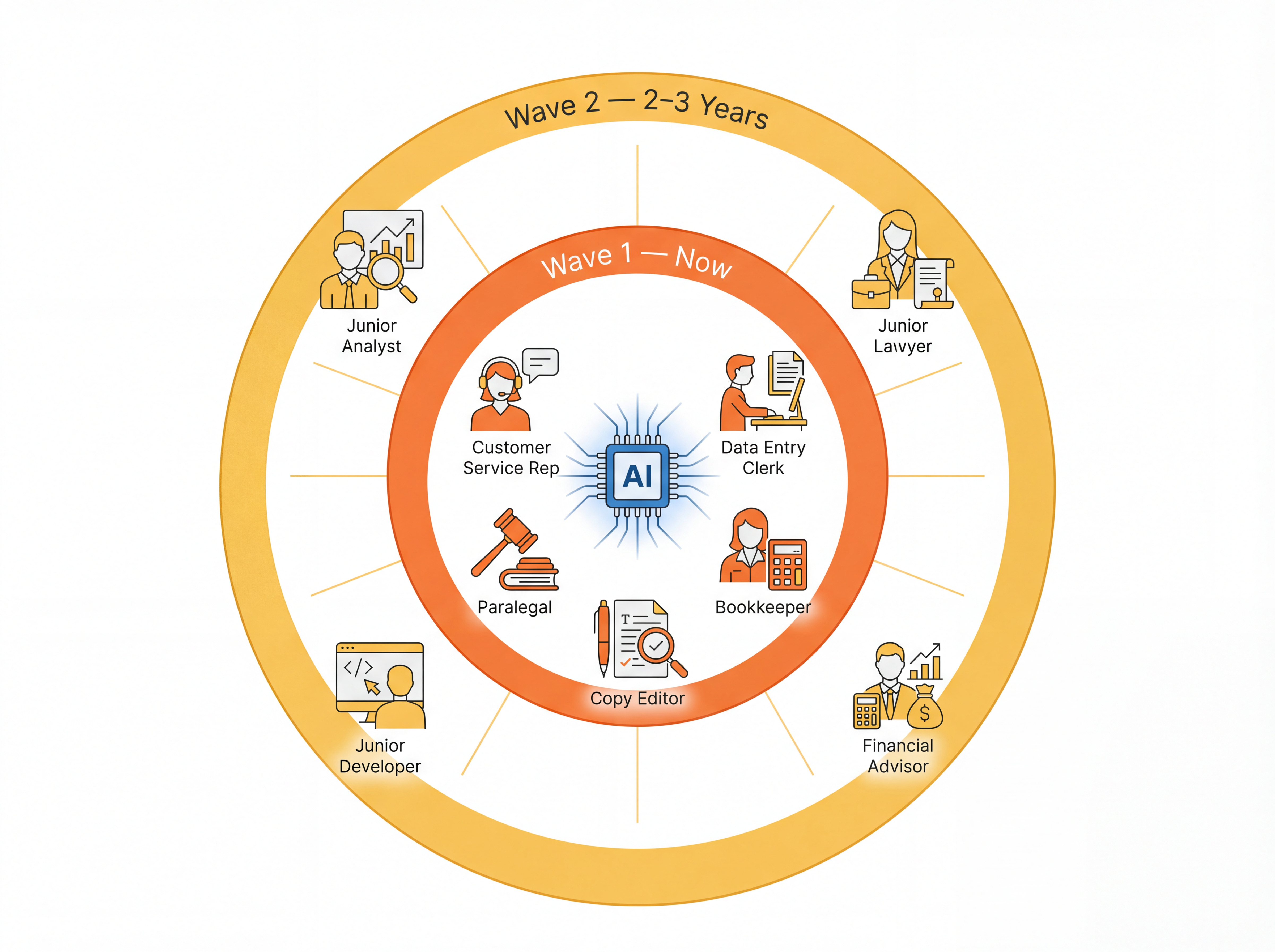
There are two waves of displacement happening right now, at different speeds.
The first wave is already well underway. It’s hitting jobs where the core task is processing information according to rules. Customer service. Data entry. Bookkeeping. Administrative assistants. Paralegals. Copy editors. Transcriptionists. Basic financial analysis. Anything where you could, in principle, write down the rules of the job in a document and someone reasonably smart could learn it in two weeks.
Here’s a simple test you can run on your own job today. I call it the two-week test: could a reasonably intelligent person, given a thorough manual of your role, do most of your job after two weeks of study? If the honest answer is yes, AI can probably do it now or will be able to within a year. If the answer is no — if your job requires years of embodied experience, genuine human judgment in ambiguous situations, real relationships, or physical presence — you have more time.
Most people, when they apply this test honestly, get an uncomfortable answer.
The second wave is the one that surprises people. It isn’t the obviously routine jobs. It’s the entry level of prestigious careers. Junior lawyers. Junior software developers. Junior financial analysts. Junior journalists. The entry-level positions that used to be how young people broke into a field and built expertise over years are being eliminated before young people can enter them. There’s been a measurable drop in employment for recent graduates in AI-exposed fields. The ladder hasn’t disappeared, but it’s losing its bottom rungs.
This matters even if you’re not a junior employee. If your field stops producing new entrants, the whole ecosystem changes. The pipeline of talent dries up. The informal knowledge transfer that happens when junior people work alongside senior people stops happening. Entire fields quietly lose a generation of practitioners.
I used to love coding. Genuinely good at it — not just as a job but as a craft. I now supervise AI that writes better code faster than I ever could. That transition happened faster than I expected. And I was paying attention.
What about physical work?
Here is a genuine piece of good news: physical skilled work is considerably more protected than knowledge work, for now. A plumber. An electrician. A personal trainer. A chef. A carpenter. These jobs require physical presence, embodied judgment, and the ability to navigate unpredictable real-world environments. Robots are coming for these too — eventually — but they are years behind AI’s progress in knowledge work.
I say this not to glorify manual labor sentimentally but because it’s factually true and actionable. If you have a physical skilled trade, your runway is longer than you might fear. If you’re a knowledge worker, learning a physical skill on the side is not just a hobby — it’s a hedge. A plumber who can also use AI to run their business efficiently will do well for a long time.
The side income question
Here’s the thing about having only one source of income: it means you are one restructuring memo away from a very bad month. That has always been true. The probability of that memo just went up significantly.
The antidote is not to quit your job. The antidote is to start building a second income while your first one is still working. Not to replace your salary tomorrow. Not to become an entrepreneur. Just to have something running — something that puts money in your pocket from a source you control — so that if your primary income changes, you are not starting from zero.
What does this look like? Anything. Freelance work in your field. A newsletter about something you know well. Teaching a skill online. Photography. Consulting on weekends. Writing. Tutoring. The specific thing matters less than the fact that it exists and is generating some income before you need it to.
I want to address the objection I always hear: “I don’t have time.” You probably have more time than you think once you stop spending two hours a day consuming content that makes you anxious. Start with three hours a week. The point is not to build an empire. The point is to build a habit and a foundation.
Eight options worth looking at
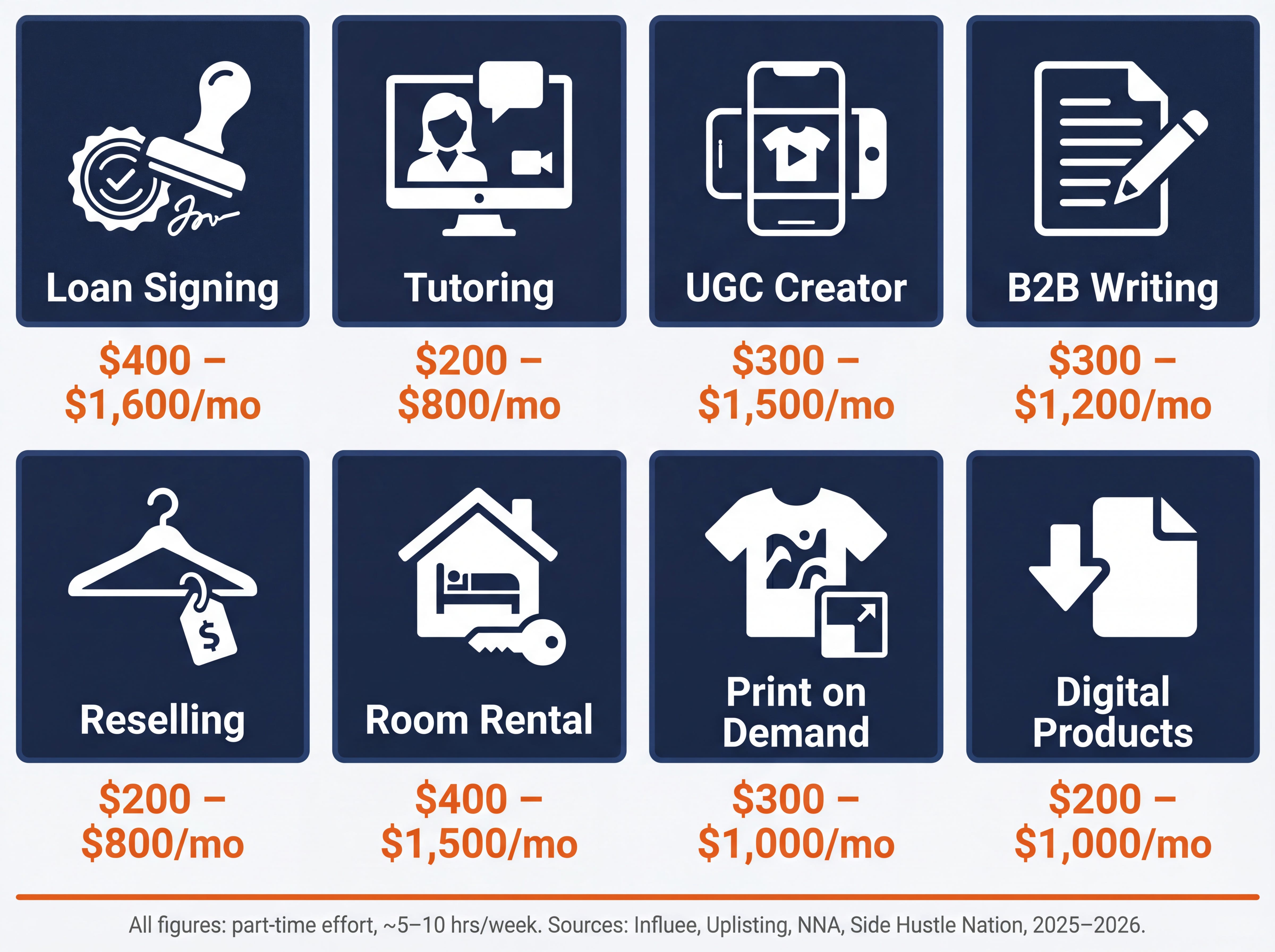
I researched this properly so you don’t have to. Here are eight side income paths that are working for real people right now, with honest numbers and honest notes on how AI is affecting each one. They are not all equal, and they are not all right for everyone. Read through them and see which one you could plausibly start.
1. Loan Signing Agent. You become a notary who specializes in witnessing real estate loan signings — meeting clients at their home or office, walking them through a mortgage document package, witnessing signatures. One appointment takes about an hour. Pay is $75–$200 per signing. Part-time effort (five to six signings a week) earns $400–$1,600 a month. Startup costs are $500–$900 for your notary commission, certification, and a printer. Takes six to ten weeks to get your first job. AI cannot notarize documents. This one is about as protected from disruption as anything on this list.
2. Online Tutoring. You work with students over video call in a subject you know well — math, science, test prep, foreign languages. Set your own schedule, accept or decline students. Platforms like Wyzant let you keep 75% of what you charge. A tutor charging $60/hour and working eight to ten hours a week earns $400–$700 a month net. Startup cost is essentially zero. AI has reduced demand for generalist homework help, but test prep and accountability-based tutoring are holding steady — those are relationship-dependent, which AI is not yet good at.
3. UGC Creator (User-Generated Content). Brands pay you to film short product videos (fifteen to sixty seconds) that they use in their own paid ads. You do not need any followers. You need comfort on camera and the ability to follow a creative brief. Beginners earn $100–$150 per video; once you have a track record, $175–$300 per video is realistic. Eight to ten videos a month is achievable part-time, producing $800–$1,500 a month. Startup cost is near zero — a smartphone and decent light are enough. AI-generated video ads are coming, but in 2025-2026 brands still strongly prefer real human face8s for conversion. This window is probably two to three years wide.
4. Freelance Writing (B2B). Writing blog posts and articles for businesses — not newspapers or magazines, but companies in tech, finance, healthcare, and professional services that need regular content. Beginners earn $100–$250 per article; experienced niche writers in B2B command $300–$500. Four to six articles a month part-time earns $400–$1,200. Startup cost is near zero. I’ll be direct: this is the most AI-pressured option on this list. Demand for generic content has fallen. Demand for writing that requires real expertise, original interviews, and a recognizable voice is holding up. If you have industry knowledge that an AI doesn’t, there’s still a market. If you’re a generalist, this is harder than it was two years ago.
5. Thrift Reselling. You source clothes and accessories from thrift stores and estate sales, then resell them online at a markup. The reliable categories are vintage band tees, Levi’s and Wrangler denim, Patagonia and Nike, 90s branded items. You photograph, list, and ship. Profit margins are typically 50–75% after platform fees. A consistent part-time reseller moves $1,000–$1,500 in gross sales a month, netting $500–$800. Startup cost is $100–$300 in initial inventory. The learning curve is real — you need to develop an eye for what sells — but YouTube will teach you faster than you’d expect. AI is not threatening this. It’s actually helping, with tools that price your listings based on comparable sold items.
6. Airbnb Room Rental. If you have a spare room, this is the fastest path to meaningful income on this list. Create a listing, set your availability, automate check-in with a lockbox, keep the room clean. A well-reviewed private room in a mid-size city priced at $75/night and booked ten to twelve nights a month grosses $750–$900. In high-demand markets, $1,500 a month is realistic. First income can come within weeks of listing. Startup costs are $200–$800 for a keypad lock, quality bedding, and decent photography. Check your city’s short-term rental regulations first — many now require a permit.
7. Print on Demand. You upload a design, someone orders a T-shirt or hoodie or mug, the platform prints and ships it, and you keep the margin. No inventory, no upfront stock, no fulfilment logistics. The hard part is creating designs people actually want to buy — and that’s where taste and niche matter more than graphic skill. A phrase that resonates with a specific community, a reference only a certain group gets, a design that says something people want said on their chest. A dozen well-targeted products can generate $300–$1,000 a month in passive income once they find their audience. Startup costs can be zero. Full disclosure: I run my own print on demand platform, supercoolgear.com, where designs go live immediately with no gatekeeping — it’s worth checking out if you want to start without dealing with the bigger platforms. AI has become genuinely useful here: text-to-image tools generate design concepts you’d have paid a designer for three years ago. The moat is the same as digital products: specific taste and a community who trusts you.
8. Digital Products. You create something once — a video course, a template bundle, a set of Canva designs, a guide, a Notion dashboard — and sell it repeatedly. The key is specificity: “Canva templates for hair salon owners” sells; “improve your design skills” does not. Income takes longer to build (two to four months before consistent sales), but once it runs it requires very little time to maintain. A niche product priced at $47 selling twenty copies a month earns $940. Startup costs can be zero — Gumroad’s free tier works fine. AI speeds up production dramatically but also lowers the barrier for competitors. Your moat is specific expertise and a community, not the product itself.
How to choose. If you want the fastest income and have the space: Airbnb. If you want the most insulated from AI disruption: loan signing or room rental — both require physical presence that software can’t replace. If you are camera-comfortable and want no startup cost: UGC creation. If you want income that eventually runs without you: print on demand or digital products, but be patient. Pick one. Start this month. Do not wait until you have fully researched all eight — that is the paralysis disguised as preparation.
The retirement question
If you are within fifteen to twenty years of retirement, look hard at your assumptions. Governments around the world are going to be under enormous fiscal pressure during this transition. Mass displacement creates mass need for social support at exactly the moment when tax revenues from labor are shrinking. I’m not predicting that social security collapses. I’m saying that the people who assume every promised benefit will arrive exactly as advertised are making a bet I wouldn’t make.
Diversify your retirement assumptions the same way you’d diversify an investment portfolio. Don’t rely on a single government promise. Don’t rely on a single employer pension. Build multiple smaller streams. This is unglamorous advice, but it’s the actual minimum.
THE MINIMUM — Chapter 1 checklist
Apply the two-week test to your own job, honestly, this week.
If the answer is uncomfortable, start one side income this month. Any size.
Learn one physical or hands-on skill this year.
If you’re within 15 years of retirement, stress-test your income assumptions.
Watch your industry’s hiring patterns, not just your own employer’s.
The book has six more chapters covering equally important subjects. It’s available from Amazon as e-book, paperback and audiobook. You can download PDF worksheets for free.
No posts
Comments
Nothing yet. Say the first thing.
Sign in to join the conversation.