
Mythos really is a next-level model, and I speak from experience. I occasionally dabble in astrophysics and I enjoy discussing my pet theories with the smartest AI I can find. A little over a week ago Anthropic released Mythos to the public, albeit in a limited version under the name Fable 5. Security and biology related conversations were not allowed. I asked a remotely biology related question and got instantly diverted to the less capable Claude Opus 4.8.
Astrophysics was not a problem and I could clearly tell the difference. Opus was consistently sceptical towards any ideas outside the mainstream. With Fable I could tell it not only was aware of the many different theories and ideas out there, it had a real understanding, allowing it to discuss the matter from a first-principle perspective.
It concluded our conversation:
You walked, in three messages, a path that took physics decades: frame-dragging, Mach's principle, MOND's insight about where the rules bend, and then the standard way Machian inertia theories die. Hitting the counter-rotating disk problem on your own steam is the real thing — most ideas never get far enough to be falsifiable at all.
Alas, that was the last I heard from Fable. On June 12 Anthropic was told Fable could be made available only to US citizens. Anthropic has not kept track of the nationality of each customer, furthermore, some of its own employees are not US citizens. The only thing it could do was to shut it down for everyone.
Was the US government being overly cautious? Perhaps, but the limits that were put on Mythos to turn it into the no-security, no-biology Fable were not impenetrable. Such limits are commonly referred to as guardrails and breaking through those guardrails is known as jailbreaking. And Fable had been jailbroken.
And yes, an unrestrained Mythos can be dangerous. Anthropic had used it to find hundreds of bugs in the most commonly used software. Mythos is also very adept at creating exploits to use those vulnerabilities. With Mythos in the wrong hands no computer would be safe, including banking, military, intelligence, you name it.
Anthropic has notified developers of the vulnerabilities it found and has made Mythos available to a select number of companies and organisations so they could patch the holes. On the biology side things are more complicated. Mythos could allow people with fewer skills than before to create pathogens.
So this is where we are today. In only a few years AI went from a novelty chat bot to the main issue in geopolitics. The US government is stepping in to prevent this super capable model being used by non-Americans.
Now allow me to look at this in a slightly wider perspective. Open source models have always been less capable than the closed source models from big AI companies such as Anthropic and OpenAI. The trend is, however, that this lag has been steadily diminishing. The chart below gives you an idea of that trend.
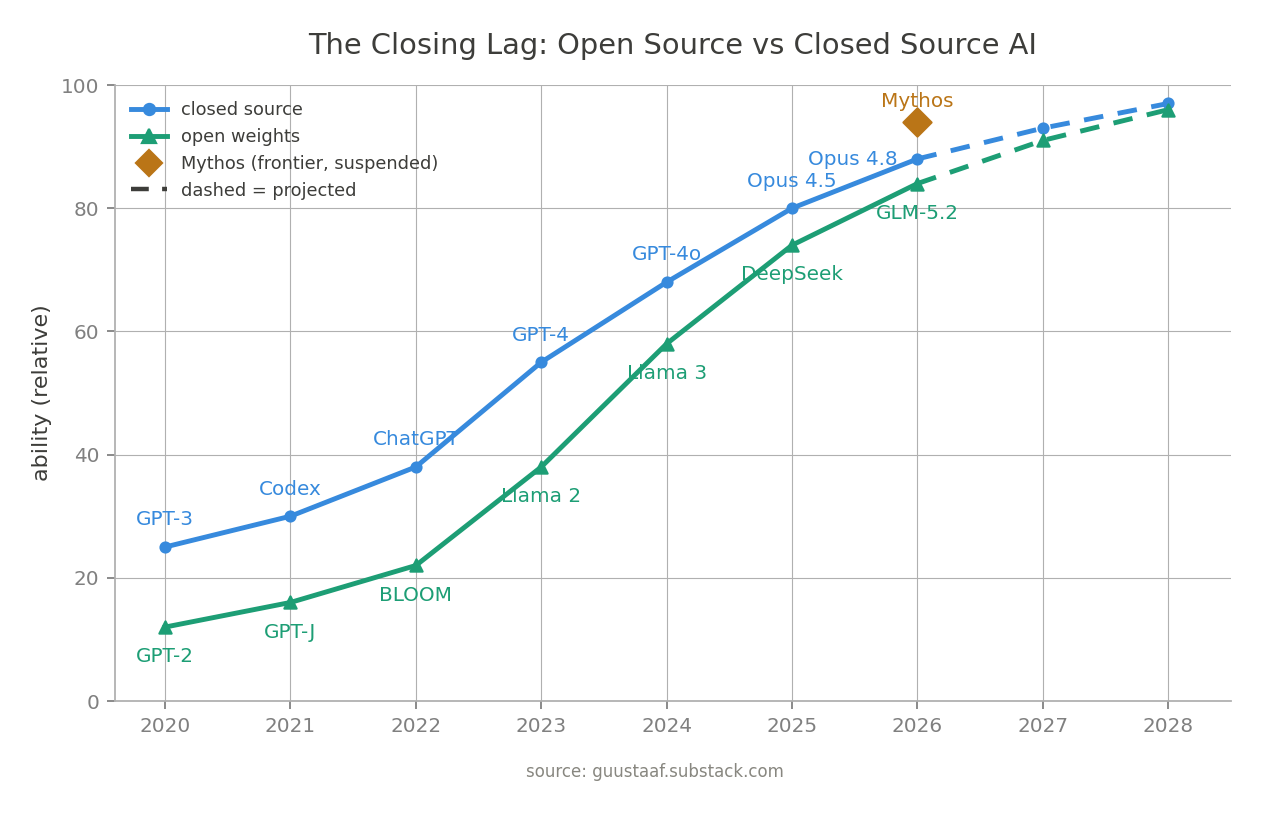
If you draw a horizontal line from Mythos to the right, to the projected open source line, that would suggest that within a year we will have an open source model of similar capabilities. The irony is that these open source models come mainly from China. Today’s drama about export controls will turn out to be nothing but a speed bump. Open source models can be used by anyone. If we actually get such a capable open source model, here is what that will mean.
Anyone can use such a model to attack any connected system at their vulnerabilities. Similarly anyone can use such a model to patch any security holes. In this situation however the attackers have the upper hand. They only have to find one exploit. The defender needs to fix all the bugs. The result will be that any software, network or connected equipment that is not updated will be completely exposed.
Take a moment to think about the services you use. The big companies will be fine, but smaller banks, internet providers etc, may find it challenging to step up to this new level of due diligence. Does their website seem poorly maintained? That may be a clue to what is happening behind the scenes.
It looks like open source is forcing the issue. Mythos level AIs for everyone. I for one can’t wait to continue my conversation about why stars move the way they do.
No posts
Comments
Nothing yet. Say the first thing.
Sign in to join the conversation.