
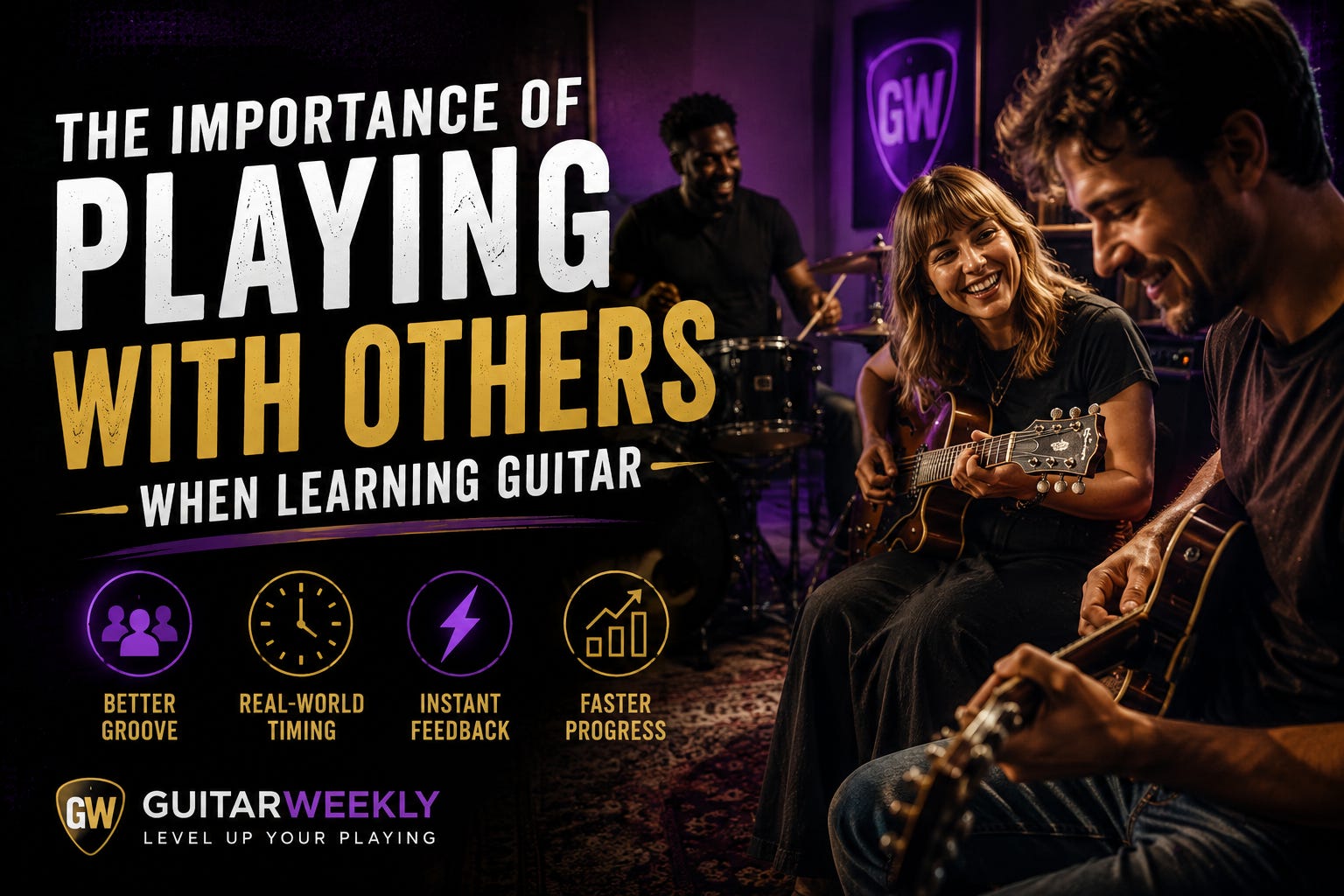
You can spend years alone with a guitar and never really learn what the instrument is for.
You learn the chords. You nail the riff. You record yourself, listen back, fix the timing, post a careful Instagram clip. Progress feels measurable. The practice log grows. And yet something essential stays missing.
Music is not a solitary skill. It is a social one.
Most of us begin alone. YouTube tutorials, method books, apps that listen to your playing and give you a score. The feedback loop is tight and private. You improve in isolation, and isolation starts to feel normal.
There is nothing wrong with this phase. Technical foundations require focused, quiet work. But if it becomes the permanent mode, the guitar remains a personal puzzle instead of a shared language. You develop competence without developing the deeper skills that make music alive: listening, responding, compromising, locking in, and risking failure in front of other people.
Playing with others forces those skills into the open.
The moment another musician enters the space, everything shifts.
Your sense of time is no longer theoretical. You either lock with the drummer or you don’t. The bassist’s pocket either feels right under your chords or it doesn’t. You stop playing at the music and start playing inside it. Mistakes become collective events instead of private embarrassments. You learn to recover together, to leave space, to push and pull against someone else’s phrasing.
Listening becomes active rather than passive. You hear the difference between a rigid metronome and a human groove. You discover that the best parts of a song often arrive in the unplanned moments—the glance across the room, the unexpected fill, the decision to drop out and let the other player take it.
You also learn humility. Your carefully practiced solo can sound self-indulgent next to a simple, well-placed rhythm part that serves the song. Playing with others teaches you that music is rarely about individual display. It is about making something larger than any one person.
Practice alone relies on discipline. Practice with others relies on relationship.
When you know three friends are showing up on Thursday night, you prepare differently. You learn the changes. You think about dynamics. You care about the arrangement because someone else will feel it. Accountability becomes social rather than internal. The desire to contribute and not let the group down is often stronger than the abstract goal of “getting better.”
Jams, open mics, church bands, community orchestras, living-room sessions—these environments turn practice into something you look forward to rather than something you schedule. The emotional reward is immediate: the feeling of locking in, the laughter after a train wreck, the quiet satisfaction when a song finally breathes.
Certain musical abilities only develop in company:
Real-time adjustment. You cannot rehearse adapting to a singer who phrases behind the beat or a drummer who pushes the tempo until you are actually in that situation.
Ensemble awareness. Knowing when to play less, when to support, when to step forward.
Communication without words. Eye contact, body language, the shared breath before a downbeat.
The courage to be imperfect in public. This is the gateway to actual performance.
These are the same skills that make someone a good collaborator in any creative field. Guitar is simply the vehicle.
Across cultures and centuries, music has been a communal activity—work songs, dance music, religious ritual, storytelling around the fire. The modern image of the solitary guitarist in a bedroom with headphones is relatively new. It is useful for skill-building, but incomplete as an end point.
When you play with others you re-enter the older tradition. You remember that the guitar is a social instrument. Six strings, a wooden box, and the willingness to put yourself in relation to other people.
If you have been practicing alone for a long time, the first step does not need to be joining a serious band. Find one other person. Learn three songs together. Sit in a circle. Make a mess. Notice how different the instrument feels when it is no longer only answering to you.
The technical work you did in private will still matter. It will simply start serving something larger.
Music is a social thing. The guitar is waiting for company.

No posts
Comments
Nothing yet. Say the first thing.
Sign in to join the conversation.