
Unless you're living under a rock, you already know that tomorrow a total eclipse will sweep across parts of the North Atlantic, from Greenland to Spain. What you probably don't know is that eclipses like this one can strongly affect surface weather in ways that weather forecast models often fail to predict.
What do I mean by that? Let’s start with a video I made back in 2024 of the total eclipse in the United States. It shows an animation of the eclipse shadow moving across the US and its effect on surface weather, as measured every 10 minutes by the ASOS weather network.
Each wind barb shows wind direction and intensity, the numbers show the actual measured temperature, and the colored scatter points show how temperature varies over time, making it easy to spot even small deviations.
As we can see, the umbra passing over the domain causes a local drop in temperature and a decrease in wind speed, both of which recover once the eclipse has moved on. In fact, many studies have shown that the darkening not only causes air cooling but also a decrease in surface wind speeds (as happening over night) and can eventually affect cloud formation1.
Because many weather models don’t account for the reduced radiation caused by an eclipse, they tend to underestimate its effects on surface temperature, wind, and other variables. That’s why scientists have been working to incorporate eclipse effects into forecast models; a parametrization that’s now present in some global models, including ICON.
A few weeks ago I received an email from DWD (the German Weather Service) saying they had finally added a solar eclipse parametrization to ICON, so I decided to check it out myself. Since we’re looking for a fairly small effect, and the model’s hourly output resolution usually isn’t enough to capture such fast, localized changes, I wasn’t expecting much - but once I downloaded and plotted the clear-sky shortwave radiation, I could see a clear signal.
The first animation shows the clear-sky shortwave radiation flux (essentially solar radiation without the effect of clouds). Watch how it evolves over time: as the terminator (the line between darkness and daylight) moves westward across Europe, you can see a brief “dip” near the eclipse’s center line.
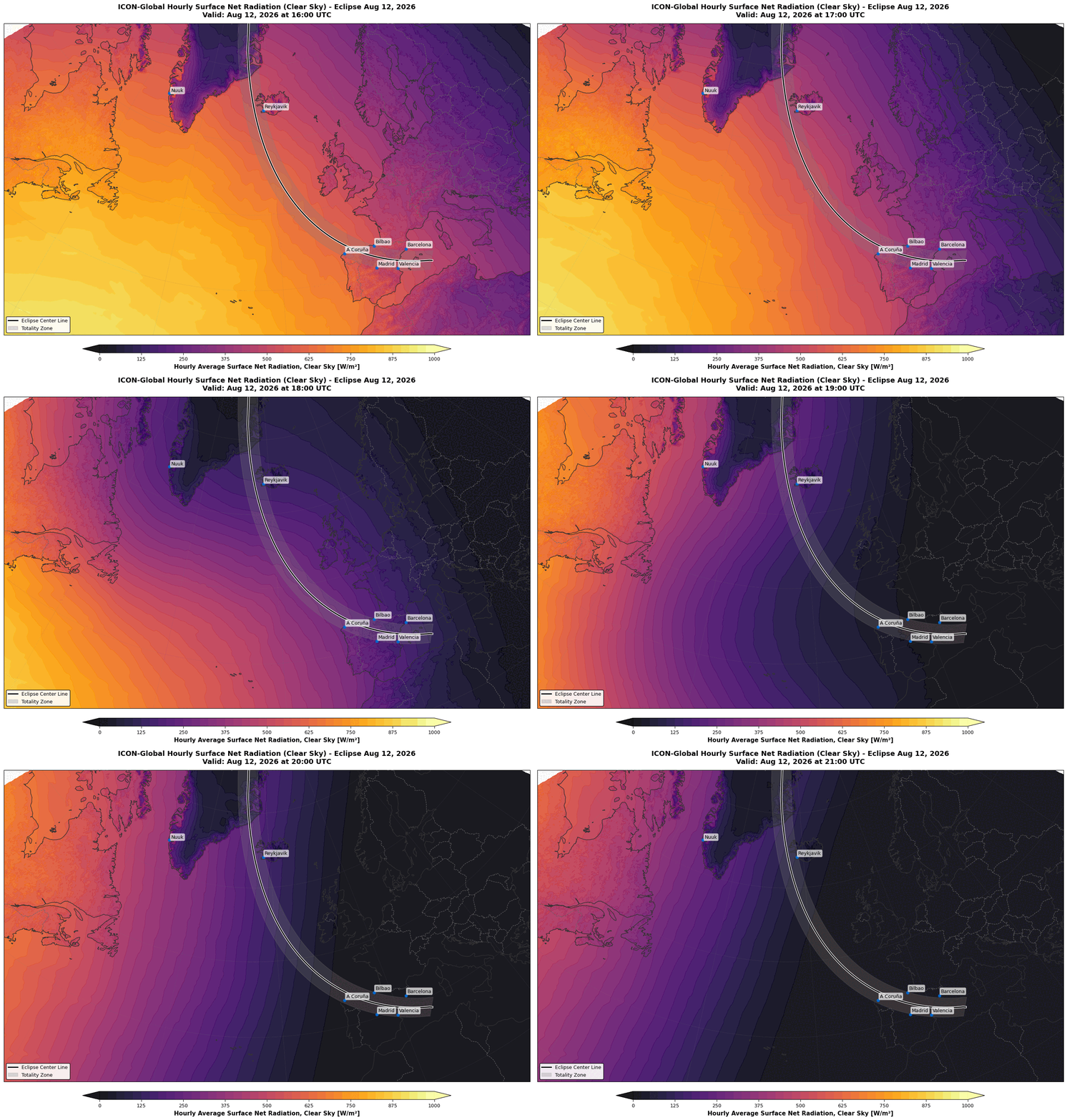
These differences are hard to spot with an untrained eye, so I computed the difference between this radiation field and the previous day’s. That’s not a perfectly clean comparison, since some of the difference simply reflects the changing solar angle as we move toward autumn - but the eclipse signal still stands out clearly as a drop in radiation trailing to the southwest of the eclipse’s center line.
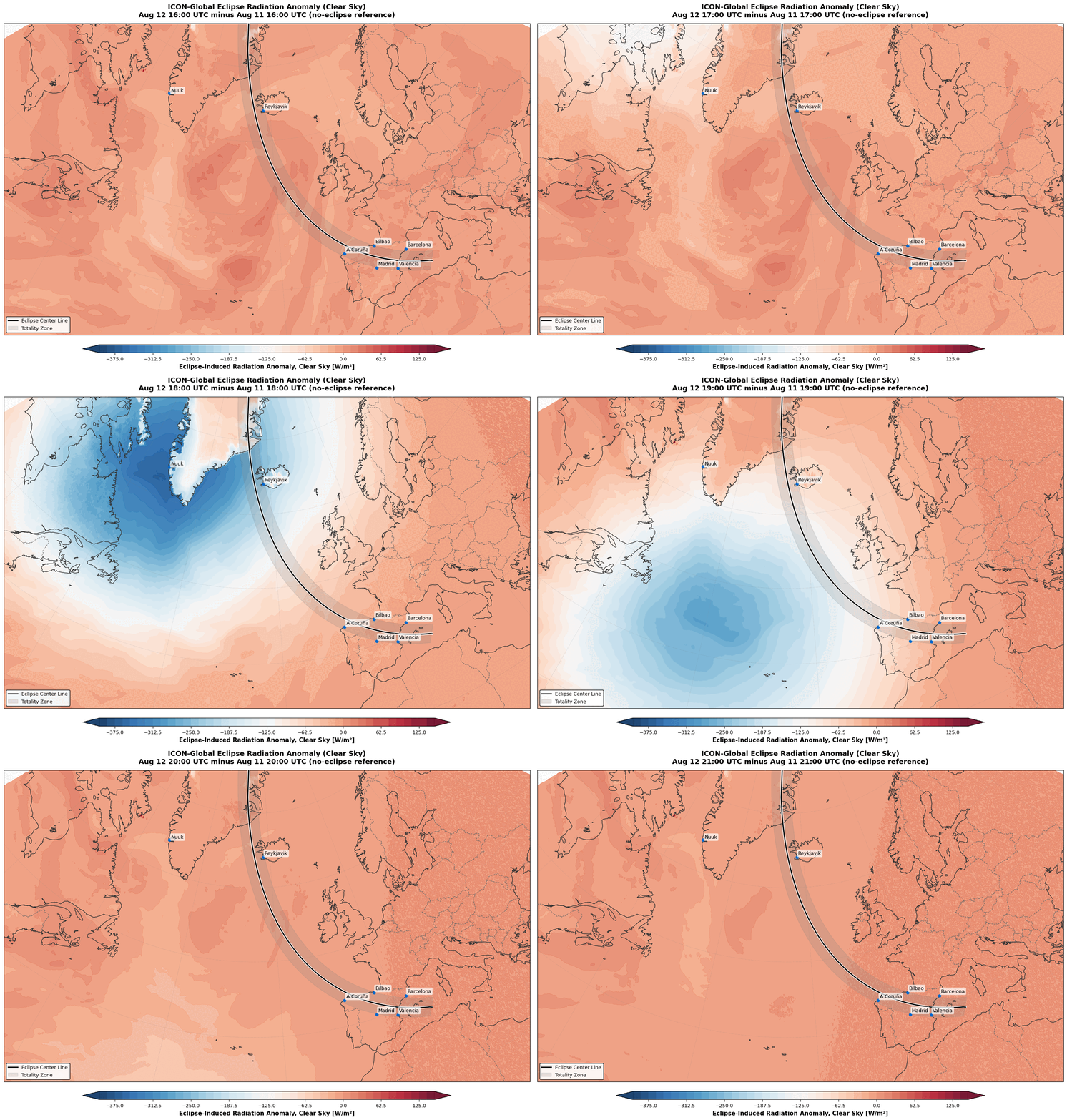
Why to the south-west? I think it has to do something with the sun inclination, projecting a shadow on the west side, and on the hourly averaging of radiation coming out from ICON. Furthermore, notice how the darkening is not entirely visible over Greenland, where the albedo of snow and ice is winning. Arguably it would have been better to use the net short-wave radiation at the top of the atmosphere, but this is unfortunately not availabe in the ICON open data sets of data.
As for the effect on surface weather, it will likely be much smaller this time than what was observed in the US two years ago. In this case, the eclipse’s darkening falls over areas with heavy cloud cover, so its effect will be largely masked at the surface. I couldn’t find any noticeable effect in the surface variables I checked for a few locations in Spain - though the hourly output frequency of the models I have makes it hard to spot any meaningful difference in the first place.
No posts
Comments
Nothing yet. Say the first thing.
Sign in to join the conversation.