
As a revenue leader, you are expected to do the impossible.
Hit an aggressive number while spending less. Defend your forecast to a skeptical board. Make hiring decisions based on pipeline that may or may not be real. Cut budget without cutting results. And do all of this while your CEO asks hard questions and your team looks to you for clarity you may not feel.
I’ve been there. As a Fractional CRO and sales transformation leader, I’ve spent years watching revenue leaders face this exact moment: growth slows, pressure mounts, and suddenly every budget line is under scrutiny.
The instinct is to cut. The question is where?
Here is what I have learned: most revenue leaders get this decision wrong.
Not because they lack intelligence or experience, but because they lack a system. They cut based on gut instinct and end up eliminating the very motions their own numbers say are working. They slash the SDR team when conversion is the real problem. They cancel the event program that was generating their best deals. They freeze hiring when pipeline coverage is already dangerously thin.
Six months later, they are rebuilding what they just cut.
Imagine if you had a decision roadmap...
A structured process for deciding where to cut, where to protect, and where to double down. A way to turn messy CRM data into clear decisions you can defend. A system that replaces “I think” with “the math shows.“
That’s exactly what the Where to Cut Without Killing Growth Playbook series delivers.
Starting today and over the next couple of weeks, I am sharing a playbook I have developed through years of sales transformation work. It walks you through the six decisions that determine whether your cuts strengthen your business or cripple it.
The best part? This isn’t just “theory” - it’s tactical guidance.
Every framework comes with a specific calculator you can use to run the numbers for your own business. By the end, you will have the clarity and the language to walk into any CFO conversation and defend your choices with confidence.
Here is what we will cover:
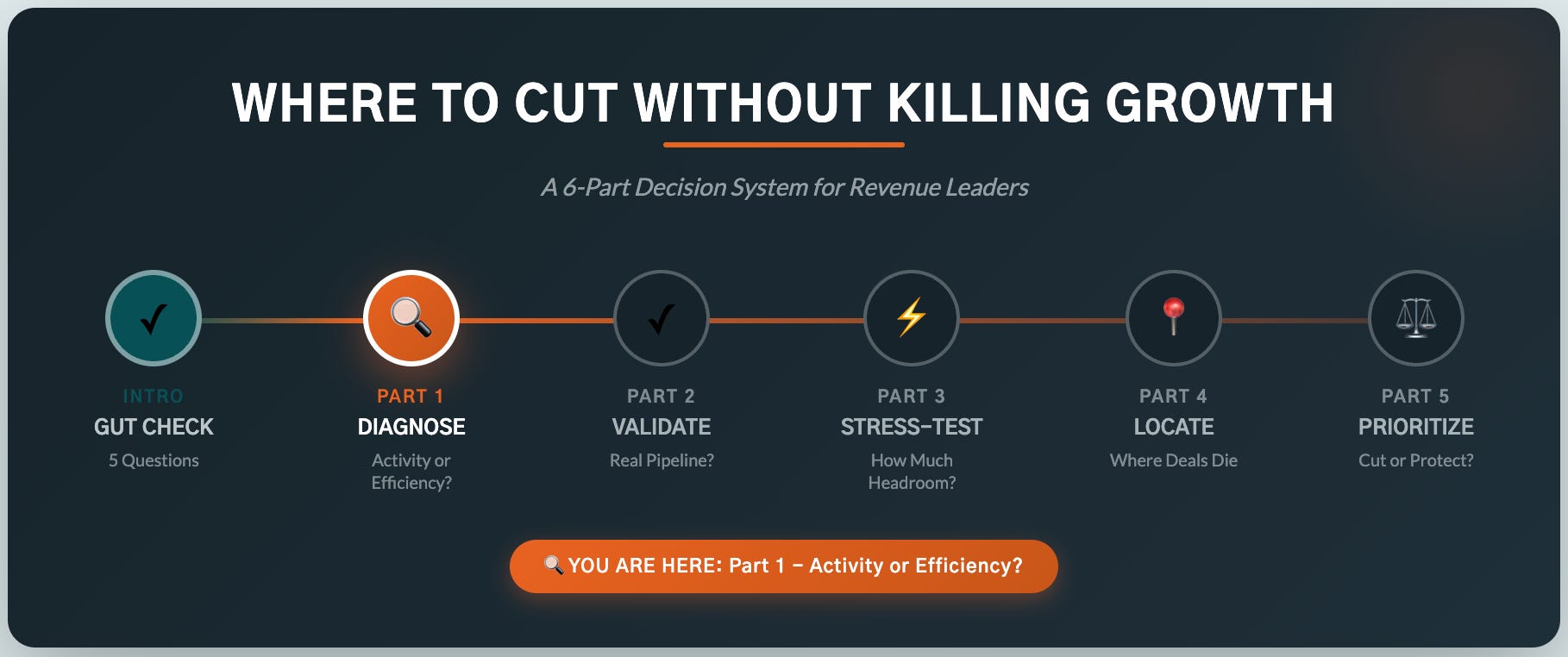
Part 1: DIAGNOSE - Is your problem activity or efficiency? ← This post
Part 2: VALIDATE - Is your pipeline real or fantasy?
Part 3: STRESS-TEST - Can you afford slower growth?
Part 4: LOCATE - Where exactly are deals dying?
Part 5: PRIORITIZE - What to cut, protect, or double down on?
Part 6: COMMUNICATE - How to turn the math into a leadership story
Following these steps will not guarantee perfect decisions. But it will dramatically reduce the odds that you cut something you will spend the next year trying to rebuild.
Before we dive into Part 1, I want to give you a quick gut check...
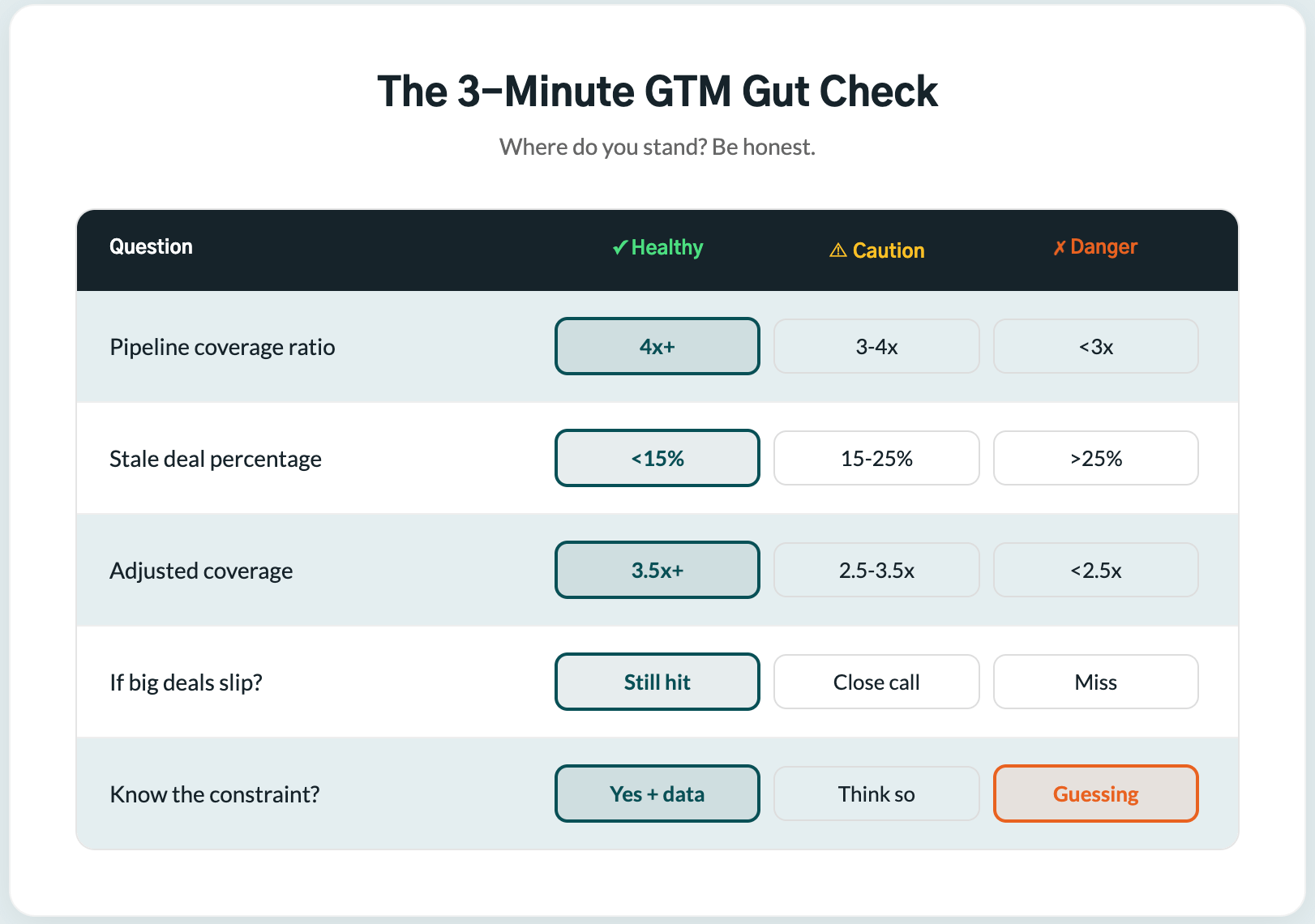
Before you make any budget decisions, answer these five questions honestly. You don’t need a spreadsheet - just your best estimates.
Take your total open pipeline and divide it by your revenue target for the quarter.
4x or higher → Looks healthy (but keep going)
3x to 4x → Adequate
Below 3x → Already thin
Write down your number: _______
Think about how many deals in your CRM are sitting there with no recent activity. No meetings scheduled. No emails returned. Just... there.
Under 15% → Pipeline is reasonably fresh
15% to 25% → Some inflation happening
Over 25% → Your coverage ratio is lying to you
Write down your estimate: _______
Take your coverage ratio from Question 1. Multiply it by (1 minus your stale percentage from Question 2).
Example: 4x coverage with 30% stale deals = 4 x 0.70 = 2.8x real coverage
Your adjusted coverage: _______
If your adjusted number just dropped below 3x, you have a pipeline quality problem masquerading as healthy coverage.
Think about the big deals your forecast depends on. If the three largest ones push, what happens?
Still hit target → You have cushion
Miss by a little → You are running tight
Miss significantly → You are one bad month away from a crisis
Your answer: _______
Be honest. Can you point to data that tells you which one it is? Or are you guessing?
I know, and I have data → Ready to make targeted cuts
I think I know → Need to validate before cutting
I am not sure → Do not touch the budget yet
Your answer: _______
If you answered “healthy” or “confident” on 4-5 questions: You may have room to make strategic cuts. This series will help you identify exactly where.
If you answered “tight” or “uncertain” on 2-3 questions: You have blind spots that could make budget cuts dangerous. This series is essential reading before you decide anything.
If you answered “thin,“ “lying to you,“ or “not sure” on 3+ questions: Stop. Do not cut anything until you complete this series. You are operating on assumptions that could be wrong, and the cost of guessing is two to three quarters of recovery time.
The goal of this series isn’t to help you avoid cuts. Cuts are a natural part of revenue hygiene and sometimes necessary to keep your bottom line healthy.
The goal with this series is to help you cut intelligently. To protect what matters. To maintain the credibility to lead through the next cycle and not get blindsided.
When you finish this playbook, you won’t walk into your next board meeting with a list of cuts…
You’ll walk in with a data-driven reallocation strategy that protects next quarter’s number while improving efficiency.
That is the difference between a revenue leader who is reacting and one who is in control.
The single most important question to answer before touching any budget line.
Comments
Nothing yet. Say the first thing.
Sign in to join the conversation.