
In the Intro to the Series, I asked you to take a 3-minute gut check. Five questions. No spreadsheet required.
If you did the exercise, you probably noticed something uncomfortable: you could answer some questions with confidence, but others made you pause. Especially that last one.
Do you know whether your revenue problem is upstream (not enough at-bats) or downstream (deals dying in the funnel)?
If you hesitated, you are not alone. This is the question that trips up most revenue leaders. And it is the question that, if answered wrong, leads to cuts that take two to three quarters to recover from.
Today, we answer it.
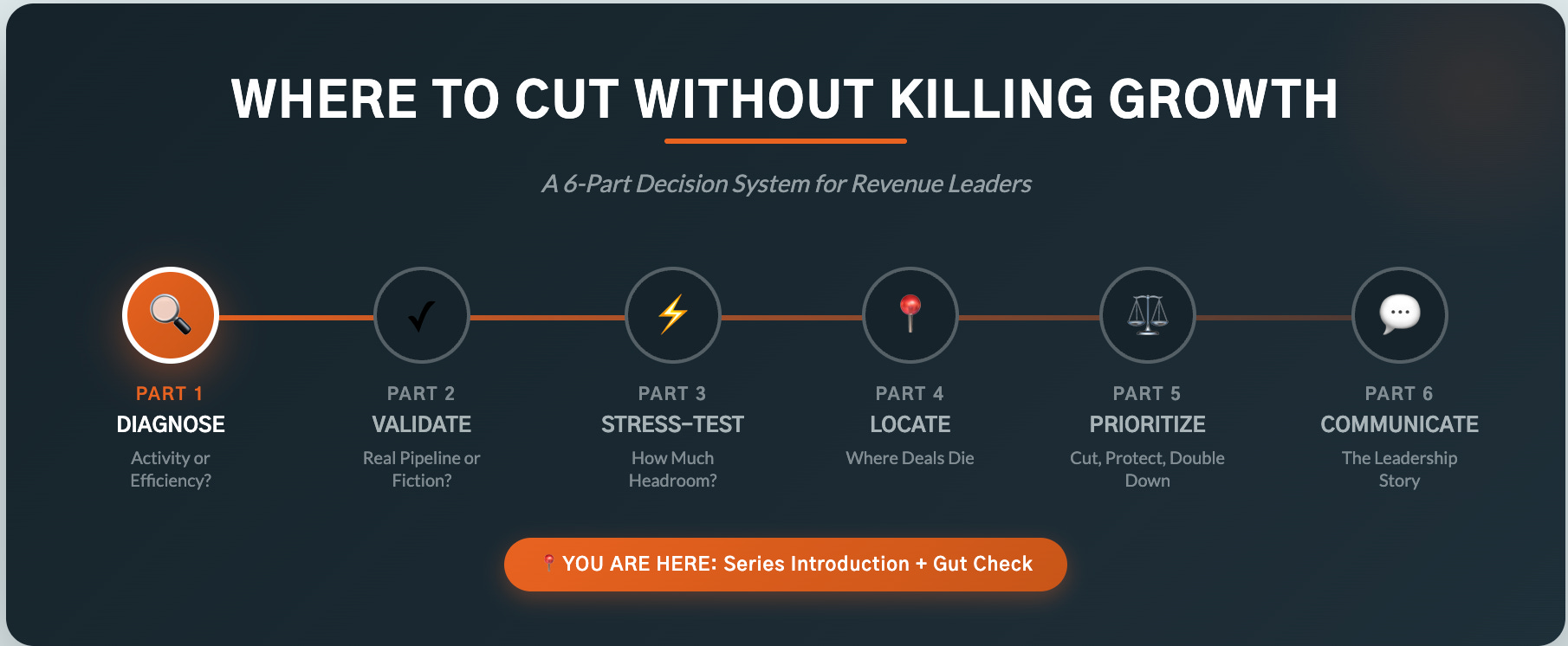
Every revenue problem you face falls into one of two categories:
Activity Problem (Upstream) You are not generating enough opportunities. Not enough meetings. Not enough qualified pipeline entering the funnel. The machine is not fed.
Efficiency Problem (Downstream) You are generating opportunities, but they are dying somewhere in the funnel. Deals stall. Conversion rates drop. The machine is fed, but it is leaking.
The fix for each is completely different. And here is the trap: most revenue leaders, when growth slows, default to the same conclusion.
“We need more leads.“
Nine times out of ten, they are wrong.
When results slow down, the instinct is to look at the top of the funnel. It feels logical. Fewer closed deals must mean fewer opportunities, which must mean we need more activity.
But here is what the data usually shows: the problem is not that you lack opportunities. The problem is that opportunities are dying somewhere in the middle of the funnel, and more activity at the top just creates more revenue leakage.
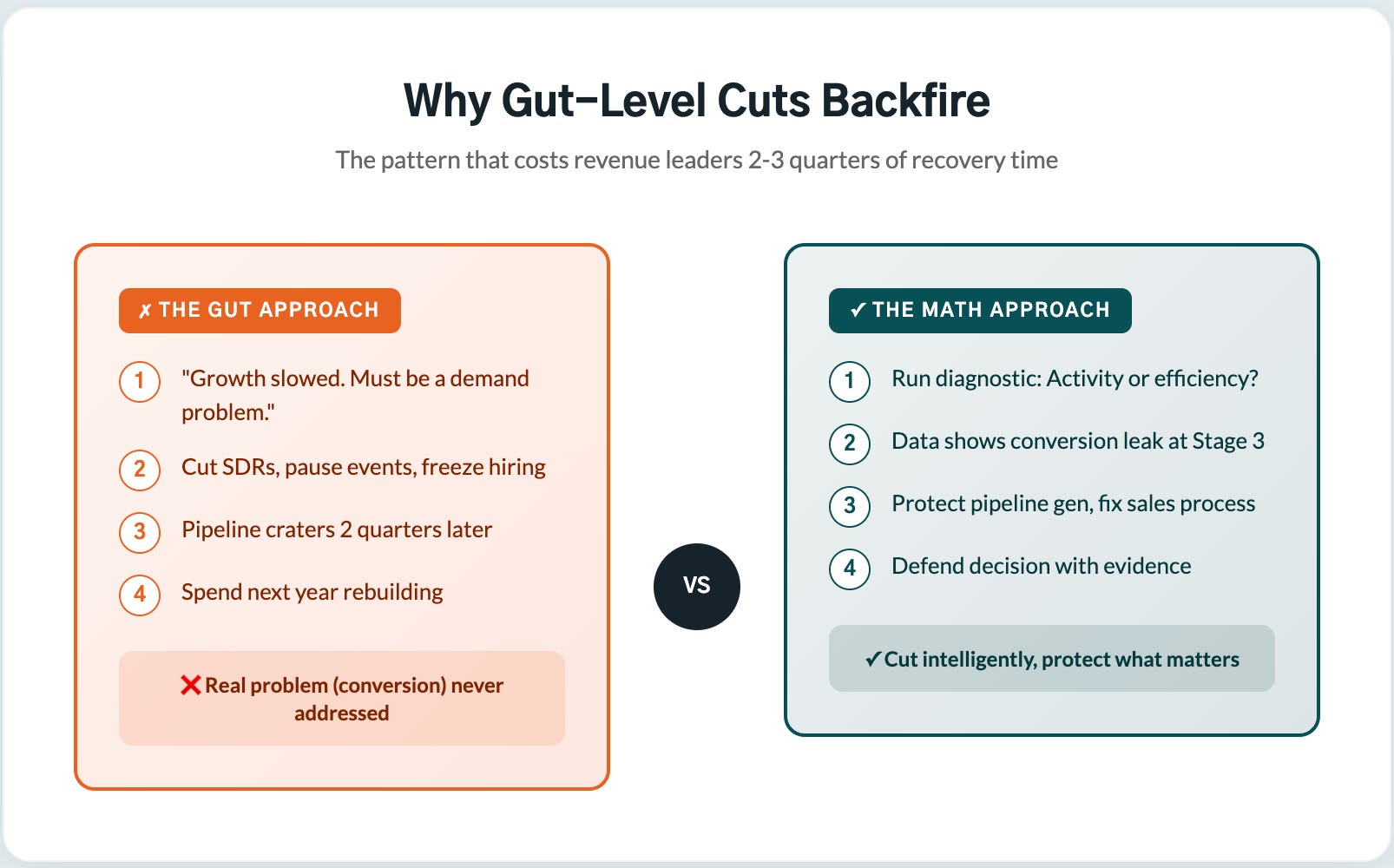
The danger of getting this wrong is not abstract. It costs real money and real time.
If you cut SDRs when conversion is the problem:
Pipeline craters 2 quarters later
You spend the next year rebuilding what you just cut
The real problem (conversion) never gets addressed
If you double down on demand gen when activity is actually fine:
You waste budget on leads your system cannot absorb
Reps get overwhelmed with unqualified opportunities
Win rates drop even further
Either mistake costs you two to three quarters of recovery time. That is a year of your career spent fixing a self-inflicted wound.
Before you touch any budget line, run this diagnostic. You need three numbers from the last 90 days. If you do not have exact figures, use your best estimates. Directional accuracy is enough.
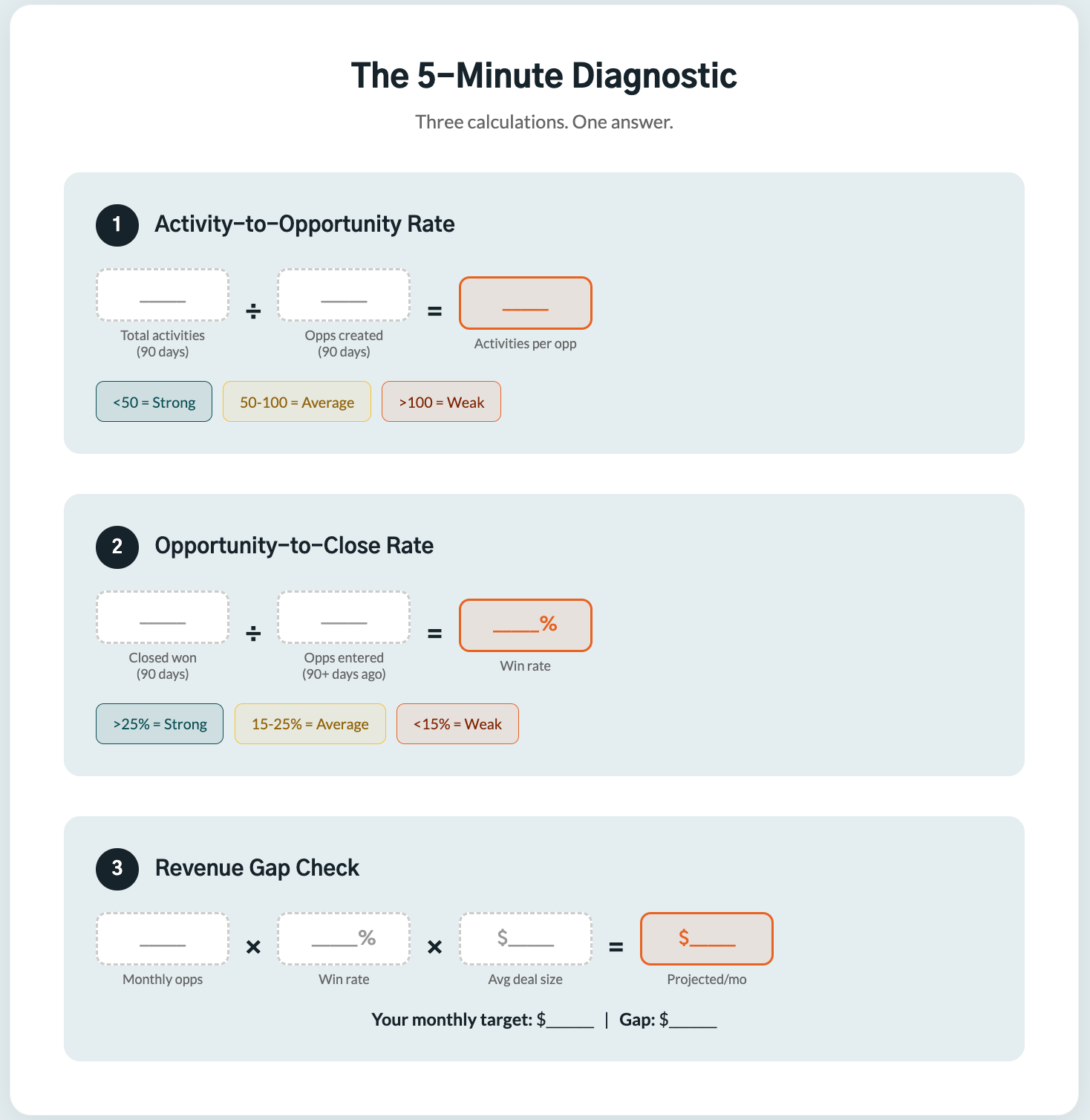
How many total activities (calls, emails, meetings) did your team execute in the last 90 days?
Divide that by the number of new opportunities created.
Your number: Activities per opportunity = _______
Benchmark:
Under 50 activities per opportunity → Strong activity conversion
50 to 100 activities per opportunity → Average
Over 100 activities per opportunity → Activity conversion is weak
How many opportunities entered your pipeline in the last 90 days?
How many closed won in that same period? (Use opportunities that entered 90+ days ago if your sales cycle is longer.)
Your number: Win rate = _______%
Benchmark:
Above 25% → Strong conversion
15% to 25% → Average
Below 15% → Conversion is weak
Given your current activity levels and conversion rates, are you generating enough closed-won revenue to hit your target?
Calculate: (Monthly opportunities created) × (Win rate) × (Average deal size) = Monthly projected revenue
Your number: Projected monthly revenue = $_______
Your target: Monthly target = $_______
Gap: _______
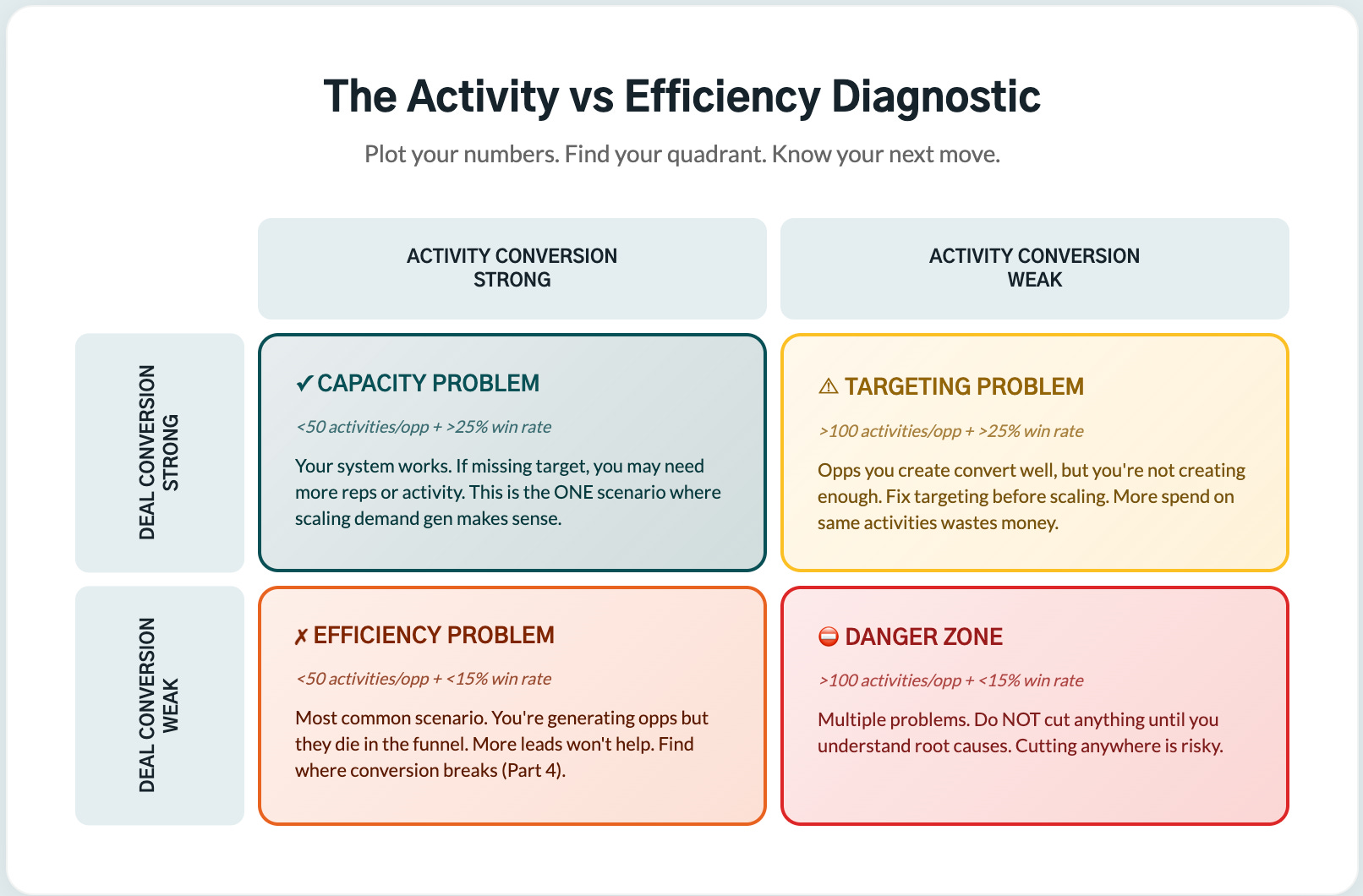
Your system is working. If you are missing target, it is likely a capacity issue. You may actually need more reps or more top-of-funnel activity. This is the one scenario where increasing demand gen spend makes sense.
Implication for cuts: Be very careful cutting anything. Your machine is healthy.
This is the most common scenario I see. You are generating plenty of opportunities, but they are dying in the funnel. More leads will not help. You need to find where conversion breaks (we will cover this in Part 4).
Implication for cuts: Protect your pipeline generation. Cut or fix whatever is causing deals to die.
You have a targeting or messaging problem at the top of the funnel. The opportunities you do create convert well, but you are not creating enough of them. More spend on the same activities will just waste money. You need to fix your targeting before scaling.
Implication for cuts: Do not cut outbound or demand gen yet. First, diagnose why activity is not converting to opportunities.
This is the danger zone. Your system has multiple problems, and cutting anywhere is risky until you understand the root causes. Do not make budget decisions until you have more clarity.
Implication for cuts: Pause. Diagnose before deciding.
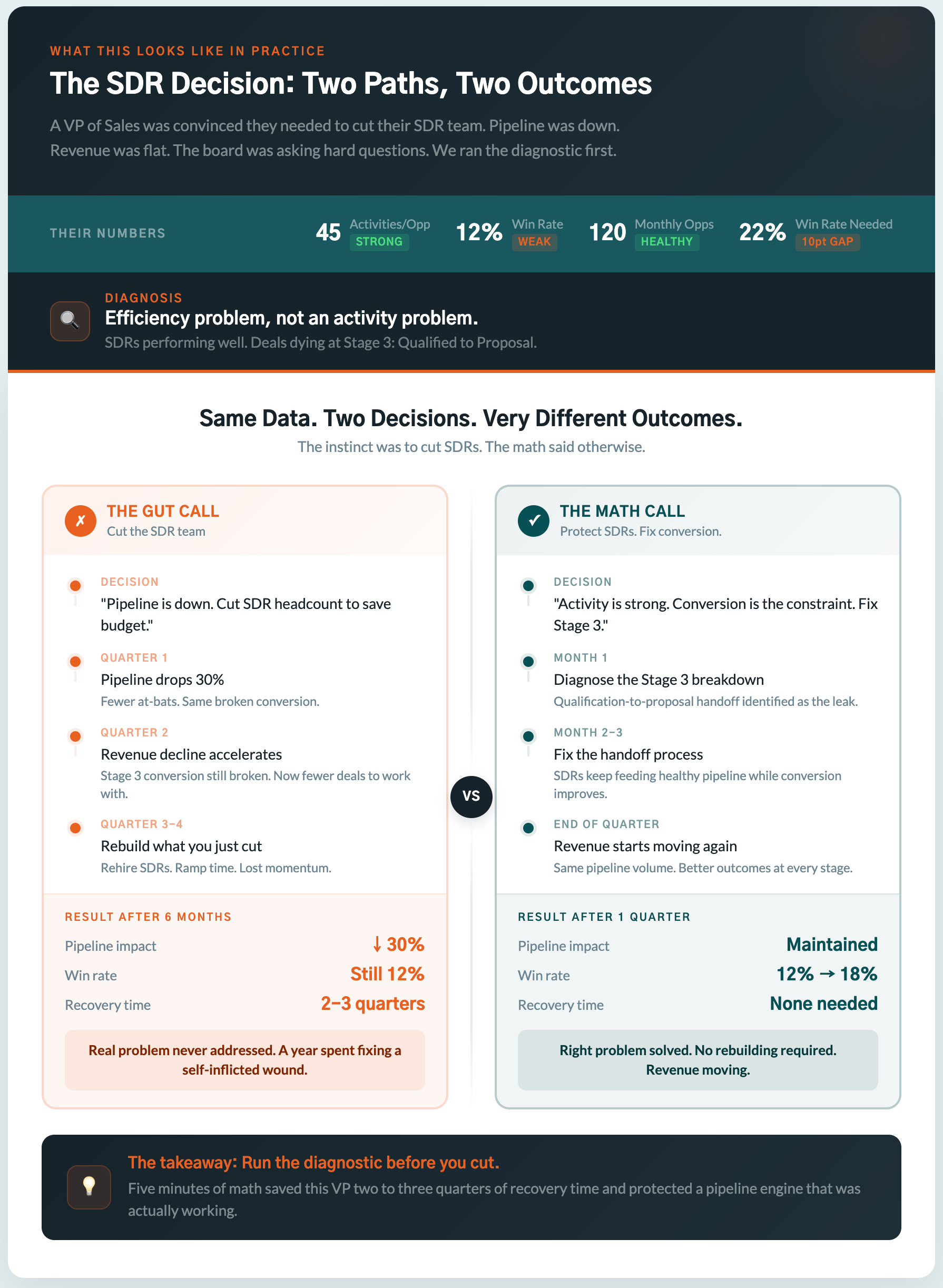
Let me show you a real example (numbers changed to protect the company).
A VP of Sales came to me convinced they needed to cut their SDR team.
Pipeline was down. Revenue was flat. The board was asking hard questions. Cutting SDRs felt like the obvious move. We ran the diagnostic...
Their numbers:
Activity-to-opportunity rate: 45 activities per opportunity (strong)
Win rate: 12% (weak)
Monthly opportunities: 120
Target close rate needed to hit plan: 22%
The diagnosis was clear: they had an efficiency problem, not an activity problem.
Their SDRs were doing fine. The deals were dying at Stage 3 (qualified to proposal).
If they had cut the SDR team, they would have reduced pipeline by 30% while the real problem (Stage 3 conversion) went unaddressed. Six months later, they would have been rebuilding the team they just cut.
Instead, they protected SDR headcount and focused on fixing the qualification-to-proposal handoff. Win rate improved from 12% to 18% in one quarter.
Revenue started moving again. Here’s the breakdown:
Before you move on, answer these three questions:
1. Can you confidently say whether your revenue problem is upstream (not enough at-bats) or downstream (deals dying in the funnel)?
If yes → You are ready to validate your pipeline coverage (Part 2)
If no → Run the diagnostic above before touching any budget lines
2. Do you have data to support your answer, or are you guessing?
If you have data → Write down your activity-to-opportunity rate and win rate. You will need them.
If you are guessing → That is okay for now, but flag this as a gap. Estimates are fine for directional decisions.
3. Based on this analysis, what does it mean for potential cuts to pipeline-generating activities?
Write one sentence: “Based on my diagnostic, cutting [SDRs / events / marketing] would be [safe / risky / dangerous] because _______.”
Getting this diagnosis right prevents the most expensive mistake in revenue leadership: cutting the pipeline generation machine when conversion is the real problem.
I have watched this mistake play out dozens of times. It always follows the same pattern:
Growth slows
Leadership assumes it is a demand problem
They cut SDRs, pause events, freeze marketing spend
Pipeline craters two quarters later
They spend the next year rebuilding
The diagnostic takes five minutes. And it could prevent a mistake that could cost you a year of growth.
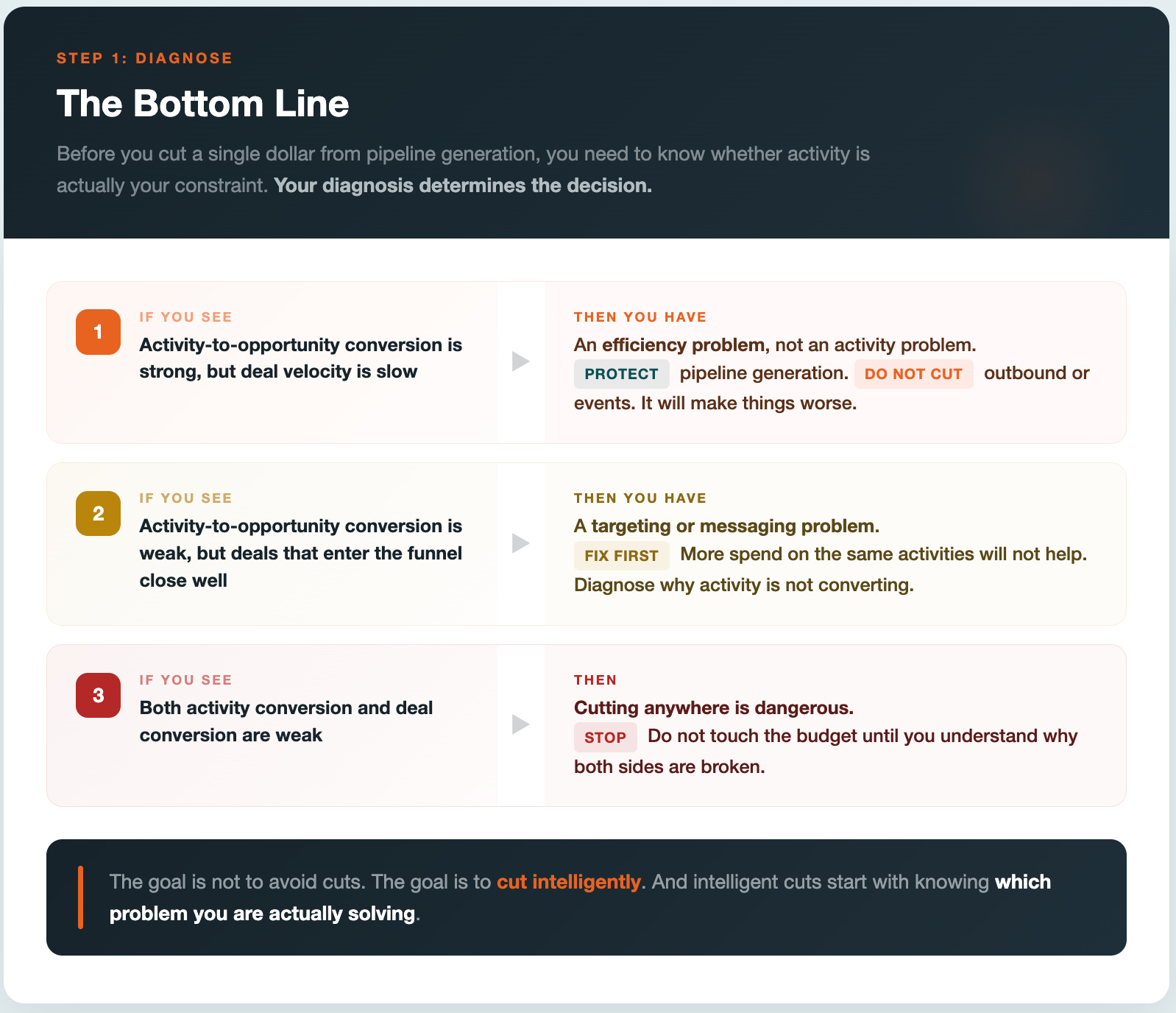
Before you cut a single dollar from pipeline generation, you need to know whether activity is actually your constraint.
If your activity-to-opportunity conversion is strong but deal velocity is slow, you have an efficiency problem, not an activity problem. Cutting outbound or events will make things worse.
If your activity-to-opportunity conversion is weak, you may have a targeting or messaging problem. More spend on the same activities will not help.
If both are weak, cutting anywhere is dangerous until you understand why.
Once again…the goal is not to avoid cuts. The goal is to cut intelligently. And intelligent cuts start with knowing which problem you are actually solving.
Run the 5-minute diagnostic. Write down your two numbers (activity-to-opportunity rate and win rate). Note which quadrant you fall into.
If you are in Scenario 2 (strong activity, weak conversion), you already know that cutting top-of-funnel spend would be a mistake. You just saved yourself two quarters of recovery time.
If you are in a different quadrant, you now know what questions to ask before making any cuts.
Either way, you are no longer guessing. And that is the whole point.
Your CRM probably shows healthy pipeline coverage. But how much of that pipeline is real?
In our next part, we expose the difference between reported coverage and adjusted coverage. Because if you cut spend based on inflated numbers, you will not see the damage until it is too late to recover.
The question we will answer: Is your pipeline real or fantasy?
Comments
Nothing yet. Say the first thing.
Sign in to join the conversation.