
The notion that social media is “harmful” particularly to teens and young adults (older adults ironically complaining about social media on social media are presumably immune somehow) has generated great social interest. Many countries have banned social media for youth under 161 (though France’s courts recently struck down theirs). The US is seeing massive lawsuits that are catnip for trial lawyers looking to get that Manhattan penthouse. However, the jury decisions are not based in good science2 and which may, effectively, be an end-run around the First Amendment, resulting in significant government intrusion into internet speech.
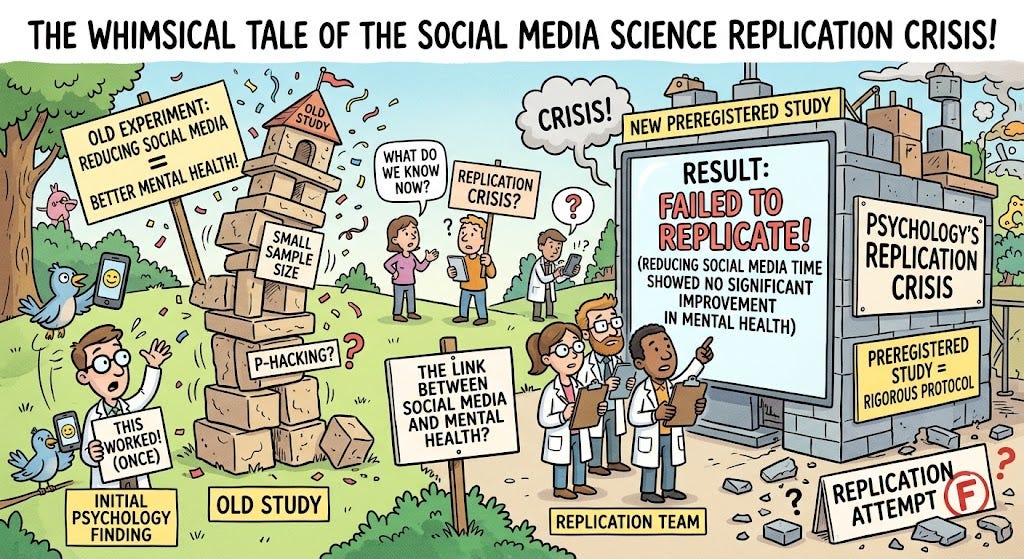
Interestingly, unlike the video game panic where, for a time, there seemed to be a majority of studies3 that supported links between violent games and aggression (at least until that all collapsed under psychology’s replication crisis and newer, preregistered studies failed to find effects), there never has been anything like consistent, dramatic research findings linking social media to youth mental health. The predictive value of social media time on youth mental health, particularly once other factors like neuroticism, family environment and school environment are controlled, is basically zero. Nor is there any academic consensus social media is harmful or “addictive”.
For awhile, some advocates claimed that there was consistent evidence in the experimental studies. Basically, these studies would randomize people into two groups, one of whom would be told to reduce or eliminate social media time, the other group to keep using social media as usual. It turns out that claims that these studies produce consistent positive outcomes are false, with three meta-analyses now all finding either null or “weak” effects of social media reduction on mental health. These studies also have major limitations in other respects, which I’ll get to (teaser: after the paywall!)
Now a new study has gotten some media attention. This one is interesting because it attempted to replicate an earlier influential study cited by supporters of social media bans. The original study appeared to show reducing social media time resulted in small improvements in mental health. However, the original study was not preregistered, which means researcher expectancy effects may have created a false positive result. By contrast, the new study was preregistered, significantly restricting the researchers’ ability to monkey around with their data to force a desired result. So what did they find?
Comments
Nothing yet. Say the first thing.
Sign in to join the conversation.