
Audio voiceover available here for paid subs!
Christopher Nolan’s The Odyssey is about a hero’s journey home—but it’s almost more so about the contagion that spreads from violating sacred hospitality.
In this sense, art really does imitate life. And life is a lot like The Odyssey.
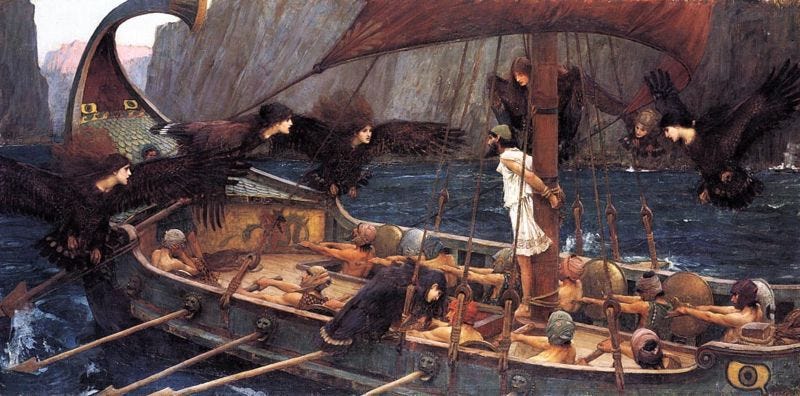
To say “spoiler alert” feels mildly ridiculous, since its title is so ubiquitous that it’s used as shorthand for its own plot: someone faces various trials on their way home.1 However, since I’m discussing Nolan’s reimagining of the story, there are definitely those kinds of spoilers.2
I’m also not going to compare this reimagining with the original epic poem. I also care exceptionally little—and would encourage others to care less—about whether the film was too woke or not woke enough or just the right amount of woke.3 I’m less interested in talking about what the movie says about culture than what it says about the human experience.
Throughout the film, we’re rhythmically fed a glimpse of Odysseus keeling over a set of stairs in the center of Troy’s sacking. Viewers divine something profound boiling through his facial expression—but it’s clear it’s not the kind of triumphalism you’d expect.4
As the story unfurls, we gather that Odysseus’ plan to sow soldiers inside the wooden horse to penetrate the city walls has been immortalized across the sea as a legend of his greatness. But he’s reluctant to accept it; they sing praises he doesn’t crave. We slowly intuit that Odysseus’ replays of that night are similar to how a trauma victim accidentally rehashes critical memories.
Near the climax, the reason behind the rehashing becomes clear: he offered Troy the trojan horse as a gift of reconciliation, but the gift was laced with the surprise attack that became their demise.5 He broke Zeus’ Law in a grand way. And by breaking it, he’s set up a mimetic contagion for the breaking of Zeus’ Law across the West.

This law basically stated that you should act hospitably toward strangers; but more than just having them over for dinner, it also implied the “provision of food and protection for travelers” and could even include “a bath, supplies for the traveler’s onward journey, and an escort along the road to the traveler’s next destination.”6 Basically, it’s the “kind reception of a stranger.”7
Ironically, this law that Odysseus spends a decade in regret over desacralizing is the very principle that legitimizes his wife and son’s torment back in Ithaca. Penelope and Telemachus entertain a gaggle of suitors taking advantage of them by invoking Zeus’ Law on the daily. Each wants to marry Penelope, establish themselves as king, and get rid of Telemachus.
At the height of their need for the return of their king, Odysseus is stuck on Calypso’s island, filled with lotus flower that forces him to forget everything about himself. But as Calypso weans him off the lotus, the broken chains of memory slowly piece together.

As he Bourne-style relearns who he is and what he’s done, he grapples with the gravity of it. The trojan horse tale spread the breaking of Zeus’ Law like stomach flu. He became another reason for the world to start locking their doors at night.8 This is sort of how mimetic contagions work: one person’s violation of sacred law authorizes someone else’s violation.
Even still, the king must return. He’s not meant for shame-induced self-exile. He can’t fix the past; the past is past.
But the gods won’t allow a homecoming on his own terms. The only way forward is letting go of what’s backward. So he builds a raft, drifts into the expanse, and surrenders control. And this relinquishment of control—surrendering power, his lust for glory, his craving to tone down the fallout of his sins—convinces the gods to wash him onto the shores of Ithaca.9
He returns to his palace disguised as a beggar, since the clearest way to see what a man is really like is from below.10 The suitors unveil their true selves embarrassingly quickly. Still disguised, he enters a challenge that Penelope devised to take on a new husband, and wins—the king’s come home.
The viewer is frothing at the mouth at this point for comeuppance—like an itch they’re dying to scratch but can’t reach.11 And we’re not denied it. Despite all the repentance and letting go, Odysseus can’t not take revenge.12 Odysseus breaks Zeus’ Law once more, purging the suitors from his temple.13
And this is why life is like The Odyssey.

I’m not an expert in hospitality, but I’d like to be.
It’s why I resonated with Odysseus’ arc: I want to act hospitably because I’d like others to act hospitably toward me. But my actions are usually dictated by convenience. Zeus’ Law becomes an optional add-on, reserved for when I have enough time and energy (two qualities that are scathingly rare to just stumble upon).
Obviously, we don’t worship Zeus; but we worship a God who makes a similar law central: “So whatever you wish that others would do to you, do also to them.”
In early Christian history, Zeus’ Law is basically what you’d call xenia.14 The related term philozenia (literally, “love” and “guest” mashed up) pops up all over the New Testament (Rom 12:13; 1 Peter 4:9; 1 Tim 3:2).15
Henri Nouwen captures the beauty behind philozenia:
When hostility is converted into hospitality, then fearful strangers become guests—revealing to their hosts the promise they are carrying with them. Then the distinction between host and guest proves to be artificial and evaporates in the recognition of the newfound unity. Thus the biblical stories help us to realize not just that hospitality is an important virtue, but even more that in the context of hospitality guest and host can reveal their most precious gifts and bring new life to each other.16
And fascinatingly, the rationale behind Zeus’ Law sounds vaguely familiar: they took care of strangers in case those strangers were actually gods in disguise. Which should ring a bell for those who’ve read this sin of omission: “Do not neglect hospitality to strangers, for by this some have entertained angels without knowing it” (Heb. 13:2).
The verse hyperlinks to these weird reoccurrences across both testaments in which the strangers we care for turn out to be God or angels in disguise (Gen. 18, 19; Judg. 6; Joshua 5; Luke 24). It’s like the biblical writers were trying to spread a suspicion that caring for other people might just unearth the best in them. Consequently, it also brings about the best in ourselves: everyone who cares for these angels-in-disguise gets blessed beyond measure.
Summarizing the strange God-stranger phenomenon, the scholar John Koenig writes, “If we love God and God meets us in the stranger, then we shall naturally (and even unconsciously) love the stranger.”17
But over and above Greek hospitality, we’re not just accepting the poor and powerless because they might be gods, but because Christ became them. “Whatever you did not do for the least of these you did not do for me” (Matt. 25:45).
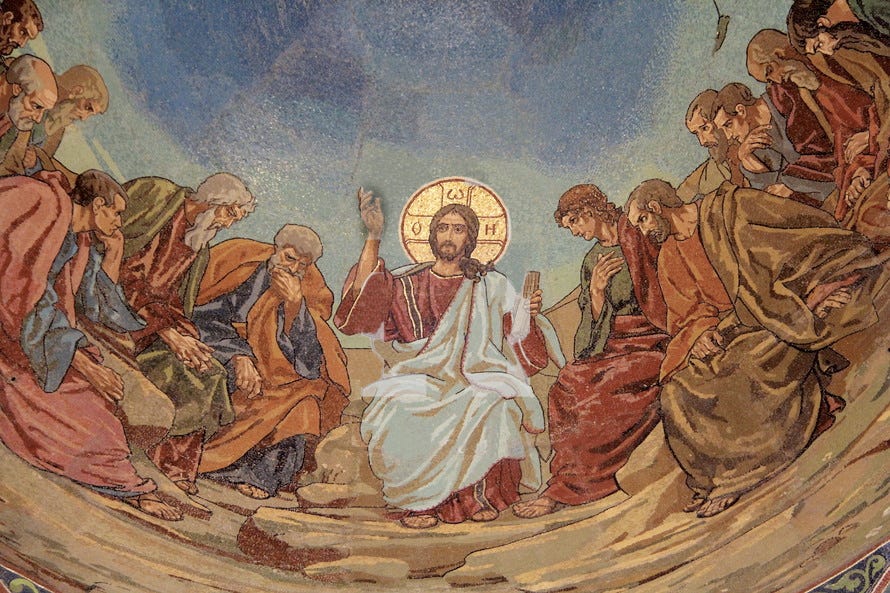
Sadly, we sometimes resist divine hospitality because it seems prudent—wise, even.
It’s easy to disregard what’s right for the sake of the logical, the rational, and the cinematic. Like Ovid put it, “I see the right way and approve it, but follow the wrong.”18 We struggle to not take the other’s eye or tooth—especially in situations where turning the other cheek feels imbecilic.
And yet, in Jesus’ school for living the best kind of life (Matt. 5-7), He instructs us to care for the enemy, love those unfamiliar to us, and transform others through hospitality (cf. Ex. 23:4-5; Prov. 25:21; Rom. 12:19-21). And it’s not something we need to choke down and carry out begrudgingly—it’s something that’s as good for the other as it is for us. As Parker Palmer writes,
when we invite the stranger into our space, important transformations occur. Our private space is suddenly enlarged; no longer tight and cramped and restricted, but open and expansive and free. And our space may also be illumined...Hospitality to the stranger gives us a chance to see our own lives afresh, through different eyes.19
After studying how asking people for favors actually makes them feel loved—because it makes them feel needed—the Harvard Professor Arthur Brooks started asking homeless people if they wouldn’t mind praying for his family after giving them money.
Almost all of them happily agree to do so. After describing one of these interactions, he wrote:
I happen to believe, as my Christian religion teaches, that God hears the cries of the poor—so I judge that I got a lot more than I gave that day.20
And ever since I’ve read this anecdote, I’ve made a habit of doing this exact same thing. Which just goes to show how even though one person’s bad actions can create a negative mimetic contagion, another person’s altruism can create a stronger, positive contagion.
Similarly, my wife and I are currently riding a wave of inspiration after having lunch with Phylicia Masonheimer and her lovely family this past weekend. In all earnestness, she should probably do a bootcamp on hospitality to whip the rest of us in shape. We felt elevated for the rest of the day because generosity and kindness are just plain contagious.
Now, I’m a big fan of generosity out on the streets and hospitality in third spaces, but I’m frankly terrible about being open with our house. But limiting that real and true and deep hospitality—the kind that welcomes others into the most intimate recesses of your life—is something I’ve been convicted about lately.
George Saunders once said that the greatest regrets of his life weren’t his business blunders or even contracting a rare illness after his friends dared him to dive into the Amazon River, but his “failures of kindness.”21 That’s what truly chews us up when all’s said and done.

Nolan’s message is just as unsubtle as it was in Oppenheimer: we’re our own demise. If we don’t put our passions for conquest, power, and personal security, under control, we’ll never find the beautiful kind of mutuality that we know is possible but struggle to realize.
Essentially, until we find a way to accept our neighbors, treating them as potential little-g gods, we make ourselves less like Odysseus and more like Sisyphus: rolling a boulder up one side of the hill just to watch it fall off the other side. Doing the same things, expecting different results. The security we hoard for ourselves keeps us stuck in cycles of fear and distrust, while using our potential to reciprocally help others is what gives our boulder pushing an actual telos.
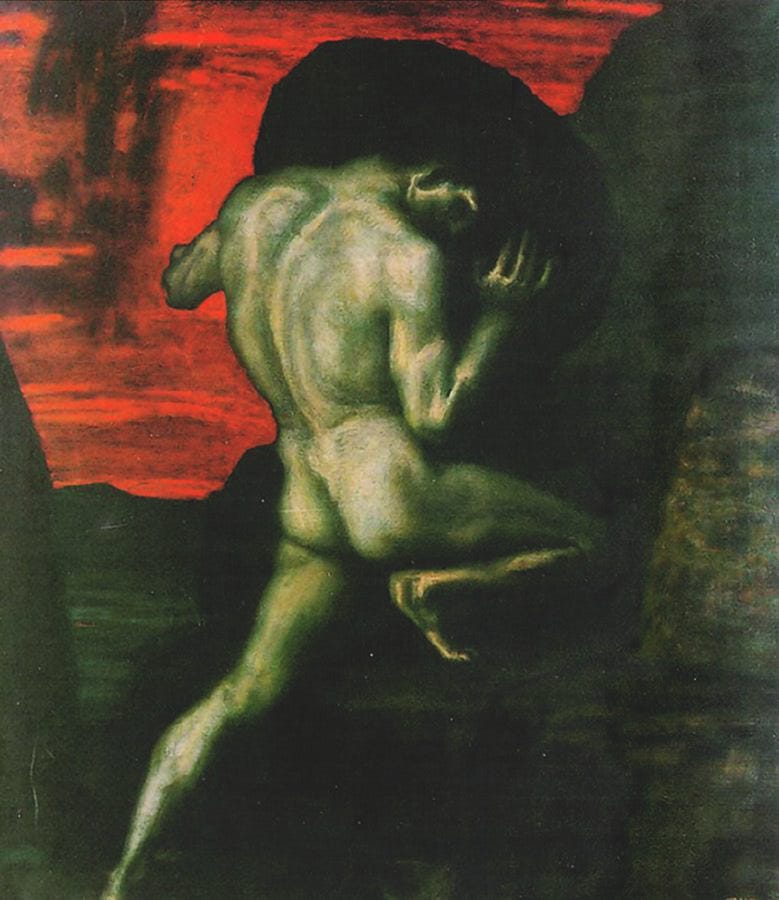
Yet, I think it’s easy for viewers to miss this message.22 Because after seemingly repenting over trampling Zeus’ Law, Odysseus returns to slaughter the suitors.
However, I’d argue that regardless of our Christian ethics, this ending is completely satisfying; but even further, I don’t think we should feel guilty for finding this ending satisfying. Take Matthew’s “The Parable of the Wicked Tenants” (21:33-36) for example. A man leases his vineyard to a group of farmers, but when he sends a servant to retrieve his harvest, they kill the servant. He sends a second servant, they kill him too. Then he sends his own son, and, predictably, they also kill him.
But crucially, Jesus pauses the parable at that point to ask the crowd what they think should happen to the tenants. And I’d wager that He decided to fish for the parable’s ending because He knew we’d find the tenant’s actions horrendous. He predicted how we’d fill in the blank, so he lets the crowd write the ending: the owner should bring the tenants to a wretched end.
Conversely, if they thought, “Well, we should’ve humanized the tenants a little more and felt more compassion for them,” then they might’ve bypassed a basic moral sense of justice that Jesus anticipated within us. That said: it’s not wrong to want to protect Penelope save Telemachus’ throne.
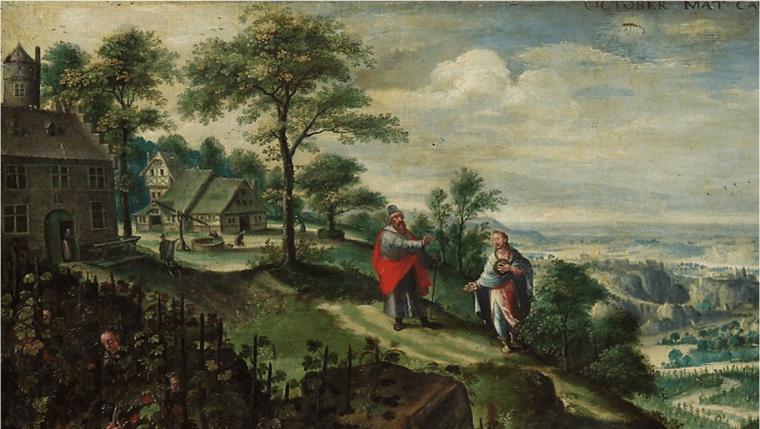
Nolan gives us a hero who regrets violating hospitality, who unearthed some regret in myself for my own failures of kindness. The Christian faith pushes the envelope even further in caring for the other. Not just regretting the wounds we’ve caused through greed or inattention—but learning to welcome them, to love them, to see ourselves—even God—in them.
And paradoxically, we may find ourselves endlessly better off for it.
Also! I recently started a job as a professor at a small Bible college. If you are or know of an 18-25 year old looking for what is almost assuredly the cheapest undergrad that they could find, that comes packaged with a ministry training and solid community, please DM me and I’d love to share some more details!
If you’ve somehow lived your whole life insulated from this plot, I’m curious how this is so.
Yet, be warned that I don’t have the best radar for what’s a good or bad spoiler because they rarely upset me. Only exception for me personally was when people would tweet “Han Solo dies” after the release of The Force Awakens.
The fact that this is a legitimized style of film review that garners hundreds of thousands of views does indeed make me feel a tad hopeless.
This is where Nolan’s The Odyssey sharply differs from the original epic poem, since Odysseus isn’t portrayed as a psychologically tortured veteran but as a largely proud warrior basking in the glory of winning the war. But on a side note, the way Nolan crafts this aspect of the story is a nearly perfect manifestation of his film editing techniques that he’s refined over the past decade; he’s increasingly telling stories that mirror the ways that human cognition blend together. In the same way that we go about our present, we also experience memories flashing before us. And so the way that memories feel seamlessly woven and superimposed upon the present narrative in Nolan’s movies is just such a cool move.
This breaks the Greco-Roman ideal of gifts (see the patronage conversation). Anyways, in short, all you really need to know is just that it was a big no no.
For what I assume to be essentially the only monograph that constrasts ancient Greek hospitality to early Christian hospitality, see Andrew E. Arterbury, Entertaining Angels: Early Christian Hospitality in Its Mediterranean Setting (Sheffield: Sheffield Phoenix, 2005).
Or traveler. See Arterbury, Entertaining Angels, 57.
For those who’ve seen the film, I found the analogy of comparing himself and his men to the “people from the sea” super good.
This sequence of the film felt the most modern psychology-ish to me. I think it speaks to a genuine spiritual reality – the necessity of letting go of control – but it seemed a bit too secularized in that it felt like the implication was that by letting go, we will get exactly what we want.
Best line from the movie, probably.
Inglorious Basterds is probably the only comparable film in terms of how deeply craved vengeance for the protagonist and shameful comeuppance for the antagonists.
This is a point where the film and the source material converge. It would’ve been somewhat inconceivable for a Greek myth to deny its listeners vengeance for their protagonists. Greek ethics would’ve considered anything else silly.
This is where my friends and I have had loads of debate. At first glance, I found Odysseus’ purging of the suitors as an immoral backslide. But the more I’ve thought it over, I’m not totally uncomfortable with the idea that it was a fair response that ultimately set up his wife and child for flourishing. This may sound utilitarian, but I don’t think it is, since it’s not merely a matter of justifying an action on account of the greatest good for the greatest number of people, but spreading a message and an ethic that tells others to stop taking advantage of Zeus’ Law for their own gain (more in line with a DCT or potentially virtue ethics). Further, it seems like suitors had plenty of chances to repent, and they refused. Obviously, a Christian in this situation would want to find a more creative workaround, but we also must remember that Odysseus is not a Christian and should not be judged by those some standards. Even further, I feel like you could draw a decent parallel between Odysseus’ purging of the suitors and Jesus’ cleansing of the temple, insofar as Odysseus’ actions are kept within paradigmatic myth category and Jesus’ are kept within biography of Divine reality category,
But interestingly, Arterbury notes that “Jewish hospitality differs very little from the Greco-Roman hospitality.” Arterbury, Entertaining Angels, 90.
Interestingly x 2: “For the most part, early Christian hospitality was in continuity with the broader Mediterranean social convention of hospitality.” Arterbury, Entertaining Angels, 94.
Henri Nouwen, Reaching Out: The Three Movements of the Spiritual Life (New York: Doubleday & Co., 1975), 47.
John Koenig, New Testament Hospitality: Partnership with Strangers as Promise and Mission (Philadelphia, PA: Fortress Press, 1985), 4.
Ovid, Metamorphoses, Book 7, Line 20.
Parker Palmer, The Company of Strangers: Christians and the Renewal of America’s Public Life (New York: Crossroad, 1981), 65.
Arthur Brooks, The Meaning of Your Life (New York: Portfolio, 2026), 160.
He mentions this in his commencement address “Congratulations, By the Way.”
I’d also like to note that I’m entirely comfortable if I’m missing the message entirely. Some have argued that the film is more about masculinity and honor in modern America. That doesn’t feel off to me. The great part about interpretation is that we can come away with different conclusions. But if you would, I’d love it if you pressured Ross Byrd to write up his take on the movie. We talked on the phone about it and his take was awesome. Also, thanks for the peer-review Ross! And Marc Sims too.
Comments
Nothing yet. Say the first thing.
Sign in to join the conversation.