
I love books. Twelve times a year I hit a peak of euphoria as I plan out next month’s reading plan. But I rarely devote a full article to just one book.
However, after reading an advanced copy of Bonnie Kristian’s In Defense of Evangelicalism, I asked Bonnie if she’d wanna do a written interview.
I once heard an acquisitions editor say that no one, not even the upper echelon of the publishing strata, can predict how or why a book takes off. But even keeping that in mind, I’d be shocked if this one doesn’t.
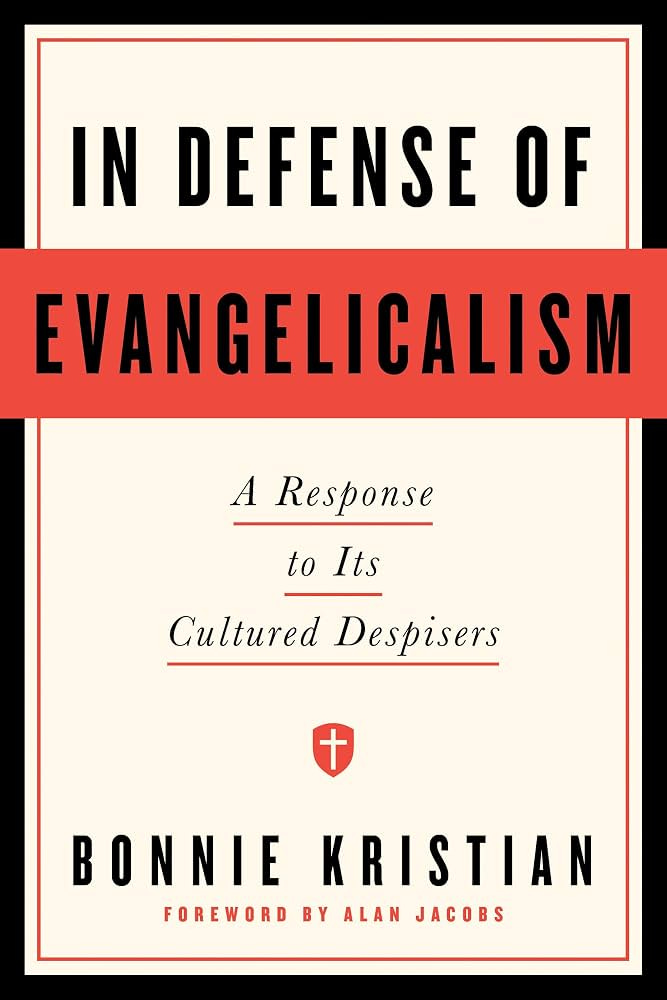
For some context, Bonnie is my point editor at Christianity Today. She gatekeeps all my writing’s characteristic buffoonery from making its way into the hallowed pages of America’s flagship evangelical publication. So it was lovely to turn the tables on her for once and edit her words (which I didn’t actually have to do, because of her whole actually being a professional writer thing).
Let’s get into it.
Griffin: Full transparency, as I started reading your book, I was genuinely waiting for it to answer this question: Am I an evangelical?
Not because I don’t respect or have affinity with evangelicalism, but purely because I’ve heard it defined so many different ways that I actually wasn’t sure.
So, in service of starting you off with what the historian Mark Noll called “an impossible job,” how do you define evangelical? I’ve heard Anglicans and Baptists and non-denoms call themselves evangelicals. Is it really, as you refer to it (semi-ironically), primarily a “vibe”?
Bonnie: Yes and no. I spend half a chapter on this because it’s such a big question, and I explain my aim as describing more than defining, and describing evangelicalism as a movement—or, yes, a vibe—with a knowable center rather than hard edges. Think more or less evangelical, rather than is or isn’t.
That said, the short and necessarily inadequate answer that I’ll give in interviews like this is: Evangelicals are creedally orthodox Protestant Christians who have a shared history and culture dating to the First Great Awakening, who generally attend church, and who maintain in action and belief alike the four emphases of scholar David Bebbington’s well-known quadrilateral, which I recently wrote about for Comment: conversion, activism, Bible, cross.
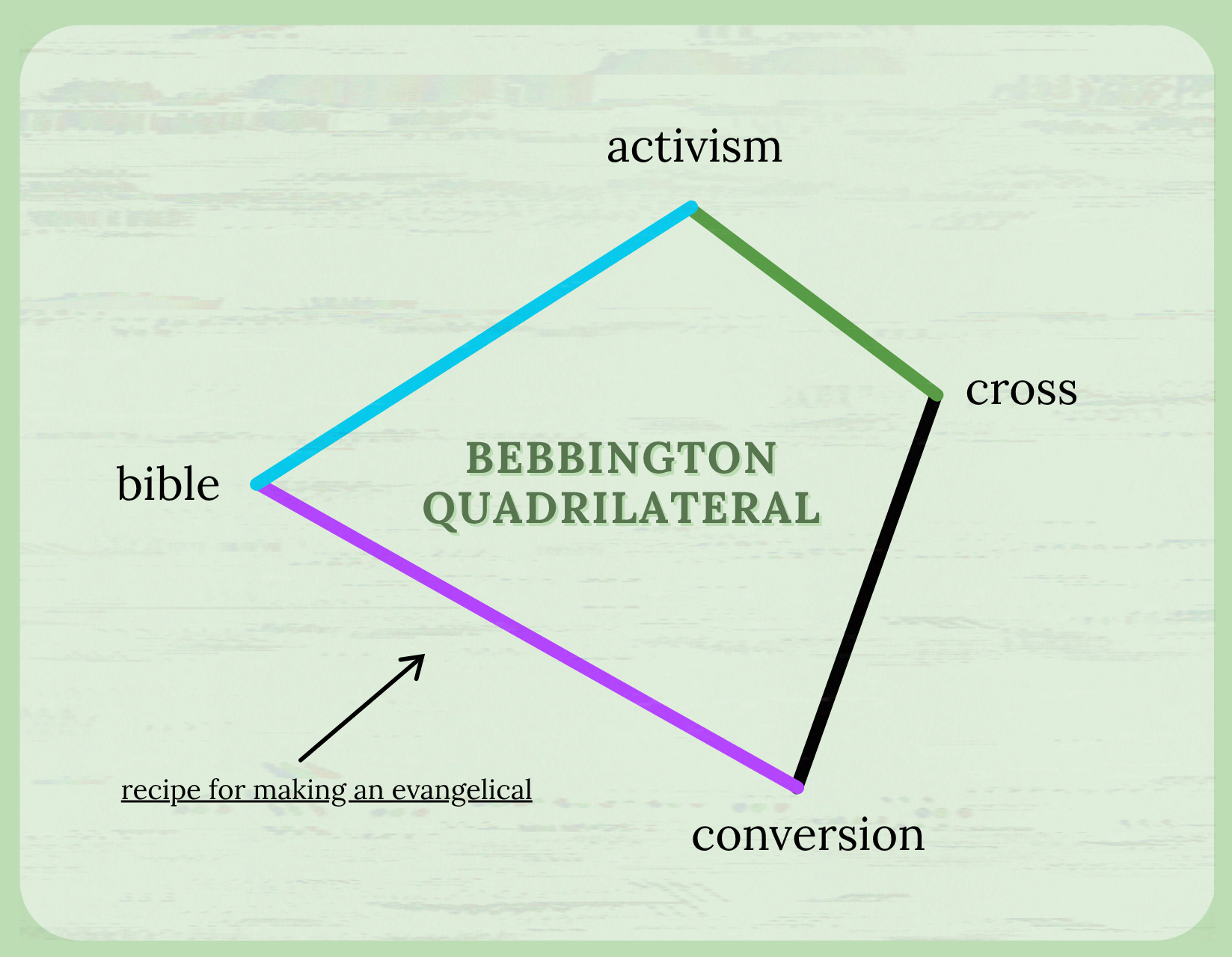
But again: more or less. There are people and groups who fit most of that description, but not all, or who have other emphases too, and yet are still substantially evangelical. As for you, from what I know of your writing and background, I think you’re squarely evangelical, even if the label feels weird.
Griffin: That makes way more sense.
I’ve always thought that it was some kind of weird overarching denomination, but thinking about it as a spectrum or movement helps it click way more.
But also: not sure if I should be offended by being called “squarely evangelical,” especially given that Pew stat you reference that found that Americans view evangelicals more negatively than any other major religious group—which is wild but not all that surprising.
You also say that “there is no other religious group that can be so safely skewered” as evangelicals.
Why do you think this is?
Bonnie: Some of it is as basic, I think, as an inverse of the comedy practice of “punching down” (i.e., making a joke at the expense of an easy target). By just about any measure or definition, evangelicals are very numerous in America, so where it’s obviously rude and gross to go after a tiny religious minority, the same skewering of us might feel okay. And if we’re talking about actual comedy, then sure, that may be true. We should be able to take a joke!1
But I do think the first joke isn’t the same as the 5,000th, and there’s a darker edge here as well. I’d point to someone like Jennifer Welch, an enormously popular podcaster whom I wrote about for The Free Press. Extremely prominent Democrats, up to and including Barack Obama, go on her show—and she routinely calls evangelicals a “cancer,” a “cult,” the “worst people” in America. She’s said evangelicalism is a “dumb factory” and “white trash, magical thinking, dumb people bull****.”
Can you imagine Obama doing a podcast with a host who talked that way about Catholics or Muslims or Jews? No—and that’s good! Evangelicals deserve the same courtesy.
Griffin: Yeah, that feels accurate. There’s almost an assumed disdain for low-church evangelicals and non-denom Pentecostals on the internet—presumably because their (general and supposed) lack of education, knowledge of church history, and focus on sanctification just makes them the pestering, immature little brother of the religious world.
On that note, when I first saw the title of your book, I was surprised by how genuinely ballsy it seemed. There are few things more unpopular than evangelicalism right now. Any reason in particular you wanted to step up to the bat on this topic?
Bonnie: In some ways I didn’t! I’m not afraid of a taking a controversial position—you can’t be, as an opinion journalist—but I’m not someone who really courts controversy, especially not for its own sake. You don’t find me out picking fights on social media.
When my editor and I first discussed the idea, in fact, I had to seriously think it over. Like: Do I want to be that person? And I realized a few things: One is that, to most of the world, I kinda already am that person. I mean, I work at Christianity Today. I’m a member of an evangelical church and a graduate of an evangelical seminary. My beliefs are not exactly a secret.
Another is that while I do care about my own reputation—and Matthew Lee Anderson has some great developing work on the theology of reputation that has been very helpful to my thinking here—if people are mad at me because I liked this huge swath of the church too much, well, okay. I can live with that.
And then finally, as I recently wrote in a Substack post explaining the history behind the book’s subtitle, the more I thought about it, the more I felt compelled to do it—that this stuff needs to be said. I’m equipped to say it, and I came to feel both a freedom and a duty to do it and do it well. As Paul says about other matters of Christian dispute in Romans 14:16, “do not let what you know is good be spoken of as evil.”
Griffin: I’m almost the opposite. I joke with friends that my only hot takes are cold takes phrased slightly more bluntly than people are used to. So I applaud the gusto. And I’ll be sure to make a reel about you in the vein of Taylor Lautner when he prayed for John Mayer in the wake of the internet backlash he’d face after the re-release of Taylor Swift’s “Dear John”
Anyways, in your first couple chapters, you talk about this phenomenon in which people who are Muslim or Buddhist sometimes list themselves as “evangelicals” on self-ID forms. How is that possible?
Bonnie: That’s wild, right? I touched on this a bit in that Comment piece too—and it’s hard to say this without sound condescending—but I think it’s basically low-information voters. People get things wrong.
Even a lot of actual evangelicals aren’t totally sure what the word means; historian Thomas S. Kidd describes it as a word more native to journalists and academics than most of the people it describes. I think it’s even more unfamiliar to people outside Christianity, so if they only ever hear it in political contexts, then it makes sense that they might mistake its meaning to be something like “religious and Republican” or even just “Republican.” Ryan Burge wrote the definitive article on this subject for The New York Times.
I so appreciate and often rely on Ryan’s work, but the point I want to drive home is: Those people are wrong. It’s interesting and informative to think about why they made the mistake they did, but evangelicals are necessarily Christians. There is no such thing as an evangelical Buddhist, for instance, and a few Buddhists’ confusion here does not override hundreds of years of history and millions of Christians’ practice of faith. That isn’t how words work.
Griffin: That’s genuinely wild but makes sense: part of my trepidation in using the evangelicalism moniker is purely because it seems more indicative of a political vibe than a faith.
I’m nowhere near as well-versed in the history as you are, but you list a few turning points where evangelicals became more maligned than usual (The 2016 Presidential Race is a big one).
What’s your take on the relationship between these turning points and the literal state of evangelicalism? Are they literal shifts, or are they more shifts in evangelicalism’s PR?
Bonnie: Some of both! Evangelicalism isn’t a static movement—and this is true on many fronts. Brad East wrote a great piece about this for me at CT a while back, expanding on a post he’d done on his blog the year prior. Weirdly, none of the changes mentioned (i.e., shifting opinions on alcohol, tattoos, gambling, church calendars, and raunchy movies) are political. Even as that basic description of evangelicalism I sketched above remains consistent and recognizable—not only across decades but centuries and also continents—there’s always going to be change.
One change I’m thankful for is the move off purity culture in the last 20 years. It was well-intended, I think, and, as Katelyn Beaty recently wrote, an understandable reaction to an era of pop culture prone to gross sexualization of young girls. But also, I have a daughter and am so glad she’s not going to hear about how premarital sex would leave her indelibly dirty, like a piece of used chewing gum or a manhandled rose. That’s literally sub-Christian, undermining the work of Christ and limiting his power to save us from our sin, and it’s good that evangelicals have learned there are better ways to teach biblical sexual ethics.
In the political space, again there’s both real change and changes in perception. And here it’s vital to be distinguish which evangelicals we’re talking about. There are very prominent and powerful people like James Dobson who, in my view, directly and knowingly reversed themselves on questions like whether character counts when picking a president. That gets bad PR because it is bad.
But there are also tens of millions of ordinary evangelicals who simply did not make a decision of that same weight, knowledge, and responsibility, and it’s unjust to sweep them into the same pile as the prominent people who did. I go into this in far greater detail in the book because it’s an incredibly important question.
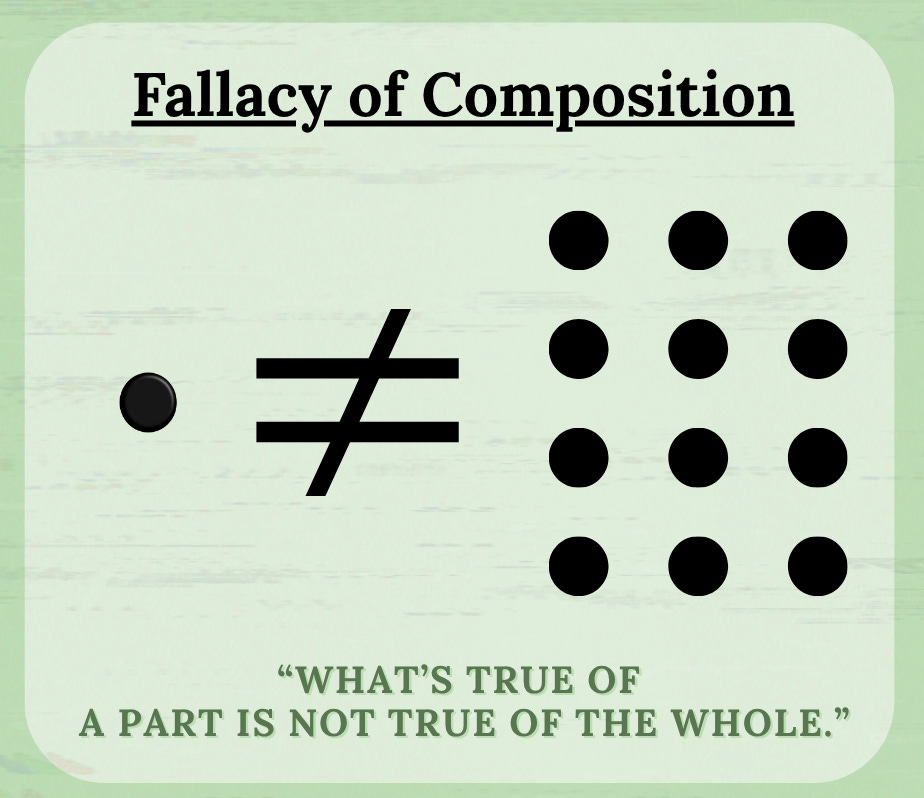
Griffin: That kinda reminds me of my undergrad logic courses, where we learned about this thing called the “fallacy of composition.” It’s basically the logical error made when we mistake what’s true for a part of a system as what’s true for the whole of a system. Is this kind of like the mistake we make with evangelicalism?
Bonnie: Tossing me a softball here! Yes, in fact, I made just this analogy in an email the other day. The person I was corresponding with likened my book and some of the books I critically engage to that parable of the three blind men encountering different parts of an elephant and mistaking the parts for the whole.
I replied and said I think there’s something to that—but let me specify that the part the critics have found is the tail. I grant that there’s a tail. But I reject that an elephant is just a thin, bony string.
Griffin: Yeah, a lot of the time when I hear the horror stories about evangelicals online, I think of that news slogan “If it bleeds, it leads.” Like, that isn’t the norm or even a generalizable experience, they’re just presenting the parts that capture attention. Most evangelicals I know are excruciatingly normal and uncontroversial.
And yet, your book doesn’t put makeup on evangelicalism’s myriad pitfalls. You’re not saying “Evangelicalism isn’t that bad,” you’re saying “It kind of is that bad at certain times and in certain places, but it’s still worth recovering.”
However, many people won’t/don’t like this. Would you mind explaining why you think evangelicalism is still worth fighting for even when it has so many blemishes?
Bonnie: Because it has real goods, real faithfulness, real gifts for the church universal—and all that is neither negated by nor reducible to the real foibles and wrongs also present in the movement.
Alan Jacobs put it wonderfully in the foreword:
I’m glad because, in spite of everything—and if you don’t know what I mean by “everything,” this book will tell you—I remain an evangelical. One of the people Kristian interviews says of evangelicals, “They are my people.” Well, they are my people also, because they brought me out of a dark place—what that proto-evangelical John Bunyan called the Slough of Despond—and up to a higher ground where the sun shines on the green grass. Almost all that’s good about me comes from my immersion in the world of evangelicalism, and I must honor my sisters and brothers in the faith for all they’ve done for me. Yes, sometimes—well, often—they drive me nuts, and when they do so in the future, as they certainly will, and when I start to forget the debts I owe them, as I certainly will, I’ll have this book to help me remember what’s what.
Griffin: In that vein, here’s a quote from pages 22-23:
“It’s impossible to go to an evangelical church on a Sunday morning and come away honestly convinced that faith isn’t relevant there, that the whole thing is a self-serving charade, that these people are having prayer meetings and studying the Bible and organizing meal trains and serving at homeless shelters and giving altar calls as some sort of elaborate disguise of hidden, power-mad intentions. That’s absurd. Evangelicalism makes sense only if folks really believe it—and for all our flaws, we do.”
Now, you’re basically arguing against popular conceptions of evangelical churches that you’ll find online, both from secular folks and high church theo bros. Why are you confident enough to say this?
Bonnie: Partly because, as I said, it’s absurd. We’re talking about normal people here: people with jobs and kids and mortgages who are not, in fact, a lurking menace. Talking about them this way is ridiculous conspiracy theorizing that flies in the face of common sense—a modern, secularized update to Know Nothing ravings about Catholics’ supposed Papist conspiracies to seize power in Washington and submit the Constitution to the whims of Rome.
But also, I’m confident to say it because I’ve observed a great deal of evangelicalism both personally and professionally. I grew up in evangelical churches—a lot of them, in fact, because we move around quite a bit: Southern Baptist, Pentecostal, Independent Fundamental Baptist, Christian & Missionary Alliance, Methodist, Mennonite, Anglican, and nondenominational churches from New York to Texas. I’ve attended evangelical schools and seminary, too.
My work at Christianity Today brings me into contact with American evangelicalism all day, every day, including the ugly stuff. And for this book, I did extensive research, cross-country reporting, and dozens of interviews with scholars and ordinary Christians alike.
Griffin: As a side note, I think your readers may need a small memoir about your time in a Mennonite community.
In terms of the good stuff you’ll find from evangelicals, one stat from the historian Timothy Larsen that I found hilarious was the fact that evangelical seminaries allowed women to join their faculties long before Harvard Divinity School even allowed females to enroll as students. Which just totally flies in the face of evangelical caricatures.
Why is it that we don’t know these stats—or even hear about them?
Bonnie: Some of it may be evangelicals failing to study our own history—we do need to be better about that—and in some complementarian circles that could include a deliberate neglect: After all, if you don’t think women should teach or preach to men, you probably won’t be eager to tout histories of people putting women in positions of theological authority. (It bears noting here that most evangelicals are egalitarian now, including me.)
In some cases, though, I suspect evangelicals have been a little too eager to believe caricatures about ourselves. As I’ve begun telling people about this book, I’ve encountered a real eagerness for it in some people—like they’re hungry for permission to be openly happy about their own tradition.
These are generally evangelicals who have a vague sense that they should feel bad about being evangelical even though evangelicalism has been a positive thing in their lives. They’re in a good church every Sunday, but out in the discourse, they’ve absorbed the idea that evangelicalism is kind of shameful, backwards, something for which you need to apologize. And someone in that frame of mind might not even know to go looking for history like this, which I honestly find very sad.
Griffin: This bit from your epilogue was one of my favorite parts of the book:
“There is nothing wrong with evangelicalism that cannot be cured by what is right with evangelicalism.” For all that there is to critique, evangelicalism has much to offer its own. We have the resources we need.
Sure, there’s detritus too. Lots of saccharine knickknacks and badly acted movies. I don’t especially like contemporary Christian music and don’t understand why so many do. But honestly, who cares? Tackiness is not a sin.”
It resonates because it’s true: it’s not a sin to be uncool and stylistically lame. However, what would you say to those who really do push back on evangelicalism for this exact reason?
Bonnie: The first thing I’d say is that I get it. As is obvious from that quote, I tend to share those frustrations. At that level of lifestyle and culture, I am in many ways pretty atypical for an evangelical, especially a middle-aged evangelical mom.
But the part of me that wants to detail for you here and now how much better my taste is—that is not a good part of me! Indulge it too much and I could all too easily be a “cultured despiser” myself.
But (as I said in a recent conversation here on Substack) in my better—more gracious, kindlier, more Christ-like—moments, I want to say that having good taste does not reliably correspond to the imitation of Christ, and that having bad taste is never a justification for looking down on someone, and that I think it has become too common to cover distaste for evangelical tackiness with a gilding of political and/or theological superiority and pretend it’s solid gold all the way through.
That’s what I’m against, because there are many deeply tacky old church ladies who have done more in love of God and neighbor than I can ever hope to do. Far be it from me to dismiss the importance of aesthetics, but we can have and propagate good taste without plunging into an attitude of Can anything good come out of Nazareth?
Griffin: We’d truly be nowhere without those church moms.
As a side final observation before shooting my last question, when I finished reading the book, I thought “Man, this is like the metamodern update to Jesus and John Wayne.”
For readers unfamiliar, whereas postmodernism seeks to cynically deconstruct everything until there’s nothing but wheel-spinning suspicion about power grabs, metamodernism identifies cynical tendencies and the reality of evil while still charging forward, choosing hope and beauty and meaning over cynicism. Whereas Du Mez’s book felt very much in the genre of diagnosing issues for the sake of critiquing them, your book is more bent toward diagnosing critiques for the sake of redeeming issues. As such, yours felt practical, theological, and hopeful—and that’s very worth commending.
Anyways, lastly, in my own personal experience, I’ve been moving away from the evangelical label both because I think the broader culture doesn’t understand it and I myself barely understand it.
Can you maybe comment on why I shouldn’t?
Bonnie: I think there’s a place for going either way on this, and in the context of specific relationships and ministries, it might be prudent to jettison the word: “I am made all things to all men, that I might by all means save some.” As I said above, plenty of evangelicals don’t even know the word themselves. You don’t have to call yourself an evangelical to be one, and this label certainly not the measure of salvation.
And yet: I don’t want to distance myself from the people in those pews. I’m not embarrassed of those people. Annoyed with them sometimes? Oh, yes. But embarrassed, ashamed? No. I’ve read the history and grappled with the theology and argued about the politics and still come to the conclusion that there are real goods here in evangelicalism, that these are my people, that we are doing our ever-inadequate best to follow Jesus in the same way, together.
Griffin: Lovely, thanks so much for taking the time to respond to all these questions!
Pre-order the book here!
Subscribe to Bonnie here:
Subscribe to me and/or wish me well financially here:
Comments
Nothing yet. Say the first thing.
Sign in to join the conversation.