
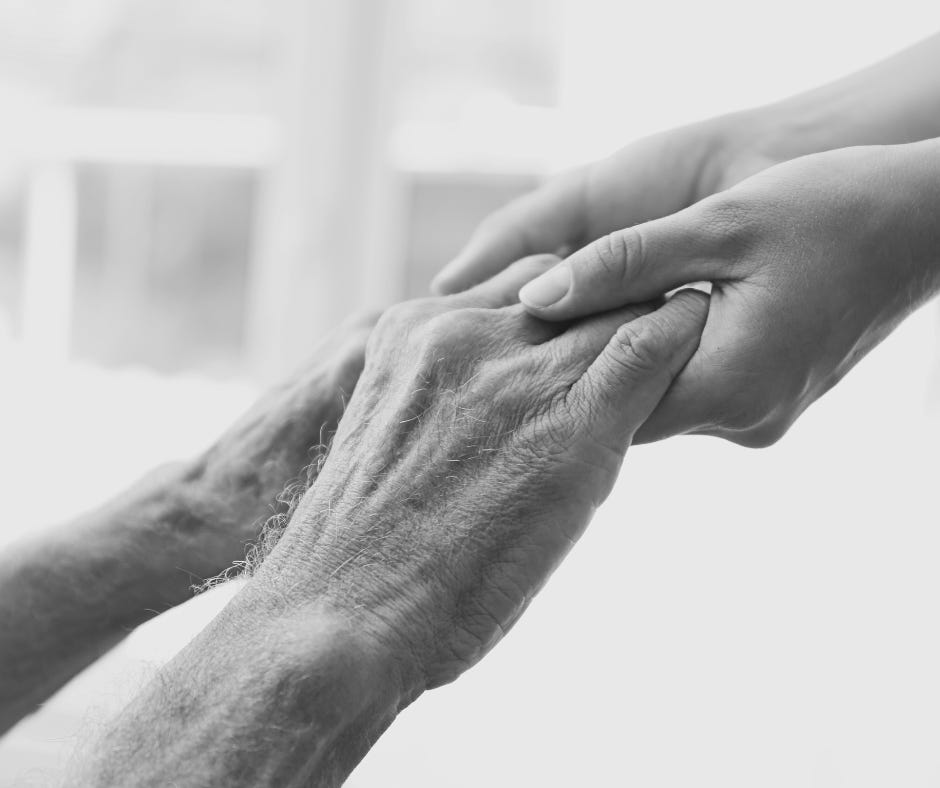
I’m sitting at my grandparents’ kitchen table, laptop open, trying to finish a presentation when my grandfather interrupts with a story about a YouTube video he watched the night before. Something about the new Pope’s upbringing that struck him as remarkable.
I must have had an annoyed look on my face, because my husband quickly chimed in: “At least you’re getting to witness them in their old age.”
His comment made me pause.
In grief, “at least” is a naughty phrase. “At least” is a trusty chart topper on every single what-not-to-say-to-a-griever list, article, podcast, book, all the things. You just… don’t.
But in this context, it landed differently, bringing some much-needed awareness.
I am the lucky granddaughter of not two, but four amazing grandparents, all a click away from their 90s. Each still thriving. The sheer magnitude of that privilege is not lost on me.
This particular set of grandparents—my maternal ones—have been steady presences in my life since the day I was born. That’s not an exaggeration. There has not been a single year of my four decades on earth where they have not been present.
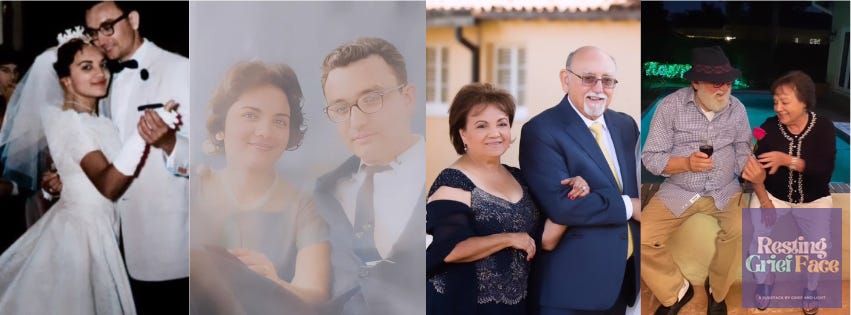
They’ve lived in the same house since I can remember. The house where my brother, Yosef, passed. The home that has witnessed every stage of our lives, including this moment as I type these words.
Even before Yosef’s death, I was acutely aware of how precious it was to have them in my life. Long before I experienced the sudden grief of losing my only sibling, I carried the anticipatory grief of knowing, one day, my grandparents would not be here. The thought of that terrified me, so I swatted it away like a pesky fly.
The fact that my octogenarian grandparents outlived my 32-year-old sibling is a reality I still struggle to reconcile. But such is life. There truly are no guarantees.
After two years of holding space on the Grief and Light podcast and grief-tending circles for conversations about the many ways we lose those we love, I’ve come to see aging as a privilege, not a given.
Contrary to what culture sells us, gray hairs and wrinkles are a gift. I’m not saying you have to embrace them. That’s a choice. But getting to an age where they appear means you’ve been afforded the rare gift of time.
My grandparents are truly special.
Not only because it’s impressive they’re independent at almost ninety, or because my grandmother still puts on his socks, or because my grandfather still remembers the full names of his high school teachers. But because wherever they are, there is love. There is joy. There is home.
They believe in helping others, just because.
They open their doors to people who need a place to stay, simply because no one should be unhoused.
They visit “old people” in the hospital, because no one should suffer alone.
They financially support their family members or those in need, because its the right thing to do.
They sing love songs to each other on karaoke nights at home.
She wakes up early to make sure he has a fresh cup of coffee.
They kiss all of their children and grandchildren on the forehead, and light up when we walk into the room.
They are gifts in human form, and I have the privilege of calling them my grandparents.
Routine, though, is deceitful.
The fact that they seem to be doing so well tricks me into believing they will live forever. To this day, I cannot fathom life without them. And yet, I know better.
My husband’s comment—“at least you’re getting to witness them in their old age”— continues to echo in my heart.
As I thought about what that means, another thought was whispered into my heart: you’re getting to witness their final form.
I don’t know how to explain this, but that thought was not mine. More like a gentle whisper from somewhere else, reminding me to pay attention. To notice what actually matters.
My grandfather’s recap of a YouTube video on Pope Leo XIV’s early life is more important than the presentation I was working on at that time. My grandmother asking me if I ate for the 20th time as a way of her showing she cares is more important than my fleeting annoyance.
I’m getting to witness them in their final form.
That doesn’t necessarily mean they’ll go before I do. Anything is possible.
But it feels like a nudge from the universe to tune in, to savor the ordinary moments while I still have them.
This thought about being a witness to someone’s final form continues to echo in my heart, mind, and spirit. Slightly eerie, slightly comforting.
It reminds me that I also got to witness my brother in his “final form”.
Final, in this context, doesn’t mean last or finished. This is not a reflection on the afterlife or what happens to our physical body after we die.
But final in the sense of time. Of being granted the privilege to witness someone in all their stages—until the very last one you’ll share together.
And in my grandparents’ case, that means I get the sacred gift of witnessing them in old age.
Grief teaches us that nothing is guaranteed. And yet, it also teaches us how to see the extraordinary in the ordinary. To sit in a living room, to hear a story we’ve already heard before, to receive the 20th “did you eat yet?”, and realize these are the moments we’ll miss most when they’re gone.
Maybe that’s what all of this is about. Not just my grandparents, not just my brother, but all of us.
We are each other’s witnesses.
We hold the privilege of seeing one another across time, across stages, across endings that are never really endings. And what a sacred, fleeting gift that is.
Nina Rodriguez is a Grief Guide, educator, podcaster, and speaker who helps people navigate grief with hope and agency. Following the unexpected loss of her only sibling, Yosef, she founded GRIEF AND LIGHT, an award-winning podcast and supportive online community to educate and empower individuals navigating loss and life-altering change. Through her work and collaborative spaces, Nina aims to foster a more grief-informed, hopeful world. Learn more at: griefandlight.com.
Comments
Nothing yet. Say the first thing.
Sign in to join the conversation.