
What if writing (and reading) with depth is one of the last remaining ways we can preserve our humanity in a distracted world?

We are living through a time when critical thought is often dismissed as elitism, nuance is flattened for clicks, and the act of caring for just about anything is often labeled dramatic, indulgent, or it devolves into endless arguments among “keyboard warriors”.
This isn’t just aesthetic preference. It’s also cognitive science.
Studies have consistently shown that sustained, narrative-rich reading can deepen our cognitive and emotional capacities. A meta-analysis published in the Journal of Experimental Psychology examined data from over 30,000 participants and found that “people who read a lot of fiction” performed significantly better on measures of verbal reasoning, general cognitive ability, and (critically) empathy and theory of mind.
In other words, reading long-form fiction, with its emphasis on character development and interior complexity, strengthens our ability to hold nuance, consider multiple perspectives, and resist cognitive shortcuts.
These are the very “muscles” we need to build grief literacy, not just to process our own losses, but to witness the pain of others without turning away or rushing to fix it.
In contrast, skim reading, like social media and headline culture, can dull our capacity to make connections and think critically.
For context, here are some statistics and data about the five literacy levels, and current literacy statistics in the US.
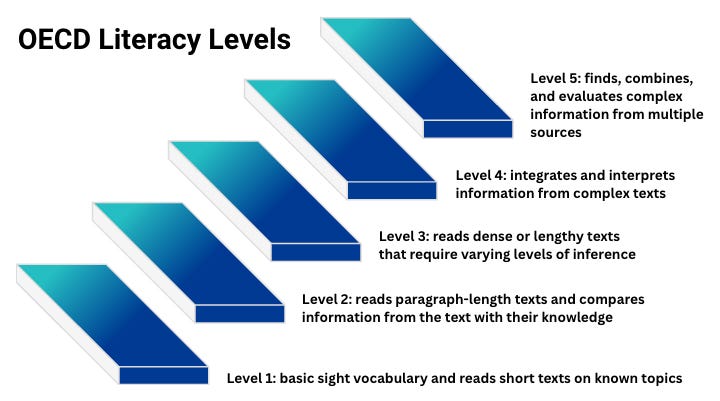
According to the National Literacy Institute:
On average, 79% of U.S. adults nationwide are literate in 2024.
21% of adults in the US are illiterate in 2024.
54% of adults have a literacy below a 6th-grade level (20% are below 5th-grade level).
Low levels of literacy costs the US up to 2.2 trillion per year.
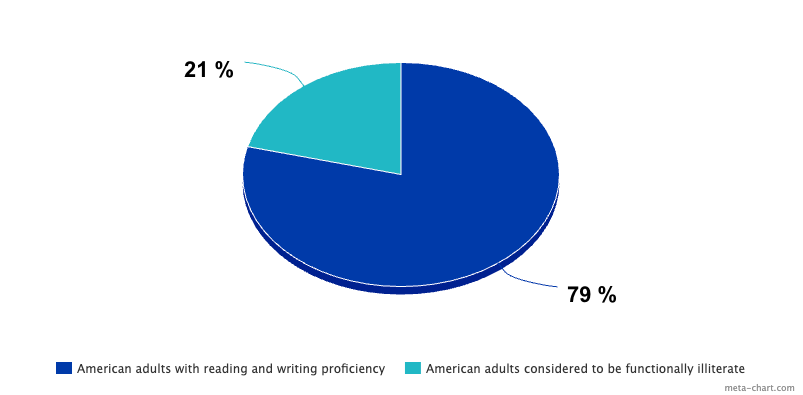
The data paints a sobering picture of where we stand as a country when it comes to literacy and, by extension, our collective capacity for depth.
When we train our brains to expect TL;DR versions of reality, we weaken our tolerance for ambiguity. And when we weaken our tolerance for ambiguity, we can lose our ability to think critically, grieve honestly, and live meaningfully.
In other words: long-form reading strengthens the muscle that anti-intellectualism weakens. Our willingness to stay with hard things, unresolved things, human things.
As cognitive neuroscientist Maryanne Wolf wrote in 2018:
“We need to cultivate a new kind of brain: a ‘bi-literate’ reading brain capable of the deepest forms of thought in either digital or traditional mediums. A great deal hangs on it: the ability of citizens in a vibrant democracy to try on other perspectives and discern truth; the capacity of our children and grandchildren to appreciate and create beauty; and the ability in ourselves to go beyond our present glut of information to reach the knowledge and wisdom necessary to sustain a good society.”
Wolf’s vision wasn’t just academic. It was, and is, an urgent warning.
In a world of doom scrolls and skims, reclaiming our capacity for sustained attention becomes a civic, moral, and even spiritual act. Platforms like Substack, where ideas can unfold slowly and voices can develop outside the logic of virality, are helping to keep that capacity alive.
I host a podcast about grief, so I’ll use this topic as my example.
By divine design, the lived experience of “big-G Grief” (for example, the grief we experience after the loss of a loved one or beloved pet), represents what an anti-intellectual world tries to avoid:
discomfort contradiction nuance uncertainty liminality unfixability patience …
Grief doesn’t offer clean answers.
It asks hard questions.
It insists on nuance, resists resolution, and exposes the illusion of control.
It’s not surprising, then, that grief is so often misrepresented, muted, or avoided altogether in our mainstream discourse.
Recent studies show that literacy is alarmingly low. Similarly, we live in the context of a grief-illiterate society where most people underestimate how long grief lasts, overestimate how much it resembles depression, and lack the skills to support others in loss. This widespread illiteracy mirrors the broader cultural discomfort with complexity and nuance.
An anti-intellectual culture is selectively allergic to anything that can’t be solved in a soundbite or bumper sticker zinger. And grief, by nature, refuses to be rushed, simplified, or “fixed”.
To understand grief (and life), to really understand it, we need to think, to feel, to hold opposing truths in our mind-body-spirit at the same time.
We need to sit with the sentence for longer than three seconds.
We need to be willing to be changed by the radical acceptance of what is, as it is.
We need to learn to embrace the both/and of life.
That’s why long-form platforms like Substack play a key role in today’s zeitgeist.
Substack and long-form content platforms (books, podcasts, documentaries, etc…) invite us into a different rhythm. A slower, deeper, less performative rhythm.
It values honesty and writing that doesn’t pander. Thinking that doesn’t conclude prematurely.
It gives room for those of us who don’t want to reduce our grief or [insert important topic here] into an aesthetic carousel or 90-second clip.
In a culture that’s increasingly suspicious of depth, nuance, and emotional range, Substack feels like a sanctuary for the parts of us that can’t be simplified, both individually and collectively.
Anti-intellectualism doesn’t just reject knowledge. It rejects the effort of knowing.
It turns curiosity into cynicism.
Grief into pathology.
Feeling into flaw.
It makes people embarrassed to not know something, so they stop asking questions altogether.
It makes slowness feel like failure.
It treats complex emotion as weakness.
And so we grieve privately. Suffer in silence. Write quietly. Or worse, stop writing at all.
But what if our stories are exactly what the world needs right now?
What if long-form content, fiction, sharing our stories, research, and findings, is how we reclaim our right to not know, not fix, not reduce?
And what alternative reality are we fostering if we don’t?
Long-form may not be the only antidote, but it’s one of the few we can reach for with our own hands.
This form of content, particularly fiction, informs and reforms us. It changes the shape of our attention. It teaches us to stay with discomfort, to track our thoughts all the way down, to engage both our minds and hearts.

And in a time where grief is privatized, learning is politicized, and distraction is monetized, that feels like a better path forward.
On that note, I’d love to know what your favorite fiction reads are and why, as well as any other long-form content that you gravitate towards. Let’s curate a reading list! Feel free to tag or share links below.
Stay with Resting Grief Face
This is a grief-informed newsletter, but it’s also a refuge for anyone tired of quick takes. If you’re still figuring it out, still in process, still holding contradictory truths, welcome. You belong here.
Forward this essay to someone who’s been told they feel or think too deeply
Let them know their depth is a feature, not a “bug”.
Nina Rodriguez is a Grief Guide, podcaster, writer, and speaker who helps people navigate grief with hope and agency. Following the unexpected loss of her only sibling, Yosef, she founded GRIEF AND LIGHT, an award-winning podcast and supportive online community to educate and empower individuals navigating loss and life-altering change. Through her work and collaborative spaces, Nina aims to foster a more grief-informed, hopeful world. Learn more at: griefandlight.com.
Comments
Nothing yet. Say the first thing.
Sign in to join the conversation.