
0:00
-14:16
Grief, right now, is not just personal. It is ambient. Collective.
It lives in the background noise of our days, humming beneath “circling back” emails and errands, beneath conversations that make us wonder if we’re the only ones feeling the sense of dissonance. This grief has settled like humidity in the air.
It’s the kind of grief shaped by world events and political realities, and the firehose of breaking headlines. By the visible and invisible violence enacted against those who are most vulnerable in our society and communities. By the sense that something fundamental is unraveling while we’re still expected to participate in daily life as though everything is fine, just fine, while the world ‘burns’.
For many of us, that grief feels as though it has reached a crescendo, tipping the scale of our nervous systems from overwhelmed to collective freeze, fawn, shutdown. There are memes and social media posts about 2026 coming with a heavy dose of sleepy energy, because we’re seemingly all yawning and exhausted. This lack of energy likely being a symptom of a nervous system needing repair, tending, and rest.
And yet, we are asked to continue showing up at work, trimming fiscal budgets, making sales calls and small talk, and planning for a future that keeps shifting. Somehow, we’re expected to continue making decisions as if the fabric of our existence isn’t unraveling before our eyes.
That dissonance, the gap between what is happening inside us and what is expected of us, can be deeply destabilizing. Internally, alarm bells are ringing, yet externally the world seems to carry on leaving many of us wondering: Do others not see what’s happening? Am I overreacting? Do they not care? Are we supposed to pretend things are normal until we just… can’t anymore?
As a grief guide and podcaster whose work centers grief, I’ve struggled to find my words for much of the last month. This is not unfamiliar territory, but it has felt heavier than usual. That struggle was further complicated by what I often call the holiday “grief hangover”, where an emotional and physiological crash tends to follow the holidays. Even in the best of circumstances, that period can be tender and disorienting. This year, it felt especially loud to the point that I have been unable to pick up my microphone and hit the record button.
Still, beneath the fog and fatigue, I felt a persistent pull to offer something of value without bypassing the reality we are living through or attempt to silver-line it away.
I wrote about this last year and recorded a podcast episode on the grief of uncertainty in unprecedented times.
And yet, here we are again, experiencing waves of disconnect and disruption. Perhaps even more intensely. At least for those of us who are paying attention, refusing to look away. Those who are acutely aware of the erosion of safety, dignity, and humanity for so many, with no clear end in sight.
I don’t have a single answer to any of this.
What I do have is a perspective that began to surface after moving through a familiar cycle:
disbelief —> panic and fear —> anger —> disbelief —> search for answers —> nervous system regulation —> turning off the firehose of information and stepping away from constant consumption —> tuning back into the mundane rhythms of daily life, practicing presence in small, ordinary ways.
And from that place, something else began to emerge.
We often describe moments like the ones we’re living through as unprecedented times. And in many ways, they are. But what if it’s more helpful to reframe that language? What if these are unprecedented times for us?
Humanity has faced versions of this before, different in form, but similar in essence. Periods of immense upheaval, moral rupture, and collective fear. Uncertainty about what comes next, and somehow, humanity has survived. In some cases, even found ways to create meaning, beauty, and progress amid the chaos.
If we zoom out far enough, what becomes visible is not that this is a never-before-seen reality, but that it is part of a long human lineage of disruption and response.
I say this with a healthy dose of nuance, of course. This is not denial or bypassing of what is happening now; quite the opposite. It’s a way of pulling on a thread that runs through past, present, and future, so we can reclaim our sense of agency as we move forward.
The same way we carry grief with us, moving with it rather than past it, we can also move with the wisdom of those who came before us.
I know this can sound abstract. So let me offer one concrete example.
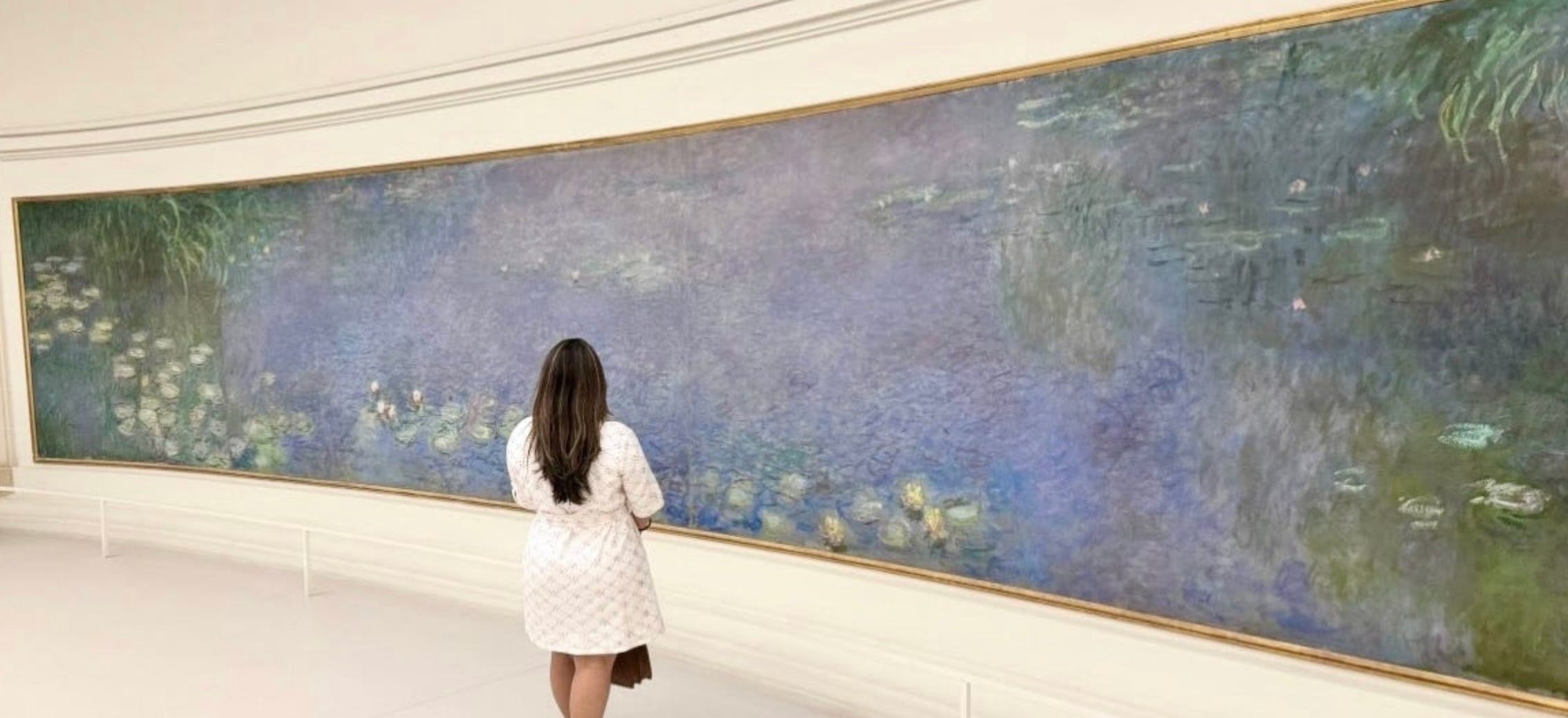
About two years ago, I traveled to Paris and visited the Musée de l’Orangerie to see Claude Monet’s Water Lilies. Standing inside those oval rooms was, in itself, a heart-opening experience. But what stayed with me most was the story behind them.
During World War I, Monet struggled deeply with the act of creating art while unimaginable suffering unfolded around him. In a letter from 1914, written while he was working on the Water Lilies at his home in Giverny, he expressed a profound sense of guilt and shame:
“Yesterday I resumed work. It’s the best way to avoid thinking of these sad times.
All the same, I feel ashamed to think about my little researches into form and colour while so many people are suffering and dying…”
Monet was not removed from the war’s impact. His family was directly affected. His younger son, Michel, was called up for service in 1915. His stepson, Jean-Pierre Hoschedé, also served in the French Army. His eldest son, Jean, died in 1914. Monet remained in Giverny, hearing the distant gunfire from nearby battlefields while members of his household were evacuated or sent to serve.
Out of that grief and uncertainty, Monet painted not only the Water Lilies but also the Weeping Willow series—a tribute to fallen soldiers.
Eventually, Monet made a decision. He chose to create a grand series of the Water Lilies as a gift to France, intended to memorialize the end of the war in 1918. These paintings were meant as a counterpoint to the brutality of destruction. As a space for peace, contemplation, and beauty in the aftermath of devastation.
Today, they live permanently in the Musée de l’Orangerie, housed in rooms designed specifically to hold them.
What stands out to me most is not just the art itself, but the deeply relatable human experience behind it.
Like many of us, Monet did not know what to do in uncertain times. Like many of us, he felt guilt, confusion, fear, and still, he chose to paint.
He chose art. He chose the water lilies. He chose hope.
Remembering this brought me back to a phrase I return to often:
hope is a verb. And one of its love languages is art.
This runs parallel to another belief I hold that more often than not, we have the potential to be someone’s answered prayer. Our lives, our choices, our kindness, our care can become the very thing another person needs to survive. And theirs can become ours.
We tend to imagine solutions as singular, sweeping moments of divine intervention, a final turning point, a one-and-done resolution. But as long as we are human, we will be subject to both the beauty and the limitations of the human condition.
By nature and divine design, we will always encounter hardship, disruption, grief AND joy, hope, love, and moments that feel miraculous. Our task is to learn to thrive in the and of life.
Even if the world were to somehow arrive at perfect equilibrium, disruption would eventually follow. Change moves like a pendulum: order —> chaos —> new order. Thesis —> antithesis —> synthesis (Hegel’s dialectic).
To be clear, our north star should always be the fostering of the better parts of humanity, including sovereignty, freedom, justice for all. That commitment must remain unwavering. And we also need to get better at how we relate to disruption itself. When we don’t, the worst of humanity tends to take root.
It is a paradox: to move toward peace and justice, we must remain vigilant, engaged, and participatory. We cannot opt out of our lives or our communities, even when it feels unbearable.
A few days ago, I shared Monet’s story on social media, alongside videos I had taken of the Water Lilies. That post reached nearly a million people. I don’t share that as a metric of success, but as evidence of resonance. Of how many people needed to feel seen, understood, and perhaps given quiet permission to keep creating. (The comments alone are touching and full of hope.)
Maybe our existence in this moment isn’t just about surviving some abstract “earth school,” as certain spiritual frameworks suggest. Maybe we are also here as creators.
And what happens next, what we build, what we protect, what we imagine forward, is up to us. Me. You. All of us.
The next iteration of our shared humanity will not arrive overnight. It is formed in the smallest moments. In choosing hope again and again. In spending less time and energy doom-scrolling and panicking, and more energy deciding on the right shade of green for your water lily. Or outlining your next essay. Or making something, anything, that speaks life into the world.
Each of those choices creates ripples that extend far beyond what we can see.
Today, I choose to speak of hope.
I believe the present, and the future that we will co-create, asks us to speak life into ourselves and into one another. To slowly shift our collective discourse from panic and despair toward imagination and intention. Toward what we want to create next.
It may or may not happen in our lifetime. And that’s okay.
Hope has always been a long game.
May our existence, in all its imperfection, be a ripple moving steadily in the direction of love and hope.
Because hope, after all, has always been a verb.
Nina Rodriguez is a Grief-informed Guide, podcaster, writer, and speaker helping humans thrive in the “and” of life. Following the unexpected loss of her only sibling, Yosef, she founded GRIEF AND LIGHT, an award-winning podcast and supportive online community to educate and empower individuals navigating loss and life-altering change. Through her work and collaborative spaces, Nina aims to foster a more grief-informed, hopeful world. Learn more at: griefandlight.com.
Comments
Nothing yet. Say the first thing.
Sign in to join the conversation.