
I remember the moment of realisation that my life was plunging into darkness.
Choral voices began lifting one of my favourite pieces of music into Gothic ceiling arches. A subtle tension in the opening notes hung in the air, unresolved, as the harmonies rose and fell. Ambient sound swelled as it reverberated off ancient stone.
The intensity grew, sending harmonic wave vibrations pulsing through me. I started to tremble and realised I might not hold myself together. I closed my eyes, hoping it would somehow make me invisible to those seated around me in the nave. The sound pressed in: a sonic massage releasing overwhelming anguish.
It was my fortieth birthday; I was falling apart.
***
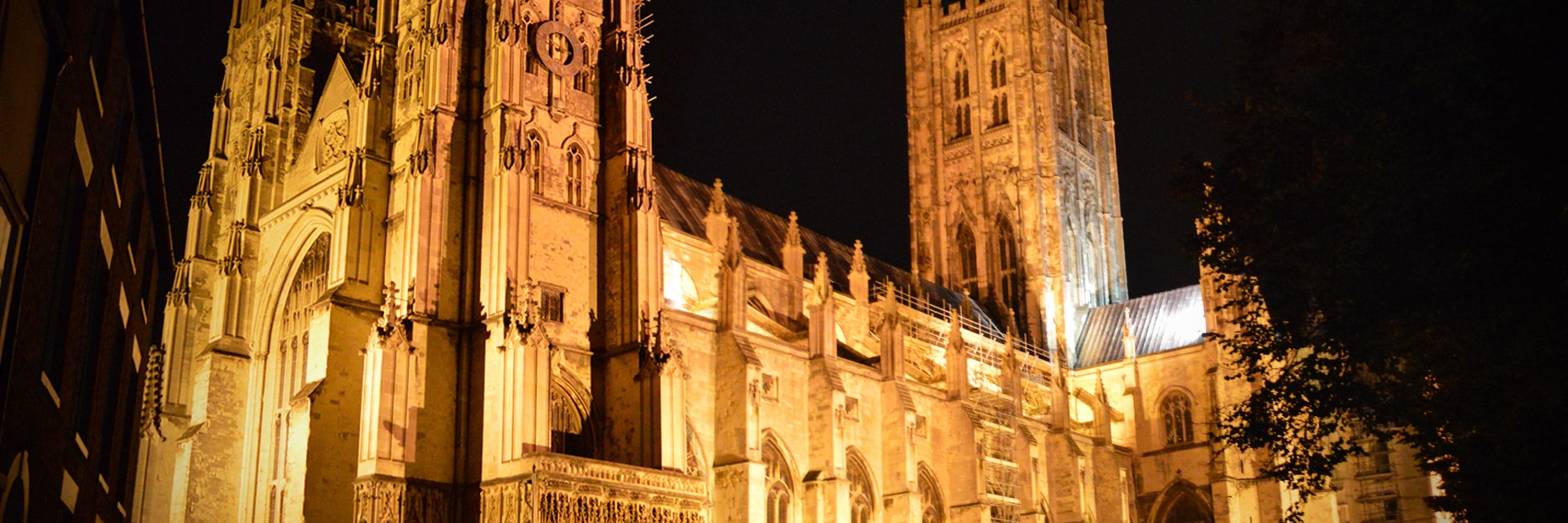
It’s an hour earlier and we are in the grounds of Canterbury Cathedral, on a particularly cold Tuesday evening in early December. My parents, myself and the other attendees are kept waiting in line for what feels like an age. The chill starts to bite so much that it penetrates my usually impregnable leather gloves.
The courtyard gardens are world-heritage pretty but not ostentatious. This is England, after all. People wait patiently, stoically. Warm breath from their chatter rises like shisha smoke, illuminated against dark sky by decorative lights. An austere Christmas tree and scant decoration create an underwhelming festive feel. The cold pierces through my jeans, stinging my thighs.
The last few months have not gone as planned. I’m not in the mood for any of this. It’s not how I imagined my fortieth birthday, nor my life, to turn out.
In front of us is a Japanese group: two couples around my age with their respective sets of children. They seem elegant, immaculately turned out. Their soft dulcet voices carry their language rhythmically, as though reciting poetry. I wonder whether their conversation is as graceful as I imagine.
I prefer to remain ignorant, rather than risk shattering my idealised notions of them. The line should at least be shuffling forward to give the impression of progress, but there is no movement.
My mother makes conversation with the middle-aged couple behind us. Wishing not to engage with them but without appearing rude, I attempt to give the impression that I am unavailable; that I am lost deep down some pensive well.
I have plenty on my mind. A few months prior I returned to the UK from Trinidad, leaving behind my pregnant wife and two stepchildren in order to get work, having failed to obtain a work permit on the island. Now I am out in the cold.
I focus again on the group in front, trying not to reveal my fascination; to not appear voyeuristic. They distract me a few moments more, yet all the while I’m waiting for the inevitable “this is my son” introduction, which duly comes. My mother cannot simply converse and let you be; she has an instinct to draw everyone in so no one feels excluded. Unfortunately, she cannot read the body language of my stepfather and me, which is screaming: please don’t make us talk to these people.
The conversation imposed upon us is not interesting. If I wanted to converse with strangers, I would rather talk to the poets in front. I try not to be irritable, but it’s difficult. The bitter cold doesn’t help.
A Chaucerian character with bald scalp and overly long white locks seems to be in charge of proceedings. He looks as medieval as the great stone structure of flying buttresses and everything arched up toward heaven that he keeps disappearing into and re-emerging from. He’s busily ‘to-ing and fro-ing’ to little effect. The queue is still not moving.
He is wearing a long dark cloth robe with a rope belt tied at the waist. He looks like a Franciscan monk. I ponder this briefly before concluding that there cannot possibly be Franciscan monks stationed at this bastion of Anglicanism. Perhaps he is clergy. Perhaps a curator. Perhaps simply there in costume for the tourists. Whatever, he looks as though he has stepped out of a scene from Monty Python and the Holy Grail. But it can’t be parody; I don’t think the Church of England does parody. Not deliberately, anyway.
My mind drifts back to cold reality. It has been two months since my wife shut me out without explanation, blocking me on WhatsApp and ignoring my emails. It makes no sense.
Eventually the aged Friar Tuck comes good: he gives the signal that guests can start to be admitted inside the cathedral. Finally!
Processing through the vestibule, the aroma of old church hits immediately; an uplift in temperature does not. We emerge into the nave, flanked by interior cloister-like side chambers, which must be the best part of a thousand years old and yet would have been, in its day, a state-of-the-art modern renovation in the ‘new’ Gothic style. Other parts of the cathedral are older still.
Rib-vaulted ceilings stretch high above us. The tone of the walls is magnificently understated, leaving stained glass to provide colour and narrative. It’s a triumph of limestone that probably hails, I imagine, from the same place as my ancient forebears on my mother’s side – Normandy, across the Channel. We slide into place on our pews. The Japanese group sit on the row immediately in front of us. If they are in awe of this place, they show no signs of it.
We are there for the Princess of Wales’s Royal Regiment – “The Tigers” – annual carol service. My brother, the music teacher at a nearby grammar school, received an invite for his choir to perform. They’ve spent the past couple of months working on a piece of music I suggested he try out. Despite everything else, I am looking forward to hearing it in person for the first time. Even in a bad mood, I can appreciate good architecture and good music.
First, it’s the turn of a primary school. We get through the obligatory carols: an annual reminder of the moving powers of Silent Night, which always transports me back to childhood. The choir changes and my brother takes up position to conduct, his pupils file into place. Proud parents – of pupils and conductor – sit quietly.
Lauridsen’s O Magnum Mysterium starts to fill the pointed arches of the medieval masterpiece …
A haunting, subtle dissonance within the harmony of the opening phrase creates the suspense which constantly builds as choir voices weave in masterful homophony … then the pause, allowing the sound to dissipate, rising and falling away, before the tenors repeat the same melody as the altos.
I no longer feel cold but start to notice a trembling inside me; and realise that I will struggle to maintain myself. My eyelids burn as I close them, hoping to be anonymous for a second time that evening. The ambient sound engulfs us, releasing the most profound sadness I have felt since childhood. It pulses through me in waves, heightened by the acoustics. Resistance is futile.
My thoughts turn to my stepchildren. The children I have lost. What I wouldn’t give to scoop them up once more in my arms. Will I ever see them again?
My chest and throat tighten. The first crescendo arrives as the sopranos take it up to a high G, before it quickly falls away; not wanting to reach the climax of the piece too early.
I think of my child inside the womb, thousands of miles away, and wonder how the pregnancy is going ... Is our baby ok? She won’t tell me. She ignores my requests for information.
My brother’s choir is doing an incredible job. The high G heard previously is returned, bringing me back to the nave; back to the present moment. I feel warm, thin streams run down my cheeks, gathering at the corners of my mouth. Months of tension pour out. Am I actually going to be excluded from my child’s life, before he is even born?
Everything is amplified.
I find it hard to stay upright without swaying, exhausted by this overwhelming sense of failure and loss. It occurs to me that there is no comfort, no hiding place, sat on a church pew. It won’t cradle you, nor will it obscure you. I wonder whether my mother, to my right, has noticed my discomfort. I cannot bear to open my eyes for fear of catching hers. She will try to comfort me, but I want to be left alone in this grief.
The accented passing note creates a semitone clash, preparing the importance of the next chord … once more the sorrow of the falling melody landing on a dark F# minor chord resolving immediately to B minor … a shrill cry from the altos takes us closer to the first true resolution: “Alleluia!”
I tense every muscle I can muster to contain myself. Am I holding this together? The polyphony of the music matches the various competing thoughts flowing through my mind, just as the melody moves between voices.
This night will come to symbolise the beginning of everything that follows; the opening sequence of a journey that will change my life. Though in this moment I don’t yet fully realise the enormity of the struggle ahead. I just know everything I hold dearest is disappearing: my stepchildren, my unborn child, the family life I had always yearned for.
I weep inaudibly and long to return: if not to holding lost young angels, then to the courtyard. To the dark silence of the night.
Excerpt from a memoir in progress. For an overview, see here.
Nightswimming
·
March 25, 2025

My arms make arcing breaststrokes in tepid turquoise water, slicing through its smooth thickness which envelops my skin like silk. I bob down 15 feet or so to the seabed, where the water turns darker blue, cold, invigorating. I pinch my nose as I twist my body to look upwards at the light above. As a child I feared the salt stingi…
The Right to Bed-Stuy
·
April 3, 2025

It’s an unseasonably hot autumn day, about 25 degrees Celsius. I turn from Franklin Avenue onto Hancock Street, hugged tight by imposing four-storey Italianate brownstone terraces that frame each side of the road. Stoops worn smooth by decades of hard footsteps on soft sandstone seem to whisper secrets from a storied …

Thanks for reading Gridlocked! This post is public so feel free to share it.
No posts
Comments
Nothing yet. Say the first thing.
Sign in to join the conversation.