
Hello everybody. Long time no see.
It’s the NFL offseason, and all the talk is about contracts. In the last few weeks, we’ve all heard about releases. About restructures. About renegotiations. About free agency. All of this talk circulates around the nebulous concept that is the NFL’s salary cap, and yet, it remains difficult for the average football fan to understand what exactly the salary cap is, in an easy to comprehend way.
There have been other ‘salary cap for dummies’ style posts over the years, written by various denizens of the internet (JetsCap Radio made a good one just a couple weeks ago), but in my opinion, these posts have all been just a bit too dumbed down. On the other hand, there is the absolutely masterful Salary Cap 101 series of videos over on Cap and Trade, narrated by Troy Chapman, which, if you have a couple hours, will leave you feeling you can manage the cap like the pros.
I’d like to insist right off the jump that this post is not going to provide that level of detail. In a sentence, Troy attempts to prepare you to achieve an A+ on a salary cap test. If you want to be your friend group’s resident capologist, go watch Troy’s videos. They are well worth the time investment.
I am making an attempt to prepare you to score a C+ on that same theoretical salary cap test. I make an earnest attempt to explain in English most of the mechanisms related to the salary cap, good enough for you to understand ‘why that contract?’ or ‘why that renegotiation?’ but certainly not good enough to understand the ins and outs, in the way an NFL GM would.
In my opinion, to understand the NFL salary cap, you need to understand seven core concepts: the cash to cap conversion, adjusted cap numbers, bonus proration, contract restructures, dead money, the June 1 designation, and void years. I’ll go through each individually, and hopefully, by the end of this exercise, we can all be literate in salary cap lingo. To begin, I’ll discuss the very tenuous relationship in the NFL between the actual money spent, and the salary cap:
Would you believe that in the NFL, a league that has had a salary cap since 1993, there still is no limit on how much money a team can spend on players?
On the surface, that sounds like it must be false, but it’s true.
In terms of real money, there are teams in the NFL every year that are either wildly above the salary cap, or quite a bit below the salary floor. For instance, my Jacksonville Jaguars spent $350M on players in the 2025 NFL season, against our salary cap, which was $298M and change. On the other hand, the NFL’s salary floor is (in theory) 89 percent of the salary cap, so how could the New Orleans Saints get away with spending only $239M on players, against a salary cap of $283M?
I will discuss how these two teams can be playing under such radically different salary caps in the next section, but what you need to understand is that teams spend over the salary cap, and under the salary floor, every season, in terms of real money, because of the one fundamental tenet of NFL’s salary cap:
Every dollar that an NFL team spends on players must be accounted for on a salary cap. However, there is no need for that dollar to be accounted for on this salary cap.
Under the NFL’s salary cap rules, the payment schedule for the player is only very loosely tied to the cap hit schedule, for the same player, under the same contract, for reasons that I will explain later.
In the end, what needs to be remembered from this section is that cash remains king. Every dollar paid to any player will show up on the salary cap, at some time. However, the correlation from cash to cap is loose, best evidenced by well-noted cap master Howie Roseman, who found a way to pay Jalen Hurts $24.3M on a cap hit of just $6.2M in 2023, $40M against a cap hit of just $13.6M in 2024, and $42.5M against a cap hit of just $21.9M in 2025.
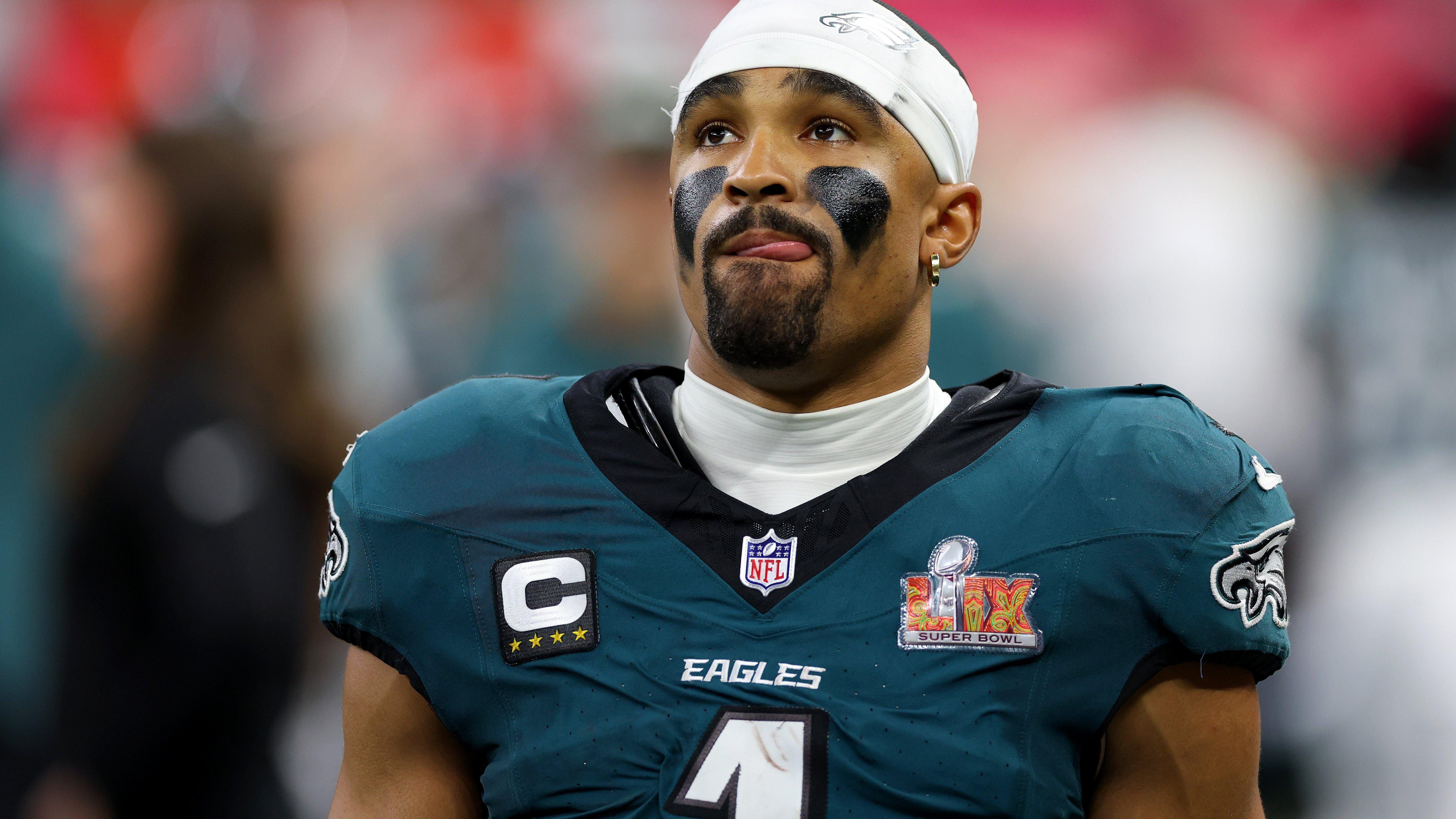
All of this money will need to be paid eventually, but the Eagles are not paying it now, and are under no obligation to pay it now. More on why later, but before we can get to that, we need to get into the specifics of the salary cap itself.
In my first section, I reported that in 2025, the Jaguars were playing under a salary cap of $298M, meanwhile the Saints had just $283M to work with. This must be a mistake, right?
No. It is not a mistake.
Unlike the NHL and the MLB’s luxury tax, where all teams are constrained by the same money figure, and similar to but different from the NBA, where all teams effectively have different caps, but are only allowed to use them on certain players, due to Bird Right rules, in the NFL, every team is working under a fundamentally different salary cap. In this image from 2018, you see just how radical the differences can be.
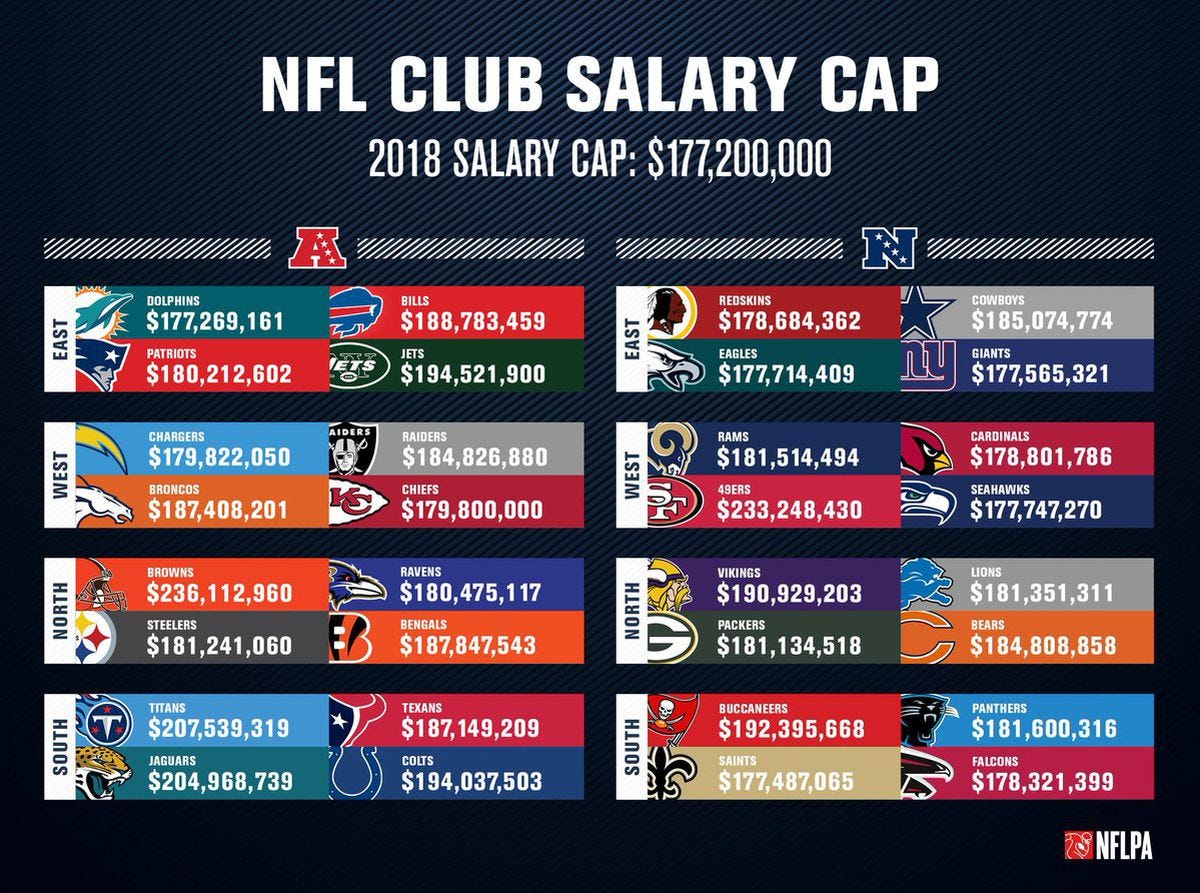
All NFL teams start from the same baseline, the league salary cap, guaranteeing 48.5 percent (give or take, as this figure is not exact in the NFL’s CBA) of league revenues to the players, which for the 2026 season is set at $301.2M. However, to this baseline, which every team shares, there are two factors that are added. The first is a series of adjustments, due to expenses either undercounted or overcounted in 2025. I will leave you to Troy’s videos to explain what exactly these adjustments are, and how teams must allow the NFL to audit them. The second differentiating factor in the size of team salary caps is the carryover allowance.
The carryover rule allows every team to carry 100 percent of their unused cap space from 2025 forward to 2026. For instance, in 2025, the New England Patriots, with a rookie contract QB Drake Maye, and an underpaid WR1 in Stefon Diggs, finished the season with $48.4M in unused cap space in 2025, despite their 13-4 record. They are rewarded for winning on a budget in 2025 with an an extra $48.4M this year, resulting in a massive $346.1M salary cap in 2026, the highest in the league.
On the other hand, due to underpaying various expenses, and finishing with only $3.1M in unused space in 2025, the KC Chiefs are going to have to try to beat the Patriots in the 2026 AFC under a salary cap of just $298.8M, the lowest cap in the league. This is the NFL’s punishment for being so close to the cap for so long, as the KC Chiefs have done. It’s not only that the players are more expensive. They are also playing under a smaller cap than the sad sack (until 2025) Patriots.
While most other leagues operate under the idea of one cap for one league, the NFL has never operated under this principle. There are 32 different salary caps for 32 different teams. There has been for over 30 years now, and now that the baseline has grown to a gargantuan $301M, there can be differences of as much as $48M between the highest cap and the lowest, as we see between the Chiefs and Patriots.
Teams are prevented from infinitely building up cap space using the carryover by the requirement to have always spent at least 89 percent of their total cap space over the last four years. This is checked every year, and if at any point a team falls below 89 percent, they are noncompliant, and penalised monetarily, bringing them up to the floor by force. This is why I referred to the salary floor as theoretical in my opening section. There is no season-to-season salary cap floor in the NFL.
The key point to take from this section is that unused salary cap space is not wasted in the NFL, the way it is in the other North American leagues, because in the NFL, last year’s space is directly related to the size of next year’s cap. Space on its own is valuable, on the condition you’re above the floor, as it can always be carried forward to another season, giving you a higher salary cap than other teams in the league.
The real cap guys will tear me apart for saying this sentence, screaming of incentives and roster bonuses and the like, but remember, we’re shooting for only C+ knowledge here. By and large, there are two components of the compensation schedule of an NFL contract. There is bonus, and there is base salary. These two parts of the deal are handled by the salary cap in different ways.
Base salary is the simplest. If a player’s base salary is $10M in 2026, that’s $10M against his team’s cap in 2026, and that’s all there is to it. Bonuses are entirely different. The cap hit for a bonus is spread out equally over the next five years, or over the entire lifetime of the contract, whichever is shorter.
The best way to illustrate this is an example. Let’s say we’re the GM of a theoretical NFL team, signing a player to a two year, $20M contract. For simplicity, all this money is guaranteed. Let us also say that we want a smaller cap hit in year one than in year two, and yet, more actual money in year one, and less in year two, as is typical with NFL player contracts.
How would we do this?
If we were to design this contract only using base salary, it would be impossible. If we wanted most of the money to be in year one, most of the cap hit would also have to be in year one. However, what if instead of paying the player week to week, we instead gave him $12M in signing bonus, and only $8M in salary?
According to the salary cap’s rules, regardless of actual payment schedule, all signing bonus money gets spread evenly over the length of the contract, which for our two year contract, means of that $12M bonus, $6M is charged to our cap in year one, and $6M in year two. That leaves $8M total to pay as base salary, but we’re already paying the player $12M in signing bonus, immediately upon signing, so he’s not short of money in year one of the deal. What if we took advantage of that, and made his salary $1.3M (veteran minimum) in year one, stuffing all the other $6.7M regular salary into year two?
We get a cash structure that looks like this:
$12M Bonus + $1.3M Base = $13.3M
$6.7M, all Base
But a cap hit structure that looks like this:
$6M Bonus + $1.3M Base = $7.3M
$6M Bonus + $6.7M Base = $12.7M
Remember what I said earlier. Every dollar of this contract has to go against our cap, sooner or later, but that does not mean we can’t mess with those dollars, to put them against the cap exactly when we want to pay them, regardless of when we pay the player his actual money.
This is important, because if we signed that theoretical deal in 2025, using the salary cap baseline of $279.2M for that year, the $7.3M cap hit would be worth 2.6% of our cap in year one. However, if the cap structure were to match the cash structure, $13.3M would be 4.7% of our cap in year one. If we’re trying to win now, we can’t afford to spend 4.7% of our cap this year. Much better to give the player the exact same money, but structure the contract with lots of the money as bonus, to bring the year one cap hit down.
This is a much smaller scale transaction than Jalen Hurts’ QB contract I discussed earlier, but remember how I said that the Eagles managed to pay him $40M, on a cap hit of only $13.6M? A much larger scale version of this same example is how they did it.
That’s the fundamental idea of bonus proration. Give the player the big money right up front, to convince him to stay, yet load all the cap payment to the back of the contract, where the win-now period may be over, but also, in the case of Jalen Hurts, the Eagles’ cap is going to be $100M higher than it was at the time they signed the deal.
Why take the pain of a $40M cap hit when the cap is $250M, when you can take that same $40M pain at the end of the deal, where the cap looks to be $350M, or higher? Inflation is important, and even in our real lives, if you can defer a payment for five years, for no penalty (which the NFL salary cap allows), anybody would take that deal one hundred percent of the time.
That’s what these teams are doing, when loading all the cap hit to the back of the contract. It’s not all desperate lust to win now (although there is some of that). There’s also some cold, hard, economics behind it. Wait for inflation to kick in (in the form of a skyrocketing salary cap), pay no interest, and only after five years of cap increases have happened, pay your payment. That’s just smart business, and that’s what spreading the bonuses over the entire length of the deal allows these teams to do, bringing year one cap hits down to boot. It’s no wonder that NFL teams are constantly restructuring deals to make more salary into bonus money, and speaking of which…
Deeply related to the concept of bonus spreading is that of the contract restructure. For those that don’t know, a contract restructure is not a contract renegotiation. Renegotiations include things like extensions, pay cuts, raises, and etcetera. Restructures are strictly an exercise in moving money around, converting salary to bonus.
Bonus is fully guaranteed though. Why would any team want to do this?
Bonus proration.
Due to the magic of bonus spreading, it’s possible for a simple restructure to take a player’s cap hit from team crippling to a bargain. We saw a perfect example of this just last week with the Baltimore Ravens. Prior to his recent restructure, Lamar Jackson had $22.5M of cap hits as leftover spread from already paid bonuses, plus $51.25M in base salary, for a total cap hit of $74.75M in 2026, roughly 25% of the Ravens’ salary cap for just one player, which makes it almost impossible to build a roster.
To get themselves out of this situation, the Ravens restructured all of Lamar’s base salary, except the $1.3M veteran minimum, into bonus money, fully guaranteeing it, but spreading almost $50M of salary, which would all be paid in 2026, into $9.99M installments on each of the final five years of his deal. Adding this bonus spread to the already existing $22.5M of bonus spread, we get $33.49M of bonus proration, and just $1.3M of base salary, for a $34.8M cap hit altogether for Lamar in 2026. That is dramatically easier for his team to work with than almost $75M.
This scenario is why teams choose to turn salary into bonus money. It becomes guaranteed, but in exchange, they get to take five $10M hits, much easier to work with than one $50M hit, and in the case of a franchise QB like Jackson, over half of that $50M was guaranteed anyways, so this was an almost costless way for the Ravens to save $40M in cap space.
Just for reference, teams do not need to consult the player before converting their salary in this way. In this case of the Ravens and Lamar Jackson, the team did not consult the player before unilaterally restructuring. This is all business as usual in the NFL. Not every team will have a ready made, $40M cap save like this one, but the Lamar example makes it very easy to illustrate exactly why teams would want to restructure a player contract, and why they’re constantly doing so.
(PS. So-called ‘option bonuses’ are all the rage these days, but they are little more than pre-arranged restructures, agreed upon several years in advance. Once again, the real salary cap grinders will not like hearing that, because option bonuses and restructures are not strictly the same thing, but at the C+ level we’re operating at, they’re basically the same.)
What if, instead of wanting to restructure a contract to save cap space, the team decides to move on from a player, cutting or trading him, either to save cap space, or just because he and the team are done with one another? This is another valid way of doing business in the NFL, but it comes with a cost.
The dreaded ‘dead money.’
This phrasing makes no sense to me. Money is never dead. Money can never die. In reality, the literal definition of dead money is cap space that is being used on a player no longer on the roster. Dead money arises from that common refrain we’ve been seeing throughout the piece.
All money that teams pay to players must show up on the salary cap at some point.
Back when I used to be a more casual fan of the NFL, or when I was trying to manage my roster on a John Madden Football game, the concept of dead money made my head hurt, but it’s actually very simple. Dead money is all the money that the releasing team has committed to pay to a player, that has not yet shown up on any salary cap.
In this context, ‘committed’ means either money already paid, or money that is fully guaranteed (refer to Troy Chapman for the nuance of partial guarantees) as of the time of the player’s release. When you cut a player without a June 1 designation (we’ll get to that in a minute), the way the NFL makes the cash balance up with the cap balance is to take the difference between committed money over the life of the contract, and the cumulative cap hit over the life of the contract so far, and charge that difference as a lump sum on the team’s present year cap.
For example, Kirk Cousins has no guaranteed base salary left. However, he does have $25M of signing bonus spread from money paid years ago that has not yet shown up on any salary cap, plus a $10M fully guaranteed roster bonus for 2026, which has not been paid for on any salary cap yet, creating $35M of total dead money that the Falcons committed to pay Kirk ($25M already paid, $10M fully guaranteed, yet to be paid) that they have to account for, even though they’ve just released the player.
Once again, not every dead money calculation will be as simple as Kirk Cousins’, but the concept of dead money is very simple. Money that either already has been paid, or that the team has made an ironclad commitment to pay, that has not yet been seen on any salary cap. When the team cuts such a player, the NFL charges that balance immediately, or in the case of a post-June 1st designation, they allow the dead money to be spread in a very specific way.
This is all when a player is released. When making a trade, the dead money calculation is very slightly different.
The team receiving the traded player takes on all not yet fulfilled commitments, even the fully guaranteed ones. However, the money the trading team has already paid remains with them. To use the Kirk Cousins example again, the $25M that was already paid in signing bonus but has not yet appeared on any salary cap would be charged all at once as $25M in dead money on Atlanta’s cap in 2026. However, the $10M fully guaranteed roster bonus would go with Kirk to his new team. The Falcons would not have to pay that as dead money.
An odd quirk in the rules is to designate a player as a post-June 1 release. The reason teams have to wait until June 1 is that the NFL very specifically does not want this extra cap relief to be used to aid a team’s ability to sign free agents. The post-free agency, post-draft designation is very specifically designed to give teams cap relief when they need it to sign rookies.
The specifics of the post-June 1 designation is that the player’s 2026 cap number stays on their books until June 2. However, it does not actually hold the player hostage, forcing him to wait until June 2 (when most spots are full) to try to find a new team. This way, it’s the best of both worlds. Teams get extra cap relief, but cannot use it to sign free agents (at least not until all the best ones are gone), and the player gets to find a new team, while his old team waits for his cap number to come off the book, instead of having to actually wait as a lame duck on the roster until June 2.
The post-June 1 designation does not do anything to change the amount of dead money that the releasing team owes to the NFL. What it does is allow the team to spread that dead money out over two seasons, instead of paying all at once, in the following manner:
All guaranteed money, plus this year’s portion of the bonus spread, will remain on this year’s cap as dead money. However, with a post-June 1 designation, all future bonus spread will be added together, and will be added to the 2027 cap, as dead money. To use the Kirk Cousins example once again, he has $12.5M in bonus spread and a $10M guaranteed roster bonus this year, and $12.5M of bonus spread remaining next year.
By the rules of a post-June 1 release, all money associated with this year will remain in 2026, as $22.5M of dead money on the Falcons’ cap. However, next year’s portion of the bonus spread will go to 2027, as $12.5M of dead money on next year’s cap. In the event of a post-June 1 trade (for which there is no designation, so the trade must actually wait for June 2), the new teams keeps all the guaranteed money, just as before, but the bonus spread is handled in the style of a June 1 designation. The spread from this year stays in this year, and all future spread gets added up, and charged next year.
Oh boy. Here we go. What’s to say about void years?
Many people (including myself) get confused over the concept of void years, but now that we understand the concept of bonuses spreading out over the life of the contract, and the concept of dead money, we can understand what makes fake years at the end of the contract so valuable to these NFL teams.
A void year is a season that is part of the player contract, with prior language in the contract indicating the deal will be voided before the player can ever get to that season, making the player a UFA.
For example, did you know that the Jalen Hurts contract actually runs all the way until 2032?
That does not fit with the reporting that he signed a five year, $255M extension in 2023. However, in the fine print, you will find the language that the 2029, 2030, 2031, and 2032 seasons all automatically void 23 days prior to the start of the 2029 league year (about a week after the 2028 Super Bowl), making Jalen a candidate for 2029 free agency, despite a contract that, on paper, runs all the way until 2032.
At the beginning of this exercise, I wondered why any team would want to add fake years onto a contract in this way, but now that we all understand that the cap impact of signing bonuses can be spread out over a full five years, we can see that adding void years onto a contract can bring the cap hit down substantially.
Let’s go back to our two year, $20M contract from earlier. Remember the cash structure:
$12M Bonus + $1.3M Base = $13.3M
$6.7M, all Base
Remember the cap structure:
$6M Bonus + $1.3M Base = $7.3M
$6M Bonus + $6.7M Base = $12.7M
That’s a perfectly fine NFL contract. However, now that we know we can spread signing bonuses out over a full five years, why don’t we add three fake years onto the end of the contract? The money structure will be the same: $13.3M in year one, $6.7M in year two, but look at how the cap structure changes:
$12M / 5 years = $2.4M Bonus + $1.3M Base = $3.7M
$2.4M Bonus + $6.7M Base = $9.1M
$2.4M Bonus
$2.4M Bonus
$2.4M Bonus
With void years, we’re now getting away with paying a player $13.3M, on a cap hit of just $3.7M, in year one, and while we’re at it, let’s say now that year one has been played out. We’re now looking at a contract with one year left on it, and this structure.
$2.4M Bonus + $6.7M Base = $9.1M
$2.4M Bonus
$2.4M Bonus
$2.4M Bonus
I don’t like that $9.1M cap hit. That’s a little high for what this player can do. To save a little space, let’s make all of that $6.7M base salary (except the $1.3M veteran minimum) into a $5.4M bonus, which because we get to spread it over all four years remaining in this contract, adds $1.35M to our already existing bonus spread in every season, leading to this new post-restructure cap breakdown:
$3.75M Bonus + $1.3M Base = $5.05M
$3.75M Bonus
$3.75M Bonus
$3.75M Bonus
Assuming this is all the finagling we’re able to do, we can look back retrospectively on a contract that paid $13.3M in year one, and $6.7M in year two, in real cash, but see that the $20M in cash was spread out on the salary cap as follows:
$2.4M Bonus + $1.3M Base = $3.7M
$3.75M Bonus + $1.3M Base = $5.05M
$3.75M Bonus
$3.75M Bonus
$3.75M Bonus
Add all those figures up, and you get exactly $20M. As before, one dollar spent equals one dollar on the cap, but in the NFL, it’s entirely possible to have leftover cap hits for as many as four years after a player is done playing for your team, via the use of void years, and bonus spreading over the entire life of the contract, even if (as in our case) more than half the length of the contract is fake. Our theoretical player still becomes a UFA after year two, at the predetermined contract void date.
Once year two is over, and our team is staring this void date in the face, there are two options. The first option is to allow the contract to void, which in the eyes of the salary cap is no different than cutting the player. Contracts can be voided either with or without a post-June 1 designation.
Taking that contract we have above, if we allowed it to void after year two without a June 1 designation, the NFL would take all of the money paid to the player, but not yet seen by the cap ($20M - $3.7M - $5.05M = $11.25M) and charge it all at once in year three, as a dead cap hit. If we were to allow the contract to void, but use a June 1 designation on it, it would work as described in the June 1 section. All the signing bonus spread associated with year three would stay there, for a $3.75M dead cap hit in year three, but the spread associated with all future years ($3.75M each in four and five, in this case) would be added together, and charged in year four, as a $7.5M dead cap hit.
The second option the team has when staring down a void date is to resign the player to a new contract. In this case, the $3.75M of signing bonus spread from years three, four, and five of the old contract would stay, as bonus spread in year one, two, and three of the new contract. For instance, if we signed him to the exact same two year, $20M, $12M up front bonus, three void year contract again, following the restructures as done above, it would look like this:
$12M / 5 years = $2.4M Bonus + $3.75M Pre-existing Bonus + $1.3M Base = $7.45M
$2.4M Bonus + $3.75M Pre-existing Bonus + $6.7M Base = $12.85M
$2.4M Bonus + $3.75M Pre-existing Bonus
$2.4M Bonus
$2.4M Bonus
In total, if we decided to do these back-to-back two year deals, and let the contract void after year four (year two of the second deal), with a post-June 1 designation, the total cap breakdown for this player’s time on our team would look like this:
$2.4M Bonus + $1.3M Base = $3.7M
$3.75M Bonus + $1.3M Base = $5.05M
$6.15M Total Bonus + $1.3M Base = $7.45M
$6.15M Total Bonus + $6.7M Base = $12.85M
$6.15M Total Bonus Dead Cap
$2.4M + $2.4M = $4.8M Dead Cap
This player played for us for four years, and made $40M. That’s $10M per year, but his cap hit was as high as $10M only once, in the six total years he spent on our books. That’s a brief and informative illustration of how void years can help a team, but how about we look at something real?
This is the Jalen Hurts contract:
(2024) $12.4M Total Bonus + $1.1M Base = $13.5M
(2025) $20.7M Total Bonus + $1.2M Base = $21.9M
(2026) $30.8M Total Bonus + $1.2M Base = $34M
(2027) $40.8M Total Bonus + $1.3M Base = $42.1M
(2028) $46.1M Total Bonus + $1.4M Base = $47.5M
(2029) $38.4M Total Bonus
(2030) $30.1M Total Bonus
(2031) $20M Total Bonus
(2032) $10M Total Bonus
As you can see, this contract goes so long that because bonuses can be spread out over five years maximum, they eventually start dropping off the deal, but you can see the structure, of how the total bonus spread keeps going up by roughly $10M every year, over the life of the real contract. This is because the Eagles are continuously stacking $50M / 5 year spreads of signing bonus on top of each other, as a way to pay Jalen $51M per year on his five year, $255M contract, without ever getting up to $51M as a cap hit in any individual season.
(Side note: these are actually option bonuses, which are not different from signing bonus unless you intend to trade the player, which I highly doubt in this case. Refer to Troy’s videos for more info if you’re interested)
For the win-now window from 2024-2028, this contract is going to work a charm for the Eagles. They are heavily banking on a perpetually increasing salary cap for this Jalen Hurts contract not to destroy the roster near the end of this decade, but as of right now, with a salary cap that has been skyrocketing every year since the pandemic ended, that may not be so bad either.
It is absurd to me that the Eagles by the end of 2028 will have paid out the full $255M, yet their salary cap will have seen only about $157M of it, but this is what the current rules with bonus spreading and void years allow teams to do. We cannot blame them for exploiting.
Void years are another topic that makes many people’s brains hurt, but I hope I’ve explained them adequately enough.
For one final exercise, I decided I’d like to see what the next big QB rookie extension contract will look like, if I can manicure it exactly like the Eagles did for Jalen Hurts. Let us say the next gargantuan QB contract is going to be five years, $350M, for a clean $70M per year. That sounds completely ludicrous, but the NFL’s per-year average leader is currently $60M, and we all know how these agents are about always wanting to represent the highest paid guy ever, so a clean $70M per year on a five year deal is the goal.
I would like to say our player is nice, and will accept only about ten percent of his deal up front, like Jalen Hurts did, but I get the feeling that $100M up front as signing bonus may be the ask of the next big QB out there. That’s an immediate $100M / 5 = $20M Bonus spread right off the top, with very little we can do about it. However, with that $100M spent, we can give him the veteran minimum $1.4M base salary, for a year one cap hit of just $21.4M.
Additionally, let us say that every offseason, we can get this QB to agree to add a void year to his contract, like Jalen Hurts did. From here, let’s say we’re really looking to get the player to stay, so offer $80M in year two, all as bonus. With the additional void year, we get $80M / 5 = $16M in bonus spread, on top of the $20M we already had, plus the $1.4M league minimum base salary, for a year two cap hit of $37.4M. That’s high, but considering we’ve paid this player $182.8M in the last two years, it’s not so bad.
With $182.8M out of the way already, that leaves $167.2M to pay in real cash in the last three years of the deal. Let’s just say we do it equally. $55.7M per year. Take out the $1.4M veteran’s minimum that we must leave as base salary, and that’s $54.4M per year we can convert to bonus. Assuming we add a void year to the end of the contract every offseason, that’s $10.9M of spread every season, which leads to the following cap breakdown, on a five year, $350M contract:
(2027) $20M Total Bonus + $1.4M Base = $21.4M
(2028) ($20M + $16M) Total Bonus + $1.4M Base = $37.4M
(2029) ($20M + $16M + $10.9M) Total Bonus + $1.4M Base = $48.3M
(2030) ($20M + $16M + $10.9M + $10.9M) Total Bonus + $1.4M Base = $59.2M
(2031) ($20M + $16M + $10.9M + $10.9M + $10.9M) Total Bonus + $1.4M Base = $70.1M
(2032) ($16M + $10.9M + $10.9M + $10.9M) = $48.7M Total Bonus
(2033) ($10.9M + $10.9M + $10.9M) = $32.7M Total Bonus
(2034) ($10.9M + $10.9M) = $21.8M Total Bonus
(2035) $10.9M Total Bonus
Spoiler alert. I am not quite as good as Howie Roseman.
He managed to design a five year contract worth $51M per year, where the cap hit never once got up to $51M. I fell barely short of that with my $70M per year contract, probably due to my player wanting $100M in year one. The real contract will probably be less than that, but not by much (Josh Allen got $57M as upfront signing bonus in his 2025 extension, on a deal worth only $55M per year), and I wanted to show you can work this cap magic even with some pretty outrageous demands from the player, if you’ve got the guts to push well over $100M of dead money into the void year, which Howie Roseman does, and very few other NFL GMs do.
On the other hand, this can also backfire really badly, as the Cleveland Browns have found out in recent years. They’ve pushed so much money back that they’re still looking at over $80M in dead money once Deshaun Watson’s contract finally voids at the end of 2026.
If you give a contract like the one I’ve just designed to a bad player, it’s all but uncuttable, as basically all the money is guaranteed, and you also turn five years of pain (the span of the deal) into seven years of pain, with five years plus two years of big time dead money on a post-June 1 designated release.
The Cleveland Browns are set to eat about $35M in dead money on Deshaun in 2027, and a whopping $51M in 2028. The team set themselves up for this on purpose, all in an effort to keep the cap hit down in 2022 and 2023, a time the team was looking to win now. To be fair, they don’t have the money for that 2023 defence without the Deshaun contract being structured in this way, but I wonder if Cleveland fans are going to think the extra two years of pain are worth it for that.
When you live by the cap circumvention sword, you also die by that same sword, and in the end, I think that’s all I have to say today.
In this piece, I’ve tried to fit myself into a niche that explains the salary cap in advanced enough terms so we can all feel like we understand, but not so advanced that it takes several hours to learn, in the style of the great Troy Chapman.
Over the last 6062 words, we have learned the core tenet of the salary cap, that every dollar spent must be accounted for eventually, even if that dollar is seen on the cap as long as five years after it is actually spent. We have learned that every football team plays under a different salary cap, and that sometimes, retaining space is valuable, as a team can carry that space forward to next season.
Then, we got into cap exploitation. The easiest way to do this is with bonus proration. While base salary goes on the cap at the time it is paid, all money paid as bonus gets spread over a period of five years. Teams have been using this process to circumvent the salary cap since there has been a salary cap, and likely will continue to do so long after we’ll all gone.
A close relative to the concept of bonus spreading is the newfangled void year, which is nothing but a fake year added to the end of a contract, so that bonuses can be spread over the full five years allowable, keeping the per-year hit as low as possible, at the cost of leaving a lot of dead money at the end of the contract.
Dead money feels like a nebulous concept sometimes, but think about it as the difference between the money that is ineligible to be released from a contract (either already paid or fully guaranteed), and the amount of money that the salary cap has seen. That exact difference is what the NFL charges. In the case of Jalen Hurts, where a $255M contract is going to end with a five year cumulative cap hit of about $157M, that creates a lot of potential dead money, and in the case of Tua Tagovailoa, with a lot of bonus already paid and over $50M of guaranteed money for 2026, that creates a lot of dead money also.
In short, if the cumulative money paid/guaranteed to be paid is out ahead of the cumulative cap hit, a team is going to incur a lot of dead money. If the money schedule and the cap hit schedule are fairly close, there’s going to be very little dead money, or perhaps none at all, as is common near the end of contracts, when all the guarantees are already paid, and all the money remaining is noncommittal.
Last but not least, there are two different ways to handle a potential dead money charge. It can either be taken all at once, if a player is released before June 2, or it can be spread over two seasons, with a release that either naturally happens June 2 or later, or a release that carries a post-June 1 designation.
In my opinion, this is everything an average football fan needs to know in order to be literate in the salary cap. Being literate does not make one into Shakespeare (once again, Troy Chapman’s Salary Cap 101), but it is enough to understand how and why football teams operate, with regards to the cap.
My apologies for being gone so long. Next time I intend to return quicker.
Thanks so much for reading.
Comments
Nothing yet. Say the first thing.
Sign in to join the conversation.