
I had never heard of Ludwig Göransson when the publicist Ray Costa hired me to write his press bio in November 2015. Creed was just about to come out, and I’ll admit I was incredibly skeptical of a) a seventh Rocky movie, and b) this young Swedish composer with long hair and a funny name whose main credit was the sitcom Community (which I had never watched).
Speaking to him for the first time over the phone eleven years ago, I was charmed by this friendly guy who was almost exactly my age and who had a very unique but relatable background (his formative love of John Williams came up organically). But the deal was sealed a week later when I saw Creed at a press screening on the Warner Bros lot—a beautiful, viscerally inspiring movie that announced Ryan Coogler as a major director of not just action but emotion, which completely justified (and mined dramatic gold from) bringing a geriatric Rocky Balboa back to the screen, and which resurrected the melodic and fairytale-anthemic spirit of Bill Conti in a way I could not have dreamed. Creed was so much better than the other seventh chapter which came out that winter (The Force Awakens), and it instantly made me an enormous fan of Ludwig Göransson.
[Listen to my NPR story on Creed, featuring Coogler and Göransson]
Creed established many of the hallmarks of Göransson’s project as a film composer: a penchant for melody and for honoring the orchestral storytelling traditions of Hollywood, combined with a contemporary producer’s sensibility, informed by jazz and hip-hop, and a keen sense of innovation in the form of sampling unusual sounds (with almost an ethnomusicologist’s curiosity, often obtained via quest) and dropping them like a DJ. The thing that really impressed me with Creed was that Göransson didn’t just quote Conti; he honored Conti. Just as he honored John Williams with his music for The Mandalorian, which again merged a beat-driven, electronica, sampling ethos with an earnest devotion to long-line lyrical melody and the full power of the orchestra. All of these elements were also on full display in his first Oscar-winning score, for Black Panther—by far the finest music that had ever emerged out of the artless Marvel machine.
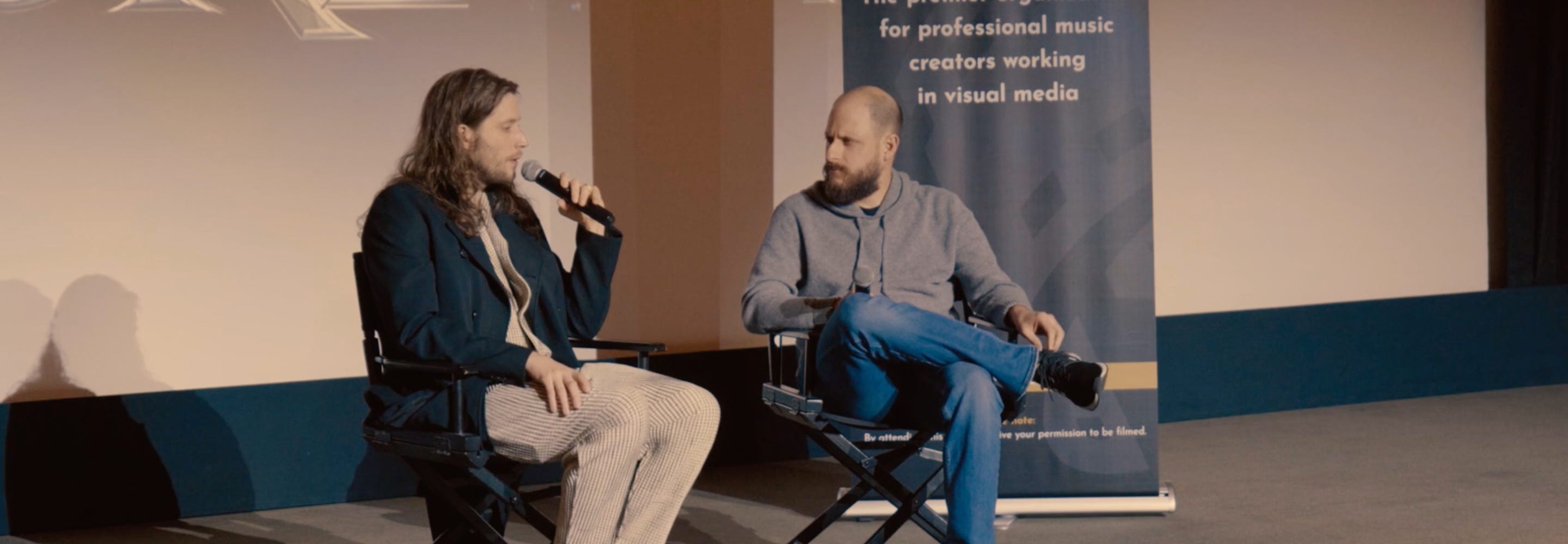
My cards are on the table: I’m a huge fan. As a journalist I’ve covered Göransson’s scoring career, interviewing him at his studio or on stage about each major new score, and even attending a few scoring sessions. (I’ll never forget hearing the training montage music in Creed II for the first time inside the booth at Warner Bros., with Rocky producer Irwin Winkler stretched out for a nap on a couch next to mine.) I profiled him in 2019 for the New York Times, and most recently did a story on the music of Sinners. Ludwig is also, dare I say, a friend, which no doubt colors my affection for his music—although I’m friends with many other composers who don’t so consistently wow me with their scores. All to say, I was thrilled when I learned that Christopher Nolan, having parted ways with Hans Zimmer after Dunkirk (a sadness), had elected Göransson as his next collaborator. In my opinion, he could not have picked a better dance partner.
Like Ryan Coogler, Nolan prefers to involve his composer at the very beginning of a project, before production even begins—a superb development in the art of film scoring that has blossomed over the past decade-plus, led by tight director-composer duos like Barry Jenkins and Nicholas Britell, Damien Chazelle and Justin Hurwitz, and David Lowery and Daniel Hart (among others).
“I’ve always viewed the music as needing to be integrated early into the DNA of the film,” Nolan told me in 2023, “and not applied afterwards, you know, like a sauce on a piece of meat.” This is one of many reasons I contend that Nolan loves music as much as Steven Spielberg—he just loves it in a different way.
But unlike Coogler (and Spielberg), Nolan doesn’t really go for melody. The aesthetic that he and Zimmer cultivated (as I explored in my previous essay) was minimalistic, repetitive, and textural—a combination of extreme economy and extreme volume. Göransson followed suit, honoring Zimmer’s spirit (much as he had done with Conti and Williams) while very much bringing his own distinct mojo to bear.
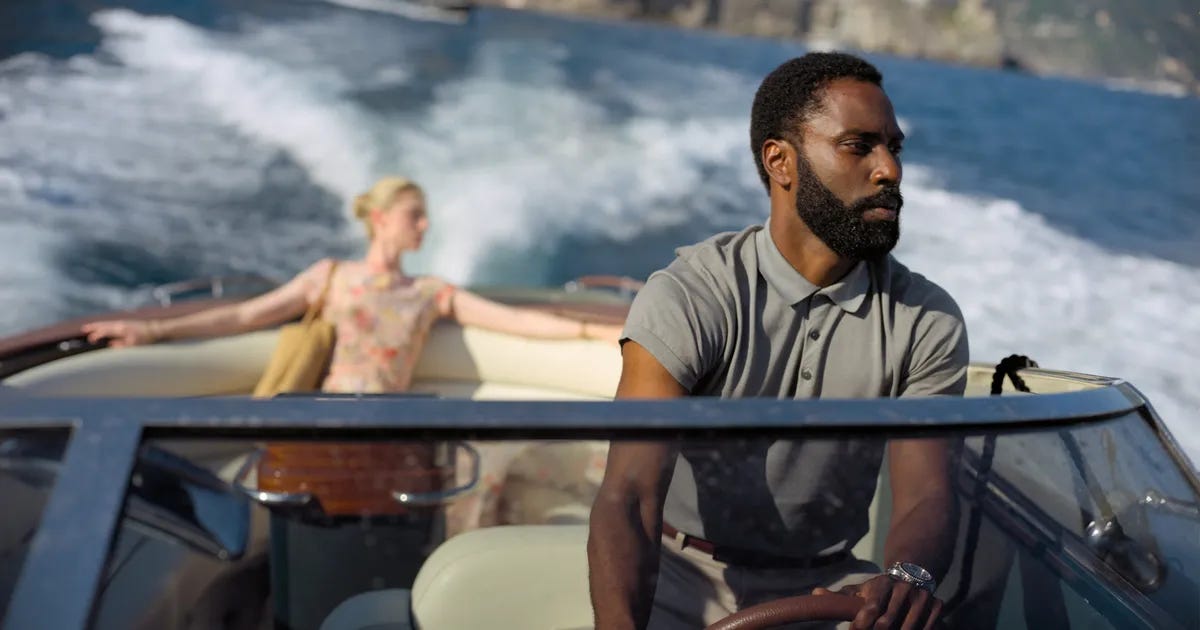
I freakin’ love Tenet. It’s my favorite James Bond movie; a heady, trippy, bewildering, sci-fi James Bond movie, to be sure, and one that I still don’t (fully) understand, and yet an endlessly seductive, globetrotting adventure with a massively charming lead in John David Washington, a strong emotional core in the character played by Elizabeth Debicki, and just scene after delicious scene… one long unbroken chain of staggering set pieces and sumptuous visuals. All best enjoyed by following a line from the script: “Don’t try to understand it. Just feel it.”
I can already hear the blood of the haters and dissenters boiling in the comments. Tenet and Nolan are decidedly not everyone’s cup of tea. But Tenet is for me what Earl Grey is for Christopher Nolan; I can never drink too much. And what makes it all go down so smooth is the terrific dance-track score by Ludwig Göransson.
Seductive is absolutely the word for it. The score pulses like a sleek nightclub, but it also rises and falls with drama and emotionality. It’s minimalistic, based on short little melodic cells and chord sequences and ostinati and lots of different rhythmic patterns that rotate like Windmills (the title of one of the score’s standout tracks), but it’s also constantly evolving and shapeshifting, turning corners and exploring. It grooves under (or often over) Nolan’s glorious montages—of exposition, of motion, of spectacular stunt sequences—creating the river, the hypnotic dream state that Terrence Malick modeled and which Nolan has made his own. But the music also ingeniously plays with time inversion, with so many bits having been played backwards by musicians and then electronically reversed. It’s addictive, dancey, and delicious, giving Tenet the intoxicating vibe that us true believers love to surrender to, and it also completely delivers as a standalone listen. (I do, however, usually skip the croaking vocals of “SATOR.”)
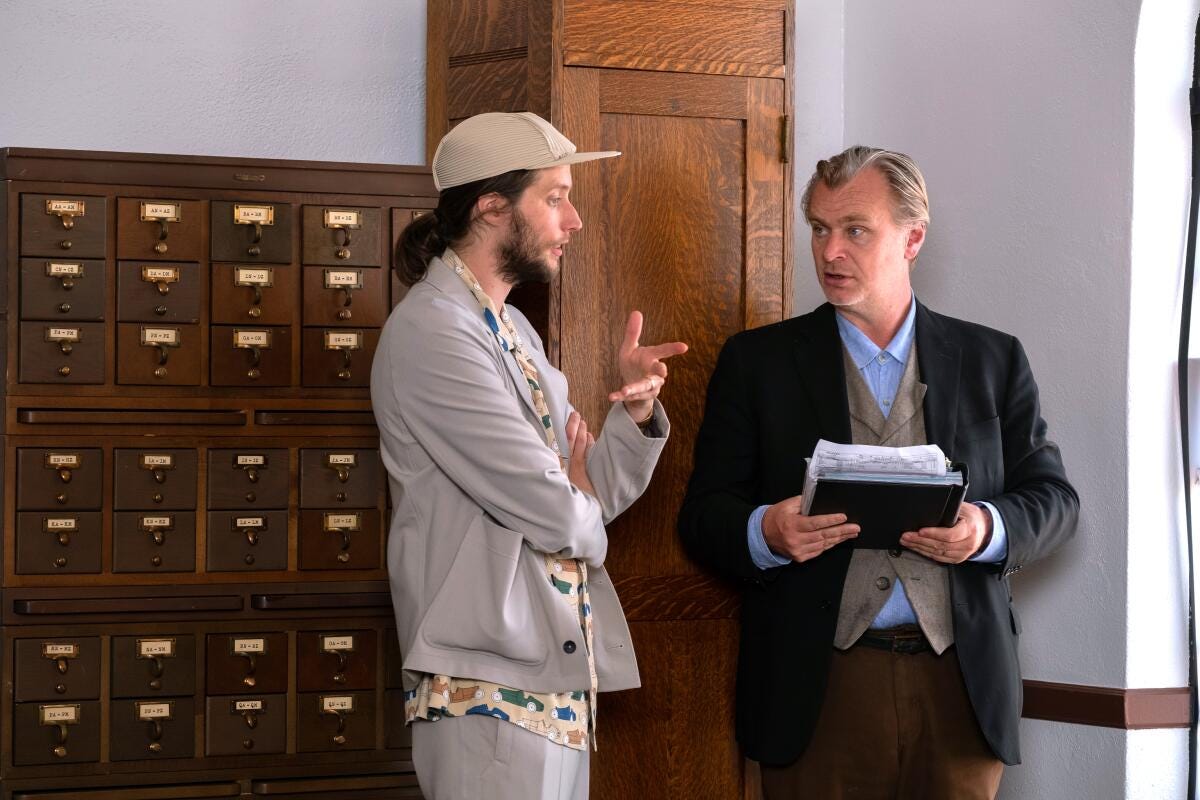
They leveled up with Oppenheimer, which is at once both meditative and breathless—a close-up interior character piece and a (literal) ticking-time-bomb thriller about the apocalypse. An immediate comparison piece for me was Oliver Stone’s Nixon, a film that helped pioneer the breathlessly edited, near-montage epic of a Shakespearean tragedy about a Great Man of History (surrounded by an enormous, star-studded cast). Everything about Oppenheimer works gloriously—Cillian Murphy’s performance, the parallel plots about the development of the bomb and the bureaucratic aftermath, the eye-popping imagery, the symbolic shots of water ripples and the repeating visual of Oppenheimer meeting with Einstein—and once again Göransson’s score is the emotional river.
More traditionally acoustic and much less dancey than Tenet, the Oppenheimer score creates its own kind of dream state, a reflective, beautiful, melancholy current befitting the melancholy protagonist. I have noticed a very sharp split among people who love John Williams and the endless melody storytelling ethos he represents when it comes to the hypnotic, minimalistic approach to scoring that Zimmer and Göransson have come to symbolize. To each their own! For my part, I can fall in love with both; I love old Tangerine Dream and Giorgio Moroder and John Carpenter scores, I love Philip Glass… and I love Bernard Herrmann, who in his own unique midcentury way introduced this vocabulary into film scoring. Economical, cell-based, repetitive music works like gangbusters as accompaniment to cinema, and when it’s done with creativity and passion, when it’s handcrafted by a real artist, it is magic. I believe Göransson (who can write a great old-fashioned tune when the assignment calls for it) is in the vanguard of this mode of film scoring, and he’s partnered up with some of the best filmmakers working today to pursue it… directors who have elevated him to the status of their co-author.
Nolan already had an abundance of Göransson’s music before he shot Oppenheimer, and he would listen to it on the set, then lay it in as he started to edit the picture—“so that way his music is always being used as a fundamental part of the narrative, rather than decoration, a sort of window dressing,” Nolan told me. “It’s essential to the narrative.”
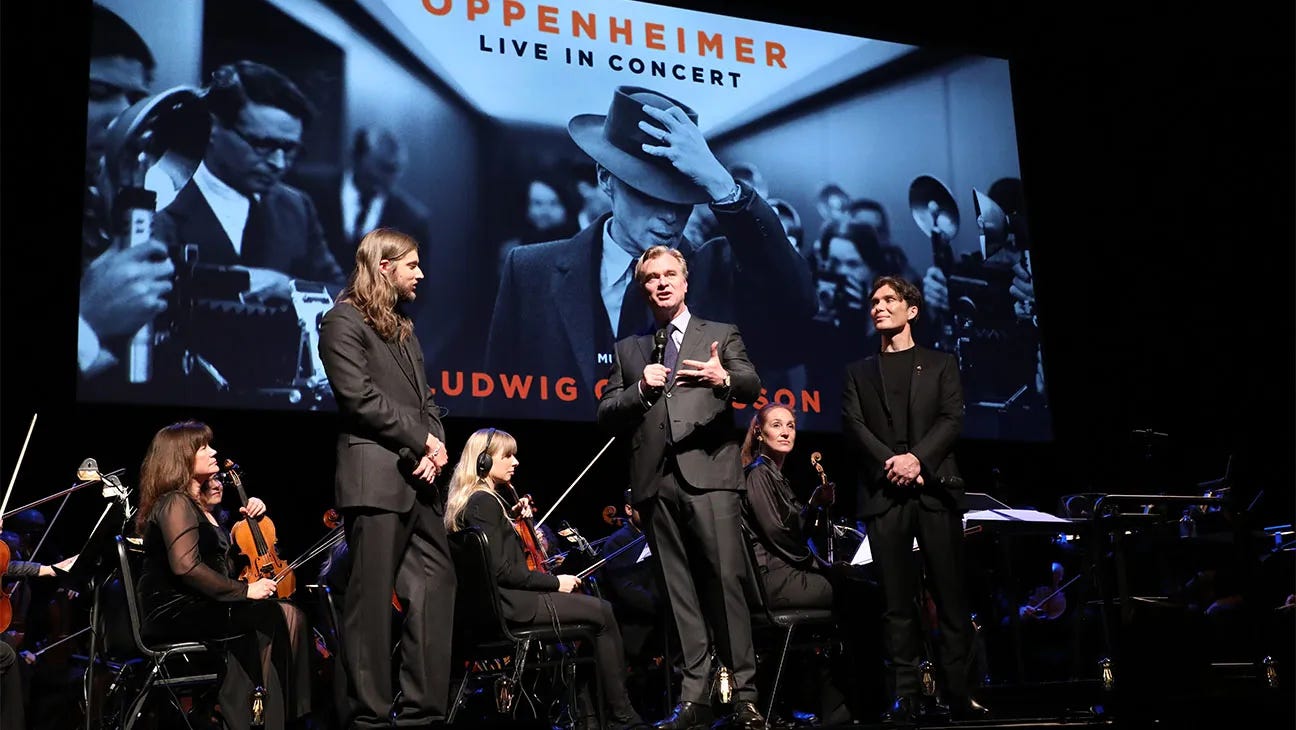
Which brings us to The Odyssey.
I’ll come right out and say that I was a little let down, both by the film and the music. I had heard the reports that Nolan asked Göransson to eschew an orchestra—which… fine! Most composers I’ve interviewed love having set parameters or only being able to use certain colors, because it forces them to be creative. But I do feel like the sparseness of instrumentation here, and the leaning into more atmospheric sound design, makes this the weakest of their trio of collaborations so far. There are many stretches in the score that, while they serve the film fine, don’t hold up on a musical level; droning atmospherics, clanking percussion, and the like do not translate as a listening experience.
But those long valleys (many of which, weirdly, are left in tact on the soundtrack album) are punctuated by incredible mountains. I love the melancholy intimate music for ancient woodwinds (or deer bone winds or whatever they are) that accompanies tender scenes between Odysseus and Penelope, and I love the melancholy action music for percussion and choir that accompanies some of the battles. Those two streams converge sublimely in the standout track “Odysseus,” as the character’s weary lament—about what his Trojan Horse deception cost him and the rest of the world—bleeds into a flashback of the fiery carnage. The score is powerful in the “Sirens” scene, as the actual sound drops out in the film and we just see Matt Damon’s Odysseus weeping in agony; Göransson’s music perfectly conveys the notion that the Siren song is about how “What you most want is what you most can’t have, and that the most you can’t have is what you already had and lost.” Exquisite.
The score gets into a nice riverine groove from time to time, like the warm introduction of Ithaca when we first meet Odysseus and his bow; Göransson used harp or guitar for this groove, which gives it a weirdly small, brittle quality (that is, until the bass drops). But the river is too often interrupted by gaseous ambience or cacophony for my tastes—which gets to my biggest complaint about The Odyssey, both film and score. They’re wildly uneven. Nolan will often get into an incredible groove with the visuals and storytelling (eventually; the very beginning is choppy and, because of the crudely expository script and Tom Holland’s performance, kind of lame), and then he’ll crash onto the rocky shores of an episode that loses the groove. The repetition of new island / new monster to run from means the film never finds a sustained, satisfying narrative rapid to race down, and the climactic Odyssey v. Suitors fight is a jumbled bore. (Cooper’s picaresque odyssey in Interstellar is far more thrilling and emotionally arresting; the stakes are more heartbreakingly personal and the characters more dimensional and endearing.) The Odyssey score suffers from a similar disjointedness, never fully surging into a headlong current like in their previous work and indeed all of Nolan’s best work. It’s way more “SATOR” than it is “WINDMILLS.”
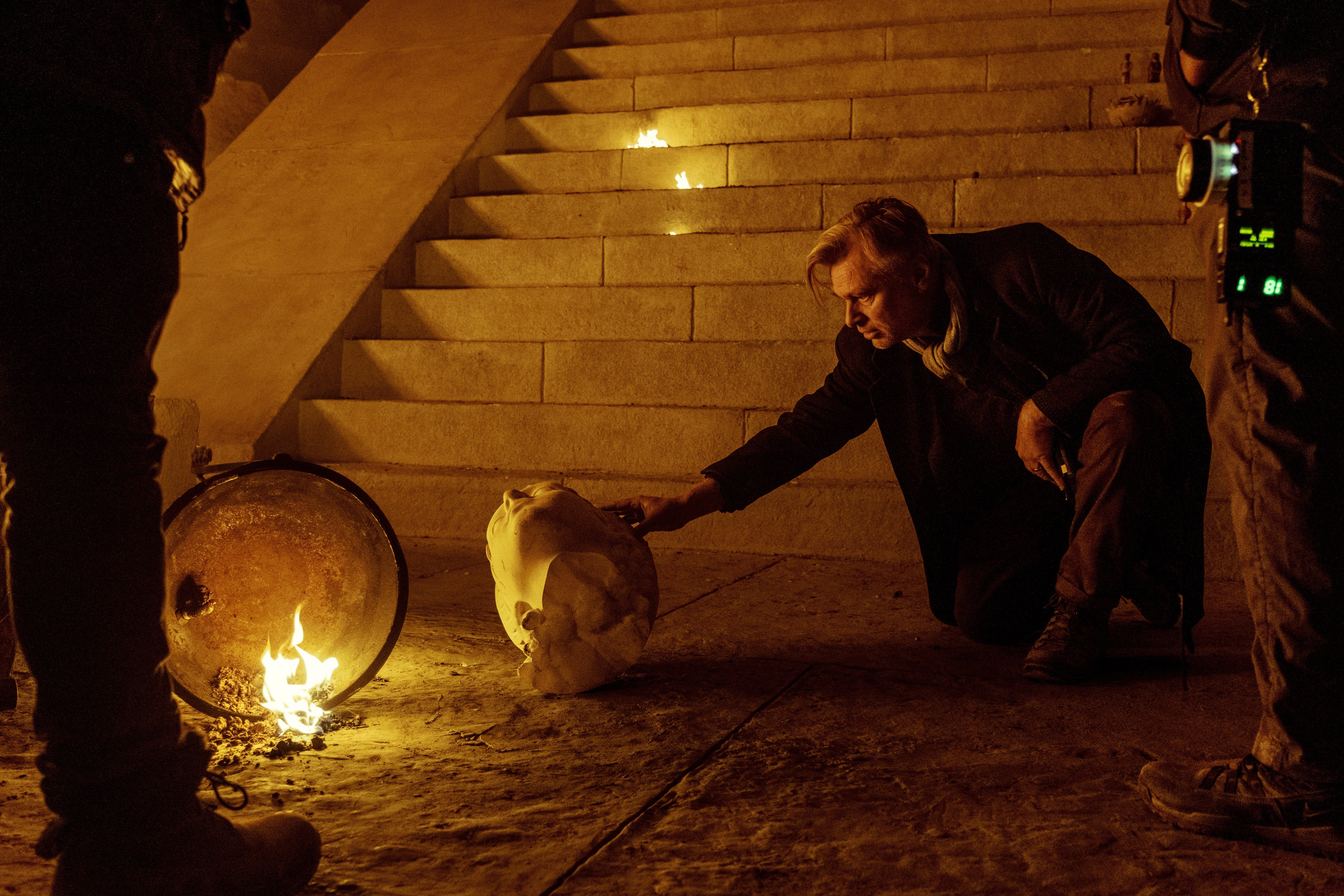
I am all for unconventional instrumentation, and for letting a story dictate the sound palette of a score. I love the dedication and ambition of Göransson traveling around the world to gather strange sounds and instruments, and I love how utterly supportive directors like Nolan are of that enterprise. James Newton Howard has complained to me about how tired he is of hearing every modern film composer talk about how they sampled this or that weird noise or created some bizarre Frankensteined instrument for their score—instead of just composing, you know, good music—and I do understand his complaint. As a journalist, I have to admit that these kinds of backstories are gold because they make film music articles more tangible for ordinary people; they come with their own story, and often have great visuals to boot. It’s much easier for me to sell a pitch about how a composer sampled a speed bag or a submarine to match the story they’re scoring than it is to talk about how the cello represents a character’s sadness or how this beautiful chord progression provides a feeling of catharsis.
But a score that’s interesting to talk about in interviews or demonstrate in a promotional featurette is only as good as the music itself. And sometimes I fear that all this effort to mine sounds from unconventional sources connected to story can ignore the basic imperative of musical integrity and emotion. The Odyssey has several stretches of sumptuous, emotional music, and I’ll admit I haven’t been able to get it out of my head. Like the best of Göransson’s work, it is often astonishing, and I don’t think the regular moviegoers going gaga over it are just giving in to some empty hype. It’s clearly touching a nerve, and it elicits deep feelings.
I guess I’m just looking forward to their next collaboration—which I hope will be a more cohesively satisfying dramatic narrative (and ideally less ALL-CAPS ALL-IMAX EPIC), as well as a more unified musical slipstream. I don’t care if it’s orchestra, synthesizers, or sampled rhino burps… as long as it grooves and moves me.
The Age of Nolan is far from over, and I can’t wait to see—and hear—what Nolan/Göransson cook up next.
No posts
Comments
Nothing yet. Say the first thing.
Sign in to join the conversation.