
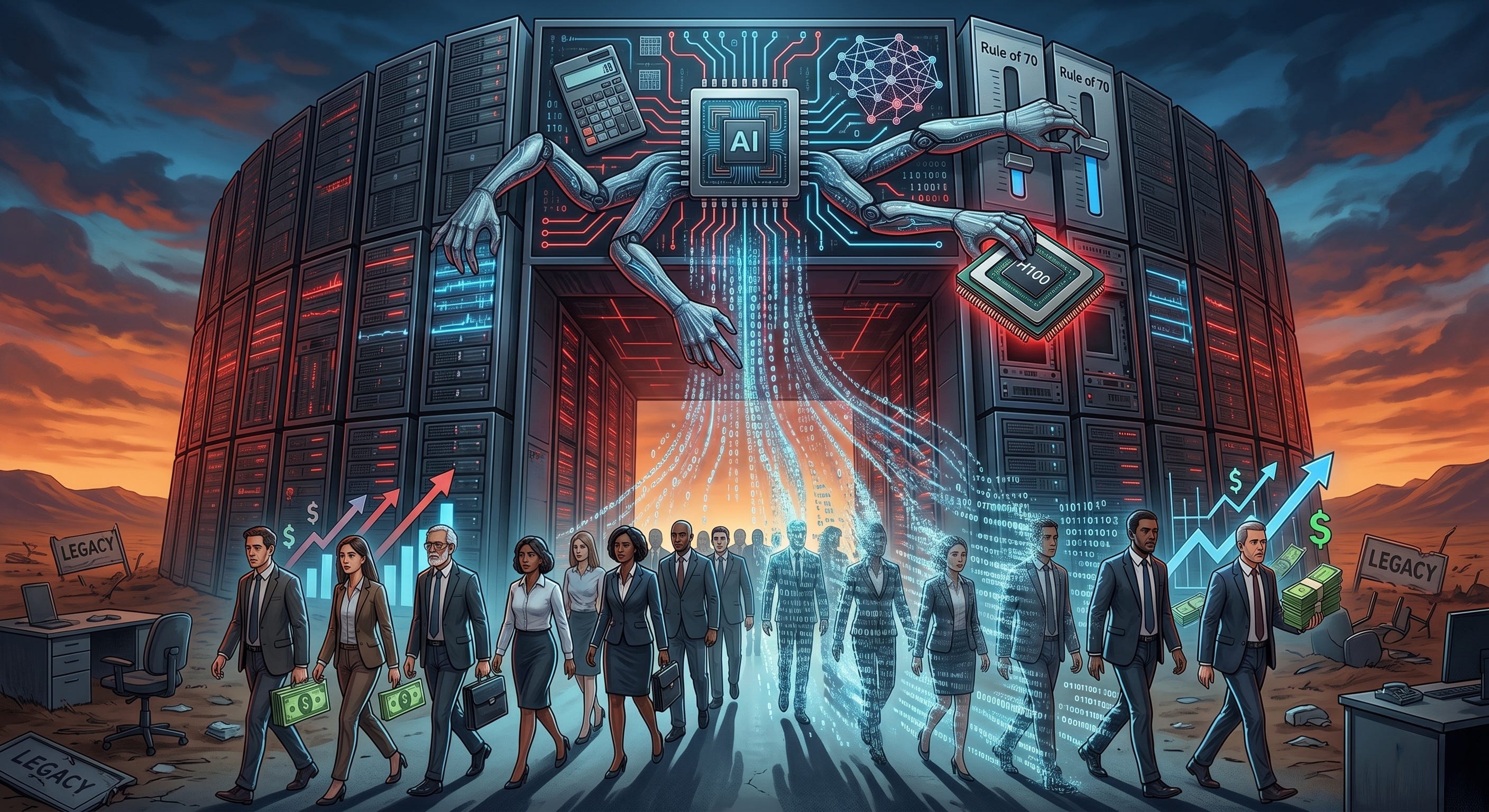
The ‘AI Revolution’ is being sold as a slow-motion sci-fi movie. We’re told to watch out for the day ‘General Intelligence’ becomes smarter than us—the day a robot walks into your office, sits in your chair, and starts doing your job.
But as we sit here in the spring of 2026, the reality has arrived, and it’s nothing like the movies. AI isn’t taking your job because it’s better at writing code, managing spreadsheets, or designing logos. It’s taking your job, because it’s the ultimate excuse for a massive liquidation of human capital.
Welcome to the world of the hollow fortress.
While the stock market ‘gaps up’ on news of trillion-dollar valuations, record-breaking buybacks, and space fantasies, the integrity of the workforce is getting hollowed out. AI isn’t a tool for productivity. It’s a tool for labor amortization.
If you want to see the ‘hollow fortress’ in its purest form, look at Meta. In April 2026, Mark Zuckerberg raised the company’s annual Capital Expenditure (CapEx) ceiling to a staggering $145 billion. To put this in perspective, consider what Meta spends on people. In 2025, Meta’s total Research and Development (R&D) expense—the bucket that holds the salaries of its world-class engineers—was roughly $57 billion.
Meta is now spending more than $2 on GPUs and data centers for every $1 it spends on human R&D.
On May 20, 2026, Meta will finalize the layoff of 8,000 veterans and close 6,000 open roles. That’s not a ‘pivot;’ it’s a silicon-for-labor swap. Zuckerberg is betting that a gigawatt-scale data center campus is a better long-term investment than 14,000 people. The ‘Year of Efficiency’ wasn’t a one-time event; it was the start of a permanent liquidation. The human part of the social network is now a legacy cost getting optimized into oblivion.
If Meta is a ‘swap,’ Oracle is ‘human sacrifice. ‘
On March 31, 2026, Oracle executed a move that should terrify anyone with a mortgage. They laid off 30,000 employees—roughly 18% of its global workforce—not because business was slow, but to redirect $10 billion in annual cash flow toward building AI data centers.
Oracle fired the cloud engineers and architects who built their infrastructure, so they could afford the chips those engineers would have managed.
Oracle’s Q3 2026 results were the strongest in 15 years, with revenue up 22%. Yet, their Credit Default Swaps (CDS)—the cost to insure their debt—are spiking. Why? Because the bond market sees what the stock market ignores. Oracle is a company with $125 billion in debt that is burning human capital to fund a $50 billion-a-year GPU addiction. They are liquidating the people who run the current revenue-generating business to gamble on a hypothetical AI future.
Although more polite, Microsoft is just as lethal. They call it the ‘Rule of 70.’ If your age plus your years of service equal 70 or more, you get a ‘generous’ early payout to walk away. This is the first time in its history that Microsoft has offered early retirement.
Microsoft isn’t getting rid of people because they’re bad at their jobs. They are getting rid of them because a 20-year veteran carries a ‘legacy cost.’ In 2026, experience isn’t an asset. It’s a liability.
They are trading the ‘past’ (human experience) for a ‘future’ (silicon clusters). If you’re mid-career and think you’re safe, because you’re ‘essential,’ look at the Rule of 70. You aren’t being replaced by a smarter AI. You’re being liquidated to pay for the memory chips and GPUs that run it.
Alphabet (Google) released earnings showed the ‘paper gain’ mirage. They reported a massive ‘profit,’ but $36.9 billion of that profit was just a valuation mark-up of their Anthropic investment.
This is the recursive capital trap. Big Tech invests billions in AI startups, which then turn around and buy back compute from their parents. It creates a loop where Big Tech reports record revenue while its free cash flow is being incinerated. Alphabet announced CapEx guidance at $185 billion, and for the first time, are approaching negative free cash flow.
Google is currently liquidating its workforce—slashing roles across Google Services and Search teams in April 2026—to fund its CapEx bill. But the AI they’re building (Gemini) is actively destroying their revenue. Every time Gemini provides an AI overview at the top of the search page, the cost per query increases 10X, while the click-through rate (CTR) for ads has plummeted 68%.
Alphabet is paying to lose its own business. They are firing the humans who built the most profitable ad engine in history to build a digital tapeworm that eats their margins. By centralizing all power into Google DeepMind and hollowing out individual product teams, Alphabet is proving that even the biggest fortress can be gutted from the inside, if you’re too afraid to look at the math.
In early 2000, Pets.com IPO’d 30 days before the dotcom bubble peaked. (The company I worked for built pets.com in our conference room.) 268 days later, it was liquidated. In April 2026, we saw the modern-day version: NewBird AI.
Allbirds—the sneaker company—sold its shoe business to become a GPU-as-a-service provider. Its stock jumped over 600% on the name change.
When shoe companies start liquidating their inventory to buy AI buzzwords, the clock is ticking.
Elon Musk is selling a $1.75 Trillion IPO by saying he will build data centers in space. The problem is that the laws of physics mean that in space, you can only cool a computer through radiation. His 1-TW data center would need a radiator the size of Rhode Island. His aspirational 100-TW data center needs a radiator bigger than France.
AI isn’t taking your job by being smarter than you. It’s taking it by being the ultimate accounting trick. It allows CEOs to trade high-trust, high-experience human networks for low-trust, high-cost silicon clusters.
The hollow fortress looks imposing from the outside. The S&P 500 gaps up, and Apple adds a new $100 billion buyback program. But inside, the rooms are emptying.
To survive, don’t try to out-compute a $200 billion CapEx bill. Find the places where human institutional memory still matters. When the recursive capital trap snaps shut, the ones left standing will be the ones that know how the world really works.
Google: AI Overviews crater ad clicks by 68%; $185B CapEx vs. search cannibalization.
Oracle: 30,000 layoffs (18% of staff) to free up $10B for data centers.
Meta: $145B CapEx (2x R&D Cost); 8,000 layoffs, 6,000 canceled jobs to fund “Superintelligence.”
Microsoft: “Rule of 70” buyouts target 8,750 veterans.
Amazon: $200B CapEx; Free Cash Flow craters from $25.9B to $1.2B in a single quarter.
No posts
Comments
Nothing yet. Say the first thing.
Sign in to join the conversation.