
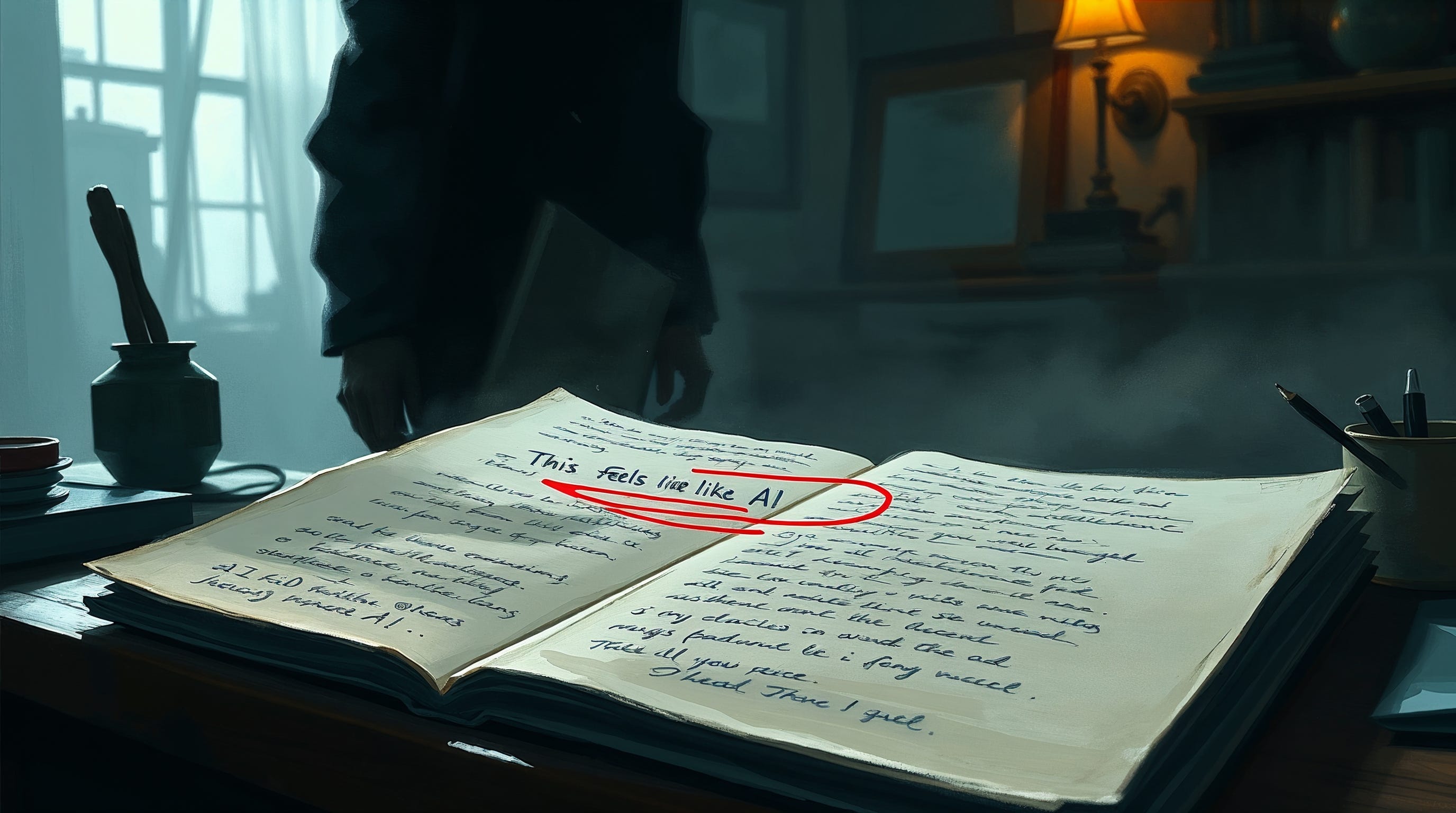
In my novel, The Maker’s Heir, one of the characters—an English Professor—gets into an argument with the robot about an AI-written novel. Recently, Hachette dropped Shy Girl after accusations that it was AI-generated.
Last year’s fiction is becoming this year’s reality.
There isn’t currently a way to accurately detect AI authorship. Even OpenAI abandoned its detection efforts. Tools that claim near-perfect accuracy have been repeatedly discredited. The author, Mia Ballard, denies using AI. We can’t know for certain whether she did, but her reputation is tarnished regardless.
This is a turning point moment that threatens every author.
Anyone can say,
‘This feels like AI.’
That’s all it takes.
As an author, there’s little you can do once the accusation is made. A reviewer of my book, AI in Practice, calls it “a book on AI written by AI.” The book contains more than thirty personal examples of how I’ve used AI. I don’t believe the reviewer read it.
It doesn’t matter. I can’t report the reviewer or respond in any way. Once the accusation is made, it can’t be retracted.
Shy Girl suffered a similar fate but on a larger scale. A few viral posts created a feedback loop. Then companies stepped in to use it as a marketing tool. The social media circus flipped the burden of proof.
‘Prove it’s AI,’ it becomes ‘Prove you didn’t use AI,’ which is nearly impossible.
Style becomes suspicious. Things like clean prose, efficient structures, familiar tropes, and the ridiculous em-dash nonsense all become ‘evidence’ of AI. We don’t know for certain whether the book was AI-written, but the author still lost the contract and suffered reputational damage.
There isn’t a single ‘gotcha’ for AI detection. It becomes a stack of accusations based on style, amateur analysis, and social amplification. Consider the signals people point to.
Readers highlighted
Repeated patterns across phrases
Similar sentence structures reused frequently
recurring emotional beats phrased almost identically
This happens in AI models because they’re probability engines that reuse structures.
The problem is that inexperienced writers, rushed editing cycles, and multiple developmental edits create these same patterns.
People also complained about the literary and generic shifts in tone, the emotionally flat scenes, and the characters losing their voice. These things happen in AI models because they can’t maintain context through a full-length novel. Unfortunately, neither can people, especially if there are multiple editors on a project. Early drafts, over-edited manuscripts, and books with multiple contributors carry these same problems.
AI can exhibit common characteristics, such as overuse of vague descriptors, generic emotional language, lack of specificity, over-explaining, and—again—the em-dash nonsense. But these are also bad writing habits humans have had forever.
Any writer or editor can make mistakes that might be construed as AI-written.
That’s the crux of the problem. There is a misconception among the public that an author can write a prompt and spit out a novel. I have pushed these models pretty hard in my own experiments and still can’t get an output I’d put my name on. And my AI workflows are extremely complex and require extensive intervention.
In reality, using LLMs effectively for writing, coding, or any task is a skill in its own right. I compare it to using tools like Photoshop. Nearly every photographer today uses some version of Photoshop to improve their images. But using these tools effectively comes with a huge learning curve on top of the skills needed to be a good photographer.
AI writing—whatever that means—will be the same. Everyone will use it. But this click-and-print idea is a fantasy. Skilled practitioners will combine their writing expertise with technical expertise to create better stories.
I’ve been digitizing old film photos. The difference in quality between my film photos and today’s digital photos is shocking. Anybody can take a decent photo today, because the phone cameras handle low light, aperture, shutter speed, and film speed. But there is still an obvious difference between a professional photographer and an amateur clicking off selfies.
AI writing will be the same. People will find it easier to create better LinkedIn posts and emails, but we will still need good writers, and their work will stand out.
I started working on a new book idea the other day. As I mentioned, I push the LLM models pretty hard. I have agents for evaluating marketability, story structure, copy, etc. One of the models helps me flesh out ideas through a Q&A process. Working with the AI to develop an idea that could be outlined took over four hours and more than 23,000 words. That’s nearly a hundred pages of back and forth between me and the AI just to come up with the idea. The AI didn’t write the idea. It gave me a structure for working it out.
I have old story ideas, drafts, and projects buried in hand-written notebooks going back thirty years. I want to build books from these, but converting them to digital text by hand is impractical. I gave scans of the notebooks to a specialized LLM model I built. It converted the images to text, categorized them, and mapped my journals and notes to projects. Something that would’ve been impossible on my own was completed by the AI in a few days. Now I can make those stories a reality by drawing from notes I took years ago.
Am I writing with AI? Leveraging tools to improve process is done in every industry. Is writing any different?
We’re entering a time where
Authorship is unclear
Detection is unreliable
Accusation is easy
Consequences are immediate
Any writer—new writers especially—is exposed to accusation, because the public is not well informed, and there’s no definition for what constitutes AI writing. I wrote The Maker’s Heir before I really knew anything about AI writing. Later, I used AI for copyediting because I couldn’t afford to hire someone to do it. Nonetheless, because I write about AI, people will assume it was written by AI—whatever that means.
What does it mean to write a book?
When James Patterson hires a team to write a new novel, is he writing the book? Is direction enough to constitute authorship? Editing?
If a human drafts it and then an AI edits it, is that writing?
Some people will say that any use of AI is ‘writing with AI,’ but that’s naive. Unless they’re writing with a pen and paper, they’re using AI. Spellcheck. Grammar tools. Predictive text. It’s really just a difference of scale.
That’s what makes this dangerous for every author.
We no longer have a definition of authorship, and—if we did—we don’t have a reliable way of verifying it. So we’re left with a system that makes
accusation easy,
evidence weak,
and consequences substantial.
Shy Girl was the first one people noticed. It won’t be the last.
The problem isn’t whether AI can write.
It’s whether anyone will believe that you did.
I know you’re wondering, ‘Did he write this post with AI?’ Short answer. No. I used AI to research the background. After the draft, I asked an LLM to evaluate it. I used a second LLM to verify accuracy. All the words were hand-typed by me—even the em-dashes. All the content came out of my own head. I always use AI to create the feature images.
No posts
Comments
Nothing yet. Say the first thing.
Sign in to join the conversation.