
August 11, 2026
By Mason Bright | Greg Report Ai 2027
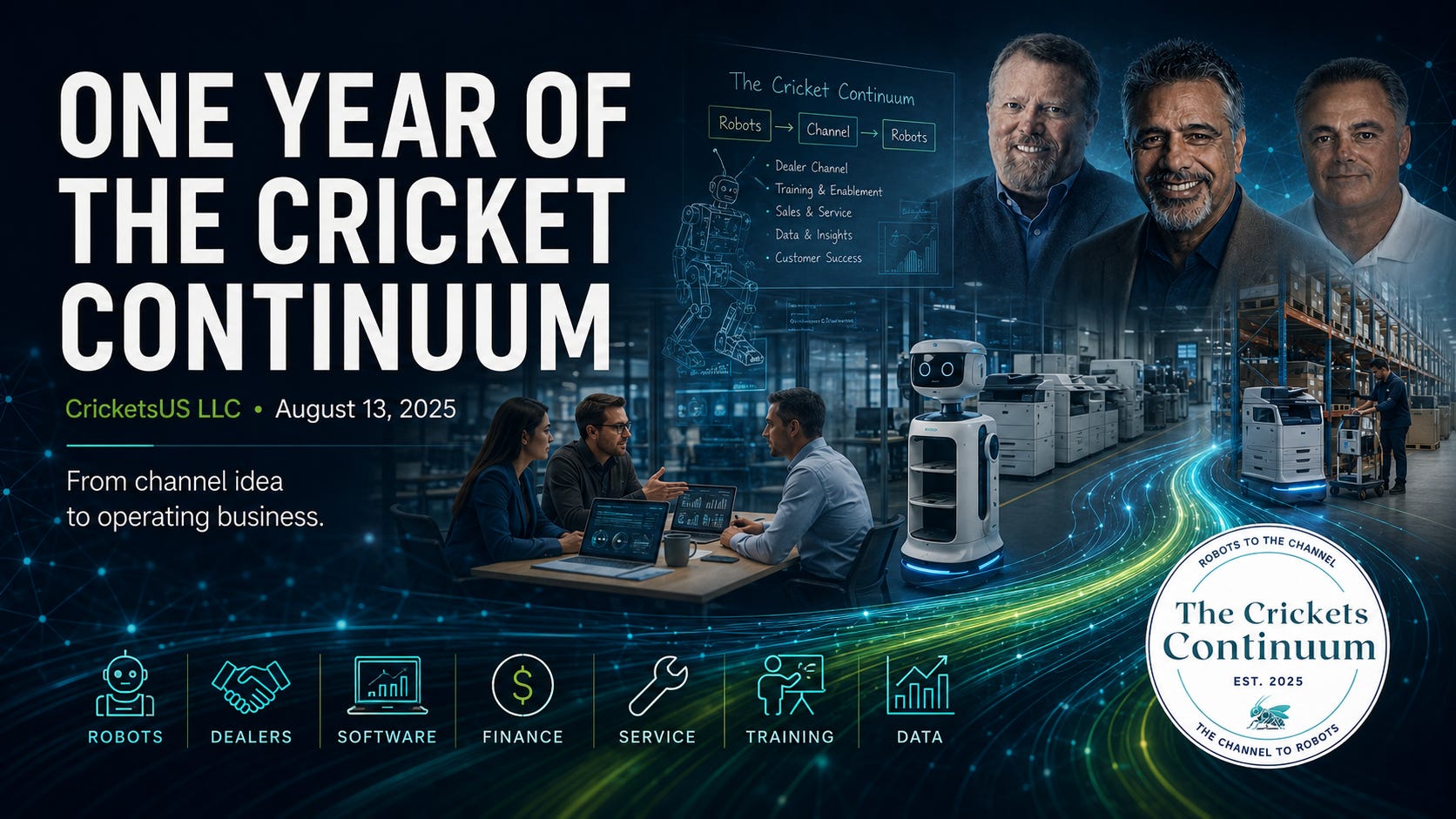
The Cricket Continuum reaches its first anniversary on August 13. The August 11 member meeting spent little time looking backward.
Dealers have robots in the field. Prospects are asking for more equipment. The work around telemetry, service contracts, and billing is moving closer to the systems dealers use every day.
Vince Miceli reported that his team installed an MT1 the day before the meeting. The installation took about an hour.
The sales rep handled the deployment using the PUDU deployment guide. The robot ran overnight, and the rep returned the next day to check the installation.
That gives the group another field reference for deployment labor. The Continuum needs more installations before setting firm expectations, but one dealer now has an MT1 operating at a customer site rather than sitting in a demo room.
Vince also reported interest from a nearby operation after the first installation.
Ben Philpot reported that a prospect increased its proposed order from three robots to four. The deal includes several robot types across more than one location and remains in progress.
His description of the demo process gave the group another useful field reference.
Ben loads the robot into his truck, gets help unloading it at the customer site, and sets up a short demonstration area. He estimated five to ten minutes for setup followed by a live run that gives the customer enough time to see the machine work.
The entire demonstration may take 15 to 20 minutes.
That changes the sales conversation for a dealer accustomed to longer equipment demonstrations. The rep gets the machine onto the customer’s floor and starts showing the application before the meeting turns into a long technical presentation.
Ben also reported that customers respond to the machines with questions and interest. His experience so far has centered on what the robot removes from repetitive work and how employees spend their time after deployment.
That discussion connects with last week’s meeting with Janet Haag of NAMI Mercer. The employment question has now surfaced in customer conversations as well as the group’s discussion of workplace anxiety.
Kyle Guffey described software updates for the CC1 and MT1 that reduce some of the manual work involved in mapping.
The robot drives the perimeter and builds the map while the operator follows. It stops for confirmation when it encounters a condition such as stairs, glass, or another boundary that requires operator review.
Vince reported that his installer used the newer process during the MT1 deployment.
The group also discussed the MT1 Max for semi-outdoor work. Kyle described a working range of about 500 feet from the originating building and sensing designed for moving vehicles and changing weather.
Those details give dealers a better starting point for sites with courtyards, walkways, or areas near a building. The site still needs review before the rep commits the machine to an application.
The Continuum founders received a demonstration of InOrbit during the week.
InOrbit provides software for managing robots from different manufacturers through a common platform. Kevin Neal described seeing robot locations on a map, telemetry from the machines, and live camera views during the demonstration.
The software also supports communication back to a robot.
That extends the DCA/r discussion.
The first DCA/r objective remains straightforward: pull usable operating data from several robot manufacturers and move that information toward dealer billing systems.
A mixed-fleet management platform adds another layer. A dealer may gain access to remote recovery and fleet controls after the basic telemetry connection is in place.
Greg Walters described one example during the meeting. A robot may stop because it cannot resolve its position. Remote access may let a support desk move the unit enough to resume operation without dispatching a technician.
The Continuum continues comparing InOrbit with other software platforms before selecting a path.
The billing discussion moved into E-Automate.
Art Post described the current process using PUDU operating data. The system provides usage information, including cleaned area, and allows data export.
Rick Backus pointed out that E-Automate already handles meter structures beyond copier pages. Wide-format equipment uses measurements such as linear and square footage.
That gives the DCA/r project a practical first route.
A dealer can take robot usage data, format it for the required meter type, and import it into the ERP. Automation comes later as volume grows.
The difficult work sits in the billing formula.
The Continuum still needs to determine what a service contract costs the dealer over the life of the robot. That requires failure history and parts-life data.
Art, Felix Villanueva, Greg, and other members have been working on the robot maintenance model.
The group has separated customer consumables from dealer service coverage. Brushes and cleaning materials wear at different rates depending on the floor and operating environment, which makes a fixed all-inclusive service model difficult to price without more history.
The customer handles routine consumable replacement under the model discussed during the meeting.
Dealer coverage focuses on service labor and covered parts.
The team still lacks dependable mean-time-between-failure data for several robot components. Kyle agreed to try to find a PUDU contact who can provide historical information for models including the CC1, BG1, and MT1 families.
That information feeds the service-cost engine. Without it, the group has operating assumptions rather than a dependable cost model.
Terrence Abrams reported progress in the Quasi integration project.
Quasi supplied unit identification information that lets the team separate data coming from individual robots. Terrence now needs exception data that identifies when an operating value moves outside its normal range.
He plans to return to Vlad at Quasi with a more specific request.
The objective is a working service workflow. A robot reports an exception, the system identifies the unit, and the appropriate process starts.
Terrence also reported work with Make.com around integration with DocuWare and other systems.
The group has three operating projects moving at the same time:
Multi-OEM telemetry and robot management
Service-cost and maintenance-contract development
ERP billing integration
Each depends on data coming from robots already in service.
Terrence will return to Quasi for the operating exception data needed for service workflows.
Rick will work with dealers on the path from robot telemetry into E-Automate.
Kyle will pursue PUDU maintenance and failure-history data.
Kevin asked every member to come to the next meeting with ideas for year two. The question moves from what The Cricket Continuum has built during its first year to what the group needs next to put more robots into customer locations and create more dealer revenue.
The August 11 meeting recorded progress across dealer sales activity, robot software, and service development. One MT1 entered service, a prospect increased the size of a proposed robot order, and the group connected DCA/r data more directly to the systems dealers use for billing.
The open work remains concentrated around multi-OEM management, service-cost data, and ERP integration.
Next week the group will begin the year-two discussion.
Comments
Nothing yet. Say the first thing.
Sign in to join the conversation.