
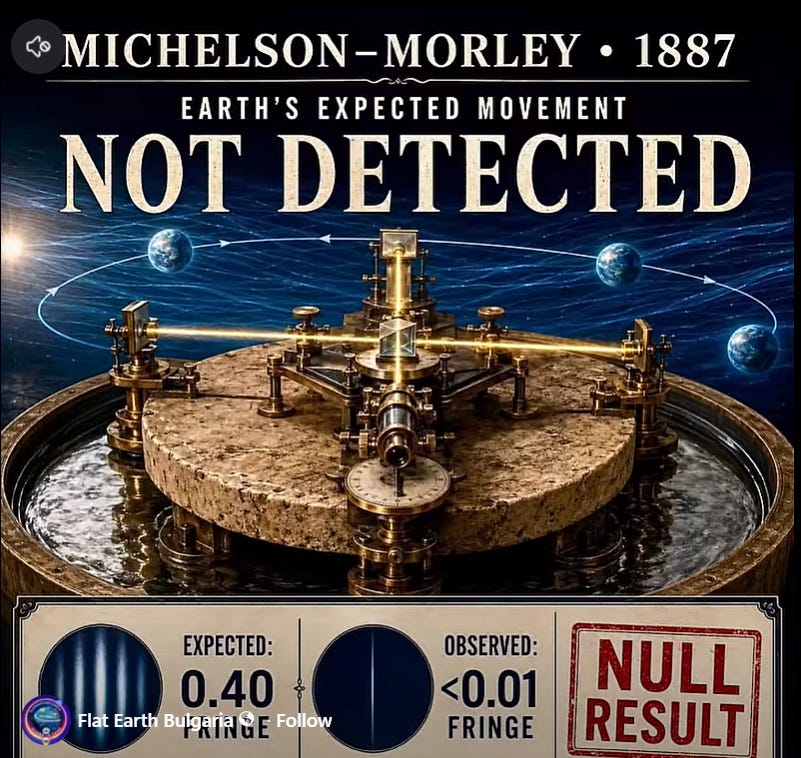
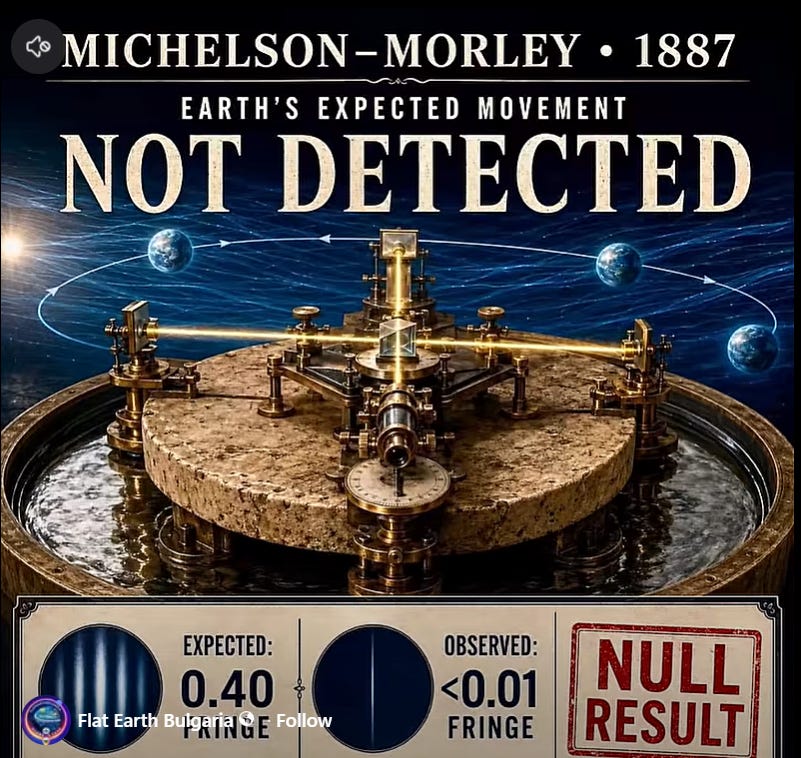
The Michelson-Morley experiment of 1887 tried to detect the Earth’s motion through a supposed invisible medium called the Aether, which scientists believed light needed in order to travel. The experiment compared beams of light sent in different directions, expecting one to travel slightly faster or slower depending on whether it was moving “with” or “against” the Earth’s path through the Aether. To everyone’s surprise, no difference was found. The result was completely null.
This created a puzzle. If the Earth was moving through the Aether, the light speeds should have differed, yet they did not.
Two physicists, George FitzGerald and Hendrik Lorentz, explained. They suggested that any object moving through the Aether shrinks ever so slightly in the exact direction of its motion. In the Michelson-Morley apparatus, the arm pointing in the direction of Earth’s travel would have contracted just enough to cancel out the expected difference in light-travel times. That made the null result understandable while still allowing the Aether to exist.
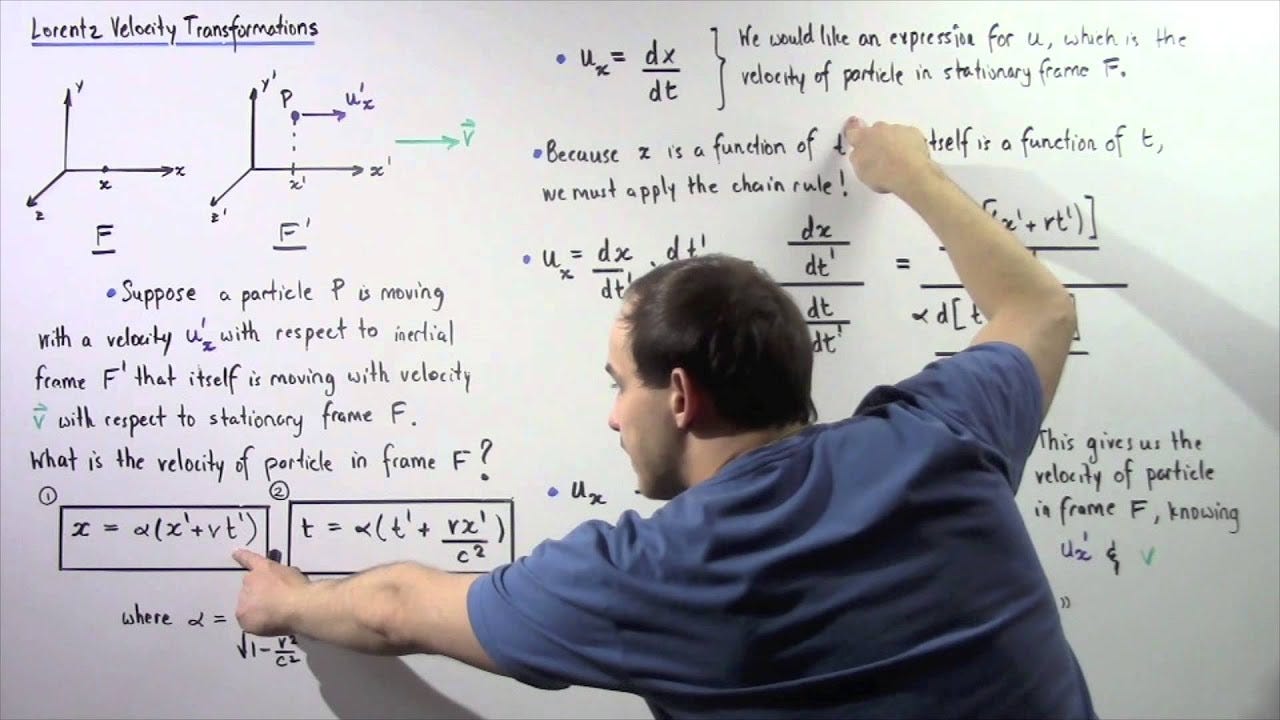
Lorentz then developed a more complete set of rules describing how measurements of space and time change when one observer is moving relative to another. These rules—now called the Lorentz transformations—ensured that the laws of electricity, magnetism, and light always look the same no matter how fast an observer is moving. As a direct consequence, experiments like Michelson-Morley’s must always give a null result.
A few years later, Albert Einstein took the same mathematical rules and gave them a new meaning. He showed they follow simply from two ideas: that the laws of physics are the same for all observers moving at constant speed, and that the speed of light is always the same. In this view, the Aether is no longer needed, and the Michelson-Morley null result becomes a natural and necessary outcome rather than something that has to be patched up with special assumptions.
In short, the Lorentz transformations grew out of the attempt to explain why the Michelson-Morley experiment found nothing. They provide the precise description of how space and time adjust so that light always behaves the same way, which is exactly what the experiment observed.
In his 1922 lecture quote at Kyoto University, Einstein simply states it as a fact that the Earth is revolving around the Sun without providing the proof, right after confessing that “the motion of the Earth cannot be detected by any optical experiment.” These contradictory statements have sparked much interest among Enclosed Cosmologists for obvious reasons.
Einstein’s Full Quote:
“Since then I have come to believe that the motion of the Earth cannot be detected by any optical experiment, though the Earth is revolving around the Sun.”
In this quote, Einstein was referring to the famous Michelson-Morley experiment with its Aether Hypothesis, which failed to detect the Earth’s movement through a stationary Luminiferous Aether medium. The “null result” of the 1887 Michelson-Morley experiment meant that the experiment failed to detect any significant difference in the speed of light, regardless of the direction the light traveled or the Earth’s movement through space. The null result meant the Earth was not moving relative to the Luminiferous Aether, proving that the Earth is completely still within an Aetheric Field.
In the 1880s, physicists learned that light waves required a physical medium to travel through, just like sound waves require air. They called this substance the Luminiferous Aether. Denying the existence of the Aetheric Field is tantamount to a fish denying that it is surrounded by water to swim, or denying that sound waves require no medium for transmission. Even Sir Issac Newton confessed to the existence of an Aetheric Medium for light transmission. Newton’s speculative queries in the Opticks about a denser or rarer Aether hinted that a medium was required for light propagation.
Isaac Newton suggests the existence of an Aether in the Third Book of Opticks (1st ed. 1704; 2nd ed. 1718):
“Doth not this Aethereal medium in passing out of water, glass, crystal, and other compact and dense bodies in empty spaces, grow denser and denser by degrees, and by that means refract the rays of light not in a point, but by bending them gradually in curve lines? Is not this medium much rarer within the dense bodies of the Sun, stars, planets, and comets, than in the empty celestial space between them? And in passing from them to great distances, doth it not grow denser and denser perpetually, and thereby cause the gravity of those great bodies towards one another, and of their parts towards the bodies; everybody endeavoring to go from the denser parts of the medium towards the rarer?”
Ultimately, the null result of the Michelson-Morley experiment compelled Einstein to create the imaginary hypothesis of Special Relativity to explain away the results. This is not how science works. It does not conjure up speculative pleading hypotheses to explain away results that it does not like. And since Einstein had already confessed that “the motion of the Earth cannot be detected by any optical experiment”, and then, in contradiction to that, stated that “the Earth is revolving around the Sun”, it becomes clearly evident that Einstein was dabbling in the world of science fiction fantasy world-building, ad hoc justifications, and wishful thinking far more than in science.
In Einstein’s defense, some have stated that in the lecture, Einstein’s goal in that talk was to explain the history of Relativity, not to write a textbook proving Heliocentrism. Defenders also add that while Einstein didn’t list the proofs in that single sentence, astronomers and physicists had already gathered ironclad, measurable proof of the Earth’s orbit long before he spoke, which, of course, is a patent lie since no ironclad, measurable proof of the Earth’s orbit had ever been demonstrated using Scientifically Falsifiable Evidence, which was the very reason Einstein was having so much difficulty with The Michelson-Morley experiment and its Aether Hypothesis.

The Michelson-Morley Experiment didn’t inspire the Lorentz Transformations. The Lorentz Transformations were worked on by many people and were discovered by Lorentz and surely also by many others independently. A short list of people who worked on these Transformations would include Voigt, Fitzgerald, Lorentz, Larmor, and Poincaré. The Transformations were part of the invariance group of the Maxwell Equations.
Einstein, infamously, derived the Transformations independently of the Maxwell equations, in his 1904 paper, starting from the two simple postulates that he proposed for Special Relativity. So he is another who should be put on the list.
In fact, while the invariance groups of various quadratic forms were investigated by various mathematicians much earlier on and were known in a sense, it was the Maxwell Equations and the attempt to make a mechanical theory of the Aether that Maxwell believed must carry the oscillations of his fields that inspired the discovery of The Lorentz Transformations in the context of physics. Since Lorentz was among the first to have discovered them and also did extensive work on the theory of the Luminiferous Aether and had published on the subject, his name became associated with the Transformations that he used. He did work on the Transformations as late as 1902. It was Henri Poincaré who first described the full invariance group of the Maxwell Equations, which actually has several more generators than those which Lorentz knew. But that was done later on, after 1904.
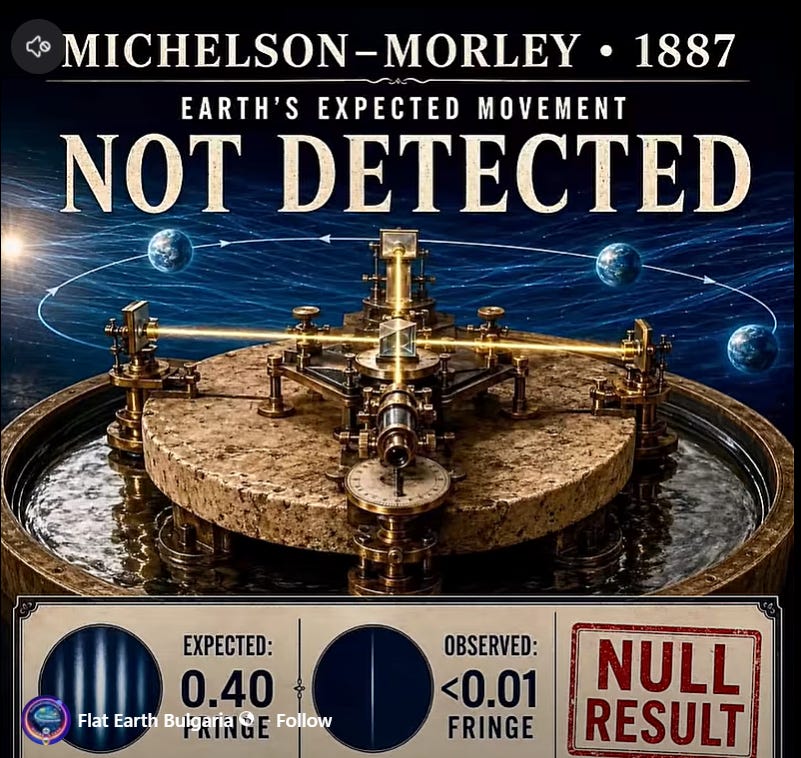
The Michelson-Morley Experiment was a second order Aether drift experiment that produced a null result. The Michelson and Morley experiment was a very important experiment and a very important result, but Lorentz has his name much more correctly connected with the Transformations.
Incidentally, Einstein said that even without knowing of the Michelson and Morley null result he would have been convinced that Special Relativity was needed. For him, the results of the Fizeau Experiment and the phenomenon of stellar aberration were more than enough.
In physics, The Lorentz Transformations are a six-parameter family of linear Transformations from a coordinate frame in spacetime to another frame that moves at a constant velocity relative to the former. The respective inverse Transformation is then parameterized by the negative of this velocity. The Transformations are named after the Dutch Physicist, Hendrik Lorentz.
Frames of Reference can be divided into two groups: inertial (relative motion with constant velocity) and non-inertial (accelerating, moving in curved paths, rotational motion with constant angular velocity, etc.). The term “Lorentz Transformations” only refers to Transformations between inertial frames, usually in the context of special relativity.
In each reference frame, an observer can use a local coordinate system (usually Cartesian Coordinates in this context) to measure lengths, and a clock to measure time intervals. An event is something that happens at a point in space at an instant of time, or more formally a point in spacetime. The Transformations connect the space and time coordinates of an event as measured by an observer in each frame.
They supersede the Galilean Transformation of Newtonian physics, which assumes an absolute space and time (see Galilean relativity). The Galilean Transformation is a good approximation only at relative speeds much less than the speed of light. Lorentz Transformations have a number of unintuitive features that do not appear in Galilean Transformations. For example, they reflect the fact that observers moving at different velocities may measure different distances, elapsed times, and even different orderings of events, but always such that the speed of light is the same in all inertial reference frames. The invariance of light speed is one of the postulates of special relativity.
Historically, the Transformations were the result of attempts by Lorentz and others to explain how the speed of light was observed to be independent of the reference frame, and to understand the symmetries of the laws of electromagnetism. The Transformations later became a cornerstone for Special Relativity.
The Lorentz Transformation is Linear Transformation. It may include a rotation of space. A rotation-free Lorentz Transformation is called a Lorentz Boost. In Minkowski Space, he mathematical model of spacetime in Special Relativity, the Lorentz Transformations preserve the spacetime interval between any two events. This property is the defining property of a Lorentz Transformation. They describe only the Transformations in which the spacetime event at the origin is left fixed. They can be considered as a hyperbolic rotation of Minkowski Space. The more general set of Transformations that also includes translations is known as The Poincaré Group.
The Michelson-Morley Experiment: No Movement of The Earth Through Space:
In 1887, Albert Michelson and Edward Morley set up a device which split up light: one beam in the direction of the Earth’s rotation, and one at right angles. The two light beams then recombined and hit a photographic plate. The difference is speed of the two beams would create an interference pattern. They expected to measure a speed of 30 km/s as that was the speed of the Earth’s supposed rotation, but instead registered a variable difference of between 1 and 10 km/s each time the experiment was repeated. They called this a “null” result. This proves that the Earth is not moving at all through space, and at the same time, proved the existence of the Aether. The traveling light wasn’t moving with the Earth.
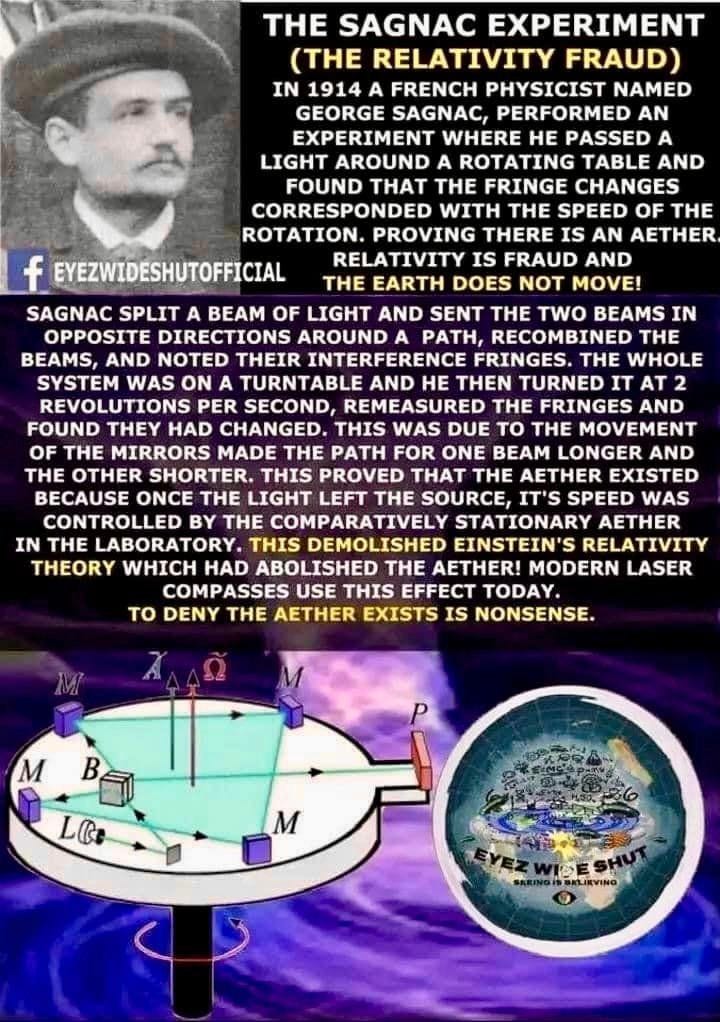
It didn’t stop there, Georges Sagnac, and Henry Gale conducted similar experiments, but on a rotating platform, which again demonstrated the existence of the Aether, already proved by default in 1871 and 1885 by combining the results from George Airy and Foucault’s pendulum, and also in 1887 by the Michelson-Morley experiment.
Dr. Albert Michelson (1852–1931)
Professors Michelson and Morley were the 2 halves of the famous team who conducted experiments on the speed of light. Dr. Albert Michelson used an interferometer for measuring the speed of light. At that time, all scientists believed in the existence of an invisible Aether which carried light waves. They supposed that the ether would cause a drag on the speed of light as the Earth raced around the Sun at 30 km/s or over 108,000 km per hour. To their astonishment, no variation in the speed of light was found. An interferometer for measuring the motion of the earth around the sun used by Dr. Michelson in 1887. After serving as professor at Clark University at Worcester, Massachusetts, from 1889 until 1892, Michelson was appointed professor and the first head of the department of physics at the newly organized University of Chicago. With his big salary from Rockefeller, and the Nobel Prize money, Michelson was content not to make WAVES about the non-motion of the Earth.
In 1924, Michelson received a huge grant from the university in order to determine the ROTATION of the Earth by using the speed of light. This test consisted of a mile long 12 inch tunnel with all the air removed. As expected, all the results were NEGATIVE.
Send in The Clowns: Jesuit Stooge Albert Einstein:
Special Relativity was conjured up by Einstein to explain away The Michelson-Morley Experiment of 1887, which proved that the Earth is not moving in an orbit around the Sun. By 1900, the proof of the non-motion of the Earth did not cause Michelson to get on his knees and acknowledge that the Bible was correct after all. Had he and the “scientific” community done so, the whole evolutionary house of sand would have come crashing down. That is the last thing that the Jesuits wanted. Their answer was to use Albert Einstein to invent a completely new theory of the universe called RELATIVITY to fabricate an illusory universe that could not be supported by any real empirical observations. Einstein was the beginning of goofy, nonsensical, hocus pocus science. The entire empirical narrative shifted from the U.S. to Switzerland and an obscure patent clerk in the Swiss Patent Office named Albert Einstein.
Proof of a Stationary Motionless Earth and Aether:
“For those who say they believe and trust in Science, here are Five Famous, but hidden from “education” Peer-reviewed Significant Scientific Experiments, of true Science, using the scientific method, that prove with absolutely irrefutable scientific certainty that the Earth is stationary & motionless as well as proving the existence of the Aether, containing the stars that revolve above the Earth, as the necessary medium always required in which light waves must travel.
These scientific experiments demolish Einstein’s theory of relativity, and by extension, gravity, the spinning globe and the heliocentric model, not to mention the Big Bang theory as well as the theory of Evolution. Conversely, not ONE single scientific experiment has ever detected, never mind proven, a rotating, nor orbiting, globe Earth.
All inconvenient implications of scientific experiments that have proven a stationary motionless Earth, however, have been discarded & swept under the rug of the shocked scientific establishment, in order to uphold at all cost, the pseudo-scientific proofless theory and religious blind faith belief in the Copernican principle and heliocentric model.
Obviously, due to the questions that would inevitably arise, resulting in the whole proofless heliocentric spinning globe theory falling apart, these experiments are not taught in schools or Universities, unless simply mentioned as allegedly incorrect theories, that were conveniently replaced when Einstein came along and simply announced that the Aether did not exist, with no evidence what-so-ever to support or prove his claim, because of the inconvenient reality that these experiments in fact proved.
5 Hidden Peer-reviewed Scientific Experiments that prove a stationary motionless Earth:
Nikola Tesla Quotes on Aether:
“There manifests itself in the fully developed being , Man, a desire mysterious, inscrutable and irresistible: to imitate nature, to create, to work himself the wonders he perceives.... Long ago he recognized that all perceptible matter comes from a primary substance, or tenuity beyond conception, filling all space, the Akasha or luminiferous Aether, which is acted upon by the life giving Prana or creative force, calling into existence, in never ending cycles all things and phenomena. The primary substance, thrown into infinitesimal whirls of prodigious velocity, becomes gross matter; the force subsiding, the motion ceases and matter disappears, reverting to the primary substance.”
--Nikola Tesla
This conceptualization of Aether matches Maxwell’s statements about Aether behaving as “Wheels and pulleys” and furthermore supports the Thompson (Lord Kelvin) vortex ring model of the atom which is now being re-investigated through inviscid fluid dynamics.
--See Ross Anderson and Robert Brady of Cambridge
Excerpt from Tesla’s prepared statement for his 81st birthday (July 10, 1937):
“Only the existence of a field of force can account for the motions of the bodies as observed, and its assumption dispenses with space curvature. All literature on this subject is futile and destined to oblivion. So are all attempts to explain the workings of the universe without recognizing the existence of the ether and the indispensable function it plays in the phenomena. My second discovery was of a physical truth of the greatest importance. As I have searched the entire scientific records in more than a half dozen languages for a long time without finding the least anticipation, I consider myself the original discoverer of this truth, which can be expressed by the statement: There is no energy in matter other than that received from the environment. –Nikola Tesla
Once again this indicates a vortex model of matter in which the energy of an atom is like the energy of a tornado: a localization of the energy of a larger system.
Various Other Quotes Attributed to Tesla:
“A good example for such an interaction becomes apparent in gravitation, which should rather be named, universal compression. I think the material bodies do not gravitate between each other but it is the ether that makes one material body to press to another.”
“We wrongly call this phenomenon gravitation.”
“We can also feel Aether’s reaction when sudden acceleration or braking.”
“The stars, planets and all the universe appeared from the ether when some part of it, due to certain reasons, became less dense.”
“It can be compared with formation of blebs [air bubbles] in boiling water although such a comparison is only rough. The Aether tries to return itself to its initial state by compressing our world, but intrinsic electric charge within material the world substance obstructs this. It is similar to that when the water compresses blebs [air bubbles] filled with hot water steam. Until the steam does get cold the water is unable to compress the bleb. With time, having lost the intrinsic electric charge, our world will be compressed with the ether and is going to turn into Aether.”
“Having come out of the Aether once - so it will go back into the Aether.”
– Nikola Tesla
Gravity and The Aetheric Field:
Gravity, misnamed, is merely a property of dielectric differentials in The Aether, in conjunction with the “molecular density” and buoyancy conferred to objects by the magnetic and dielectric properties of The Aetheric field.
In electromagnetism, a dielectric (or dielectric material or dielectric medium) is an electrical insulator that can be polarized by an applied electric field. When a dielectric material is placed in an electric field, electric charges do not flow through the material as they do in an electrical conductor, but instead they shift, only slightly, from their average equilibrium positions, causing dielectric polarization.
Matter behaves in such a way as to obey both the ferrous and non-ferrous dielectric and magnetic properties of The Aetheric field. The density of objects, as well as their index of buoyancy in the Aetheric field, is derived from this interrelationship between magnetic and dielectric properties in The Aether.
Objects need not be ferrous nor necessarily “magnetic”, per se, to be effected by The Aetheric field, since it is not the object that is causing repulsion or attraction, but rather, it is the exclusive property of Aetheric field perturbation that causes any movement of objects, or light, for that matter. Magnetism is not one thing, and the point is that when both magnetic and dielectric properties conjoin to create perturbations in the Aetheric field, we witness movement in matter.
A Simple Analogy to Illustrate Perturbation of The Aetheric Field:
If I drop a marble into a jar of water, it falls at a certain rate.
But if I drop the same marble in a jar of maple syrup, it falls at a different rate.
What caused the change in the rate of descent?
Was it the marble and some special magnetic properties that it has?
No, it was the field, or medium, in which the marble was dropped that dictated the rate of descent. Maple syrup is denser than water, and so the marble responds in kind.
And so, though ferrous objects will respond more dramatically to direct magnetic fields, ALL objects are affected by the mere existence of the Aetheric field, regardless of their magnetic properties. In other words, The Aetheric field is not merely a magnetic field. Rather, it exists as the interplay between both magnetic and dielectric (non-magnetic) potentialities, acting as a singular unified substrate, or Aetheric perturbation modality, for all matter, whether ferrous (magnetic) or not.
And any disturbance (perturbation) of The Aether will translate as mechanical motion. Again, Gravity is a completely extraneous, unconfirmed, and unnecessary variable to the equation of mechanical motion.
Luminiferous Aether According to The Heliocentric Theory:
“Luminiferous Aether or ether (”luminiferous”, meaning “light-bearing”) was the postulated medium for the propagation of light. It was invoked to explain the ability of the apparently wave-based light to propagate through empty space (a vacuum), something that waves should not be able to do. The assumption of a spatial plenum of luminiferous Aether, rather than a spatial vacuum, provided the theoretical medium that was required by wave theories of light.
The Aether hypothesis was the topic of considerable debate throughout its history, as it required the existence of an invisible and infinite material with no interaction with physical objects. As the nature of light was explored, especially in the 19th century, the physical qualities required of an Aether became increasingly contradictory. By the late 1800s, the existence of the Aether was being questioned, although there was no physical theory to replace it.
The negative outcome of the Michelson–Morley experiment (1887) suggested that the Aether did not exist, a finding that was confirmed in subsequent experiments through the 1920s. This led to considerable theoretical work to explain the propagation of light without an Aether. A major breakthrough was the theory of relativity, which could explain why the experiment failed to see Aether but was more broadly interpreted to suggest that it was not needed. The Michelson-Morley experiment, along with the blackbody radiator and photoelectric effect, was a key experiment in the development of modern physics, which includes both relativity and quantum theory, the latter of which explains the particle-like nature of light.”
--Wikipedia
Wikipedia was disproven countless times, as it was shown by modern physics that Light requires a medium for its propagation, which was Michelson and Morley’s Aether, all along.
Comments
Nothing yet. Say the first thing.
Sign in to join the conversation.