
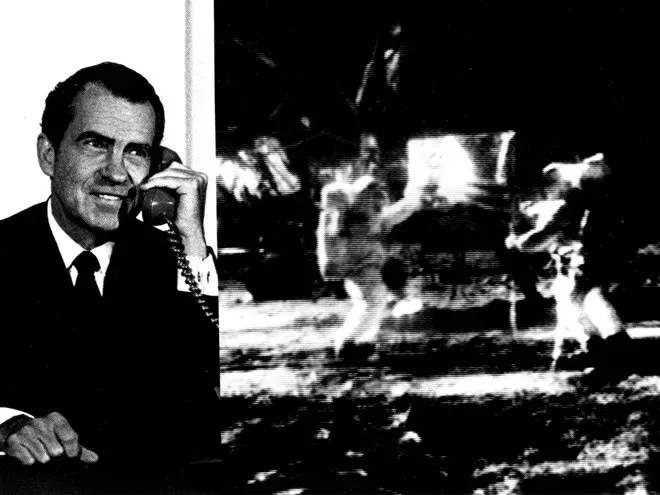
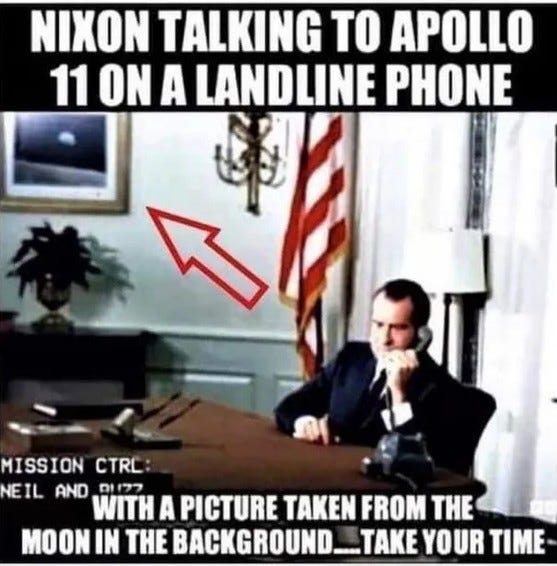
The following exposition assumes the Heliocentric Model as its basic foundation for examination. The purpose of assuming the Heliocentric Model is to illustrate how absurd this model is when under scrutiny. The idea here is that Richard Nixon’s landline was patched through to a radio transmitter to the Moon. Let’s see how that hypothesis holds up to deeper examination.
The Official CAMERA of Apollo 11 | Clip of Uncommon Ground #38:
President Nixon Talks to Astronauts Who Are Not on The Moon:
The technology and computer power that we have now is approximately 20 million times more powerful than what NASA had when they claimed to go to the Moon in the Apollo Missions in the 60s, and yet they cannot return to the Moon? Is anybody really buying this?
Millie Bobby Brown, the Stranger FlatEarther & “Isn’t that awesome! Technology, man!” Don Pettit:
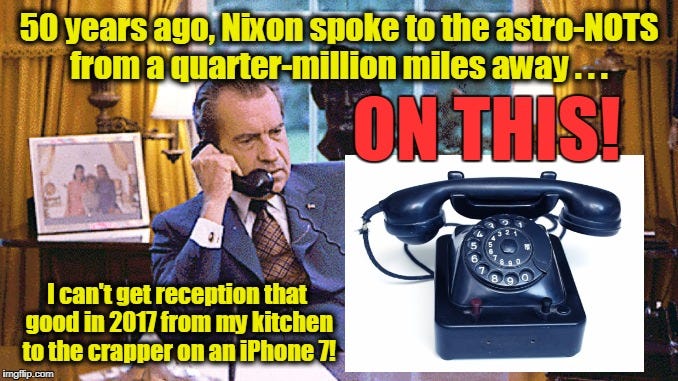
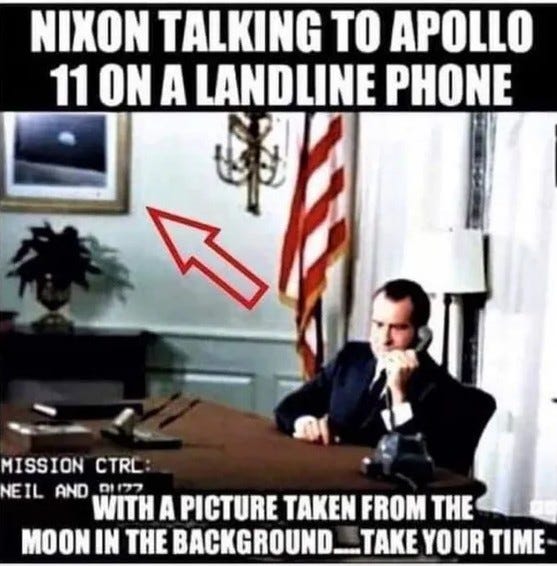
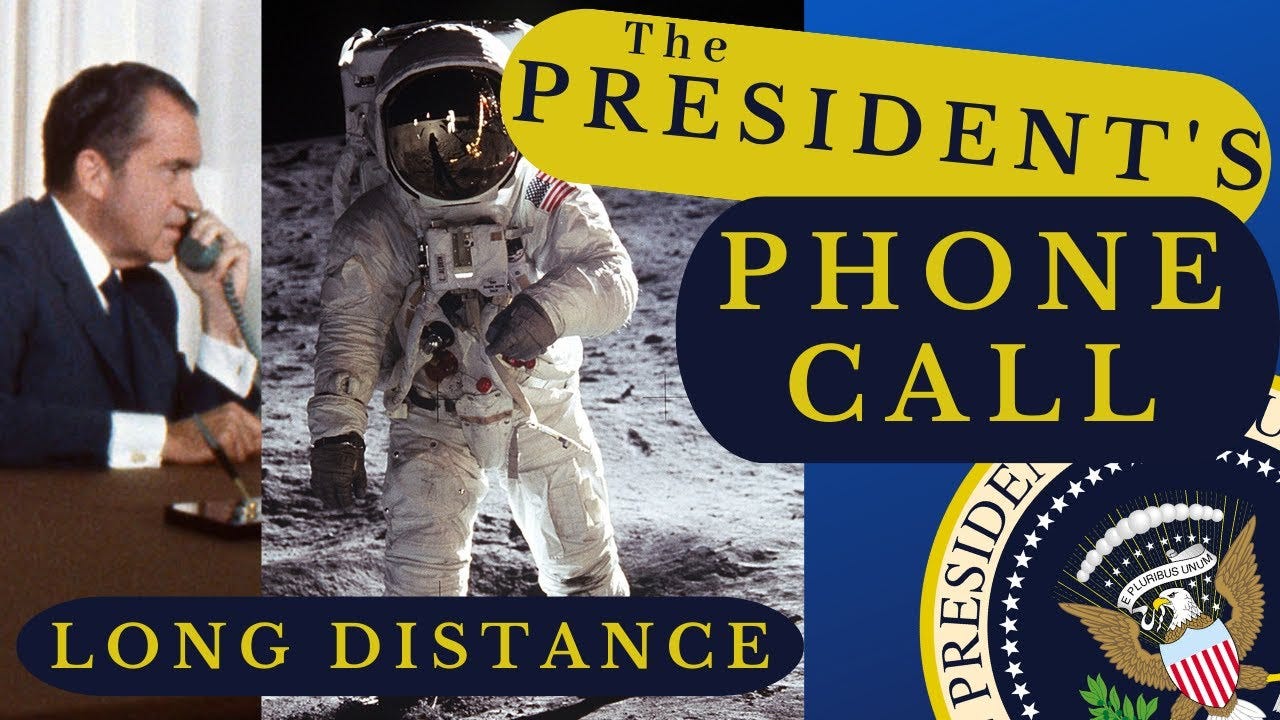
Before we begin, it must be remembered that in the 1960s everything was bigger, less compacted, and less Microsoft friendly. NASA did not have the nanotechnology that we all enjoy with our cell phones, with their infinitely more sleek, powerful, and compact design than anything NASA had in the Apollo Mission days.
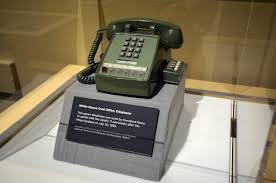
The Landline Telephone Used by Richard Nixon to Fake Calling The Moon. The Landline Which Was Allegedly Patched Through a Radio Transmitter to Broadcast to The Moon:
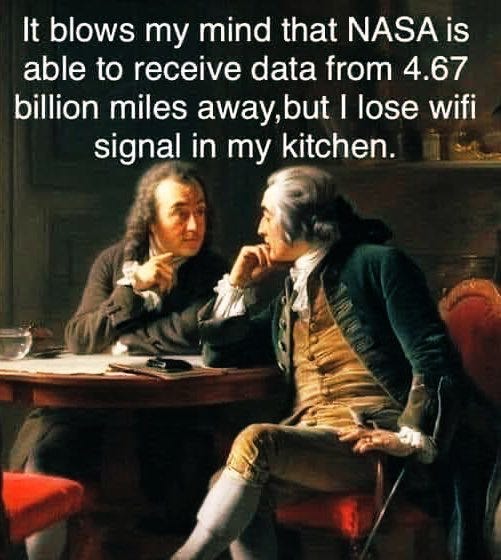
Meanwhile, modern cell phones, which are thousands of times more powerful than anything NASA had in the 1960s, lose their signal easily if not near a ground-based cell tower, or if obstructed by bad weather:
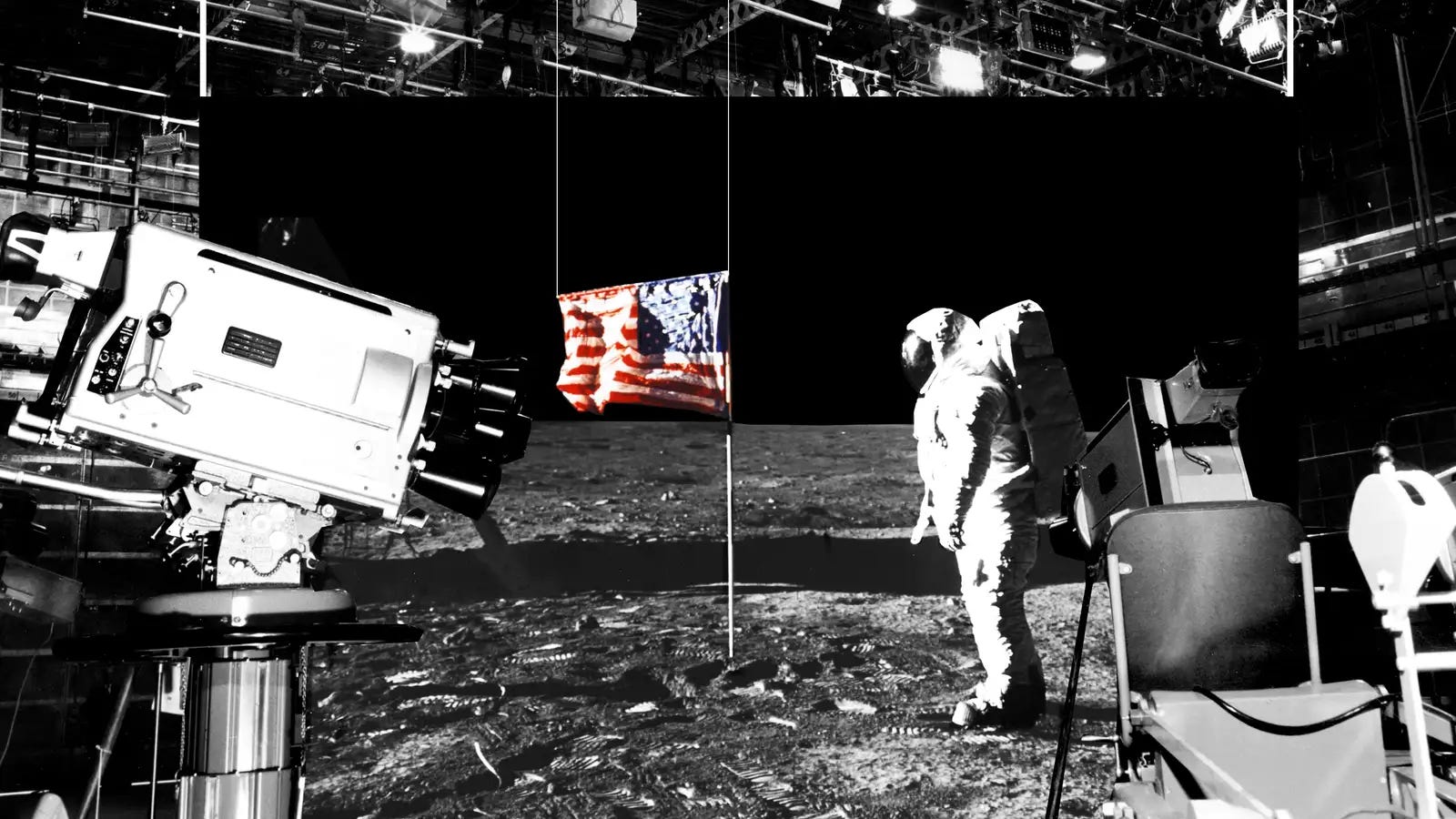
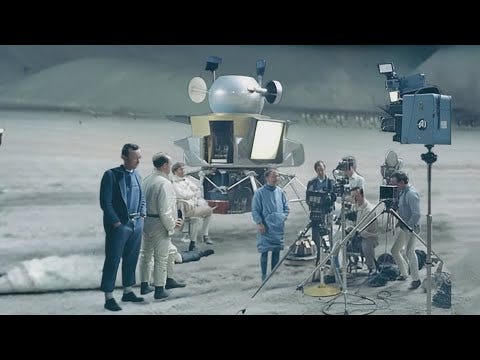
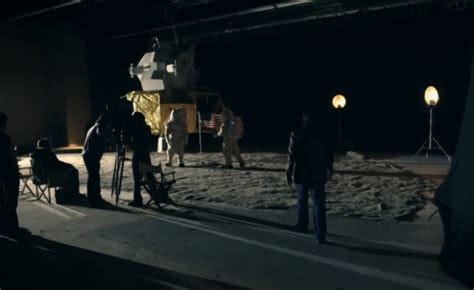
AstroNOTS on The Moon Studio Set Preparing to Take Richard Nixon’s Telephone Call:
Computers and Digital Technology in the 1960s by NASA
The digital technology on Earth during the time of the Moon landings was just in its infancy. The astronauts had relied on computers to aid in the Moon missions. The Apollo Guidance Computer was on the Lunar Module and the command and service module. For example, in 1973, one year after the final Moon landing, the Xerox Alto was released. This computer had 96kB of memory, compared to most personal computers as of 2019, which use 50,000 - 100,000 times this amount of RAM. The computers during the time of the Moon landings would not have been advanced enough to allow for manned space travel to the Moon and back. Aside from the computer technology used, other technology regarding radio transmission, radar, and other instrumentation would have been grossly insufficient for the task at the time.
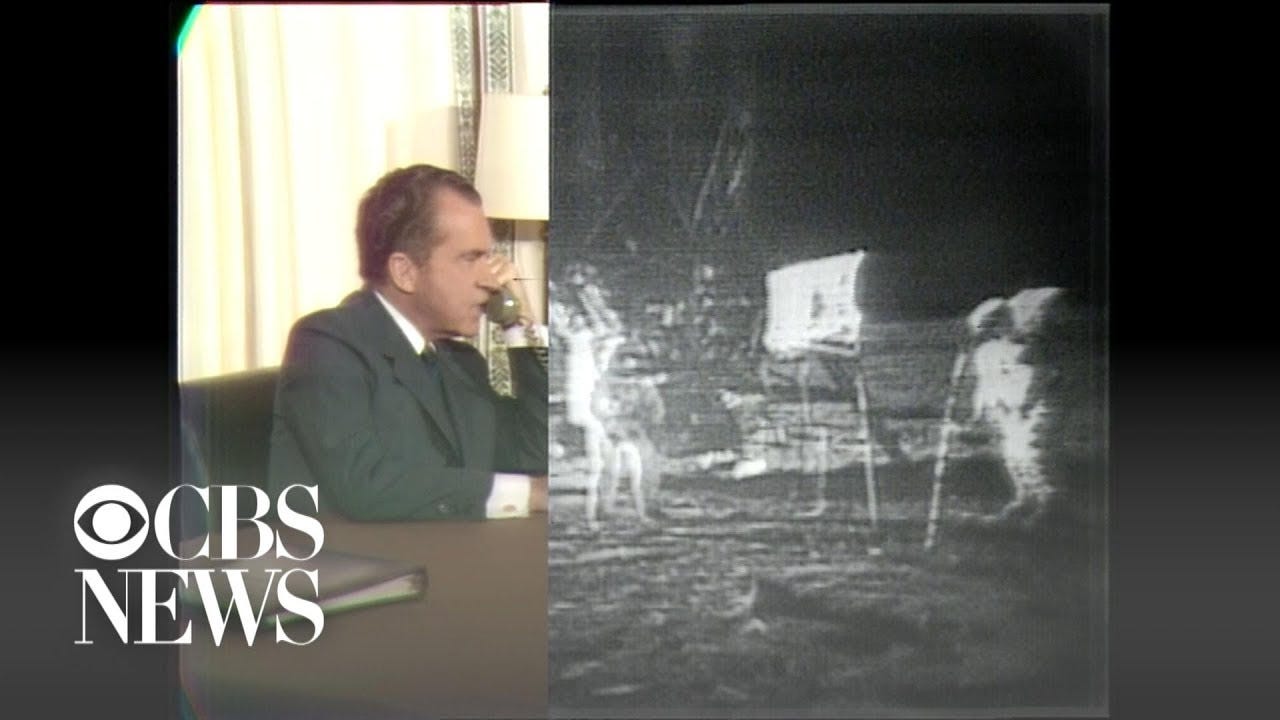
Allegedly, on July 21, 1969 (Universal Coordinated Time), President Nixon spoke from the Oval Office (shortly before midnight on July 20, Eastern Daylight Time) to Apollo 11 astronauts Neil Armstrong and Edwin Aldrin at the Sea of Tranquility on the Moon. The call was coordinated from Mission Control in Houston. According to the AT&T Archives, “Simply, the call went from the Oval Office in Washington, D.C. to Houston, where it was routed into space via Mission Control, through the capsule communicator, or CapCom, astronaut Bruce McCandless II.” AT&T’s predecessor, The Bell System, was involved with the American space program through the subsidiary that worked with NASA, BellComm.
But really, does this story make any sense? That means 294,000 miles were bridged between The Moon and The Earth for such a call to take place, with a total round trip of 588,000 miles. The first thing to realize about this wild claim is that sending radio waves from Earth is one thing. You can claim that you have a power station the size of New York if you want and could reach the Moon. Ok, fine, whatever. But then you also need to transmit that signal back to The Earth FROM the Moon. We’ll look at this more in depth in just a moment.
Of course, the second thing to realize is that to reach The Moon from The Earth, you would need to penetrate the 7 atmospheric layers surrounding the Earth which create a blanket of molecular density that radio waves love to bounce off of and scatter from but have difficulty passing through, including the famous Ionosphere, which has been used for decades to bounce radio waves from for military and commercial wireless communication purposes.
1) The Troposphere
2) The Stratosphere
3) The Mesosphere
4) The Thermosphere
5) Ionosphere
6) The Exosphere
7) The Magnetosphere
And the thing to keep in mind is that all these atmospheric layers will be encountered in the other direction, as radio signals are transmitted from the Moon to the Earth. It’s easy to imagine the garbled mess that would occur either way.
Then, you would have to get through the Van Allen Radiation Belts, a zone of energetic charged particles. In physics, a charged particle is a particle with an electric charge. It may be an ion, such as a molecule or atom with a surplus or deficit of electrons relative to protons. It can also be an electron or a proton, or another elementary particle, which are all believed to have the same charge.
Now, radio waves are a type of electromagnetic radiation. To send information using radio waves, a transmitting antenna sends out a radio wave at a certain frequency (which can tell us the size of the wave), and this is picked up by a receiving antenna. Some materials, however, can block or interfere with radio waves. Have you ever noticed that you lose reception on a car radio or cell phone when you drive into a tunnel or an underground parking garage? The wavelengths of radio waves range from a few millimeters (tenths of inches) to hundreds of kilometers (hundreds of miles). Radio waves oscillate at frequencies between a few kilohertz (kHz or thousands of hertz) and a few terahertz (THz or 1012 hertz. These waves are far larger in amplitude than the atomic density of natural barriers or the 7 layers of atmospheric density allegedly surrounding the Earth. Passing through such density is no easy matter.
Now, a transmitting antenna, or transmitter, generates and sends out radio waves thanks to a specific electrical current. This is possible because inside transmitters are wires that allow negatively charged particles, called electrons, to flow through them, which makes an electrical current. When current flows within a wire, it generates an electromagnetic field around the wire. This electromagnetic field radiates out of the antenna in all directions, creating invisible radio waves. When the electromagnetic radio waves hit a receiving antenna, or receiver, such as a radio, it generates a current inside a wire in the receiver. (The reverse process of what happened in the transmitter when the current generated the electromagnetic field in the first place.) The receiver then processes the current back into the transmitted information, which, for a radio, allows you to hear music or other broadcasts.
Now, when you’re on a wireless network, which obviously would have to have been used from the Moon, since no landlines are going from the Moon to the Earth. When using wireless, and things are slow or even not working at all, you’re out of Wi-Fi range, or the signal strength is poor. So what is the range of a typical Wi-Fi network, and do you need to be close to a router or wireless access point for a good, sustained connection? Yes, you do. A wireless network uses radio waves, just like TVs and cell phones. A radio wave degrades the further from its source the signal travels. The commonplace 4G Network wireless technology used by everyone today is thousands of times stronger than anything NASA had in the 1960s. And even the slightest atmospheric density (e.g., a cloudy day) or molecular barrier can destroy this modern technology from transmitting radio waves effectively, even 10 feet. And yet we are to believe that NASA penetrated all seven layers of the Earth’s atmospheric density, in addition to hundreds, if not thousands of miles, of Van Allen Belt Radiation Belts, with their powerful electromagnetically charged ionic density, and then 294,000 miles through Outer Space to reach the Apollo astronauts? It is so absurd that only a highly traumatized and indoctrinated mind could ever take it as possible. But it gets worse.
To calculate the FM transmission range of an omnidirectional antenna at 60 to 70 feet in height, a logarithmic formula is used to calculate the loss of a signal strength over a set distance. The basic formula is 10n * log10 (d) + C, where d is the distance of the transmission, n is the path loss exponent, and C is a constant. For a broadcast of 6 watts, the transmission range will be 3 miles. At 15 watts, the range increases to 5 miles, at 40 watts to 10 miles, and at 100 watts to 15 miles. The general rule of thumb is it will take four times the power to double the transmission distance.
Built in 1964 to support deep-space missions such as Mariner 4, Deep Space Station 42 (DSS-42) was located in Tidbinbilla, Australia (near Canberra). DSS-42 was a 26-meter (85 feet), hour-angle and declination antenna with additional equipment from the Manned Space Flight Network (MSFN) to provide backup for the Apollo program. But none of this existed on the Moon itself. You could transmit from Earth, but not from The Moon. So how did the Apollo 11 astronauts transmit back to NASA?
The key considerations that affect range are: signal type, antenna, obstructions, and signal strength (wattage). No single factor is a silver-bullet to extend your communication range. But taken in combination, they can mean the difference between getting 1/2 mile range, vs 6 miles or more. Let’s discuss each of these.
Radio waves in a vacuum travel at the speed of light. When passing through a material medium, they are slowed according to that object’s permeability and permittivity. Air is thin enough that in the Earth’s atmosphere radio waves travel very close to the speed of light.
The study of radio propagation, how radio waves move in free space and over the surface of the Earth, is vitally important in the design of practical radio systems.
Radio waves passing through different environments experience:
· Reflection
· Refraction
· Polarization
· Diffraction
· Absorption
Different frequencies experience different combinations of these phenomena in the Earth’s atmosphere, making certain radio bands more useful for specific purposes than others. Practical radio systems mainly use three different techniques of radio propagation to communicate:
First, not all radio signals are the same. They differ in how they travel and how they react when they encounter materials.
Frequencies below 2MHz (Megahertz) are reflected off the atmosphere; thus, they can follow the Earth’s curvature. So these low-frequency signals can sometimes be received by radios below the horizon hundreds of miles away. As a general rule, the lower the frequency, the greater distance it can travel. CB radios, and some HAM frequencies, are in the HF (High Frequency) range of 29-54MHz, giving them some of these qualities. BUT, low frequencies are susceptible to some other issues.
Most two-way radios used today have a frequency range somewhere within 130MHz to 900MHz (except CB & Ham radios). The two most commonly used frequency ranges for two-way radios are VHF (Very High Frequency 130-174MHz) and UHF (Ultra High Frequency 400-520MHz).
Unlike frequencies below 2MHz, radio waves in these higher frequencies travel in straight lines (called “line-of-sight” signals), and generally cannot travel beyond the horizon. So the distance to the horizon is the maximum communication range for these two-way radios, without the aid of additional equipment to “boost” the signal. Once a radio signal leaves the Moon, there is nothing to boost it in its 294,000-mile journey.
The two frequency ranges (also called “frequency bands”) used in most two-way radios are VHF (Very High Frequency) and UHF (Ultra High Frequency). We are often asked, “Is VHF or UHF better?” Neither is inherently better; they each have strong points and weaknesses.
VHF frequencies can penetrate objects better than UHF. VHF can also travel farther. If a VHF wave and a UHF wave were transmitted over an area without barriers, the VHF wave would travel almost twice as far. “Sign me up for VHF!” you say. Not so fast.
Even though VHF can pass through obstacles better and travel farther, that doesn’t mean it’s always the better choice. “Why?” you ask. It’s because of the difference between how VHF and UHF signals react around structures. Remember, UHF signals are shorter than VHF; this is important when you’re in or around buildings.
To explain this, let’s take an example. Assume you are trying to communicate from one side of a commercial building to the other. In between is a metal wall with a three-foot opening. Radio waves cannot pass through metal. The UHF wavelength is roughly one and a half feet wide; the VHF wavelength is roughly five feet wide. The UHF signal (1 1/2 ft) passes through the door easily. However, the VHF signal is reflected since it is wider than the door. As you can see, UHF is better at navigating through the smaller spaces within a building to reach its destination. VHF signals are often blocked by metal within the building.
So to sum it up, it’s a tradeoff. But the general rule-of-thumb is if you are using the radio primarily outdoors where you will have clear line-of-sight, then VHF is a better choice because its signal will travel farther. BUT, if you will be using your radio in or around buildings, in urban areas, or heavily wooded areas, then UHF is a better choice because its signal will navigate around structures better, not being blocked as easily as VHF. The trade-off you are making is longer distance (VHF) vs avoiding possible “dead spots” in and around structures (UHF).
Another important factor in determining the distance a radio can communicate is its signal strength. The stronger the signal strength, the more it can withstand weakening when it passes through obstacles. Signal strength is mainly a result of a radio’s power output, measured in watts. Commercial radio stations typically broadcast at 50,000 or 100,000 watts. Compare that to a handheld two-way radio, which uses between 1/2 and 5 watts. You can see there is a big difference. The Apollo astronauts did not have a monstrously huge, 100 thousand watt radio transmission station in their backpacks as they talked to NASA. To minimize weight, they had their compact Unified S-Band systems.
--https://www.freewaycom.ca/pages/how-far-can-i-talk-radio-range-information
The Unified S-Band (USB) system is a tracking and communication system developed for the Apollo program by NASA and the Jet Propulsion Laboratory (JPL). It operated in the S-band portion of the microwave spectrum, unifying voice communications, television, telemetry, command, tracking, and ranging into a single system to save size and weight and simplify operations. The USB ground network was managed by the Goddard Space Flight Center (GSFC).
To understand how Apollo used this device, a brief description of the Apollo “Unified S-band” (USB) system is necessary. The term “S-band” dates to World War 2 and refers to radio frequencies between 2000 and 4000 MHz (2 to 4 GHz) near the low end of the “microwave” region. The Apollo USB system, operating just below 2300 MHz, was used for all space-to-earth and earth-to-space communications beyond low earth orbit including the S-IVB upper stage of the Saturn IB and Saturn V rockets; the Command and Service Module (CSM); the Lunar Module (LM); the Apollo Lunar Surface Equipment Packages (ALSEPs); the Lunar Communications Relay Unit (LCRU) on the Lunar Rover (LRV) on Apollos 15-17; and the lunar subsatellites on Apollo 15-16.
As the name suggests, the Apollo USB combined several functions onto a single radio link in each direction. Its primary mode used Phase Modulation (PM) with a low modulation index to carry intermittent distance measurements (ranging) and continuous Doppler velocity tracking, voice communications, biomedical and vehicle telemetry.
But the Apollo PM link budget could not handle one important form of communication ‐ television ‐ even with huge receiving antennas. For TV, Apollo used wideband frequency modulation (FM) as did TV on communication satellites until their eventual switch to digital. Apollo also used FM for high-speed tape recorder “dumps”, another wideband signal with properties similar to video.
Nevertheless, we are still left with the empirical evidence that shows no matter how sophisticated NASA claims its technology was, it pales in comparison to modern radio transmitting and receiving technology. To say that today’s technology is far inferior to what NASA had in the 1960s is like saying the jet planes of World War II were superior to the Lockheed Martin F-22 Raptor of today. Technological advancement does not go backwards. It is called technological ADVANCEMENT for a reason. And we still lose cellphone connection in cloudy weather and when the least amount of molecular barrier is present. Imagine traversing 294,000 miles through 7 atmospheric layers and the Van Allen Radiation Belts, with very little wattage power transmitting from the Moon back to Earth.
It does not matter how complex the phase-locked loop control system was or the coded Doppler, ranging, and command (CODORAC) system was in the 1960s. There are radio signal degradations over distance. These are the limitation of physics. There is no Ionosphere to bounce off of and boost a transmission from The Moon. It’s a straight shot 294,000 miles to a moving target called The Earth.
NASA says that spacecraft send information and pictures back to Earth using the Deep Space Network, or DSN. The DSN is a collection of big radio antennas in different parts of the world. There are DSN locations near Canberra, Australia; Madrid, Spain; and Goldstone, California. Those sites are almost evenly spaced around the world. That means as the Earth turns, we never lose sight of a spacecraft. Ok, again, assuming the Heliocentric Model is true, where does one get the wattage power from the spacecraft and Apollo Missions to transmit BACK to Earth? Again, it does not matter how powerful or sophisticated interlocked Earth-based radio transmission systems are on the Earth if there is not sufficient wattage power on the Moon to transmit back to Earth, 294,000 miles.
XERF is the most powerful commercial radio station in North America and the third most powerful in the world. With its mammoth transmitter across the Rio Grande in Ciudad Acuña, Mexico, XERF can increase its signal up to five times the 50,000-watt limit allowed by the U.S. Federal Communications Commission. It can even go up to 500,000 watts. And yet, its maximum range is no more than a few hundred miles.
With the highly problematic difficulties in merely getting audio to come from the Moon, and with some semblance of clarity, you can imagine how absurd it would have been for the Apollo astronauts to have been broadcasting television from the Moon without a television station.
“I think we should have gotten Kubrick.”…hiding The Truth in plain sight.

What does it mean to hide in plain sight?
Hiding in plain sight refers to the act of concealing something or someone in a way that is not immediately noticeable, despite being in full view. It can involve blending in with one’s surroundings or appearing to be an ordinary or unremarkable part of the environment. This concept is often used in espionage, where operatives may operate openly while concealing their true intentions or activities. In a broader sense, it can also refer to any situation where something is present or happening in a conspicuous manner yet goes unnoticed by most people. The occult often use this dramatic technique to exhibit their actual deeds and plans while pretending that these plans are fictional and outrageously false.
FLY ME TO THE MOON - Official Trailer (HD):
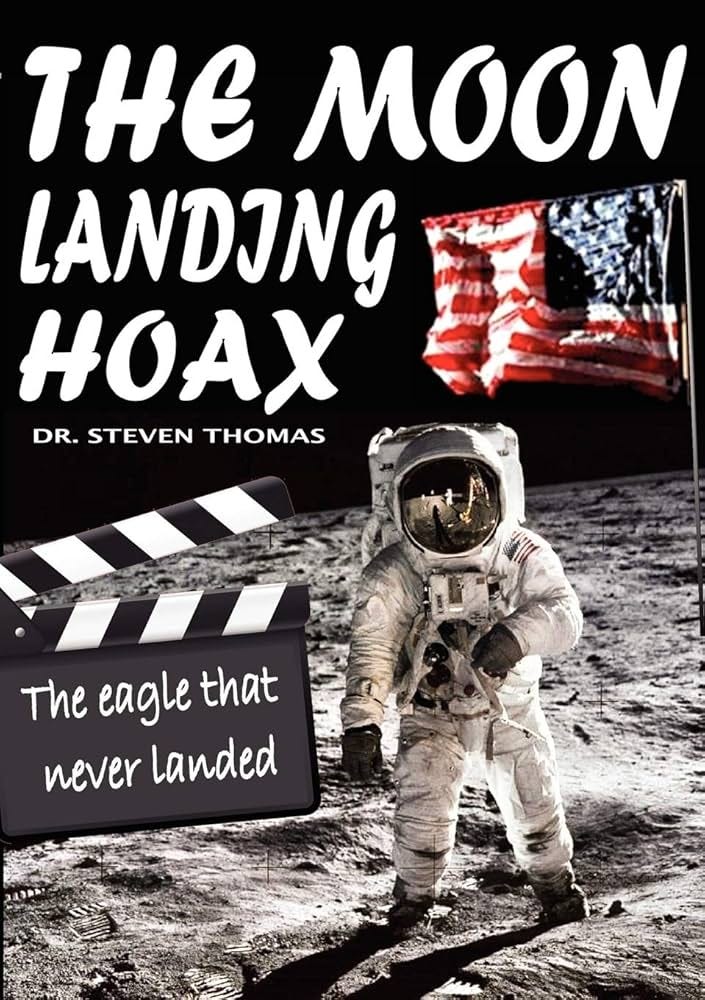
How We Faked The Moon Landing With Bart Sibrel - Candace Ep 124:
Masonic You Tube Bans Video, but Here it is on Bitchute: NASA Finally Reveals the Truth About Fake Moon Landings:
The new movie, Fly Me to the Moon, an upcoming American romantic comedy about faking The Moon Mission is an excellent example of hiding The Truth in plain sight. The film was directed by Greg Berlanti and written by Rose Gilroy. The film stars Scarlett Johansson, Channing Tatum, Nick Dillenburg, Anna Garcia, Jim Rash, Noah Robbins, Colin Woodell, Christian Zuber, Donald Elise Watkins, Ray Romano, and Woody Harrelson. Its plot follows the relationship between a marketing specialist and a NASA director during the 1960s Space Race. In the film, during the 1960s Space Race between the United States and the Soviet Union, a relationship develops between the NASA director in charge of the Apollo 11 launch and the marketing specialist brought in to fix NASA’s public image and stage a “back-up” fake moon landing.
“If you believed they put a man on The Moon, Man on The Moon…”
--The Band, REM
“Space may be the final frontier but it’s made in a Hollywood basement.”
--The Red Hot Chili Peppers
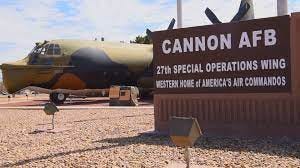
Cannon Airforce Base Implicated in Establishing a Movie Set to Fake The Moon Landing:
The rumors first got traction just a year after the first Moon landing, when the Vietnam War had led millions of Americans to question their government.
A July1970 poll found 30% of Americans declaring Apollo 11 to be a fake. That number remained relatively high throughout the ‘70s, when several books were published and a 1978 film about a phony mission to Mars, Capricorn One, convinced many that a Moon landing was also a scripted piece of high-technology bunk.
Art Harmon, a former legislative director for the U.S. House or Representatives, currently leads the Coalition to Save Manned Space Exploration. He had two words for conspiracy theorists who say men never went to The Moon – “Absolute nuts. They’re just troublemakers. There’s always people who will say ‘this never happened’ or ‘that never happened.’ They’re just trying to divide people. We went,” he said.
But those who insist the U.S. did not put astronauts on The Moon have claimed their own “evidence” to a faked landing.
The question arose that why the flag astronaut Neil Armstrong planted on The Moon could not possibly be rippling in the wind, because there is no air on The Moon? Why did the flag ripple? Well, the flag rippled because film studio fans were being employed on set to cool the actots, in addition to Earth winds on the movie set.
The conspiracy minded claim photos the astronauts took on The Moon do not show any stars in the background, which they should show from even their 1960 technology. If The Moon landing was real, they ask, why didn’t the lander scatter dust when it touched down, which is would if this was a real Moon landing with rocket thrusters.
Ultimately, hundreds of thousands of people, including scientists, engineers and factory workers claimed that The Moon Landing was faked.
When one conspiracy theorist challenged Buzz Aldrin and called him a liar, Aldrin punched him in the face, revealing that the interviewer had hit a nerve…a nerve of deception.
Verify: Viral images of moon landing filming are AI:
Masonic You Tube Banned the Video, But Bitchute Still Has it Up.
FLY ME TO THE MOON IS A CONFESSION FROM NASA! THEY ADMIT TO IT ALL & STILL NO ONE BELIEVES US:
https://www.bitchute.com/video/MfKDbA5PFKV9/
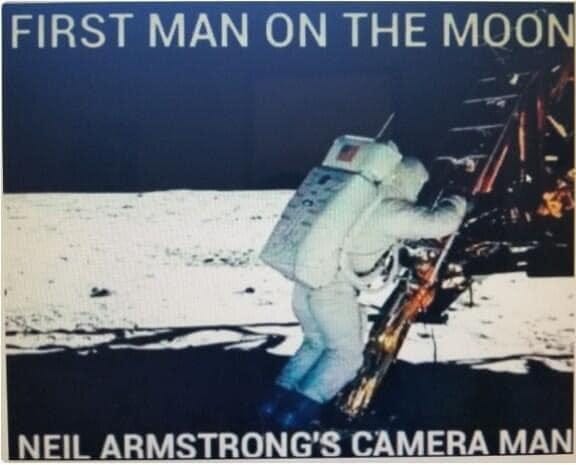
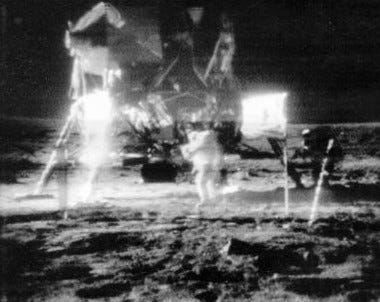
Watch Neil Armstrong’s First Steps on The Hollywood Stage Set of The Moon:
On July 20, 1969, Apollo 11 astronaut Neil Armstrong allegedly made history as the first man to walk on the moon, and uttered his famous words: “That’s one small step for Man, one giant leap for Mankind.”
But wait!
So, Neil Armstrong was allegedly the first person on the Moon, but who filmed him from the surface of the Moon? They didn’t have the tech to have a self-driving drone take the footage, so surely the person placing the camera/taking the footage was the first man on the Moon?
So who was already on the Moon to film the first alleged steps of Neil Armstrong on The Moon? NASA claims it was a super, uper, uper duper long selfie stick that protruded from the Lunar Modul that took the footage.
More Specifically, NASA Claims:
“For each lunar landing mission, a camera was also placed inside the Apollo Lunar Module (LM) descent stage’s modularized equipment stowage assembly (MESA). Positioning the camera in the MESA made it possible to telecast the astronauts’ first steps as they climbed down the LM’s ladder at the start of a mission’s first moonwalk/EVA. Afterwards, the camera would be detached from its mount in the MESA, mounted on a tripod and carried away from the LM to show the EVA’s progress; or, mounted on a Lunar Roving Vehicle (LRV), where it could be remotely controlled from Mission Control on Earth.”
Do you buy it?
I don’t, given the technology in 1969.
It makes more sense that Stanley Kubrick filmed it from the surface of the Pinewood Studio Moon set. In 1935, millionaire Methodist and flour magnate J. Arthur Rank (1888–1972) went into partnership with Boot and they transformed the estate into a film studio. Boot based designs for the studio complex on the latest ideas being employed by film studios in Hollywood, California. Boot named the new studio Pinewood because “of the number of trees which grow there and because it seemed to suggest something of the American film centre in its second syllable”.
Pinewood Studios:

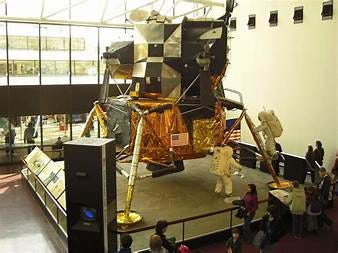
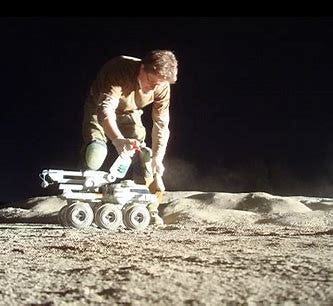
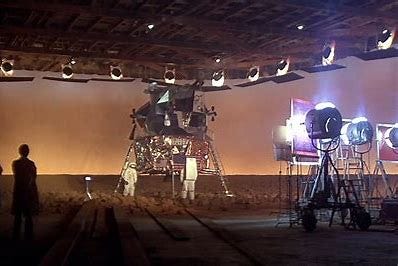

Additionally, your smart phone will do over 100,000 times the number of computations per second tham the Lunar Module’s computer could do. It was a very slow, primitive computer, at approximately 10 KB of memory, and hardly capable of rendering even a kitty cat image on a computer screen, let alone performing the complex calculations and work flow necessary to operate a Lunar Modul or remote camera on The Moon.
Also, Wi-Fi communication today is a millions time more advanced than anything NASA had in 1969, and yet I lose my cell signal if I go through a tunnel.
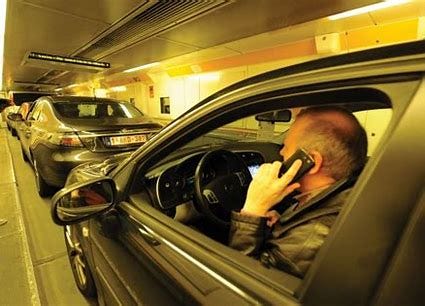
And yet, NASA is claiming almost zero latency two-way communication between Earth and The Moon at an alleged 294,000 miles!!! That’s communication through 7 layers of Earth atmosphere and then hundreds of thousands of miles of fictional Outer Space, including The Van Allen Radiation Belts.
Yeah, right…
President Richard Nixon Calling The Moon on a Landline in 1969…Make Sense?
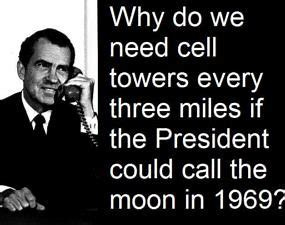

NASA Claims This:
“Nixon spoke on a telephone which was routed through the wire and microwave links of the day until it reached a Manned Spaceflight Communications Network ground station where it was modulated onto s-band radio and transmitted to the Moon. The Van Allen belts (plural) were not an impediment.”
The technical impossibility of this in 1969, not to mention their absurd disregard for the Van Allen Radiation Belts, is both hilarious and nonsensical. At best, such a routing structure would create incredible latency problems, signal repeater and relay delays, and reception dissonance.
Comments
Nothing yet. Say the first thing.
Sign in to join the conversation.