
Two things happened in medicine recently that seem at first glance to have almost nothing in common.
The first item is the news about Kalshi starting to open up prediction markets for clinical trials.
The second is the liberalization of FDA rules on several different peptides that are being used in longevity clinics and Medispas around the country.
One story is about gambling. The other story is about longevity. But they’re part of the same story: medicine is entering its You Can Just Do Things era.
For most of modern medicine, institutions decided on what you could access and what could be sold.
Increasingly, those guardrails are coming down and these two stories show that.
But an important part of understanding how this impacts people is to recognize that removing the guardrails doesn’t remove the information asymmetry that underlies so much of what happens in medicine.
Prediction markets starting to include the ability to bet on clinical trial outcomes has been a big topic of discussion on medical Substack, where both Vinay Prasad MD MPH and Daniel Flora, MD wrote about the topic with a particular focus on cancer trials.
I would recommend reading both of their pieces, which you can find here and here.
I thought both takes were interesting - Dr. Prasad made a compelling case talking about why most of the concerns that have been raised about this shouldn’t really be that alarming and Dr. Flora thinks that betting on trials runs the risk of losing the trust of patients enrolled in these trials.
Their pieces are more detailed and nuanced than I’m covering here, but I’m not really interested in rehashing or debating those angles.
My take on allowing betting markets on clinical trials is much simpler: I don’t think it will make any difference on clinical trial structure, patient outcomes, or trust in the medical system. I don’t think it actually matters at all for anyone who isn’t wagering money on the results of these trials.
But having prediction markets start allowing clinical trial outcomes to be wagered on means that some guardrails are coming off and reflects another trend in medicine that happens as supervision in the system decreases - the transfer of money from the unsophisticated to the sophisticated.
Let me make my case.
The Wall Street Journal covered betting markets a few months ago in detail, and what their reporting shows is that most people lose money and the vast majority of profits are captured by a tiny cohort of forecasters:
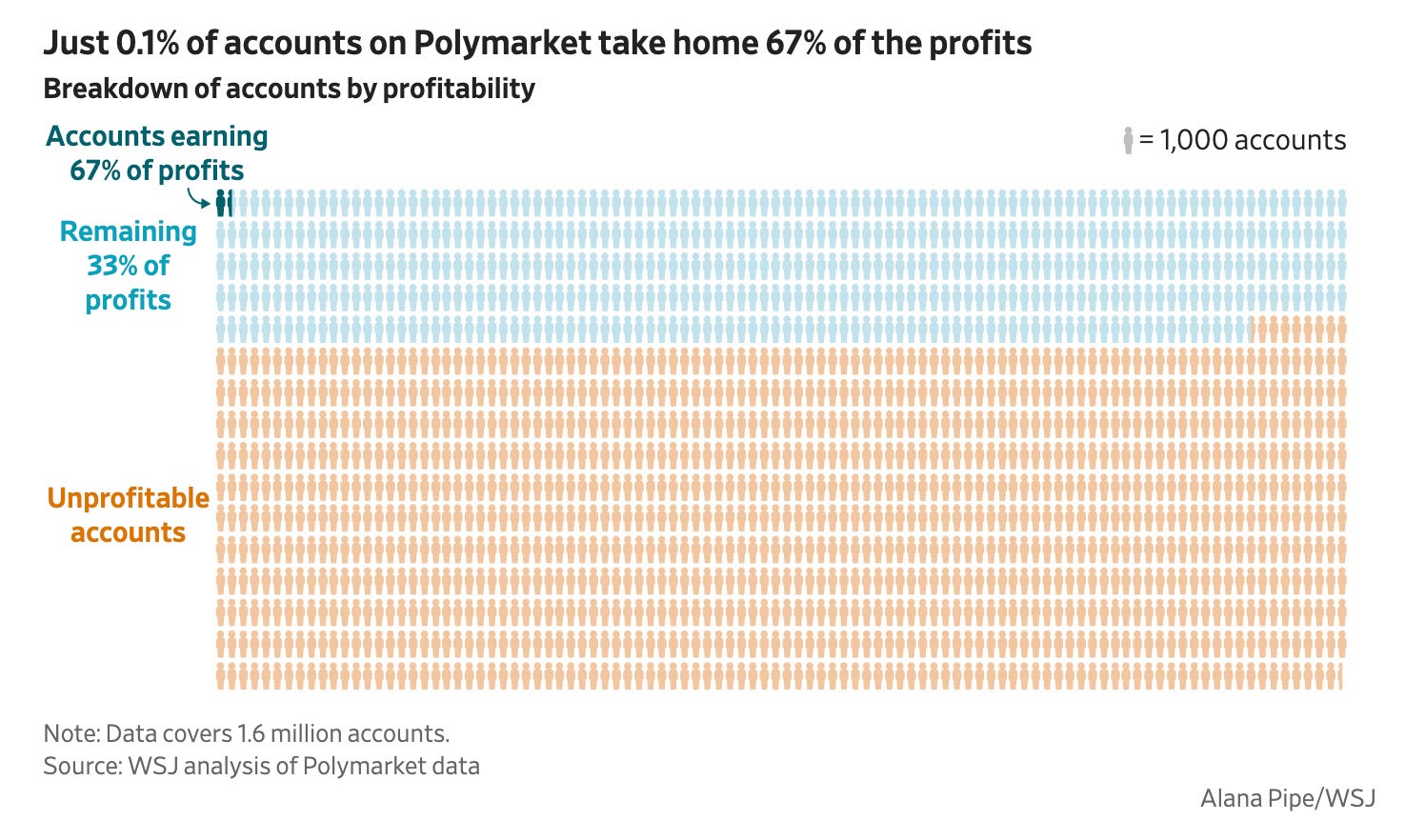
The numbers on these markets are pretty stark - more than 70% of people lose money and only a tiny fraction of people end up winning big.
And so I assume that insider information will be used on these wagers despite what Kalshi and Polymarket suggest with regards to enforcement of insider trading. Lots of people have information on what happens with these trials before their results are announced, and I’m not naive enough to think that none of that information will make its way into betting markets.
Just remember, these markets are zero sum, so everyone will use the information that is available to them, and since there is money to be made, that information has real value.
But the history of these betting markets in essentially every other domain suggests that the vast majority of people who put money into them will come out as losers with only a tiny group of winners.
The sophisticated will win and make money, and the unsophisticated will lose money.
In some ways, these markets are as much a wealth transfer from the unsophisticated to the sophisticated as they are a prediction mechanism for what happens in the world.
I also don’t think that matters for the outcomes of the trials, or drug approvals, or anything else of real consequence to patients.
The FDA isn’t going to change drug approval standards or requirements for clinical trial protocols based on who wins or loses money on Polymarket.
People already bet on the outcomes of these trials in the stock market and that doesn’t influence drug approval standards or patient outcomes, so why would betting markets have any impact?
The words peptides and clinical trials basically never show up in the same piece unless someone is pedantically telling you that “no high quality clinical trials have been run on any peptides other than GLP1s.”
With the changing FDA rules around peptides and the opening up of prediction markets to clinical trials, we’re seeing an interesting similarity between the two that’s illustrative of the changing face of medicine.
The opening up of the peptide regulations likely means that ultimately more people are going to be taking peptides. And peptides aren’t paid for by insurance - it’s a cash economy.
In my clinic, I see people everyday who are asking questions about these things. It’s all over their social media, their friends are talking about them, it’s very clear to me that peptides are hot and growing in the zeitgeist.
Peptides are short chains of amino acids that have biologic effects.
Insulin is a peptide. So is Ozempic.
But much of what you hear online about “peptides” is really a mix of a bunch of different compounds that all have different biological effects.
I have no doubt that some of these compounds will end up being beneficial. I also have no doubt that some of them will end up being harmful. Until we understand dosing, frequency of use, benefit of pulsing vs chronically taking, and many other things, we are going to be left with really no high level understanding about best practices for using many of the peptides that you see advertised.
And so liberalization of the rules around access without a corresponding financial incentive to study these things to thoroughly evaluate efficacy and safety just means more people taking them with no more idea about whether they work.
Peptides clearly seem to have a biologic impact.
That lack of high quality data hasn’t stopped many wellness places, longevity practices, and Medispas from offering peptides at a high premium to people interested in fixing a problem and blindly trusting that the offering is safe, effective, and better than a placebo.
My argument isn’t that peptides are bad or that they’re dangerous or really anything else alarming about them.
My argument is that until these things are properly studied, we don’t know much and we certainly don’t know what we don’t know.
Because peptides have the halo of feeling cutting edge, they are being sold at huge markups and the people who are offering them are making a killing on their sale.
Unfortunately, the peptide market is shaping up to be similar to the prediction markets - a transfer of wealth from normal folks to the sharps.
These things are expensive, and we don’t know whether they work, what constitutes a safe dose, and what the side effect profile is.
If I told you I had a prescription drug that modulated inflammation and blood vessel growth, like BPC-157 does, almost any physician or sophisticated consumer would wonder what impact that would have on cancer and infection risk.
But the short answer is that we have no idea, because it hasn’t been studied rigorously enough to answer that question.
I’m not suggesting that BPC-157 causes cancer, but I’m also saying I don’t actually know whether it increases or decreases that risk.
I would be fascinated to find out, but without exclusivity pathways that make it worth studying peptides properly, we are all going to be left with a massive degree of uncertainty.
And if you’re a 65 year old with a few chronic medical conditions, my medical recommendation is to exercise caution about the risk/benefit profile of biologically active things that you are putting in your body.
Much energy in health care policy debates is about the difference between the haves and the have-nots.
Policy debates often focus on access and insurance coverage and cost of prescriptions and services.
But the cash pay economy in healthcare is growing, and too often there aren’t any adults in the room.
What I see in my clinic is that the messages that people take in from their friends and their social media consumption ultimately end up informing their health literacy in profound ways.
There’s been a story for a long time about the premise that rich people have better medical care because they have access to the cutting edge in a way that the rest of us don’t.
That’s mostly a myth in my eyes, but there is a real divide in medicine between the sophisticated and unsophisticated, and we are going to continue to see this divide play out in real life.
That division is orthogonal to wealth - I’ve seen incredibly wealthy people who are wildly unsophisticated and very poor people who are quite sophisticated when it comes to their health.
But when the wealthy buy something expensive that doesn’t improve their health, it harms them a lot less than when someone with less money makes the same mistake.
The story of easier access to peptides and the ability to bet on clinical trials both fit into this growing trend.
When patients ask me about this stuff in my clinic, I answer them honestly: “I don’t know, and anyone who tells you that they know is either lying to you or lying to themselves.”
Call it the You Can Just Do Things era, or the Caveat Emptor era, but it’s clear from the people I see in my clinic that medicine is changing fast.
Buckle up.
No posts
Comments
Nothing yet. Say the first thing.
Sign in to join the conversation.