
Some people come to the doctor when they don’t feel well and the diagnosis is totally clear based on a few questions about their symptoms and a cursory exam with testing.
But most people aren’t simple like that - their lives are complicated, their symptoms don’t fit the text book, and the doctor who sees them doesn’t do a great job of understanding and treating the whole patient.
That gap between what a patient experiences and what the medical system offers explains some of the frustration with the healthcare system.1
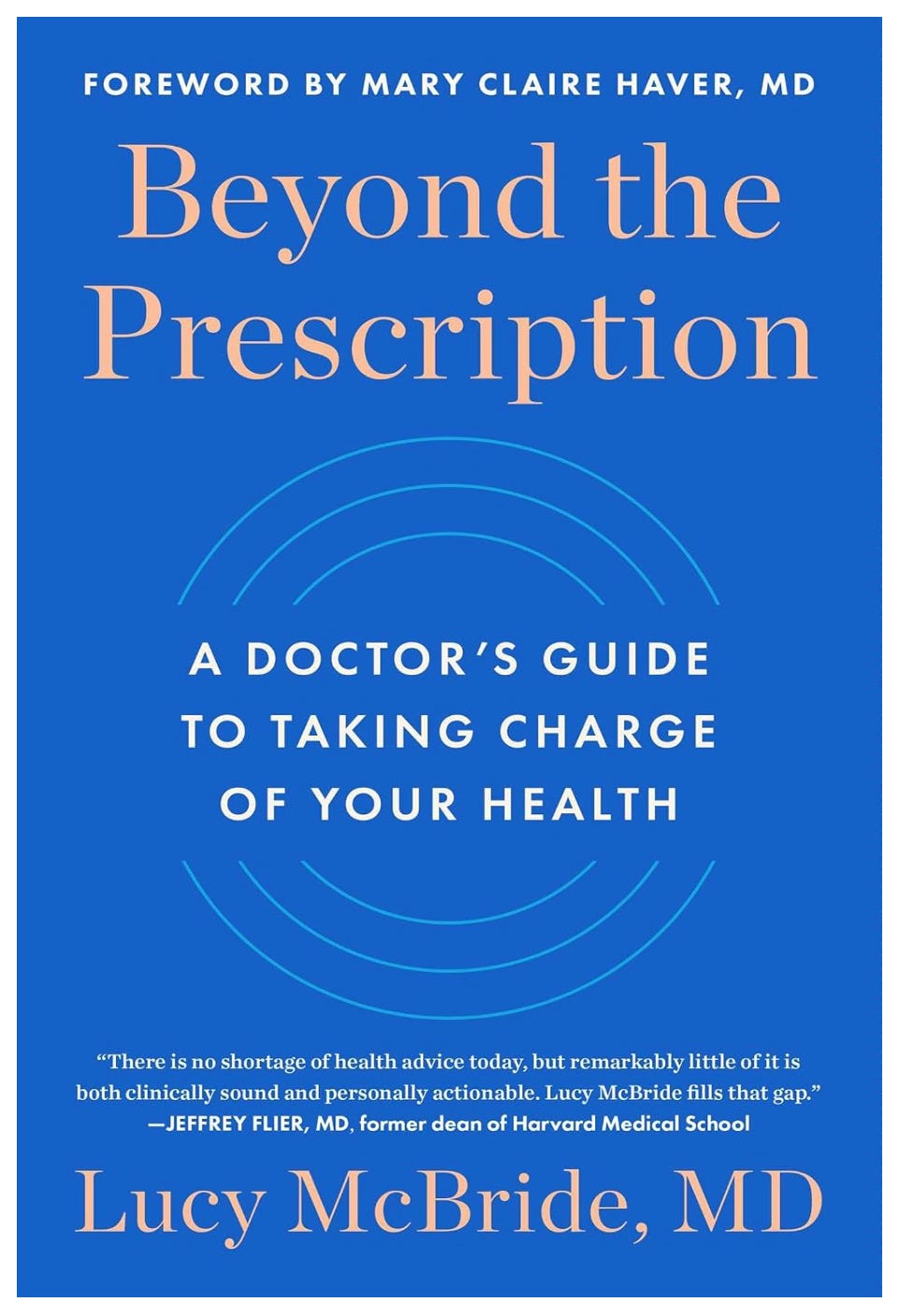
My friend Dr. Lucy McBride just wrote a book titled Beyond the Prescription that I would recommend to everyone here - and you can purchase a copy here.
Her book really showcases what medicine can be at its best: an individualized, relationship-centered process of helping people feel better and live longer.
Beyond the Prescription is a book for everyone who interacts with the medical system. For patients, I think it will help you have more fruitful doctor’s appointments and understand a bit more about how to feel control over your own health. For doctors, it reminds us about the interconnectedness of our patients lives with their medical ailments.
So for today’s post, I wanted to give you a review of Beyond the Prescription and make sure you know my strong recommendation about it.
Too much medical content is overly confident, overly pedantic, and overly prescriptive.
Dr. McBride is one of the people in this space who does things right.
If you read her newsletter, you’ll see that she’s someone who practices medicine the way it should be practiced - centering a patient’s preferences and life circumstances around a reasonable read of the medical evidence.
She’s open minded and patient centered. I want to promote her book because I think she does medical communication the right way and if we don’t elevate people who communicate like that, then we are doomed to get endless variations of “The 5 heart tests you need” in an ever-accelerating algorithm of nonsense.
The core move of Lucy’s book is that your medical record doesn’t exist in a silo away from the rest of your life.
Everything is connected and context really matters. Dr. McBride shows over and over again how sometimes belly pain isn’t just belly pain.
Maybe the person with belly pain is actually a caregiver, and so they spend their whole day worrying about someone else. That means they stay up too late, drink a little bit too much wine, and scroll for longer than they should. Mental health challenges start to become physical health challenges. And then the physical problems reinforce the mental health ones.
This book will show you how it doesn’t necessarily take a huge amount of time or a bunch of esoteric questions to get to the underlying problem - a single well-timed question or a few extra seconds of well-timed silence might crack things open.
So much stuff that I hear about “root cause medicine” is from an influencer with a ring light who is trying to sell you a CGM and affiliate links to their favorite supplements.
Lucy McBride will show you how root cause medicine actually works.
This concept is really powerful and it echoes something that a lot of really successful communicators have converged on - your values and preferences matter much more than anyone else’s when it comes to your life.
The financial writer Ramit Sethi often writes about creating your “Rich Life,” which starts out by defining what is actually important to you.
Lucy’s book gives something similar for your health - a primer to strategize about what’s important to you along with tactics to help you get there.
She organizes this around four domains, which she calls Informatics, Inputs, Infrastructure, and Insight (your data, what you put in your body, how you move, and your mental and emotional life).
And she helps you figure out your “patient personality”: the Optimizer, the Pleaser, the Internet Warrior, the Outsourcer.2 These aren’t your actual personality, instead they’re how you behave in a medical setting, which is a distinction most people have never once considered.
The Informatics chapter is a guide to what everyone should do to prepare for a doctor’s visit that they want to get the most out of:
Know your meds and supplements - like actually know them, the names, doses, how often you’re taking them, when you started them.
Bring any outside testing in a physical form (printed out) or electronically where you have already logged into the portal and don’t need to look up your password. Bring the wearable data if you want it discussed and be able to access it quickly.
Write your symptoms as a timeline, including life changes and med changes, and bring it with you to the visit
Know your own biographical details - family history, traumas, big life shifts. This is all the stuff your chart doesn’t have but can truly matter for how your doctor thinks about your case
Too often we hold the false illusion that there is a “right” or “wrong” answer for medical questions.
Much more commonly, it depends on the context. Who is this patient? What are their health problems? What are their preferences?
When you strip out the context, you get an answer that doesn’t actually have any meaning for the person who is asking the question.
She shows how this works in real cases. Low bone density in a menopausal woman doesn't automatically mean a Fosamax prescription. Evidence-based medicine - "there's a study for that" - too often tricks us into thinking we know the answer when we only kind of know it.
One point that Lucy makes repeatedly that goes against classic medical training is that we should often question single factor explanations - be skeptical of anyone who blames a complex medical problem solely on age, weight, genetics, or a finding on imaging.
Doctors are often taught about Occam’s razor - the most parsimonious explanation is the best one. That works well when it comes to rare or complex diagnoses that end up in case reports. But for most patients with complicated, chronic problems, just one thing rarely tells the whole story.
There's a humility running through the book that I learned from, and that I think a lot of my colleagues could too.
Many of the cases in this book have a clear arc - put the pieces together, ask the right questions, make a useful observation, and guide a patient to success.
In real life, the cases don’t always resolve in as straightforward a way as they do in the book.
But the framework holds even when the timeline doesn’t. And using cases that have a happy ending as illustrative examples gives both patients and doctors hope that we can do better.
I practice medicine every single day, and I learned a few smart tips from this book:
She connects hearing loss to cognitive decline, and hormonal shifts to chronic pain.
She tells the story of a patient written off with hip, back, and knee pain — diagnosed as arthritis and a torn meniscus, headed toward surgery. The actual culprit was a contracted psoas muscle tilting his pelvis and loading all three joints.
She explains why whole wheat pasta and an intact wheat berry are not the same thing for your body, even though both wear the "whole grain" label.
I quote the serenity prayer all the time when I talk to patients and when I teach residents, so it made me happy to see that concept echoed in the conclusion of Dr. McBride’s book (as well as quoted directly earlier on).
Awareness means an understanding of how health is connected - mental health impacts physical health which impacts mental health, and so on.
Acceptance means a recognition of things that we can’t change - we don’t get to pick who our parents are.
Agency means putting your energy where you can actually move the needle.
I’ll end this here. Just know that I strongly recommend Dr. Lucy McBride’s book, which you can order here.3
I said some of the frustration, not all of the frustration.
This really does a great job of capturing characteristics of the types of patients that I see. Most people don’t just have one of these, but instead they have aspects of a couple.
No posts
Comments
Nothing yet. Say the first thing.
Sign in to join the conversation.