
👋Hello, my friend. It feels like everywhere I turn lately, I’m getting reminded of hormones.
I pick up my soon-to-be 12- and 14-year-olds from practice and—boom—the smell smacks me in the face. (Is it really that hard to remember deodorant?)
I’m watching the latest episode of Friends & Neighbors with my wife, and the storyline is all about perimenopause.
I’m riding the elevator at work, making small talk about traffic, and a colleague casually drops, “At least I’m an old man now—no more testosterone—so I’m pretty calm about it.”
Hormones. Hormones everywhere.
And somewhere along the way, it got me thinking—specifically about testosterone, and what happens to it (and to us) as we move through middle age.
As you know, I’ve been working on a body composition project—really focused on strength training, dialing in diet, and trying to be intentional about how I take care of my body.
The good news: I’m seeing progress. A few pounds of fat down. Some early signs of muscle showing up.
But it’s slower than I want.
And I think that’s the part that’s been nagging at me. In my late 40s, I can feel that my body doesn’t respond the same way it used to. The inputs are there—lifting, diet, consistency—but the outputs take longer. They’re more subtle. They require more patience.
So naturally, I started asking: Is testosterone part of this story?
This curiosity didn’t exactly emerge in a vacuum.
I was getting a haircut recently and noticed something… the place was full of middle-aged guys who were (in my mind) almost all ridiculously jacked.
So I asked my barber, “What is going on here? Why is every guy in here completely shredded? I feel like a skinny twerp!”
Without missing a beat, he says:
“Because you’re the only one in here who’s not on TRT.”
Now… I don’t know if that’s literally true. But it stuck with me.
Because once you start noticing it, you start noticing it everywhere.
When you start looking into it, testosterone replacement therapy (TRT) is pretty appealing.
If you look at the potential upsides, it’s basically a greatest hits list:
Faster muscle growth
Easier fat loss
Better energy
Improved mood
Increased confidence
I mean… I want all that stuff!
It’s especially appealing when you feel like you’re putting in the work, but progress is painstakingly slow.
We’re also living in a moment where the idea of “taking something” to optimize your body is becoming more normalized. Between GLP-1s and other therapies, the cultural resistance to intervention is clearly shifting.
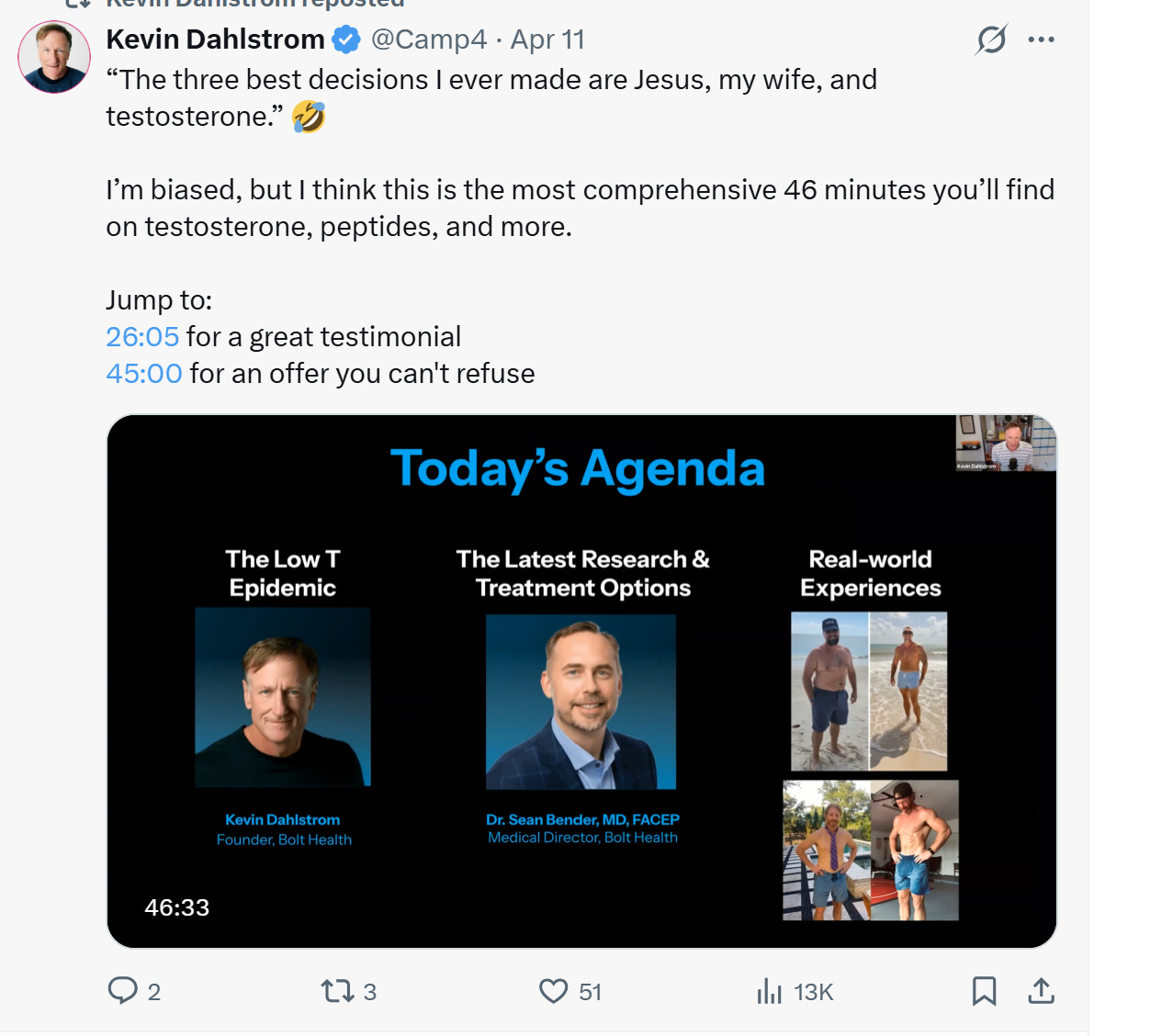
I even watched a webinar from Kevin Dahlstrom (see below) on this recently that I came across on Twitter/X, and it was pretty damn compelling!
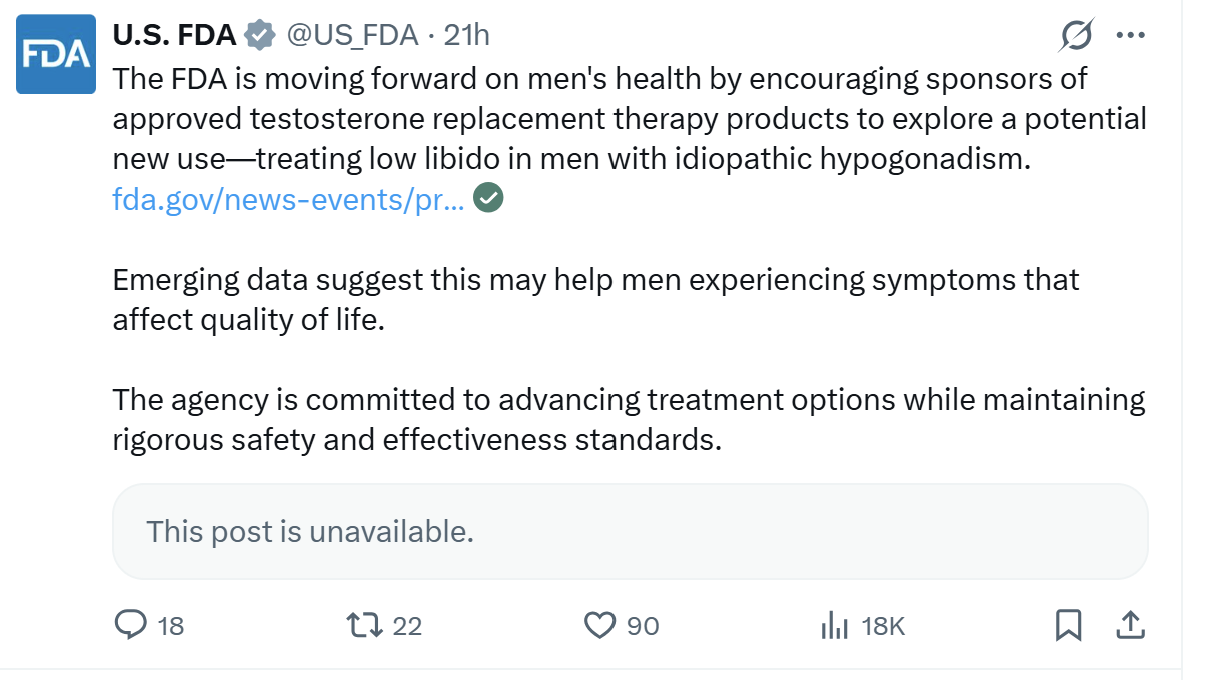
Heck, even the FDA is getting in on the craze. Draw your own conclusions about that.
So yeah… there are some notable attractions.
Part of me is genuinely curious. Would TRT be a total game-changer? A lot of people seem to swear by it.
But of course, it’s not all upside.
And I want to be really clear here—I’m not trying to present a definitive take on TRT. I’m still early in my own learning. But based on what I’ve seen so far, there are real potential downsides to consider:
Potential hair loss (especially if you’re predisposed)
Acne
Suppression of your body’s natural testosterone production
Testicular shrinkage (yes, that’s a thing)
The question of whether starting means you’re “on it for life”
Ongoing monitoring (like PSA levels for prostate health)
Some of these are cosmetic. Some are more serious.
And there’s also a broader, harder-to-quantify question: what are the long-term effects?
That’s where things get a bit murkier.
One interesting part of this journey: I’ve been using AI—primarily ChatGPT—as a kind of health sounding board.
I feed it my Function Health bloodwork, sleep data, WHOOP data, diet, and training, and I ask for recommendations.
And I have to say… it’s surprisingly level-headed.
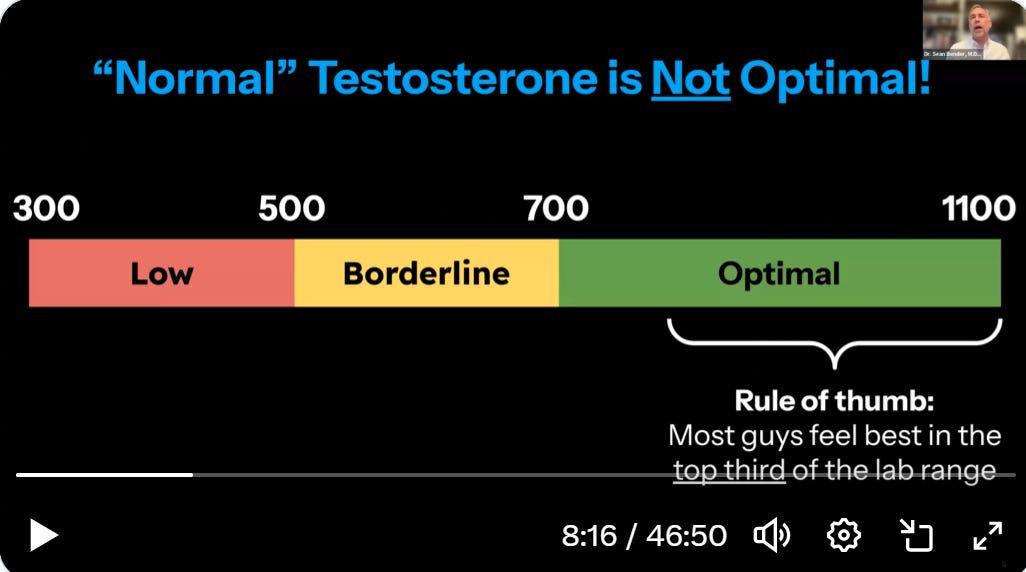
For what it's worth, my bloodwork shows testosterone in the “normal” range — at least according to Function’s definition. But there’s a ton of nuance here, including:
What’s really normal, and for whom?
There seem to be widely varying definitions. The screenshot below is from the webinar referenced above. These ranges are higher than Function — but their range (250 - 1100) seems wide enough to drive a truck through.
And, of course, do you really want to be “normal” in a population that is generally sick, overweight, and depressed?
Also, there are implications of total testosterone vs. free testosterone — the latter being what’s actually available for your body to use. Like I said… lots of nuance.
Anyhow, that’s beyond the scope of this article… maybe a podcast episode soon if I can find the right guest.
But when I asked my AI friend about TRT, the response wasn’t “go for it.” It was more like:
“Good that you’re exploring this. But based on your data—you don’t need it right now. Let’s optimize the natural levers first.”
Interesting. Not saying “never.” More like “not yet.”
And doing what it usually does — talking me out of shiny object syndrome. Which I appreciate. Pretty smart for a computer.
So what are those levers?
Nothing shocking here—but maybe that’s the point.
Lift heavy: Focus on large muscle groups (don’t skip leg day!). Push close to failure.
Sleep: Deep, consistent, high-quality sleep (this is huge for testosterone production … and just about everything else related to your health).
Protein intake: Fuel muscle growth properly.
Magnesium: Helpful for sleep and testosterone production.
Vitamin D: Especially if you’re deficient.
Body composition: More muscle, less fat—this seems to correlate strongly with higher testosterone. Kind of a chicken & the egg situation, but important to realize nonetheless.
It’s almost annoyingly simple.
But also… kind of reassuring.
Because it means the foundation still matters most.
At some point, I started thinking about what TRT “looks like” in the real world.
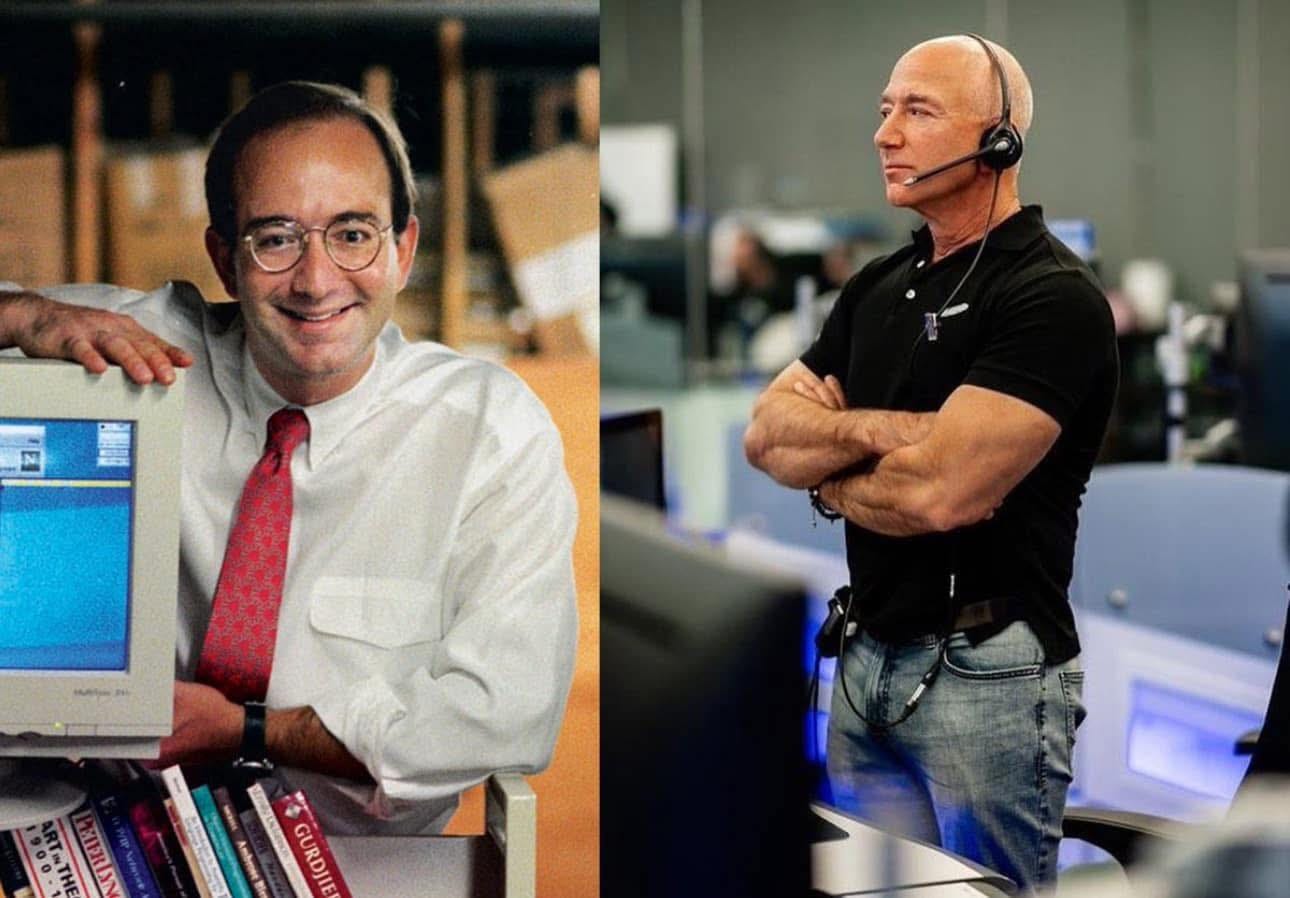
And for a lot of people, the mental image is probably something like: jacked Jeff Bezos.
You’ve seen the pictures. The transformation is… noticeable.
Now, has he publicly stated that he’s on TRT? No.
But when you see a guy in his 60s with broader shoulders, jacked arms, and a different overall presence… it at least raises the question.
And to be clear—I’m not judging.
If anything, it just reinforces how common (or at least how visible) this path has become. I’m starting to notice this a ton around me — especially with guys in their 50s.
So where does that leave me?
Right now, I’d describe my mindset as curious but cautious.
And one idea that keeps coming back to me is a version of the Hippocratic principle: first, do no harm.
I’m pretty bullish on the long-term trajectory of health and longevity. It feels like we’re on the front end of major advancements—driven in part by AI and better data.
And so part of my thinking is: Does it make sense to do something that could possibly alter my physiology in a negative way — if the medicines and therapies in the years ahead are about to get way better? Probably not.
For all the potential benefits, I’m still a big believer in the idea that there is no “free lunch” in biology, and I would guess this is the case when it comes to TRT.
I’m very interested in testosterone and learning more
I see the appeal of TRT clearly
I’m currently focused on maximizing natural approaches
I reserve the right to change my mind
And maybe most importantly…
This is one of those areas where the upside can feel immediate and exciting—but the downside requires a longer lens.
This feels like a topic that a lot of people are just starting to explore more openly.
So I’d genuinely love to hear from you:
Have you looked into TRT?
Have you tried it?
What’s been your experience?
Any resources you’ve found helpful?
And for the ladies—hopefully this didn’t feel too one-sided. I know hormone conversations are just as (if not more) relevant on your side, and I’ll admit I have even more to learn there. On that front, I’d check out the work of Dr. Rhonda Patrick and also Andrew Huberman recently put out this episode on female hormone health.
Appreciate you reading, as always.
And if nothing else… maybe this is your reminder to wear deodorant — especially if you are 1/ in middle school, and 2/ part of my immediate family.
See you next time.
Greg
No posts
Comments
Nothing yet. Say the first thing.
Sign in to join the conversation.