
👋Hello, my friend. Thinking a lot this week about what separates A players from B players. About how some people can seemingly “see around corners.” And about what may be the ultimate skill to lean into in the age of AI.
I keep coming back to this idea of curiosity, craft — and even more than that: obsession.
So let’s talk about it.
The idea of obsession has been popping up in a few different places in my life this week.
It started with my friend Rich Howe, Intentional Wisdom reader and podcast guest, who posted this on LinkedIn this week:
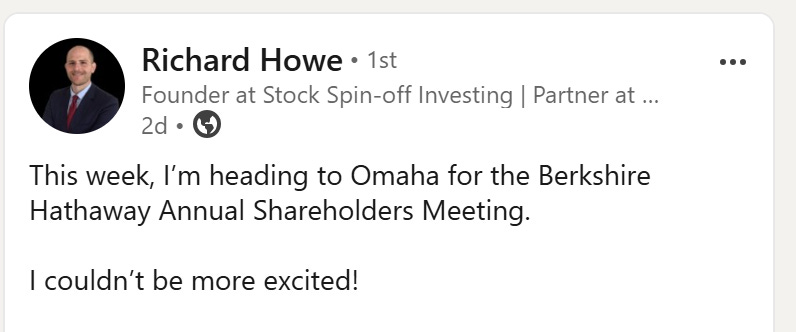
When I saw this, I thought “Of course, he couldn’t be more excited!”
For Rich, Berkshire weekend is basically Disney World. He lives and breathes investing. It’s where his natural energy goes. It lights him up.
Then I saw this post from VC firm a16z quoting co-founder Marc Andreessen:
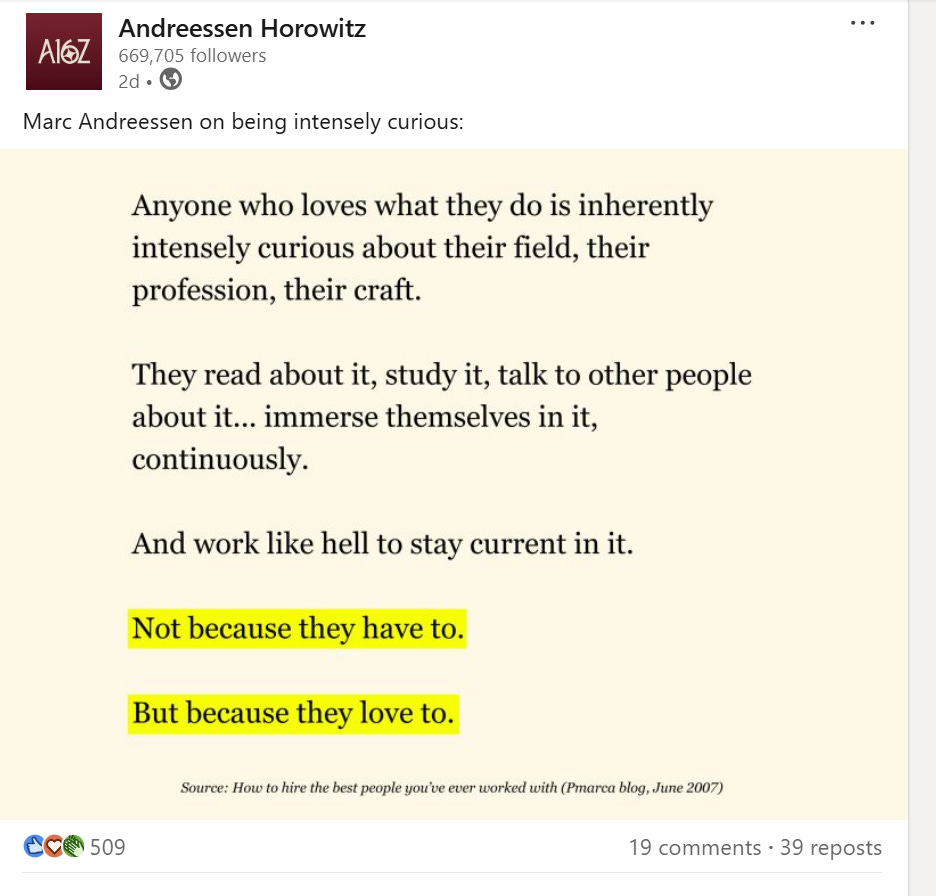
And I thought, “yeah… that pretty well verbalizes the idea that’s on my mind.”
The idea of obsession.
Not the creepy stalker kind. The kind where something pulls you in so naturally that you almost don’t have a choice.
The kind that feels like clean fuel.
A few days later, I caught myself showing my own signs of obsession.
I had just recorded a podcast episode at work — a conversation about AI in credit markets with a colleague. It was a good conversation and ran about 65 minutes.
Over the next few days, I spent what most people would probably consider way too much time editing it.
Cutting. Moving things around. Tightening. Listening again. Cutting some more.
By the time I was done, I had taken it from 65 minutes down to 44.
Part of the process involved asking AI for feedback on the transcript. And the feedback was pretty brutal — especially toward me.
It told me my questions were too long. It said some of my sidebar commentary, which I actually thought was pretty good, was getting in the way of the conversation. It pointed out places where I was probably adding more than I needed to.
That’s humbling feedback to receive.
But I’m getting used to the honesty I’m getting from AI — assuming I can ask for it correctly — and I do think it’s proving to be an effective mirror. Hopefully, it’s making me better at my job.
So I cut a lot.
Some of the stuff I took out was stuff I liked. A few tangents about AI. A few opinions I thought were interesting. A few moments where I thought I had phrased something well.
But they weren’t helping the listener. So out they went.
If someone had been watching me do all of this, they probably would have called it obsessive.
And maybe they’d be right.
But to me, it felt more like craft.
It was just caring enough to make the thing better. To do the annoying, tedious, unglamorous work that nobody sees. To keep going past the point where “good enough” probably would have been fine.
That’s the part of obsession I think we sometimes miss.
It’s not always some grand passion. Sometimes it’s just sustained attention. It’s staying with something a little longer than most people would. It’s noticing what could be better and not being able to leave it alone.
The other thing that happens when you’re genuinely obsessed with something is that you start to notice things early.
A little more than a year ago, I stumbled across a podcast called TBPN. Two hosts. Live filming. Smart but entertaining. A little loose, but in a good way. It felt different from a lot of what was out there.
At the time, I was probably one of their first few hundred viewers. I remember watching it and thinking: Why is nobody else paying attention to these guys?
I sent out the tweet below — and basically got crickets as a response.
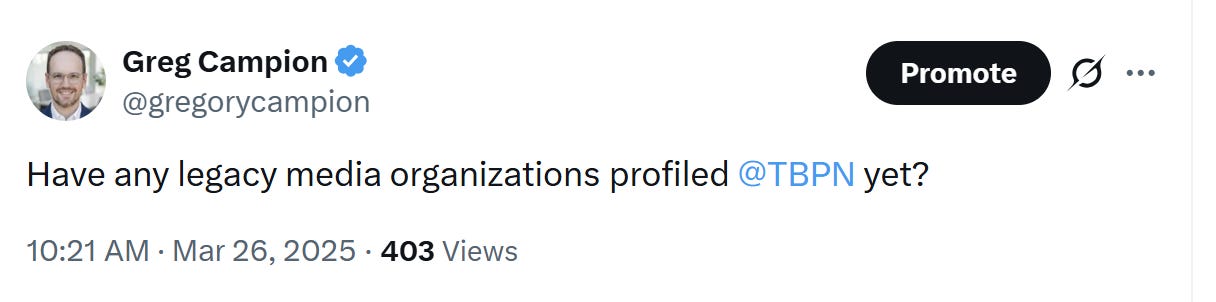
Fast forward to today… virtually every major newspaper and media outlet has profiled TBPN in some way, shape, or form. And… the kicker: OpenAI just acquired the show. Reportedly, for hundreds of millions. Not too shabby, boys!
Now, I’m not claiming to be Nostradamus. And I’m not trying to make myself the hero of this article… even though it seems like it’s trending that way. 😬
I’m saying I noticed what these guys were doing because I’m obsessed with the medium. I pay attention to content creation, podcasting, video formats, and the way audiences are changing more than the average person — not because anyone is making me, but because I’m interested.
I like seeing what’s changing. I like noticing new formats. I like watching the difference between something that feels stale and something that feels alive.
When you’re that deep in something, you’re often already paying attention before the thing becomes obvious to everyone else.
That’s one of the underrated benefits of obsession. You build a kind of pattern recognition. You start to feel when something is different before you can fully explain why.
When you’re genuinely obsessed with something, the energy around it feels different.
It doesn’t require the same kind of motivation. It doesn’t feel like forcing yourself through another task on the list. It doesn’t drain you the way grinding through something you don’t care about does.
The energy is just there.
Think about what you do when you have fifteen minutes to kill. What you’re reading at 10 p.m. when you should probably be going to sleep. The rabbit holes you fall into on a Saturday morning when nobody is making you do anything.
That stuff is data.
It’s telling you something about where your natural energy wants to go.
And I think we probably ignore that more than we should.
The practical questions still matter. What skills should I be building? What’s the smart move? Where is the market going?
But there’s another question underneath all of that:
What can you not help paying attention to?
That’s your clean fuel.
I think this is going to matter more in the years ahead.
AI is making execution dramatically easier. Creating content, building products, analyzing data, summarizing research, producing first drafts — all of that is getting cheaper and faster.
Which means the bottleneck starts to move.
It becomes less about, “Can you make something?”
And more about, “Do you know what’s worth making?”
That kind of judgment doesn’t come from nowhere. It comes from watching more, reading more, comparing more, tinkering more, noticing more. It comes from being deep enough in a domain that you start to develop a feel for what’s good, what’s noise, and what’s next.
In other words, it often comes from obsession.
I think about this with my kids.
My fourteen-year-old could not care less about what’s happening in his science class. But he can tell you every stat from the Red Sox going back years.
He is completely obsessed.
And for a while, my instinct as a parent was to try to redirect that energy toward something more “productive.”
But I’m starting to see it a little differently.
None of us really knows what jobs are going to look like in ten years. So maybe the best guidance we can give our kids isn’t just “study this” or “learn that.”
Maybe part of it is helping them pay attention to what pulls them in — and then take that seriously.
For my son, maybe that turns into sports analytics. Maybe sports marketing. Maybe content. Maybe something that doesn’t exist yet.
I have no idea.
But the energy he brings to the Red Sox is real. It’s clean fuel.
And in a world that’s getting harder to predict and easier to build in, I think that kind of energy matters.
The last thing I’ll say is that obsession changes.
What lights you up at fourteen may not be what lights you up at forty-eight. And that’s fine.
The point isn’t to find your one thing and hold onto it forever.
The point is to keep noticing what pulls you in — and to take it seriously when it does.
That’s what I’m trying to pay more attention to.
What gives me clean fuel?
What do I keep returning to when nobody is asking?
What work am I willing to make better, even if no one will notice?
I think there’s a powerful signal there that we’d be smart to pay more attention to.
—
That’s it for this week.
I hope you get to spend a few minutes today on something you're completely obsessed with.
Have a great week.
Greg
No posts
Comments
Nothing yet. Say the first thing.
Sign in to join the conversation.