
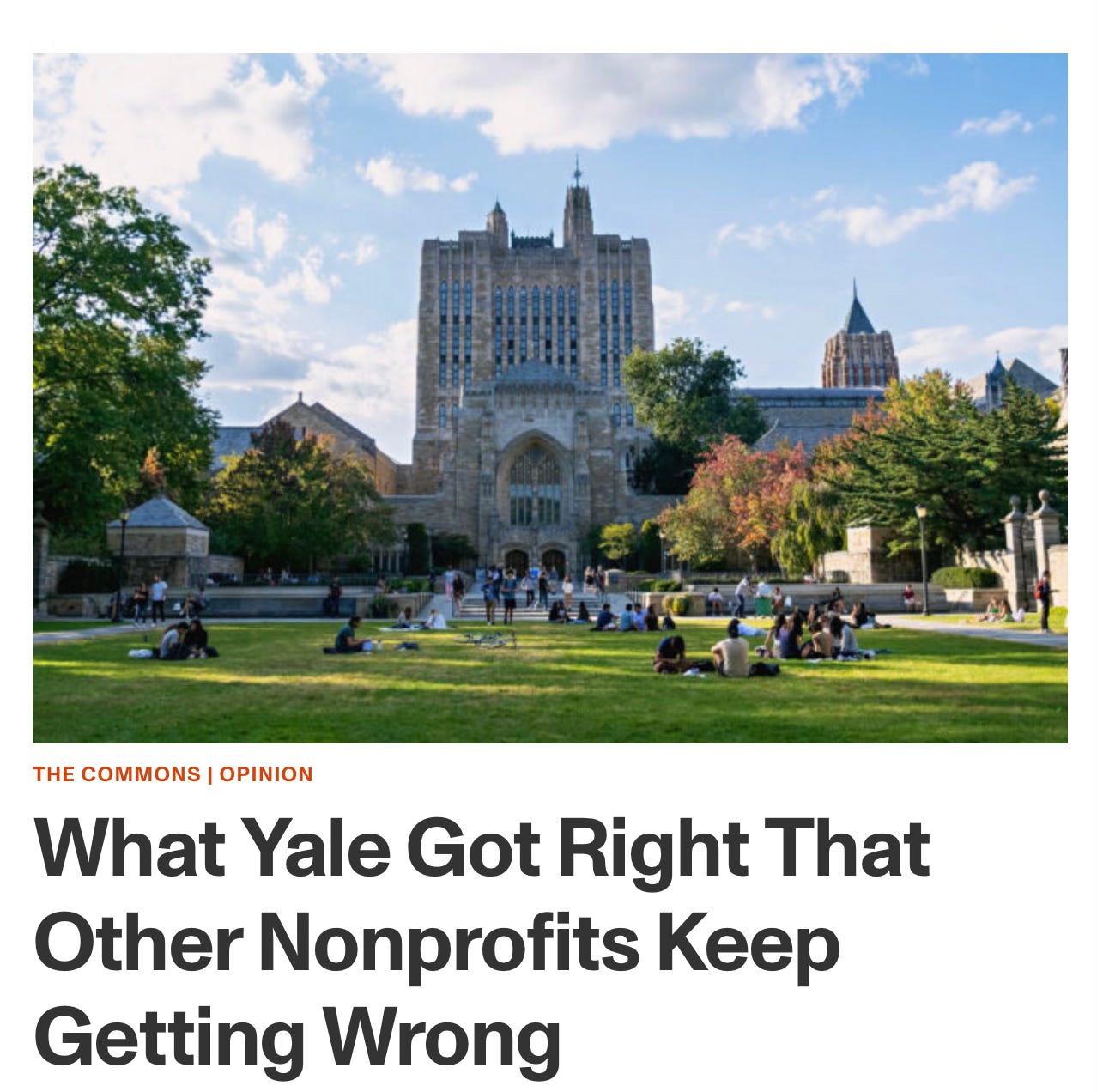
A few weeks ago, Yale University issued a report on declining public trust in higher education. Given the source and the topic, it comes as little surprise that the report received mixed reviews:
Heterodox Academy praised the report as a “landmark” that could meaningfully shift the public discourse about academia, focusing attention on issues of political bias and self-censorship on campus.
Inside Higher Ed complained that the report fundamentally misdiagnosed the problem: “The Yale committee refuses to come out and speak the truth: The decline in trust of higher education is primarily caused by conservatives being duped by right-wing con artists in a partisan attack on liberal institutions deemed to be the ‘enemy of the people.’”
Writing for the New York Times, Wesleyan University president Michael Roth split the difference, praising the report’s “smart and sensible recommendations” but criticizing it for not being willing to confront the Trump administration directly.
My take is that the report is a solid, commendable piece of work — and that it offers a model that other nonprofits should look to emulate. I have a new piece out this week in the Chronicle of Philanthropy making the case that nonprofits haven’t really grappled with declining public confidence in the sector:
The Yale report should be a template not just for other universities, but for the entire ecosystem of civil society organizations that are facing a similar crisis of legitimacy and haven’t yet mustered the nerve to confront it.
A March 2025 survey by the Dorothy A. Johnson Center for Philanthropy found that only 42 percent of respondents expressed strong trust in nonprofits. While better than many institutions — Congress and the national media, for example — it’s hardly cause for a ticker tape parade. Indeed, when the Johnson Center repeated the survey six months later, public support for nonprofits declined further. The trajectory is not encouraging.
The nonprofit sector has largely responded with a shrug. Many have simply ignored the problem or attributed it to communications challenges. If only the public really understood what we do, the thinking goes, then they would definitely love us! This is the instinct that animates Independent Sector’s plan to provide nonprofits with “tested messaging and narrative guidance” in order to help them better demonstrate their value to their communities.
Good messaging definitely beats bad messaging, but it won’t fix the problem. What Yale understood, and what the nonprofit sector has yet to fully reckon with, is that declining confidence often reflects real failures, not just PR deficits. What makes the Yale report notable is not that its findings are particularly surprising or that its recommendations are especially innovative, but that it exists at all. It’s worth noting here that the Democratic Party has scrapped plans to release a post-mortem analyzing why they lost the 2024 presidential election.
Given this context, I think that nonprofits would be well advised to emulate the Yale report, which was admirably self-critical about a number of developments on campus, including mission creep, rising tuition costs, and the lack of ideological diversity.
The Yale report is not a perfect example of public accountability, but even an imperfect model can offer valuable lessons. Imagine a major nonprofit commissioning something analogous: tasking a committee that is deeply committed to the institution’s success with honestly examining why public trust has declined and how it might be rebuilt. Imagine those findings being published in the New York Times instead of buried in board minutes.
This is hardly an outlandish fantasy. The nonprofit world has shown it can perform this kind of self-scrutiny in the past, including its efforts to address racial disparities within the sector. Now is the time to bring that same level of effort to the problem of declining public trust. Many nonprofit organizations feel under attack by the Trump administration and want to stay under the radar. Others will resist the idea of doing anything that might provide ammunition to their enemies. But that is no excuse for inaction. Avoiding problems does not make them go away.
The Yale report is one university’s attempt to respond to its critics. The rest of the nonprofit sector should follow suit. Trust is not built through better branding or narrative change. It’s built through competence, integrity, and responsiveness. That includes being willing to look honestly at one’s own organization—and then tell the world what you found.
You can read the whole essay here.
Comments
Nothing yet. Say the first thing.
Sign in to join the conversation.