
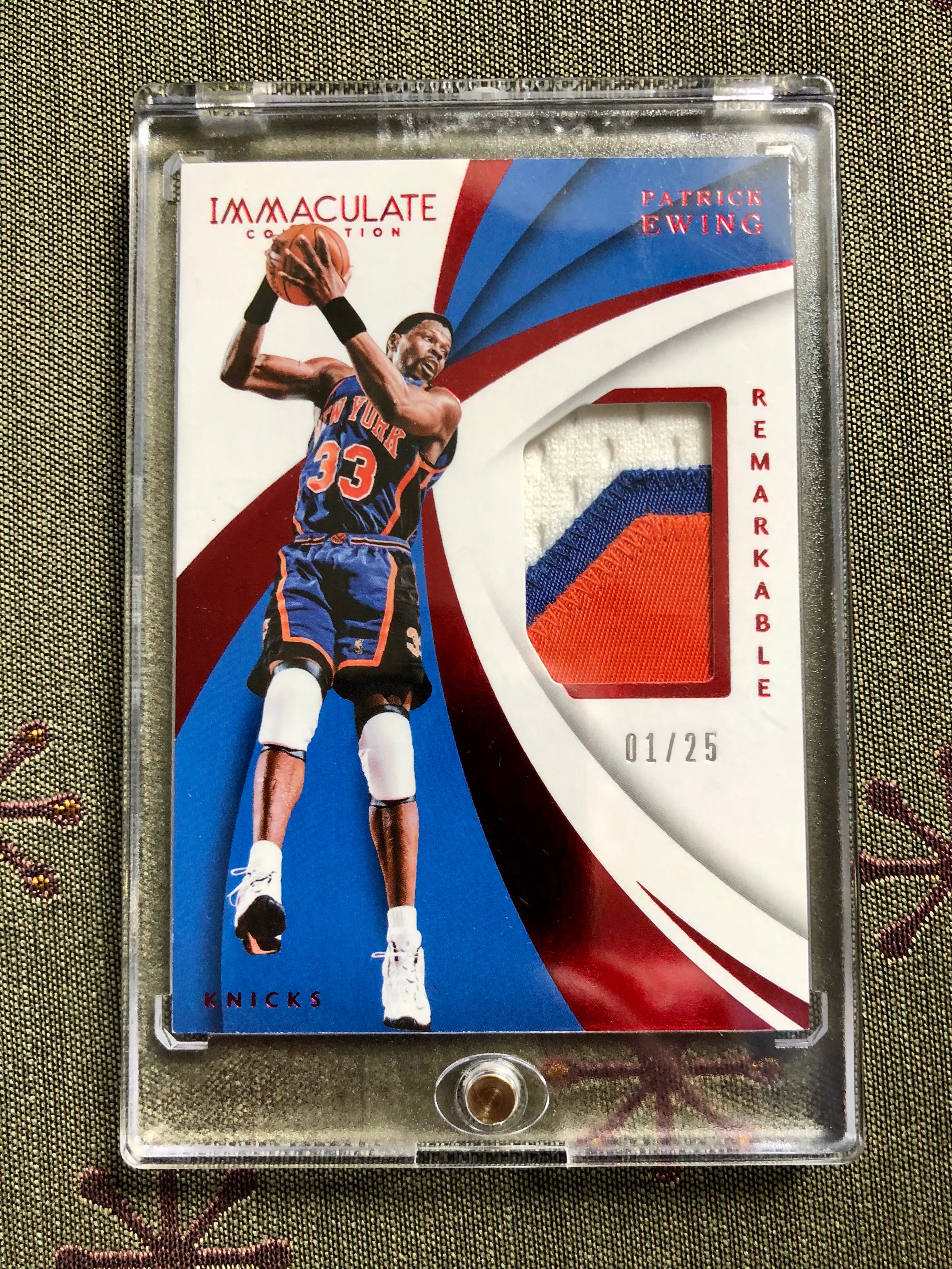
It is borderline heretical to say this among New York Knicks fans, but the championship teams of 1970 and 1973 don’t really mean much to me.
Born in 1967, I was too young to watch Walt Frazier, Willis Reed and their merry band of brothers win both the NBA and the hearts and minds of basketball aficionados across the five boroughs. Plus, I had the misfortune to be born in Washington DC, so my default setting was to support the hometown Bullets (now Wizards).
I didn’t begin life as a Knicks fan, but I did fall in love with basketball at an early age. From the start, I was a better fan than player. Indeed, being a fan has helped give shape and texture to my life. But being a fan has meant different things as I have moved from childhood to maturity. For me, fandom has had three distinct stages: devotion, inspiration, and appreciation
Devotion (Patrick Ewing)
Despite being a native Washingtonian, I started actively rooting for the Knicks in 1985. That doesn’t make me unique – the Knicks are an open church and have many fans who were born in other places. The reasons I converted weren’t complicated. In fact, it was all down to one man.
The house that I grew up in was located just a few miles away from Georgetown University. In the winter of 1982, my dad took me to what has been called the greatest on-campus game in Georgetown basketball history.
That day, before a rowdy packed house of 4,000 fans at McDonough Arena, Georgetown upset the #4 ranked University of Missouri. The game, which was broadcast on NBC, amounted to a national coming out party for Patrick Ewing, then just a couple dozen games into his college career.
The whole experience was intoxicating. The revved-up crowd. The television lights. The intensity of the action. Even in a game that featured several future NBA players, Ewing stood out. He was just a freshman, but he was utterly dominant. You couldn’t take your eyes off him.
Ewing would go on to lead Georgetown to three Final Fours before being selected with the top pick in the 1985 draft by the Knicks, carrying my enduring loyalty with him.
As a teen, my relationship with Patrick Ewing and the rest of the Knicks was straightforward: hero worship. These were larger than life figures, literally. (To this day, I have never met anyone 7 feet tall.)
It is no doubt a sign of my immaturity that I thought supporting the Knicks had a moral dimension. To me, the Knicks were the good guys, playing the game the right way, with heart and maximum effort. I was happy when they won and I took it personally when they lost.
Those Knicks were not as aesthetically pleasing or as successful as Michael Jordan’s Bulls, but it didn’t matter to me. I still defended Ewing. He may not have won a championship, but he always showed up and played hard (not something you can say about every NBA superstar, particularly these days).
Inspiration (Jeff Van Gundy)
It would be inaccurate to say that I moved to New York in 1992 because of the Knicks – I was primarily motivated by work considerations – but they were certainly part of the package, helping to create the sense that the city was the place to be.
As the Ewing era came to a close at the end of the 1990s, I felt my relationship with the Knicks evolving. Most of the players were now roughly the same age as I was, so it became harder to think of them as heroes.
The media environment was changing too. In the world of sports journalism, hagiography was out and 24-7 exposure was in. In the old days, if Michael Jordan punched a teammate in practice, sports reporters would often look the other way. No longer. Under the unending glare of ESPN and its many competitors, it became impossible to deny that our most prominent athletes often had feet of clay. (Sadly, this includes Ewing, too. Google “Gold Club” if you doubt me.)
Against this backdrop, my favorite-ever Knicks team emerged: the 1999 group that made it all the way to the NBA Finals before losing to the San Antonio Spurs. That team had several memorable players, including Latrell Sprewell, but the person who best embodied the Knicks was its coach, Jeff Van Gundy.
A long-serving assistant, Van Gundy was elevated to the top job by luck and circumstance – the Knicks fired his boss, Don Nelson, in the middle of a season and they didn’t have time to conduct a search for a name-brand replacement.
Because of all this, Van Gundy’s hold on the job was always tenuous. This culminated in the 1999 season, with the revelation that the Knicks had secretly met with the former coach of the Chicago Bulls, Phil Jackson, to gauge his interest in taking over.
The front office of the Knicks may not have wanted him, but Van Gundy had won over both the players and the fan base. During the Knicks’ run to the Finals, the fans made their position clear by chanting Van Gundy’s name during playoff games – an exceedingly rare honor for a non-player.
Van Gundy became a fan favorite because he was a likable underdog. He may not have looked like a movie star, but he was great on camera, full of passion and intelligence. His post-game press conferences were often as interesting as the games themselves.
As I became a young adult with a wife and a kid, I no longer thought of the Knicks as demi-gods battling other demi-gods on my behalf. But I still identified with the team.
Van Gundy’s Knicks seemed to capture the spirit of the city. I strove to mirror their relentless grind (and surprising success) as I started to make my way up the career ladder. Van Gundy was not a hero, but he was a role model: an unconventional leader who was comfortable in his own skin and managed to carve a path for himself in the most competitive of towns. New York and I were both lucky to have him.
Appreciation (Josh Hart)
Jeff Van Gundy quit the Knicks in 2001. The years since then have been long on drama and short on success. The faith of even die-hard Knick fans has been challenged. I must admit that I failed the test.
Jerry Seinfeld famously argued that rooting for sports teams is like rooting for clothes. The players come and go. Only the uniform stays the same.
Over the past 20 years, as the Knicks cycled through various (false) saviors – the Isiah Thomas years were particularly dispiriting – my affection for the franchise began to wane. Some of this was probably inevitable. As is the case with many middle-aged adults, the demands of work and family forced me to put aside childish things. The Knicks were just one of those things.
As a kid, I thought of sports teams as civic landmarks. The Knicks were not unlike the Statue of Liberty – a visible manifestation of the city and its aspirations. This kind of thinking became harder to sustain as a grown-up. I now understand that the Knicks are first and foremost a business, not a civic institution. And under the benighted ownership of James Dolan, the Knicks seemed to go out of their way to alienate supporters. Among other things, Dolan was responsible for getting into screaming matches with fans, feuding with former players, and pushing out beloved play-by-play announcer Marv Albert. And that’s not even mentioning all of the wasted draft picks, disastrous free-agent signings, and misguided coaching decisions.
In 2004, I left Manhattan for Brooklyn – as my family grew, we needed more room. We ended up living just a few blocks away from the Barclays Center. As I attended Brooklyn Nets games, I found myself becoming more attached to the Nets than the Knicks. But the Kevin Durant-led team of 2021 was so relentlessly unlikable that I renounced not just the Nets but the NBA as a whole.
I now find myself approaching retirement age. I gave up playing organized basketball long ago. But when the weather gets nice, I still dust off my sneakers and head to the park to shoot hoops. I no longer imagine that one day it will be me starring in Madison Square Garden, but the enthusiasms of my youth are still with me. I still love the game.
So perhaps it should come as no surprise that this year’s Knicks team has slowly but surely managed to worm its way back into my heart. Call me a fair-weather fan if you will, but success does make a difference – it is infinitely more fun to follow a team that is proficient at basketball.
For me, the main man on this Knicks team is Josh Hart. Hart has the distinction of being the first player from my high school to make it all the way to the NBA. This connection, however slim, is enough to summon emotions in me that can best be described as avuncular. Rooting for Hart feels a little like cheering for my daughter’s youth soccer team.
Josh Hart probably has many admirable qualities, but I don’t know what they are. I don’t listen to the podcasts or obsesses over the social media debates. I no longer need the players to be heroes or role models. I may feel less passionately about the Knicks these days, but in some ways my fandom is more pure – I find it easier to tune out the noise and just appreciate the beauty of the game .
Sports fandom makes little sense to anyone outside the bubble – so much money and so much emotion invested in something so insubstantial.
Still, relationships are what you make of them. The Knicks may never love me back, but I have gotten a lot of value from my relationship with them over the years. They have helped cement my connection with New York and marked my maturation as an adult. I hope to be a fan for many years to come.
Comments
Nothing yet. Say the first thing.
Sign in to join the conversation.