
Back in 2018, I wrote a book in my native Portuguese called Crónicas de um planeta que era azul (“Chronicles from a planet that was blue”), a collection of short stories, or sometimes something closer to images painted with words. These pieces are written, very loosely, from the perspective of an alien being studying our planet. Through that lens, they aim to draw parallels between human life and the lives of the countless other organisms that share spaceship Earth with us. This is the English translation of that book, which I will be sharing here on Substack, one chapter at a time.
Link to Chapter 1
In a forgotten corner of a vast galaxy, hidden in one of the great arms that traced yet another immense spiral — one among the many carved into the darkness of the Cosmos — there shimmered a medium‑sized, pale yellow star. It was a star much like countless others, drifting through the eternal galactic dance, giving off light and warmth as it slowly orbited the galaxy’s distant centre.
Around this star orbited a small family of planets and other celestial bodies, much like the many that accompanied the countless stars filling that galaxy and all the others in the Cosmos. The third planet from the star was a rocky world with three peculiar characteristics. First, it was blue. The combination of an atmosphere rich in nitrogen and vast oceans of liquid water covering most of its surface gave it a striking deep‑blue hue, a calling card that earned it the epithet of the blue planet. Second, it was extraordinarily rich in life. Life there had produced a prodigious number of organisms in a myriad of forms, colours, and habits, occupying every corner of the planet, from the depths of its oceans to the peaks of its highest mountains, and even the sky‑blue atmosphere that dominated all its landscapes. Third… well, the third characteristic is a longer story.
The third characteristic of this planet was that it was home to a species which, without asking anyone’s permission, had decided to proclaim itself the pinnacle of creation. This species, a kind of two‑legged mammal with little hair, had declared itself the only intelligent form of life in the entire Universe, though it had not spent much time searching for any others. It had also decided that its own was the only planet in the Universe with life, although again, it had not devoted much effort to looking for life elsewhere. Such conceit, such boundless arrogance, would on its own be worthy of note, even in a universe as vast as the one we inhabit. Yet what truly made this species remarkable was its strange decision to exclude itself from the Nature that surrounded it, and to declare war on it whenever the opportunity arose.
Nothing like it had ever been seen before. Of course, coexistence and cohabitation are not always peaceful, every creature with siblings knows that well. But what we had here was an attempt to reject its own origin and its very nature. These creatures, who called themselves humans, considered themselves separate from the rest of the life that inhabited the blue planet. They created not one but many intricate mythologies to defend — from whom, it is not entirely clear — their supposed right to dominate and make use of the other forms of life that shared the planet with them. In their open war against the life that was their mother, father, brother, and sister, they ended up wounding the planet itself and its ability to support the life that defined it. They turned oceans into dumping grounds and lands into deserts, exterminated entire species and reduced many others to the status of mere servants. They even altered the planet’s own atmosphere, with consequences as harmful as they were unpredictable. And when they were not destroying the planet, they were busy destroying one another, with weapons that grew ever more complex and devastating.
However, no one can reject their own nature. No one can remain forever what they are not. Masks, no matter how tightly they cling to the skin, always fall in the end. It was for this reason that I compiled these Chronicles from a planet that was blue. Step by step, line by line, they show us — or rather, remind us — that the mask was never real. From the surface of their skin to the flesh and bone beneath, humans carried their true nature written everywhere. In their actions, in their words, in their way of living, humans bore the outline of their true essence. The only place where humans were ever less a part of what surrounded them was in the minds of those weak of spirit, the ones who preferred to hand out blindfolds rather than open their eyes and see. Men who refused to embrace, with open arms and a broad smile, their communion with something infinitely greater than the myths and phantoms they had created to obscure the vision of others. For humans were as much a part of Nature as were the myriad other species that shared that blue planet with them, in an unbroken continuum from the simplest unicellular organism to the most complex higher forms. That continuity was evident in their genes, evident in the biochemical processes that governed their bodies, and even evident in the structure of their bodies and in their behaviour. The extraordinary human brain, the seat of the intellect that allowed them to create technology, the arts, philosophy, every component of their grand civilisation, had its origins in the same natural evolution that shaped, with equal mastery, the octopus’s tentacle, the oak leaf, or the lion’s mane.
As the many dramas of this tragedy unfolded, indifferent to wars and battles, to deaths and births, to conquests and losses, to flowerings and metamorphoses, to extinctions and speciations, to the rise and collapse of entire civilisations, the small blue planet continued, unperturbed, its path around its star. And like it, the star continued, equally unperturbed, its path around the galaxy, and the galaxy itself continued, no less unperturbed, its journey through the brutally vast expanses of the Universe. For in the great scheme of things, the life of one human, or of a thousand million humans, is absolutely insignificant, just as insignificant as the lives of the countless millions of ants, elephants, jellyfish, bacteria, geraniums, and mushrooms that travelled with them on the planet that was blue. And yet, across the seas, the lands, and the skies of that planet, nothing was ever more important…
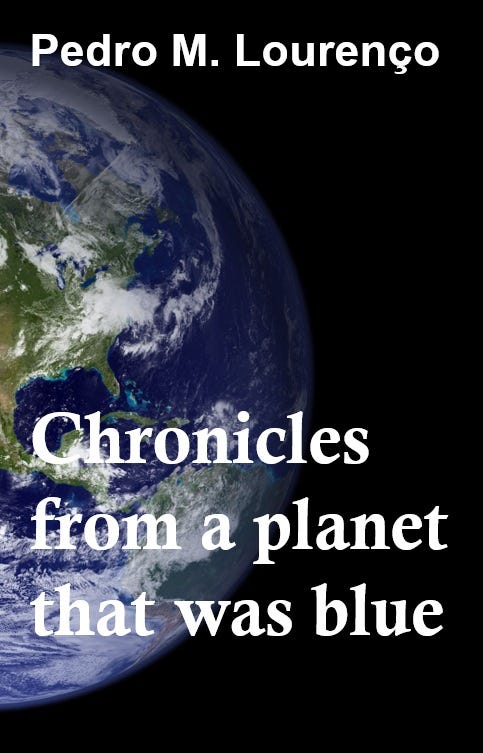
The full book will soon be available on Amazon. In the meanwhile, you can support my work by buying me a coffee.
No posts
Comments
Nothing yet. Say the first thing.
Sign in to join the conversation.