
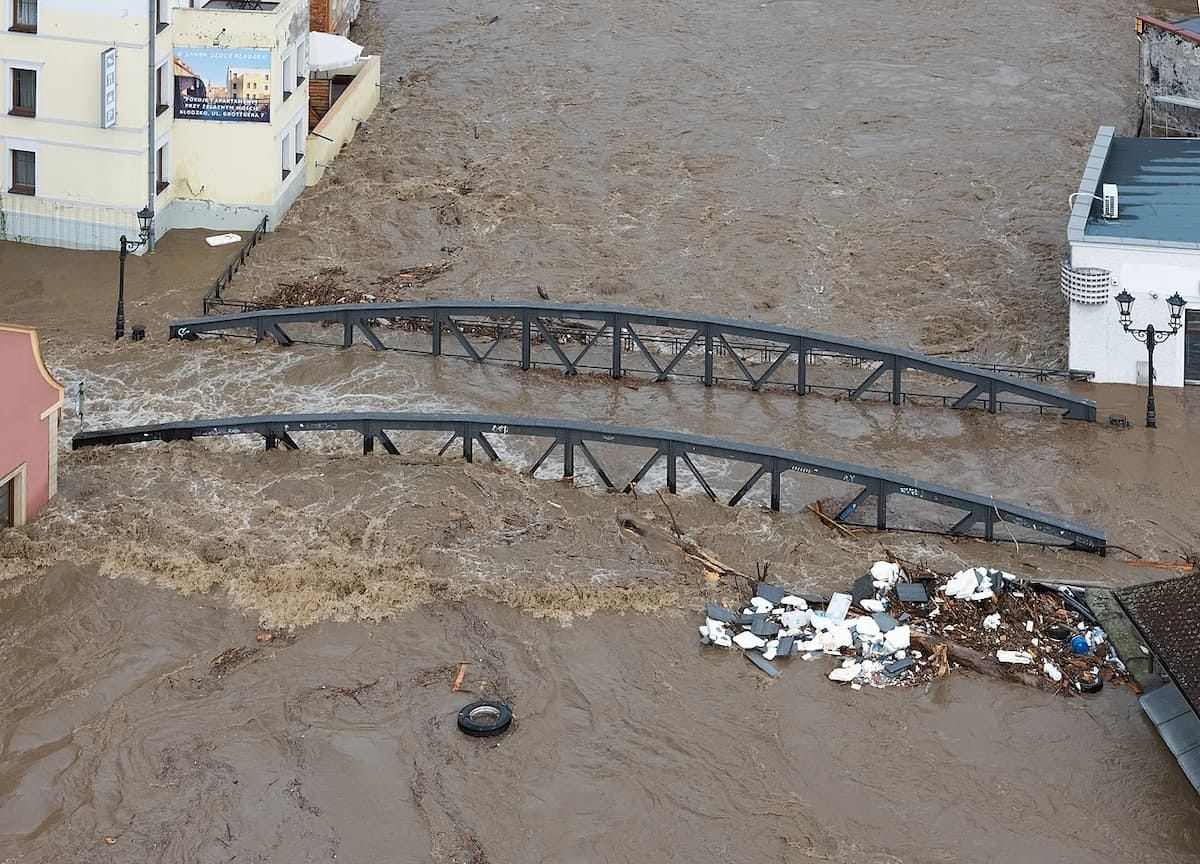
Floodwaters surge through Kłodzko in Poland, September 2024. Insurance investments in fossil fuels is leading to increased physical climate risk and higher insurance payouts. © Jacek Halicki
The EU is at the forefront of global efforts to introduce climate- and sustainability-related considerations in corporate regulation, notably through the Corporate Sustainability Reporting Directive and the Corporate Sustainability Due Diligence Directive. The EU has also started introducing dedicated provisions in their prudential requirements and supervisory expectations for the financial sector.
The European Central Bank (ECB) has also been vocal about the need for banks to effectively manage climate and environmental risks, with staggered deadlines to meet all supervisory expectations on climate-related risks by the end of 2024.
For the European insurance sector, the task is given to the European Insurance and Occupational Pensions Authority (EIOPA) to assess the potential for a dedicated prudential treatment in Solvency 2 – the EU’s solvency regime for insurance companies – of assets or activities associated with sustainability risks. An important vote at an upcoming supervisory board meeting will determine whether EIOPA will change its view on the risks posed by fossil fuels, or if it will maintain the status quo and ignore the mounting risks to financial stability.
EIOPA has undertaken a preliminary analysis on the prudential treatment of sustainability risks and in December 2023 published a consultation paper which outlines several policy options that the European Commission could take. Despite its name, the paper only addresses selected pre-agreed aspects of physical and transition risks for ESG issues in the insurance sector, namely: climate transition risks for equity, corporate bonds and property investments; climate adaptation for non-life insurance underwriting; and social risks and external impacts for insurers.
Other important sustainability-related aspects have either been treated separately by EIOPA or have not yet been addressed. The treatment of physical climate risks for non-life insurance underwriting has been the subject of a separate consultation in April 2024, with a view to reassessing Solvency 2’s capital requirements for natural catastrophe insurance, while preliminary reflections on nature-related risks beyond climate have been published in an EIOPA staff paper in March 2023.
However, the treatment of physical risks for property and their potential contagion effect on real estate markets has not been examined yet in a Solvency 2 context, and neither has the consequences of physical climate change on human health and life insurance.
During their meeting in June, EIOPA’s board of supervisors agreed with a number of recommendations in the prudential consultation paper and decided, unfortunately, not to introduce any policy changes as yet in relation to transition risk for property, climate adaptation for insurance underwriting risks or social risks.
However, board members were divided on the introduction of a dedicated capital treatment for insurers’ investments in fossil fuel-related corporate bonds and equity. They did not choose between the various options put forward in the consultation paper, which range from leaving capital charges unchanged to imposing higher capital charges in Solvency 2’s standard formula for investments in fossil fuel-related activities. The topic will be examined again, and a decision is expected to be made at the board meeting next week.
In view of this upcoming decision, let us now examine more closely what the prudential consultation paper said on climate transition risk for the equity and corporate bond investments of insurers.
It provides a risk analysis using both backward-looking evidence (ie historical data) and forward-looking projections (ie climate scenario projections). Due to the unprecedented climate transition, which is still in its early stages, limited insights can be gained from the backward-looking analysis. Forward-looking climate scenario analysis offers a more appropriate avenue of investigation.
However, the reference climate scenarios used by EIOPA come from the Network for Greening the Financial System, which have major limitations such as ignoring irreversible physical tipping points in their damage functions, as well as potential non-linear spillover effects on the financial system, the economy and society as a whole. This means EIOPA's analysis constitutes a lower bound of the potential transition risk to which equity and corporate bond investments are exposed.
Despite these important limitations, EIOPA’s own analysis already clearly show that high transition risk sectors, in particular fossil fuels, exhibit a consistent and materially higher level of risk compared to other economic sectors and to the market. This justifies a dedicated adjustment to their prudential treatment in Solvency 2.
In the consultation paper, EIOPA puts forward three options for the treatment of fossil fuel-related equity risk, ranging from no change to the existing 39% capital charge, to a 17% supplementary capital charge, increasing to 56%. Due to the limitations mentioned above, even this 56% capital charge is likely to underestimate the actual risk.
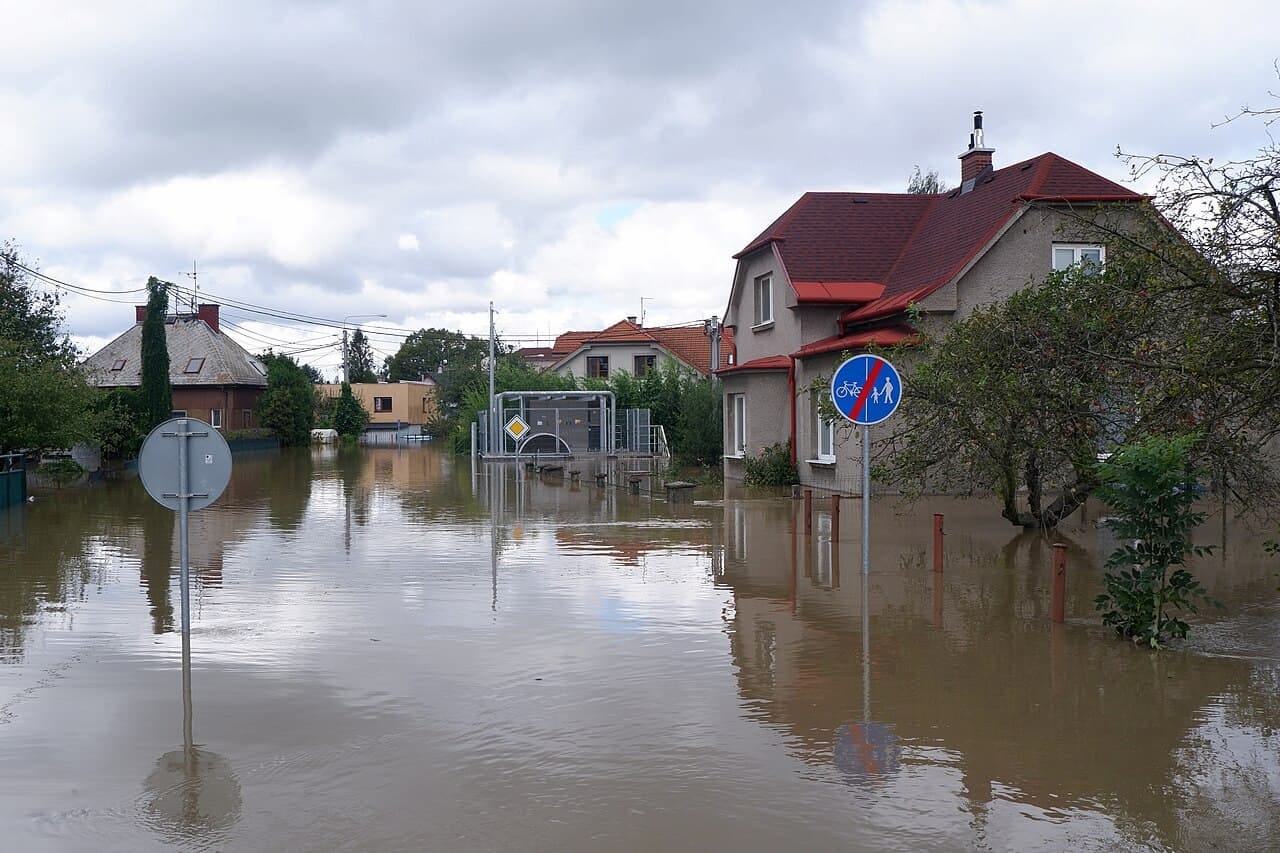
Flooding in Ostrava in the Czech Republic. Central Europe has been hit by heavy rain leading to severe flooding. © Kamil Czaiński
Pursuing another avenue of thought, Finance Watch has proposed a 77% capital charge, based on the estimated proportion of proven fossil fuel reserves that should be left in the ground in order to limit global warming to 2°C. The logic is as follows: either an effective climate transition implies that 77% of fossil fuel reserves are not exploited and leads to stranded fossil fuel-related assets, or else we collectively head towards catastrophic climate chaos due to excessive physical risk. This would wipe out the insurance sector, not just because of increasing claims but also because the increasing uninsurability of risks would lead the insurance sector to gradually lose its economic purpose.
Details of the discussion on capital charges for fossil fuel-related corporate bonds may be slightly different than for equity, for instance because bondholders rank above equity owners in capital structure. However, the same general conclusions still hold, and the option of no additional charge appears equally inadequate.
The other two options proposed by EIOPA – a rating downgrade to indirectly model higher risk, or a direct additional capital charge for spread risk – both have their merits. Anticipated rating downgrades are a simpler instrument, but they may also be the most transparent to implement in the context of Solvency 2’s standard formula.
Like equity risk and for the same reasons, the highest additional capital charge proposed by EIOPA likely constitutes a lower bound of the true transition risk for companies whose primary business is linked to the extraction, storage, transport or manufacture of fossil fuels. In the special case of bonds directly financing new fossil fuel projects, the capital charge should even be increased to 100%, also known as the one-for-one rule.
The option of changing nothing in Solvency 2’s capital charges for fossil-fuel-related equity and corporate bond investments is wholly inadequate and does not live up to most basic financial risk management and prudential supervision principles. Contrary to what the consultation paper affirms, not doing anything is not neutral. It would instead choose to ignore increasing sustainability risks in the face of both backward- and forward-looking evidence presented by EIOPA. Closing our eyes does not mean that the risks disappear.
A lack of perfect visibility and predictability about the unfolding of climate-related risks does not constitute an excuse for inaction. While there is uncertainty regarding the scope and timing, as well as the mix between physical and transition risks, the realisation of these risks is alas certain, as explained in the latest reports from the International Panel on Climate Change.
Waiting several more years to collect additional historical data is not an appropriate way to deal with emerging systemic risks such as climate and destruction of nature. It will only lead to more irreversible damage, and to additional risks for financial stability in general and for insurers themselves. As noted in a joint ECB/ERSB report on the impact of climate change on the European financial system, "policy responses need to weigh the cost of early action based on imperfect information, against the risk of acting too late."
This is especially relevant for insurers who play a twin key role in the financial system.
On the one hand, together with pension funds they are the largest and most long-term institutional investors (also noting that many pension savings are also managed by the insurance sector, so the line between the two can be blurry). What insurers collectively invest in matters for the economy as a whole and thus contributes to determining the transition and physical risks that they will be exposed to in the future. Their long investment horizon also means that they should be especially concerned with the climate transition and the risks associated with it.
On the other hand, insurers are society’s risk managers, pooling and diversifying risks that would or could not be assumed by individual people and businesses. These insurance underwriting activities are now threatened by the physical effects of climate change which endanger both property and human health. Insurers should thus be discouraged from putting at risk the savings they are entrusted with by investing them into fossil fuel-related activities that will sooner or later become stranded assets, while at the same time fueling the physical risks that increase the claims they have to pay and that ultimately undermine their own business model.
Of course, there are also other relevant lines of reasoning to support higher capital charges, for instance aligning insurance regulation with the EU official policy objectives such as the European Green Deal or the EU Fit for 55 transition plan.
However, there is no need to refer to this broader context: higher capital charges on fossil fuel investments for insurers are imperative from a risk management perspective, and therefore this is what EIOPA’s own mandate of protecting financial stability and insurance policyholders dictates.
This article was written by the author in a personal capacity and the views expressed are the author's own.
This article was first published on our website.
Comments
Nothing yet. Say the first thing.
Sign in to join the conversation.