
For those who prefer listening to reading, I’m recording all my articles (including this one), and publishing them here. They should also be accessible through Spotify or your favourite podcast player—just search for the innovatively named In Common Podcast.
So, pleasepleaseplease, don’t ask the robots to read it to you. They are ROBOTS, for goodness’s sake; they are soulless and repulsive; and, perhaps worse, they use a male American voice-like-mechanism, which lacks coherence with my personal authorship on several counts. Rather, click here to reclaim your right to be spoken to by a real-live human being—a woman, no less—and enjoy letting the dulcit tones of the Antipodes wash over you like waves lapping on the shores of Botany Bay.
In my prior article, I laid out a rough summary of the received wisdom on Greek tense and aspect, then highlighted four snaggy protrusions on which my linguistic stockings kept getting hitched and torn.
In this article, I will introduce you to my own method of explaining and interpreting Greek tense and aspect. I’ll briefly talk about time reference, to get that out of the way; and then I’ll focus for the main on what I think are the core building blocks of Greek aspect: event and situation.
I don’t have a heap to say about this—just that I believe time is encoded in the Greek verbs, in the indicative mood. What else could that ἐ prefix mean? It appears in imperfect, aorist and pluperfect moods, which all refer to past time; and the present, future and perfect tenses all don’t have it, and all of them don’t refer to past time.
There are two key objections to saying that Greek verbs encode time in the indicative. Let’s take them one at a time.
I chose this one first because it’s an easy enough problem to solve.
The historical present, as it’s affectionately known, is when in the middle of a retelling of past events, an author suddenly uses a verb in the present tense. It makes it sound like this, if you were to say it in English:
Yesterday I got up, I got dressed, I opened the curtains, I’m going into the kitchen, and I began making breakfast.
You can spot the weird present tense in that narrative, can’t you? This is what it sounds like when you run into a historical present in Greek. But the “I’m going into the kitchen” part is clearly not intended to make us jump into the author’s present time. It’s just one more in the series of past events—100% of the time. And it happens often enough that we’re all familiar with it.
Now why do authors choose to plop a historical present into the middle of their past-time narratives? I’ll explain what I think in a future article, but here’s a brief spoiler: it tells us that this particular action isn’t very interesting to the author, so save your excitement for the next bit.
The main point for my argument here is that when you stumble across a historical present, it’s always clear and obvious. The verb is always in the indicative mood, it’s always in a main clause, and it’s always set within a narrative of past events. This means that while the purpose of the historical present might be debatable, the fact that it’s happening and the rules for when it happens are so clear that the atypical time reference never causes confusion.
When it comes to the misbehaviour of the aorist tense, however, things get a lot woolier. Some people estimate that about 15% of aorist indicative verbs don’t refer to past time. But the rules for when they don’t are… well, I haven’t found anyone giving the rules. Are there any? If there are some, tell me! Generally people just get a vibe that this particular aorist verb mustn’t mean past time; but there’s nothing in the genre or the grammar or the verb’s own meaning which predicts or insists upon it. (For an example, see here.)
To solve this conundrum, some scholars suggest that the Greek verb (in all tenses) doesn’t encode time reference in the indicative. Instead, they argue that it encodes spatial reference. This way of looking at things has the distinct advantage of explaining the inconsistent time reference in the aorist. It has the distinct disadvantage of explaining precious little else.
When you apply spatial reference to the aorist verbs, 85% of the time, “spatially remote” is a metaphor for “temporally remote”, which means: past time. But the other 15% of aorist verbs, where spatial remoteness doesn’t seem to indicate past time—these still suffer from the same problem where each verb seems to be doing what is right in its own eyes. The aorist still lacks a Sheriff to lay down the law of when and under what circumstances they may (or must) mean something other than spatially remote (or past time).
And so, arguments that Greek indicative verbs encode space instead of time are, I think, more of a window dressing; it still ends up that they refer to past time, except when they don’t.
It’s also worth noting that all the other Indo-European languages encode time in their verbs; and I have never met a language, Indo-European or other, in which the verbs encode space. (At least, not in anything like the way that these scholars are proposing.)1 As I like to say, if a blue-eyed blond man and a blue-eyed blonde woman should claim a black-haired, brown-eyed gargoyle as their natural progeny, my rudimentary knowledge of genetics precludes me from saying it’s completely impossible—but I reserve the right to raise an eyebrow.
Now that I’ve explained why I remain a faithful devotee to the traditional time categories of past, present and future in Greek verbs, let’s turn to the question of aspect, where I am offering a new interpretation.
(If you missed my reasons why the widely-accepted explanations of aspect fail to satisfy me, you can catch up here.)
Allow me to start with a summary of my view. It is this.
Present and imperfect tenses share situation aspect;
Aorist and future tenses share event aspect; and
Perfect and pluperfect tenses share result-situation aspect (that is, a situation which results from a prior event).
Now let’s look at them one by one.
What is situation aspect? It’s how you’d describe a picture. Take for example this lovely cover from my forthcoming picture book. (See what I did there?)

Imagine you had to describe this book cover to a blind person (…or a podcast listener). You might say something like this:
It is a sunny day on a flower-lined street. A girl is standing on the footpath. She has a worried expression on her face. She’s carrying a backpack and holding a book of fairy tales. There’s a dog sitting next to her, holding a rope in its mouth. And when you look carefully you can see that there’s a shadow of a wolf looming over the two of them.
Notice the verbs I’ve chosen to use to describe this scene:
A few -ing verbs (English present progressive): standing, carrying, sitting, holding, looming.
A few simple present verbs: (there) is, has.
Notice that nothing occurs in a picture. There is no action, so sequence of events; only a scene. You can guess what happened before. You can guess what will happen after. But when I describe the scene, I’m describing a situation (a snapshot of what is) rather than a sequence of events (a story of what happens).
This is what I mean by situation verbs. Situation verbs describe a scene or situation, a moment in time. They are like a photo or a picture. The verbs layer over one another, giving depth and detail to the picture. But they don’t narrate action; they only give you a scene. And they go to all the trouble of setting the stage in this way, because into this setting, some kind of action will happen; and the action can be best understood if you first are familiar with the setting.
Here’s the rub. Situations are given in present or imperfect tenses in Greek: present for present situations, and imperfect for past situations. This is not unrelated to the traditional name for this aspect, which is imperfective. Imperfective means having no ending in sight. The point of these kinds of scenes or snap-shots is that they freeze time for a moment; when these scenic details cease is irrelevant.
If a situation verb is followed by another verb, the first won’t be superceded by the second; rather, it is the setting for it. Situation verbs can layer over each other, each progressively adding information to the same scene.
To put it in NSM, I believe situation aspect (present and imperfect tenses), simply communicates this:
something else can happen at the same time
Is it possible that such a tiny, simple definition can sum up this aspect? I think it is. It explains why present and imperfect tenses are used for setting scenes: they’re building layers of things all happening at once, like when I described the picture above. There’s no sequence; all of the verbs (whether they refer to states or actions) are going on at once.
I’ll unfold the implications of this more in future articles. For now, let’s flick over to event aspect, as this provides us with a nice point of contrast.
The particular artistry of this wonderful drawing of Helen’s is that it suggests that something is about to happen. It hints at a larger story; that’s why it’s such an intriguing picture book cover. But the picture itself only invites imagination as to what is to come.
Now if Helen wanted to clarify for us what happened next, she would need to create a series of pictures—or a video. And in Greek, if the present and imperfect tenses build a scene or situation, the aorist and future tenses deliver us this series of unfolding events—the story proper.
Going back to NSM, I believe the event aspect communicates the following. For aorist tense:
something else can happen after this
And for future tense:
something else can happen before this
Notice how these explications don’t use descriptions such as “from afar” or “simple” or “remote” or “complete”; they simply place these verbs in a sequence, showing how they contribute to the communication of a series of events.
In narrative, aorist tense is used when I am lining a bunch of verbs up in order, like beads on a string. Each action is narrated in aorist tense, to close off that action and make way for something else to happen afterwards. Because event-aspect verbs signal sequence (story), not layering (scene).

Notice that you can count these events. “I did three things this morning,” you might say. “I got up, I got dressed, and I opened the curtains.” In Greek, the verbs in that sentence would use aorist tense, communicating past time, and event aspect.
Notice that you can’t count situational things in the same way. Here’s something you wouldn’t say: “I did three things this morning: I was standing by the window, I was holding an empty cup, and I had a sad expression on my face.” These are all situations, not events; they are all happening at the same time, not in sequence; and just as you cannot put them into a list of “what I did” in English, so you cannot put them in aorist tense in Greek. If you try, you’ll end up saying something else.2
My thoughts on this aspect, which covers the perfect and pluperfect tenses, are the least ground-breaking of the three. However, noting how this aspect relates to event and situation does clear up many confounding “exceptions” that we find plaguing this tense, so it’s definitely worth exploring.
In sum: the perfect and pluperfect aspect focusses attention on the situation which is the result of a prior event. And so I call it “result-situation” aspect.
Putting this aspect into NSM, it pops out as follows:
something happened before now
I want you to know: something is different now because of this3
What exactly is “different now”? Well, that’s up to the reader to ascertain for themselves. It could be lots of things, depending on the verb’s meaning and the broader context. One little verb form can only do so much! (And let’s note this: varying contexts and varying verb-meanings do NOT give us license to start talking about the 53.725 “meanings of the perfect tense”. There is one meaning, and this one meaning works with the verb’s meaning and the broader context to produce as many unique outcomes as there are sentences.)
To put some flesh on it, here’s an example of a perfect tense verb in a verse that would make a nice poster for your living room:
ἀπεκρίθη ὁ Πειλᾶτος Ὃ γέγραφα, γέγραφα. (John 19:22)
Pilate replied, “What I’ve written, I’ve written.”
This is how the example plays with the NSM explication:
something happened before now => Pilate wrote something.
I want you to know: => Pilate is making a particular point by using the perfect verb here. He could have used aorist, “I wrote what I wrote.”
something is different now because of this => Pilate’s words are now sitting up there above Jesus on the cross, and, like it or not, they’re not going to be changed. So, take that!
So sassy, I love it.
Now, a whirligig of drama and debate has attached itself to the perfect tense, as I mentioned in the prior article. I’ll go into a little more depth on this in a forthcoming article dedicated to the perfect tense. Get excited, peeps. And please, fling me any questions you’d like me to address.
For your convenience, here’s my summary of the meaning of the three Greek aspects.
Situation aspect (present and imperfect tense)
something else can happen at the same time
Event aspect
(aorist tense) something else can happen after this
(future tense) something else can happen before this
Result-situation aspect (perfect and pluperfect tense)
something happened before now
I want you to know: something is different now because of this
And this is how my chart looks:
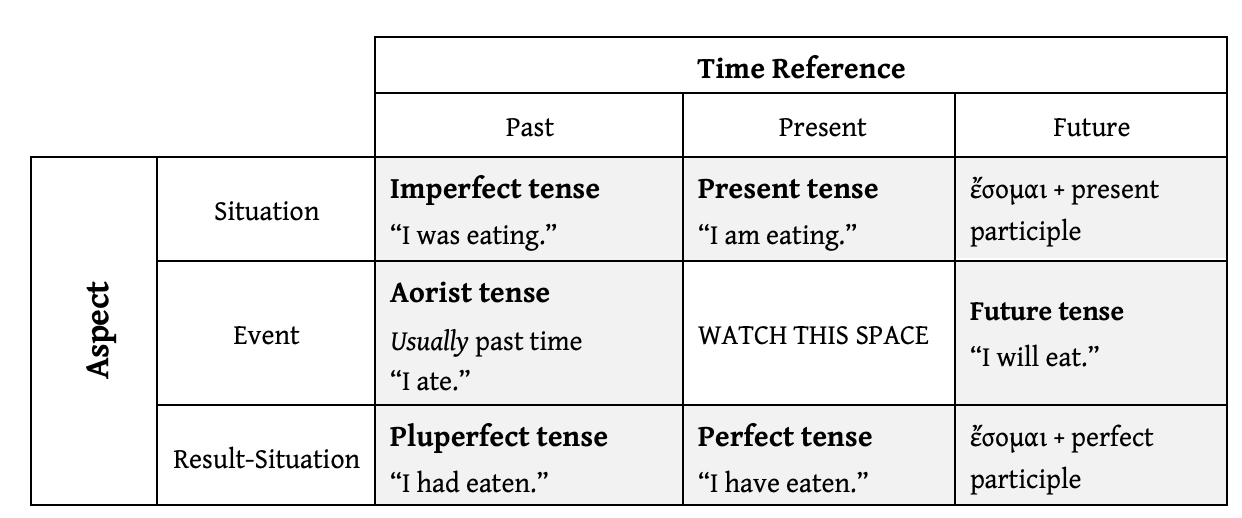
While this is a simple explanation of aspect, the implications are far-reaching, and frankly quite exciting. They will be further teased out in future articles, where I plan to give examples from the New Testament of how each tense is used, and how time reference melds with aspect to make pure magic. I’ll also discuss more about the historical present, and the curious 15% of non-past-time aorists (which end up being not so curious after all).
But while we are still in summary mode, here is a taste of some of the implications.
The traditional view that the aorist tense indicates “remoteness” or functions as a kind of blancmange, unmarked tense, is overturned in my theory. Rather, aorist (indicative) verbs are the drivers of story—the most important verbs in any narrative, as they tell us why the author is bothering to write something down in the first place.
And vice versa: imperfect tense is sometimes described by scholars as being particularly vivid (by virtue of its “within the street parade” descriptive nature), but I say it is more akin to backgrounding information; it is scene-setting. The information these verbs contain is important, of course—otherwise they wouldn’t be there. But they are setting up an opening scene for the story (or a closing scene); they are not where the story’s emotional grip lies.
Some verbs appear only in situation aspects (present and imperfect), because they always, inherently, refer to situations, and never events. I came across a prominent scholar calling these verbs “aspectually vague” (by which he might more honestly say, “I am vague as to why they only appear in one aspect”). But friends, au contraire! These verbs are aspectually rock solid—so fixed and unyielding, they never appear in any aspect other than the sensible one which gels with their meaning.
Take for example εἰμί “I am”. Being is the quintessential situation. There is no aorist form of εἰμί. Turn it into an event—“I become”—and you have a different verb for that: γίνομαι, which appears, in the Bible (NT+LXX), ten times more frequently in event aspect than situation aspect. Coincidence? I think not.
On the existence of a future form of εἰμί, despite its inherent situation aspect—hold tight for 30 seconds.Now consider ἔχω “I have”. Having something (in the sense of owning it) is inherently a situation. You can tell because if you ask, “What did you do yesterday?” no-one would answer, “I got up, I ate breakfast, and I had two dollars.” And so, if you want to put ἔχω “I have” into the past time, to make “I had”, you can’t just whack it into the aorist tense. If you do, then you’ve switched aspect; you’re in the realm of event, not situation. If you wanted to say “I had two dollars”, you’d have to use situation aspect: imperfect εἶχον.
But come, perhaps you will insist upon using aorist. Well, that option is available to you: ἔχω grants you ἔσχον in the aorist tense. But, being aorist, this refers to an event, not a situation; and now you have found yourself saying: “I acquired two dollars”.4 Aspect never lies.
Future verbs natively communicate event aspect due to the change from not-happening (now) to happening (later). Change = event. And this shared aspect is why, I believe, future and aorist share forms (namely, the σ and θη morphemes).
Future verbs are not always “perfective” (meaning they typically have a clear end-point); nor are they seen they seen “as a whole”. The action might start tomorrow and go on forever into eternity. Rather, what they share with aorist is the aspect of event in sequence.
Perfect verbs can always, without exception, be glossed as “I have VERBed” on the condition that you use an event-meaning English verb for your gloss. Trouble comes, and confusion abounds, when you try to put an inherently situation-meaning verb (“I have”, “I know”, “I believe”) in this frame. (I’ll give some examples in my article on perfect tense.)
This means that Greek-to-English dictionaries really must give separate glosses for Greek verbs which can appear in both situation and event aspects—at least until everyone accepts and intuits this event/situation distinction. Otherwise, how will people know from the lexical entry ἔχω “I have”, that they must translate εἶχον not as “I was having” but “I had”; and ἔσχον not as “I had” but “I acquired”? A major cause of befuddlement in the scholarship is that we have failed to notice that Greek verbs, depending on their tenses, must translate into English verbs which appropriately convey situation or event.5
One final thought before I go. How does all this relate to my litmus-test verse?
καὶ φωνὴ ἐγένετο ἐκ τῶν οὐρανῶν Σὺ εἶ ὁ υἱός μου ὁ ἀγαπητός, ἐν σοὶ εὐδόκησα. (Mark 1:11)
“And a voice came from the heavens, “You are my beloved son, in you [I am well-pleased, aorist tense]”.
First, I’ll note that εὐδόκησα is an aorist tense verb, therefore it has event aspect; so right off the bat, I can tell you that a situation gloss like “I am well pleased” is impossible. It’s not only for theological reasons that we can reject the interpretations “In you I was well pleased.” Whatever your gloss of εὐδοκέω, it must refer to an event. Aspect never lies.
A better, aspect-honouring reading, then, might be something like, “In you I took pleasure”, or “I displayed my good pleasure in you”, or possibly even (spelling it out) “Based on my good pleasure, I chose you”.
These translations accurately reflect the event aspect, so we have entered the realm of the possible. But the tense still seems a bit wonky. English cries out for a perfect tense form “I have taken pleasure in you” or “I have chosen you”. There’s a logical reason for this, to do with the slight difference in meaning between the Greek and English perfect; and I’ll come to that in a future article on the perfect tense.
There’s also the possibility (and I think likelihood) that this is an example of a different usage of the aorist tense, a relatively rare one in the biblical corpus, which I will come to in a future article on the aorist tense.
Oh, isn’t there a lot to look forward to!
Well, that will do for this introduction to my fresh take on Greek aspect.
I’d love to hear which tense you’re most keen to read about next. I’ll try to do one article on each tense, but I don’t mind which order. Take the poll to see your favourite tense come up first!
One final caveat, before I go. Perhaps you’ve noticed that most of my observations relate to biblical narrative texts (the Gospels and Acts). That’s because this is my current area of specialty (in a comparative sense only—I’m moonbeams behind many Greek readers). Yet so far, I’ve found the definitions to hold in the NT epistles and Revelation as well, and in my toe-dipping into the Septuagint, Apocrypha, and Ἄρειος Ποτὴρ καὶ ἡ τοῦ φιλοσόφου λίθος (Greek Harry Potter). I would be thrilled to hear from any Classical Greek readers, or Koine/biblical scholars with more runs on the board, to see how this view of tense and aspect holds up in your own readings.
I’m wildly optimistic for the utility of this framework, but also perfectly sure that refining work will be needed. Help me, Obi-Wan Kenobi [fellow Greek nerds]—you’re my only hope.
Anna
Anna Brotherson is a Research Fellow at Mary Andrews College, and lectures in Biblical Greek at Sydney Missionary and Bible College. Both of these colleges are affiliates of the Australian University of Theology.
I happened to write my honours thesis on how a previously undescribed East Timorese language refers to space. That was me living my best life. The thesis included space-referring verbs (a whole chapter’s worth of them), and you can read it yourself here.
I’m particularly proud of the thesis’s title—it’s the only place academics will let you do jokes. And I managed to sneak in a reference to a Greek epic. Now how’s that for killing birds?
Namely, “I took up a standing posture by the window, I laid hold of an empty cup, and I adopted a sad expression”: three events in sequence.
For pluperfect, with “this time” being the past time we’re talking about:
something happened before this time
I want you to know: something was different at this time because of this
John 4:18 is a particularly nice example of this. Note how the meaning would be different if Jesus used imperfect tense.
πέντε γὰρ ἄνδρας ἔσχες (aorist). (John 4:18)
You acquired five husbands.
(i.e., You married five men.)
Cf.
πέντε γὰρ ἄνδρας εἶχες (imperfect). (Not John 4:18)
You had five husbands. (implication: at once)
The fact that there are multiple ways of doing so in English has created additional confusion over the “meaning” of the Greek tenses. More on this later, too.
Comments
Nothing yet. Say the first thing.
Sign in to join the conversation.