
Over the next two decades, an estimated $124 trillion in wealth is expected to transfer in the United States—what is projected to be the largest transfer of money and assets from one generation to the next in American history.
The financial industry calls it the Great Wealth Transfer. And if you haven’t paid much attention to it (or even heard of it) I’m guessing that’s because you think it has nothing to do with you.
Or, maybe you think they are talking about “the Great Reset,” the sweeping, elite-driven plan that came out of the World Economic Forum during Covid times.

So you may assume it’s about governments, billionaires, and powerful families. It isn’t. The Great Wealth Transfer is happening right now through ordinary families, retirement accounts, homes, businesses, and the decisions you’re making (or not making) around your kitchen table right now.
If you haven’t heard of it yet, or don’t think it applies to you, I don’t blame you because you may not even think of yourself, or your family, as rich.
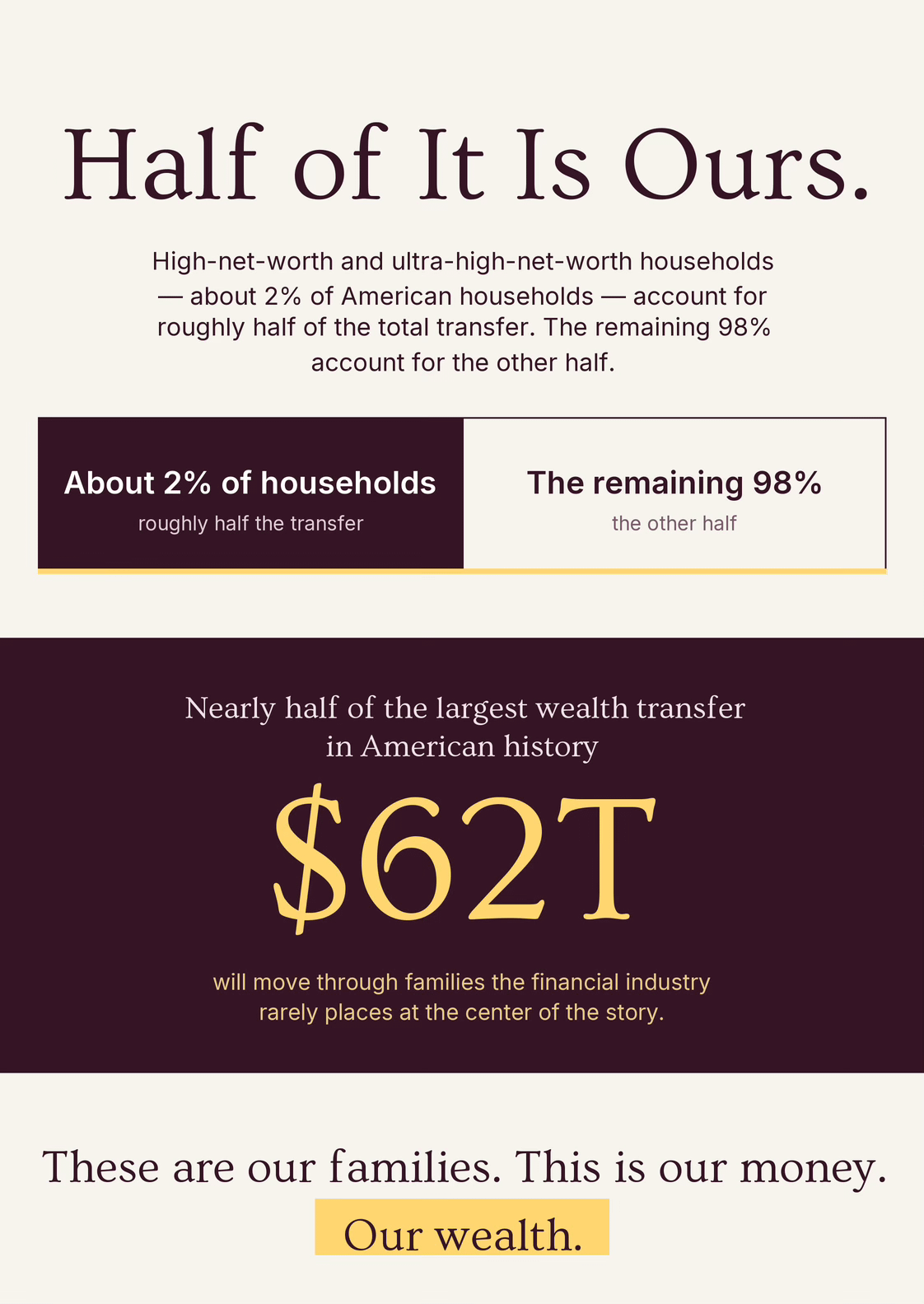
And, it’s true that the high-net-worth and ultra-high-net-worth households—the wealthiest 2 percent of American families—account for more than half of the total transfer. But, here’s the thing: the remaining 98 percent of households account for the other half. And that’s where we have a tremendous amount of power, and opportunity.
The numbers around “wealth” are often presented to emphasize how much of it is concentrated at the top. We get it. But here’s what the numbers also reveal, and it’s big:
That is the premise of this Substack, and it is why I am here with you now.
• • •
The Great Wealth Transfer is not simply a story about billionaires and their estates. It is a much more important story about those of us with houses, retirement accounts, small businesses, life insurance policies, land, farms, modest portfolios, and the obligations that come with caring for aging parents, raising children, and navigating debt. We are the families who may hold significant assets without ever thinking of ourselves as people with wealth to steward.
But before we go any further, let’s be clear about what the word wealth means here. It does not mean a fortune.
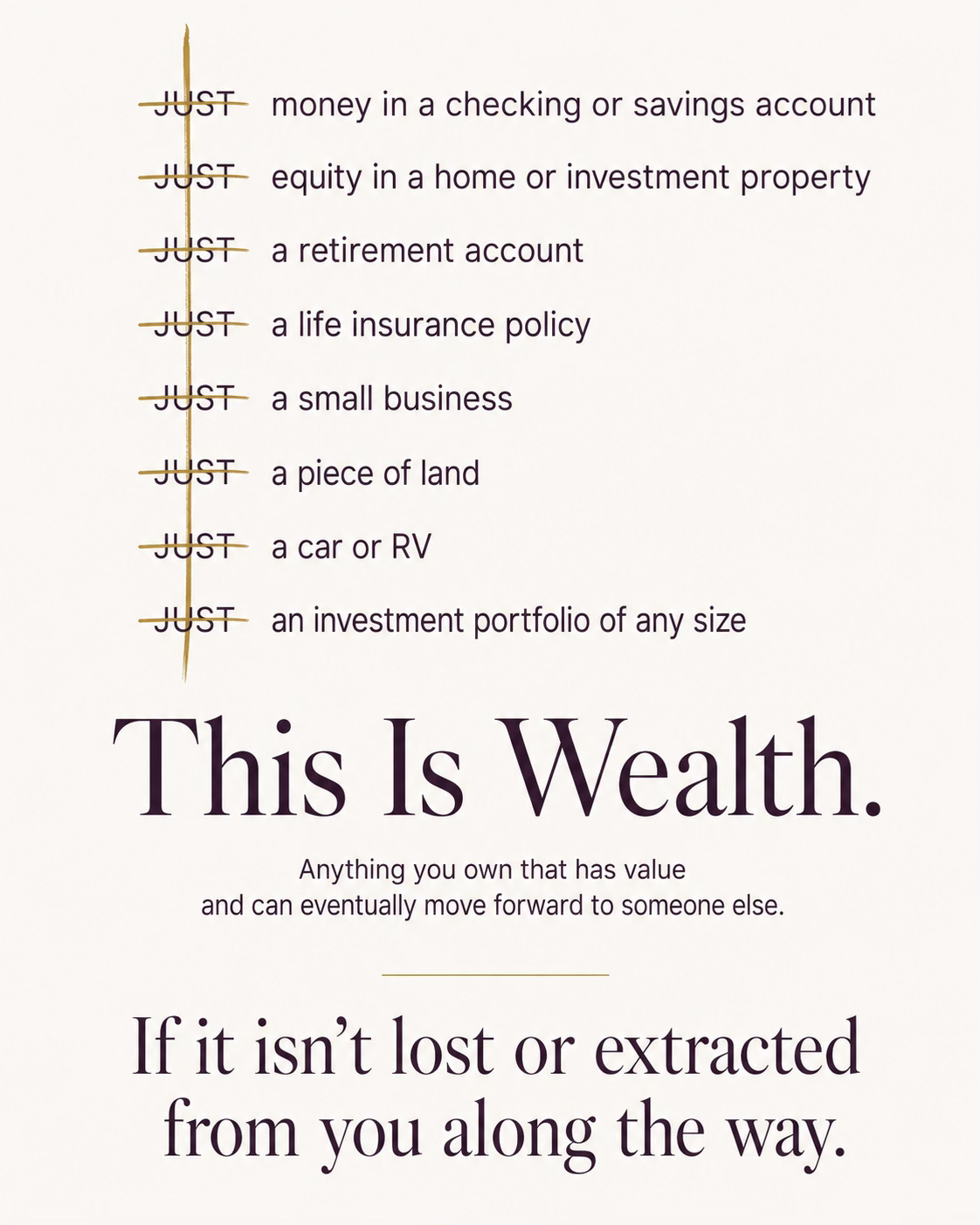
In this context, I’m using “wealth” as the container word for money and assets. And yet wealth is so much greater than just money and assets. As you’ll hear me often say, family wealth, the term I’ve built my life’s work around, includes our intangible, and most often lost, compromised or sacrificed non-renewable resources.
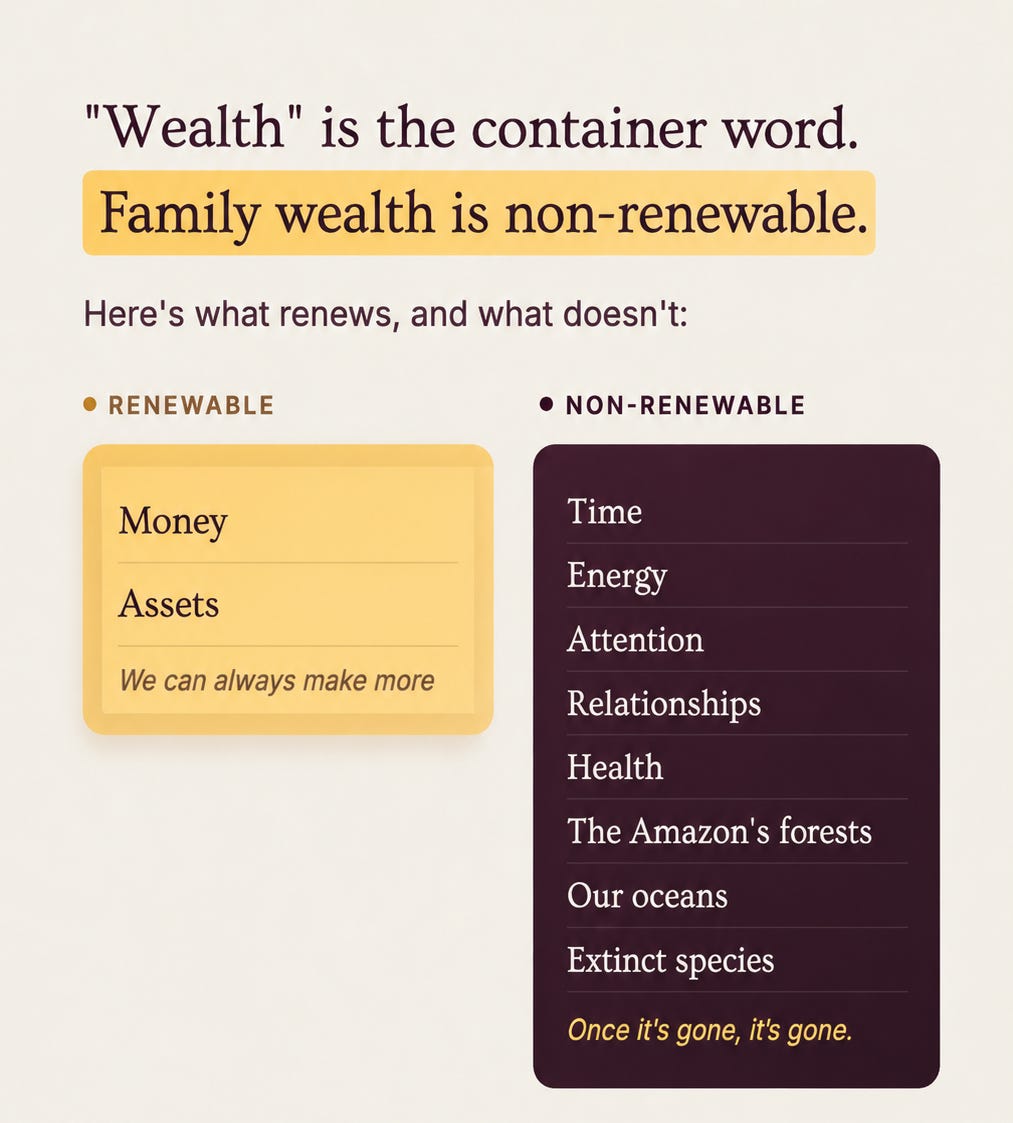
We will talk much more about our individual and collective non-renewable resources and how to stop sacrificing them in service to what is renewable: money.
For now, though, let’s look at the financial wealth—money and assets—and why we must see that what we have is worth taking a lot more seriously (and, at the same time, putting it in its right place, not centering it quite so much, and also realizing we have a lot more than we think). There’s a lot of paradox and nuance here, so stick with me through whatever may seem contradictory. It’ll be worth it.
• • •
Here are some ways your financial reality could be impacted by the Great Wealth Transfer:
Your mother gives you money from her savings to help with a down payment. That is a wealth transfer made during her lifetime.
Your uncle dies and leaves you the proceeds of a modest life insurance policy. That is a wealth transfer.
Your parents leave the family house to you and your sister. Whether you keep it, sell it, or discover that debts and deferred maintenance have consumed most of its value, that is a wealth transfer, too.
Your aunt adds you to the deed to her house or to her bank account because you’re her only heir, and you lose the capital gains benefit of her death, or she loses her bank account because you didn’t file your taxes. That’s wealth transfer.
Your father says his retirement account will be divided among his children, but the beneficiary form still names his former wife. The account will pass according to that form, not according to what he told you he intended. That is also a wealth transfer—just not the one he thought he had planned.
Your mom got remarried to a younger man who has kids from a prior marriage. She didn’t update her estate planning documents because you didn’t want to bring it up. Then, she’s hospitalized for too long to do anything about it. When she dies, her husband gets everything, and you get cut out. A very common unintended wealth transfer.
None of these families would necessarily describe themselves as “wealthy.” But all of them have wealth moving from one generation to the next. And this is happening now, not someday. The oldest Baby Boomers are turning 80 in 2026.
The decisions that will determine what your family receives—and what it loses—are being made in estate plans that have not been reviewed in a decade, retirement accounts whose beneficiaries haven’t been checked since a divorce or remarriage, and family conversations that keep getting postponed until there is more time, more money, or more certainty.
The useful window is now—while the people who built and hold the wealth are still here to clarify what they want, and what they intended, fix what no longer fits, and prepare the people who will eventually be responsible for carrying it forward.
We have a unique moment in time right now to move our resources out of old systems that no longer serve and into the new future that is emerging. You’ll hear me refer to this again and again, as we move from an extractive past into a regenerative future. It’s critical during this time of meta-crisis or polycrisis. We’ll talk much more about those terms in the future, but for now we can just say: everything is changing, and you can feel it, right?
• • •
Many of today’s most powerful family dynasties began with an ancestor who recognized a major economic shift before most people did, and acted on it.
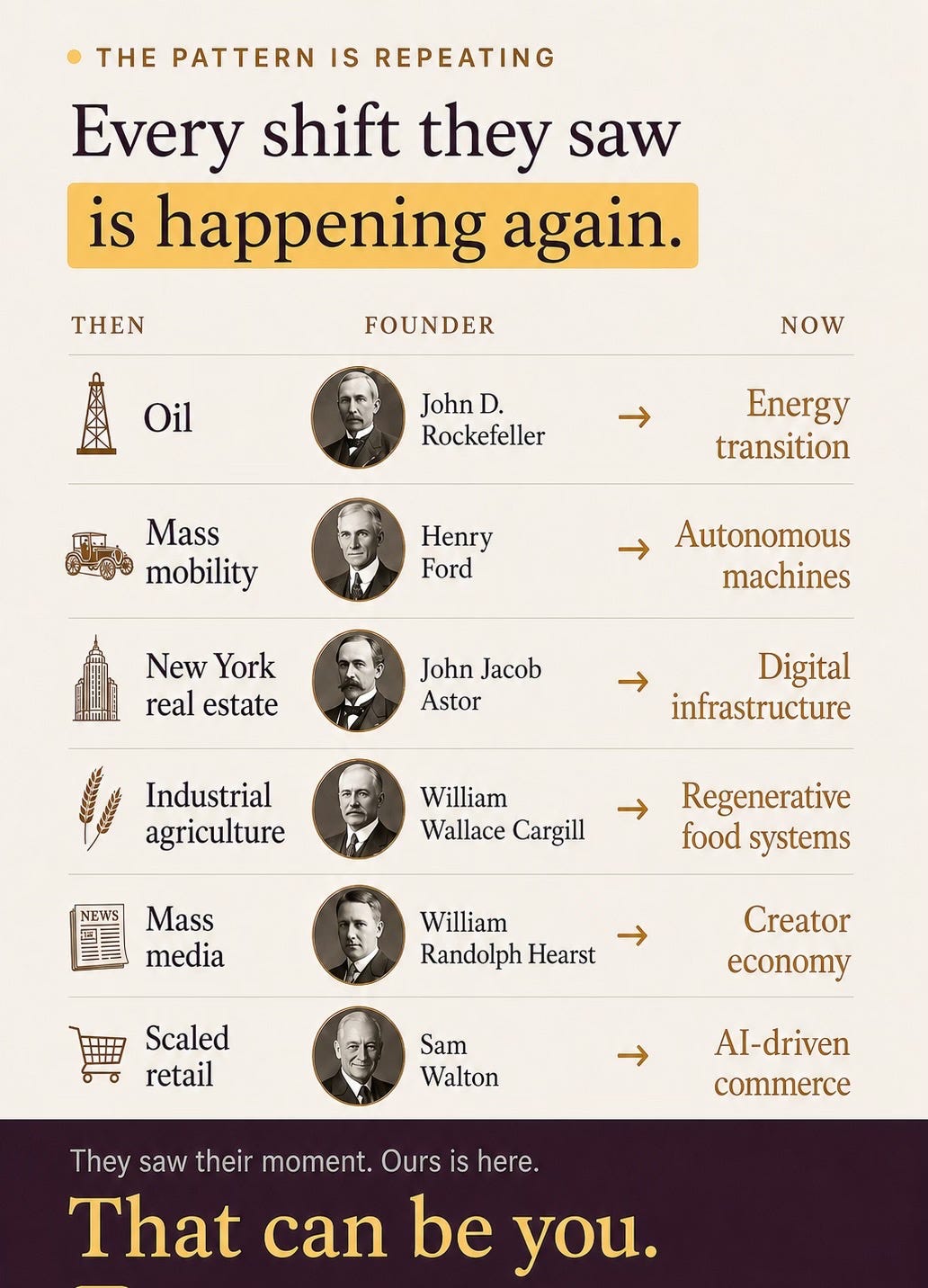
Let that sink in for a minute, and recognize that they were people, just like you, who happened to be living during a time of great change. And they saw a future that they acted upon when few others did.
That can be you, and your family could be the beneficiary of your choices now for many generations to come, depending on where you choose to focus your resources today. With more information and also more distraction at our fingertips than ever before, where you focus your resources could make all the difference in the world. I’m here to support you to hone in on what matters most.
• • •
One of the biggest differences between high-net-worth families and the rest of us (other than money and assets) is that they’re far more likely to have infrastructure: lawyers, tax professionals, private banks, investment advisors, current estate plans, regular family meetings, and professionals whose job is to notice when the pieces do not line up.
Many have formal family offices—dedicated structures built to coordinate the legal, insurance, financial, and tax decisions that affect every member of the family. The absence of that infrastructure for the rest of us is not just inconvenient. It is expensive.
These are often not failures of love or intention. They are failures of infrastructure.
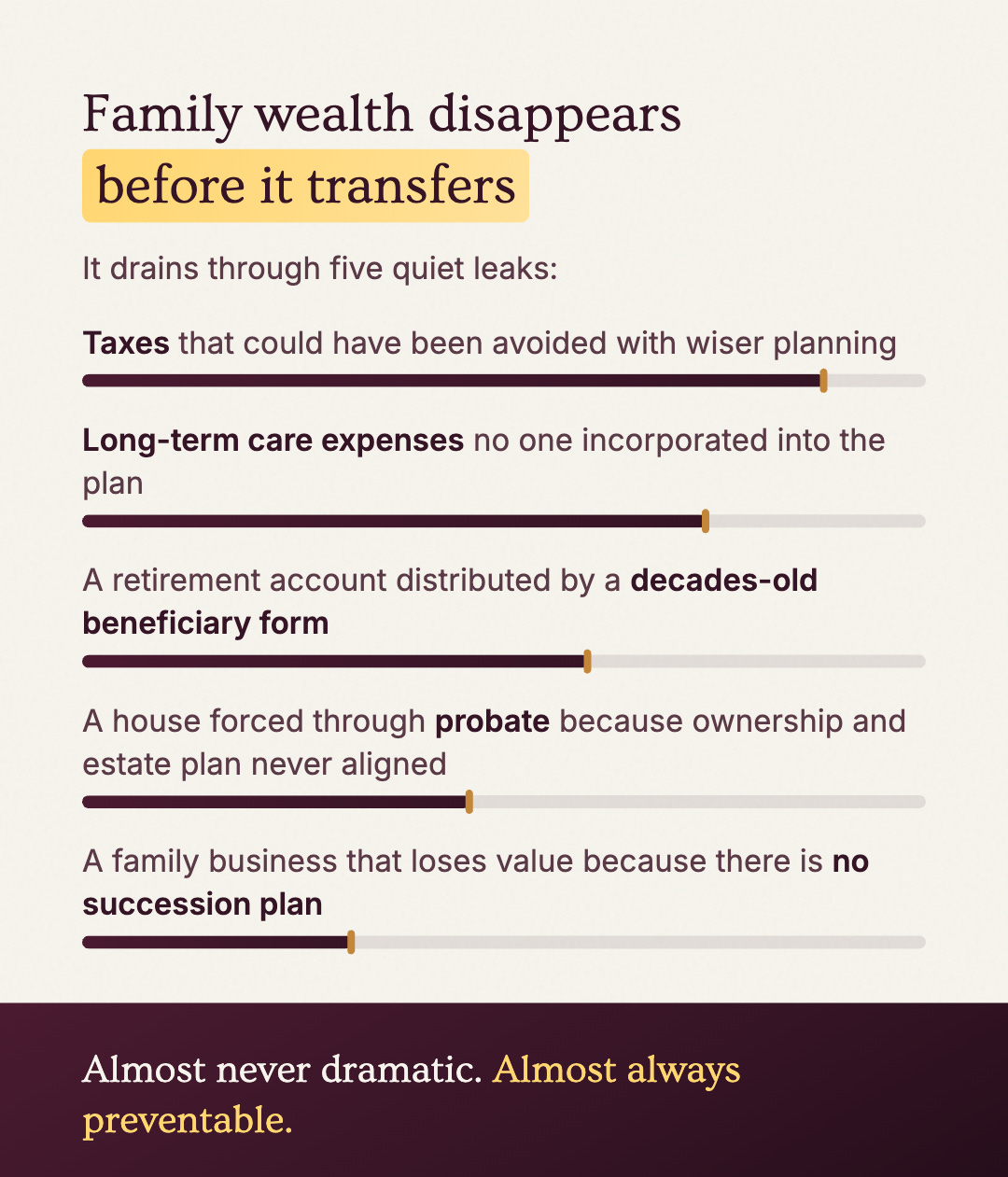
I want to be precise about what I mean by “infrastructure,” because the word can sound like something that only makes sense at eight figures. But it really matters at far less, and perhaps even more.
Every family that wants to steward what it has needs some version of the same four functions:
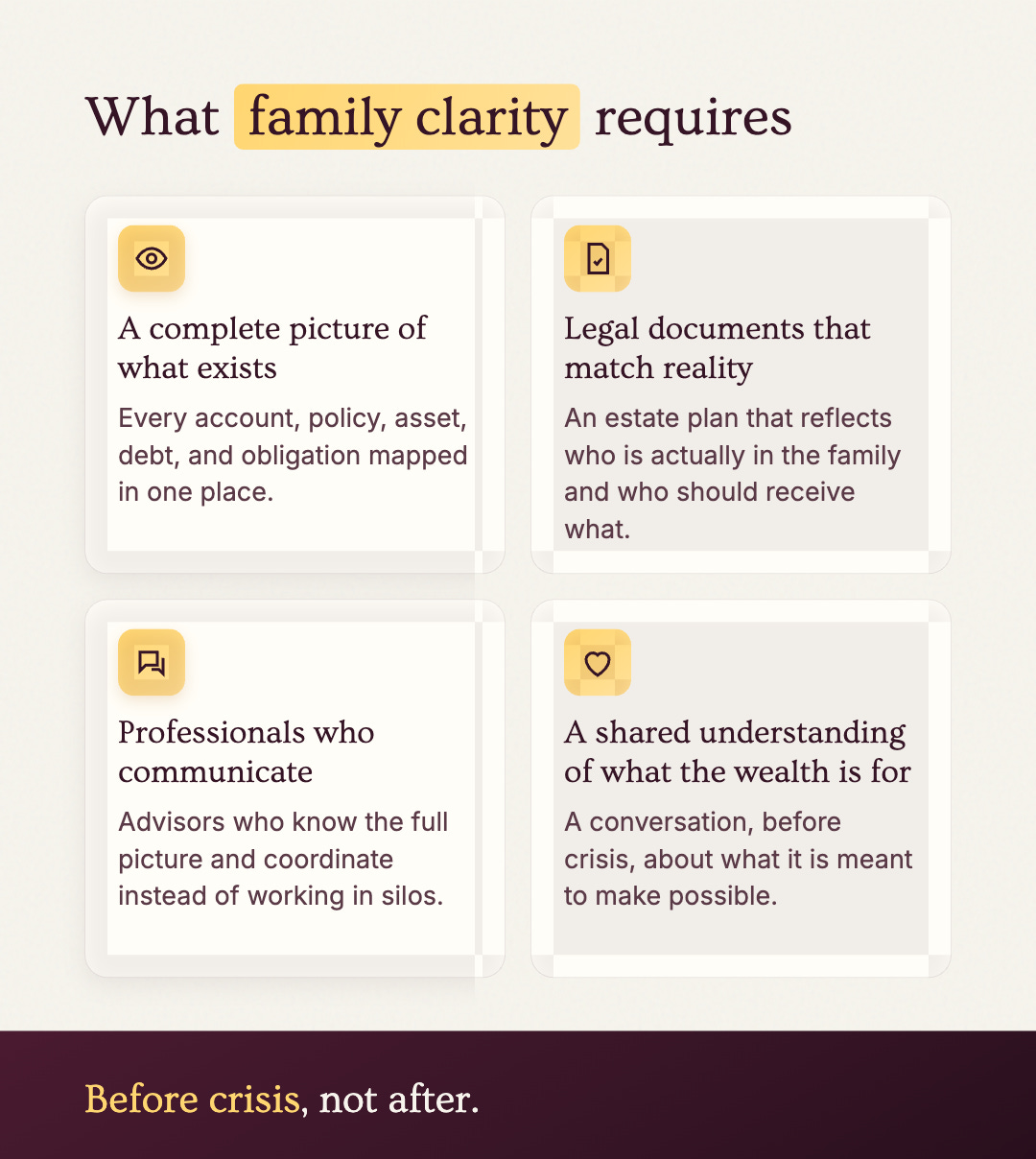
That is the work a family office performs. Most families do not need a building, a staff, or a minimum balance. They do need the function of a family office though: a decision-making structure that allows you to see your resources clearly and act on them deliberately. We’ll be looking at how we can create that together, here.
We’ll also look at:
how to find out what your family actually has;
how to talk to your parents without sounding as though you are counting their money;
how to prepare your kids for what’s coming without creating entitled brats;
how to keep court costs, care costs, taxes, and family conflict from consuming what your parents hoped to leave; and
how to decide what the money is for, once it arrives.
We will also examine what it costs to avoid this work—and how families at every asset level are beginning to do it differently.
• • •
There is a reason so many of us fail to see any of this clearly, and there is a name for it:
Money dysmorphia (n): the distorted view we have of our financial reality that causes us to sacrifice our non-renewable resources in service to money, which is infinitely renewable when we know how to use our non-renewable resources.
Money dysmorphia often causes us to measure our financial reality against an imagined standard (usually someone else’s) and could make whatever we do have look too small, too disorganized, or too inadequate to require serious planning.
It is the same distortion that convinces a family with equity in a home, retirement accounts, and a life insurance policy that it does not have “real” wealth and that the conversation about protecting it belongs to someone else.
You will see how this plays out over my future articles, and I’ll help you see what you may be missing now when it comes to the impact of this Great Wealth Transfer and money dysmorphia on you, your family and your community because until you can see what you already have, you cannot protect it, build it or redirect it deliberately.
You do not need to wait until you feel rich enough. In fact, if you do, you may never become rich. Instead, you start right now, by getting clear about how to care for what you have now.
• • •

Also published today: “Don’t Wait Until You’re Rich Enough to Build a Family Office,” which shows you what family-office thinking could look like in your life right now.
Sources: Cerulli Associates, “Cerulli Anticipates $124 Trillion in Wealth Will Transfer Through 2048,” December 5, 2024; Cerulli Associates, The Cerulli Report: U.S. High-Net-Worth and Ultra-High-Net-Worth Markets 2024.
This article provides general educational information, not individualized legal, tax, financial, or investment advice. Consult qualified legal, financial, and tax advisors who understand your complete family and financial picture before making decisions about estate planning, wealth transfer, or family financial structures.
No posts
Comments
Nothing yet. Say the first thing.
Sign in to join the conversation.