
In my early years as a lawyer, working on transactions for Warren Buffett and others like him, I got an insider view of the traditional family office. I knew what legal and financial order looked like, and I was quite sure it didn’t apply to me. My guess is you likely think it doesn’t apply to you either. As a result, the $62T that “we the people” have in our control is at risk of being lost, or extracted from us.
After graduating from Georgetown Law, I worked within wealth structures for some of the most financially sophisticated families in the country. I understood, in precise professional detail, how legal, insurance, financial, and tax realities (what you’ll often hear me refer to as “LIFT”) fit together into one coherent system.
Yet I had none of that for myself. Of course I didn’t. Frankly, I didn’t think any of it applied to me. That was for rich people. Really rich people. And I was sure I was not that.
Yes, I was earning a six-figure paycheck at 28, and then I built two seven-figure businesses by the time I was 35, but I didn’t come from money. I had student loans and debt. I didn’t even really know what a 401k was or why I needed one.
I figured that the LIFT coordination handled by the family offices of Munger, Buffett, Allen, Ovitz, Eisner, and the other big-name clients we served surely didn’t apply to me. That thinking ended up costing me over a million dollars in mistakes I wouldn’t have made if I’d understood how it all fit together.
Even though I was a very smart lawyer, I was in so many ways completely naive about money and business. I was quite literally a child when it came to personal finance. You may be too.
When I first started working at Munger Tolles, one of the first things they did was hand me a piece of paper and they said, “Congratulations, you’ve got a 401k! Now, tell us how you’d like to invest it.”
The paper they handed me had all sorts of letters on it, and I had no idea what those letters meant. I was too embarrassed to ask, and we didn’t have Google back then. So, I literally squeezed my eyes closed, put my finger down on the paper, and that’s how I picked my 401k investments.
Many of us are doing what I call eyes squeezed-shut decision-making. We outsource our financial power, make choices we don’t fully understand, and lose what we have—either as fast as we make it, or, if we manage to hold onto it, we lose it from one generation to the next.
It’s why everything I now build is organized around one core idea:
Wake up, see what you have, and learn to steward it before someone else does it for you.
• • •
The moment it first became impossible for me to ignore was during my divorce.
My husband hired a forensic accountant, worried I might hide assets. Fair. He was the stay-at-home spouse; I was the breadwinner who had started a business he really knew nothing about. He was probably right to be worried.
I had no intention of hiding assets from him, but he didn’t know that. The real issue was that I had no idea how to manage the financials of my business. It hit me square in the face when his forensic accountant looked across the table and said: “Alexis, your books are really messed up.”
Shame flooded me. The worst part was I didn’t even really know what he meant or how to fix it. Not because I wasn’t working hard. Not because I wasn’t smart. Because I had no idea what “books” even were, how to track my financials, or what I should be reporting where or when.
It was 2005. I was 32, raising two little kids, getting divorced, and only 18 months into the world of business. I had a CPA who had told me I didn’t need to incorporate my business. Bad advice.
I had bought a whole life insurance policy from an insurance guy I thought was my friend. Bad advice.
And I definitely didn’t have an integrated view of what I had, what it cost, what it was building toward, or what was falling through the cracks.
I was managing my finances the way most people do: by looking at my bank account to see if I had enough money, and running numbers in my head during yoga class to make sure I wouldn’t run out.
The result would become more than a million dollars in mistakes I wouldn’t have made if I’d had a system, structures, rhythms, and flows that would allow me to think about money when I needed to, and not worry about it when I didn’t need to worry.
But at the time, I was the only one holding the whole picture, and I didn’t even understand the frame. I felt alone. Too ashamed to ask for help, too exhausted to know where to start, and too convinced that if I just earned a little more, the chaos would somehow resolve itself.
Then, two years after the divorce, a letter arrived from the IRS. They were auditing my taxes from 2005—the same year I already knew was messed up. I stood in my kitchen and read it twice.
I cried for two days. Not just about the audit. About all of it. About how someone who knew as much as I did could have let things get this far. About the shame of it. About being so alone with something so big.
Then I woke up and realized crying wasn’t the answer: I was being taught a critical lesson. I called my personal assistant (a 17-year old working for me part time) to work with the accounting team I hired to handle the audit (oh, how I wanted to cheap out, not hire them, and try to do it myself) and told them all:
“Handle this audit and don’t bring it up to me unless there’s something specific I can do. Otherwise, just take care of it.”
And I took every bit of energy I could have spent berating myself, worrying and stressing and—any time I thought about it—I’d rip my mind away like ripping velcro, and took some action that would build my second business instead.
Within 18 months, I turned that new business into a million dollar revenue stream, and I got a “no-change” on the audit.
It felt like a miracle. And it was. But, also, it was a huge lesson in how critical my focus was, and that I could control outcomes with where I put my energy and attention.
But I still didn’t really learn what my “books” or “financials” really were. And, eventually, that once again caught up with me. There was way too much flowing through my system, and I couldn’t handle it all.
Instead of turning to face it, and figure it out, I decided I was bad at business, and I’d walk away from it all. Not because I had lost everything—I hadn’t. My businesses were still earning. I had even created irrevocable asset protection trusts to hold the businesses so if I filed bankruptcy, the businesses would survive.
I was carrying a boatload of debt: draining my creative energy, constraining every decision I made. I could see clearly that continuing to service the debt wasn’t the path forward.
Filing bankruptcy was the most strategic thing I could do: get a clean start, face my biggest fear, and rebuild on a foundation I actually understood. And I did, slowly, but on a completely different one.
Here is the thing I came to understand only after the bankruptcy: I needed my own family office. Even though I was broke and rebuilding from rock bottom, I needed to figure out how to see what I had, become my own best advisor, and then hire the right support from there.
• • •
The role of family steward—the person who holds the whole picture of a family’s wealth, household, and future—is not a modern invention. It is at least 1,500 years old. The Romans called this person the major domus, the master of the house. The role survived the fall of the Roman Empire, moved through medieval European households, and eventually became so powerful that the Frankish maior domus, the Mayor of the Palace, held more authority than the king.
The modern version arrived in America in 1882. Here is how it evolved and why it matters now.
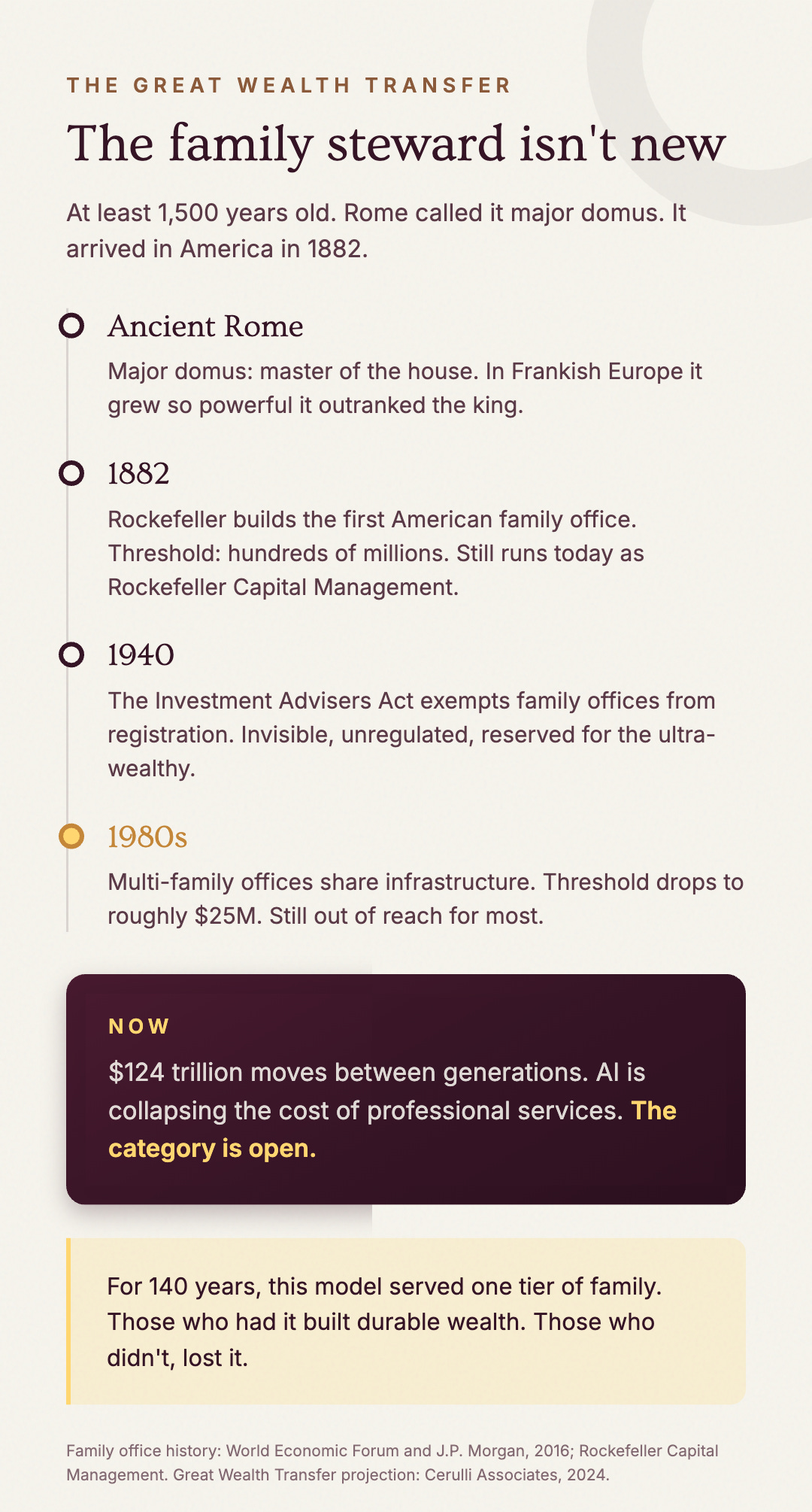
For 140 years, this model was available to one tier of family. The families who had it built durable wealth across generations. The ones who didn’t, lost it. There is a widely cited industry statistic: 60 percent of families lose their wealth by the end of the second generation. 90 percent lose it by the third.
Family offices were invented to interrupt that pattern. What I built after my bankruptcy, without yet knowing what to call it, was my own version of the same thing.
• • •
Back then, I didn’t think of it as a family office. I just knew I needed help. I wasn’t even clear what that help was, so I started with two people I already trusted. That same personal assistant who had helped me through the audit, and his girlfriend, who was also my nanny. I trusted them, and figured I could train them to help me.
This young couple had been helping me hold my life together through the divorce, the audit, and everything after, while I was raising two kids and running two businesses. I didn’t trust them to know everything about money. I did trust them not to take advantage of me when I was vulnerable. That turned out to be exactly the right place to start.
We learned together. They went to college, got married, started a bookkeeping company. We built tools and systems that let me actually see what I had for the first time: not just the number, but the whole picture. What was coming in, what was going out, what was protected, what wasn’t, what I was building toward, and what I was quietly losing.
Twenty years later, I can see that what we were building over all those years was my family office. Together, we learned how to coordinate my legal, insurance, financial, and tax reality so that I would never again be the only one holding the whole picture alone.
That is what I now call LIFT: Legal, Insurance, Financial, Tax. Four pillars. One connected system.
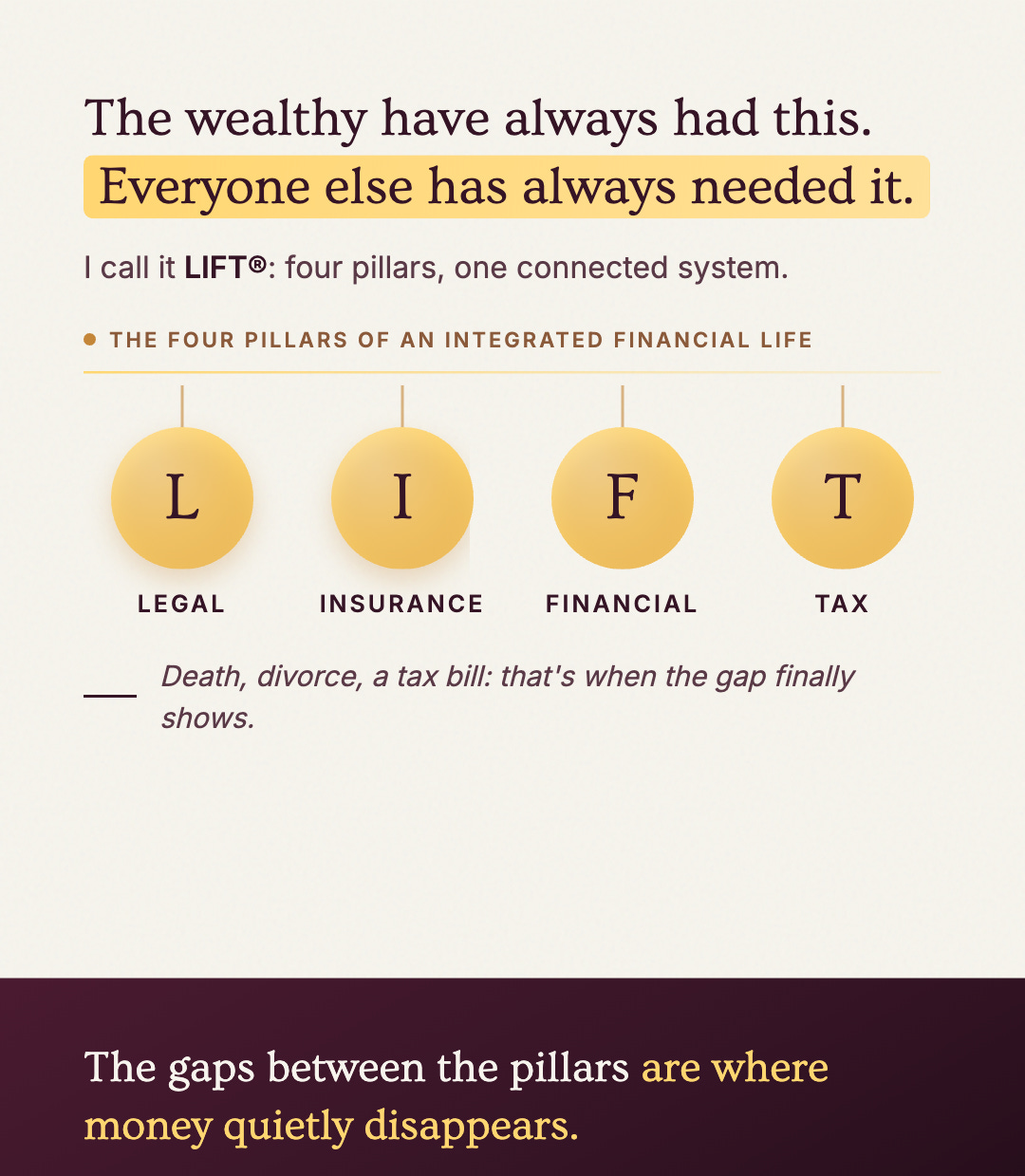
Death has a way of introducing people who should have met twenty years earlier. A business loss, a divorce, or an unexpected tax bill has a way of revealing the absence of a system that should have been there all along.
I know. I lived it. With all the professional knowledge in the world and no integrated view of my own financial life.
• • •
This is where the Great Wealth Transfer enters the picture. As I wrote in “The Great Wealth Transfer Is Not Just a Rich-People Story,” nearly half of the money and assets expected to transfer over the next two decades will move through families that do not think of themselves as wealthy.

This is not a wealth problem. It is a seeing problem. And I say that with complete compassion because I had the same seeing problem for most of my adult life, even while I was professionally solving it for everyone else.
Most of us assume the Great Wealth Transfer doesn’t apply to us because we don’t think we have enough to be part of it. But we are all inheritors. All of us will be inheriting something, even if that something is a whole lot of debt and trauma.
But, this transfer isn’t only about what gets passed down. It’s about how much of it your family actually keeps—in your own hands, your own relationships, your own community—versus how much quietly flows out to whoever is positioned to receive it.
The real risk isn’t the size of the number. It’s everything that doesn’t happen because the number seems too small to matter: the conversations that don’t take place, the documents that sit unread, the assets nobody is tracking, the adult kids who assume their parents have it handled, the siblings who stop speaking over an estate that should have brought them closer.
• • •
So here’s the great news: family offices are no longer a luxury available only at the top. AI is collapsing the cost of the professional services that used to define what a family office required. The category is being stretched, and the work—the actual coordinated stewardship of a family’s whole picture—is ready to scale.
What I am building, what I have spent the last twenty years building for myself, and I’m now able to make available to all of us is what I call Family Office at Scale: a model that brings the discipline of the Rockefellers and the Buffetts to every family, with a Personal Family Lawyer trained as a Family Wealth Advisor supporting you to become a Family Wealth Steward, at the center.
The lawyer is the only professional structurally positioned to hold this seat, with fiduciary duty, attorney-client privilege, and no product-sale incentive pulling them off the family’s side of the table.
This is not a new idea. It is a 1,500-year-old idea whose time has finally come for everyone. You do not need more money to start. You need to decide that what you already have is worth seeing. That is where everything begins, and it is available to you right now, at whatever level you are starting from, in whatever condition your financial life is currently in.
• • •
In my next article, I will be looking at Dan Martell’s news and how investments that pay off massively can be at risk if you don’t protect them by taking a simple, forward-thinking step. If you want it in your inbox, subscribe.
New to this conversation? Read “The Great Wealth Transfer Is Not Just a Rich-People Story,” where I explain why this historic transfer includes far more families than most of us realize.

• • •
Sources: Family office history: World Economic Forum and J.P. Morgan, The Single Family Investment Office Today, August 2016. Rockefeller family office history: Rockefeller Capital Management. 60/90 percent generational wealth loss statistic: World Economic Forum and J.P. Morgan, 2016. Great Wealth Transfer projection and inheritance estimates: Cerulli Associates, 2024. Planning gap data: Northwestern Mutual Planning and Progress Study. Quote on stretching of the “family office” category: Financial Planning, May 2025.
No posts
Comments
Nothing yet. Say the first thing.
Sign in to join the conversation.