

Those of you who know me for my work on risk may have been surprised to learn of my earlier work on immigration. Perhaps you have wondered what it has to do with risk. The answer is: Actually, quite a bit.
I often talk about the influence of my earlier analysis and writing on sovereign debt crisis –particularly the Argentine and Greek debt crises—on the creation of gray rhino theory.
To be honest, I myself had not given much thought until recently to how much my work on immigration from the 1980s through the early aughts (including my first two books, WHY THE COCKS FIGHT and LOCKOUT) has influenced my thinking about risk.
First, America’s long-broken immigration policy is a clear example of a gray rhino: an obvious, widely recognized challenge. Immigration is the subject of countless headlines and debates and the target of Herculean efforts to change policy for the better. Our elected officials’ failure to act on public opinion in favor of a constructive solution is a textbook case of what I call a “meta gray rhino,” or a structural barrier to solving a problem. This failure shows clearly how “democracy” as practiced in the United States does not effectively translate public opinion into policy.
Second, immigration policy is a case study in the disconnect between threat perception and reality. Whether we’re talking about national security, economics, culture, or other measures of national interest, there is a giant gap between reality and what many people believe to be true. That’s another meta gray rhino because so much public debate about immigration is based on misconceptions, which politicians and special interest groups exploit.
Over recent weeks, I’ve shared with you excerpts from my 2006 book, LOCKOUT: Why America Keeps Getting Immigration Wrong When Our Prosperity Depends on Getting It Right, as I have worked on updating the facts at hand. I’ll be sharing some of that new data and related analysis as I work it into the manuscript of the revised book.
Today, I want to talk about immigration, threat perception, and threat definition.
To effectively respond to a gray rhino risk, it’s important to clearly define the issues at hand and frame the challenge appropriately. Once you've defined the nature of the challenge at hand, it’s time to diagnose how serious it is and find agreement on the root causes and potential solutions.
Immigration policy involves economic, cultural, social, political, and fiscal dimensions, all of which come with trade-offs. Different groups have widely varying views about how to manage these trade-offs; these views also vary widely in how anchored they are to reality.
To be completely transparent about what I have concluded after hundreds of conversations and interviews and piles and piles of reading and research: I believe that the gray rhino at the center of US immigration is that our system is broken. Many people who want to “do it the right way” get locked out by legal and bureaucratic hurdles. One of the most heartbreaking things about the Trump administration’s crackdown on immigrants has been the way ICE agents have seized people at courthouses and immigration agency offices where they are following the law. Similarly, people have been deported over clerical errors caused by US government employees or third-party contractors.
Based on the facts: I do not see immigration overall as a threat. I believe that the best way forward is an orderly system that allows prospective immigrants who meet agreed-upon criteria to come to the United States legally and be treated fairly and with respect. I believe that the United States would not have achieved what we we have without the contributions of immigrants, and that we will not reach our potential without the continued contributions of immigrants. I believe that we need facts to make the right choices about the trade-offs underlying immigration policy choices.
I also believe that the current U.S. administration is committing a grave error by vilifying immigrants and misleading Americans about the alleged risks that immigration poses; by dramatically overstating the absolute numbers and percentage of immigrants who are undocumented (a civil, not a criminal offense) or have committed crimes; and by taking extreme measures against non-citizens, naturalized citizens, and U.S. citizens of all kinds. Yes, some immigrants are criminals and should either be refused admission or deported; but many Americans are criminals and should face consequences. (Actually, research over the years has consistently shown that immigrants are less likely than Americans to have committed crimes.)
The biggest risk when it comes to immigration lies in policies like the current administration’s, which are bad for businesses, tear apart families, cost lives, and — as many Republicans are starting to recognize— are bad politics.
In coming weeks, I will be sharing facts, analysis, and key debate points about the social, political, economic, and other impacts of immigration so that you, dear readers, can decide for yourselves. I will analyze the history of efforts to reform immigration in line with public opinion, why most have failed, and what policies could work.
Today, I want to share with you some research around American attitudes on immigration. A couple of key points: 1) Attitudes differ significantly by partisan affiliation. 2) Perception of immigration as a threat, and opposition to immigration, both dropped sharply from 2024.
An October 2025 report by The Chicago Council on Global Affairs found that 36 percent of Americans consider immigration to be a critical threat to vital U.S. interests over the next 10 years. That represented a sharp drop from 50 percent in 2024, and an even steeper drop from a high of 60 percent in 2002, following the September 11, 2001 terrorist attacks. It also was the second-lowest out of 12 threats; the top two were U.S. government corruption (73 percent) and weakening democracy in the US (65 percent).
In the same survey (carried out July 18-30, 2025), opposition to legal US immigration hit all-time lows of 21 percent overall, while support for more legal immigration rose to 28 percent.
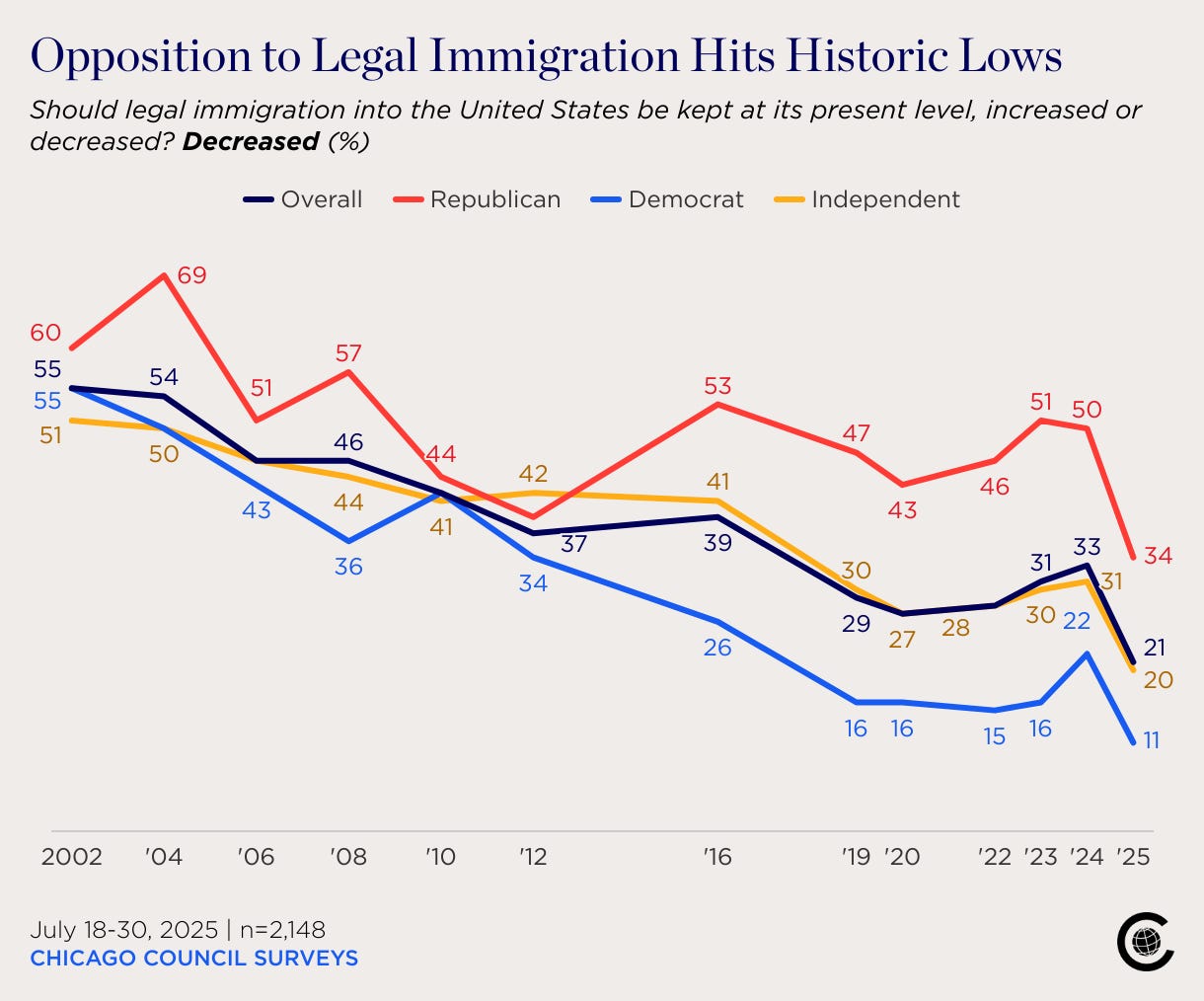
What I find most interesting about the fall in threat perception —both from 2024 to 2025, and earlier from immediate post-9/11 days to the present— is that increased anti-immigrant rhetoric paradoxically led to more positive attitudes about immigration. Also worth noting is that partisan views on immigration converged between 2010 and 2012 but then began to polarize, particularly around the 2016 presidential election. From 2024 to 2025, interestingly, the sharpest drop in opposition to legal immigration occurred among Republican voters.
A Pew Research study (based on polling from October 6-16, 2025) showed 53 percent of Americans saying the Trump administration was doing “too much” in its deportation efforts, up from 44 percent in March 2025. As with the earlier Chicago Council survey, answers varied significantly based on partisan identification. Pew also found sizable differences in these views by race and ethnicity within each major party, particularly among Republicans.
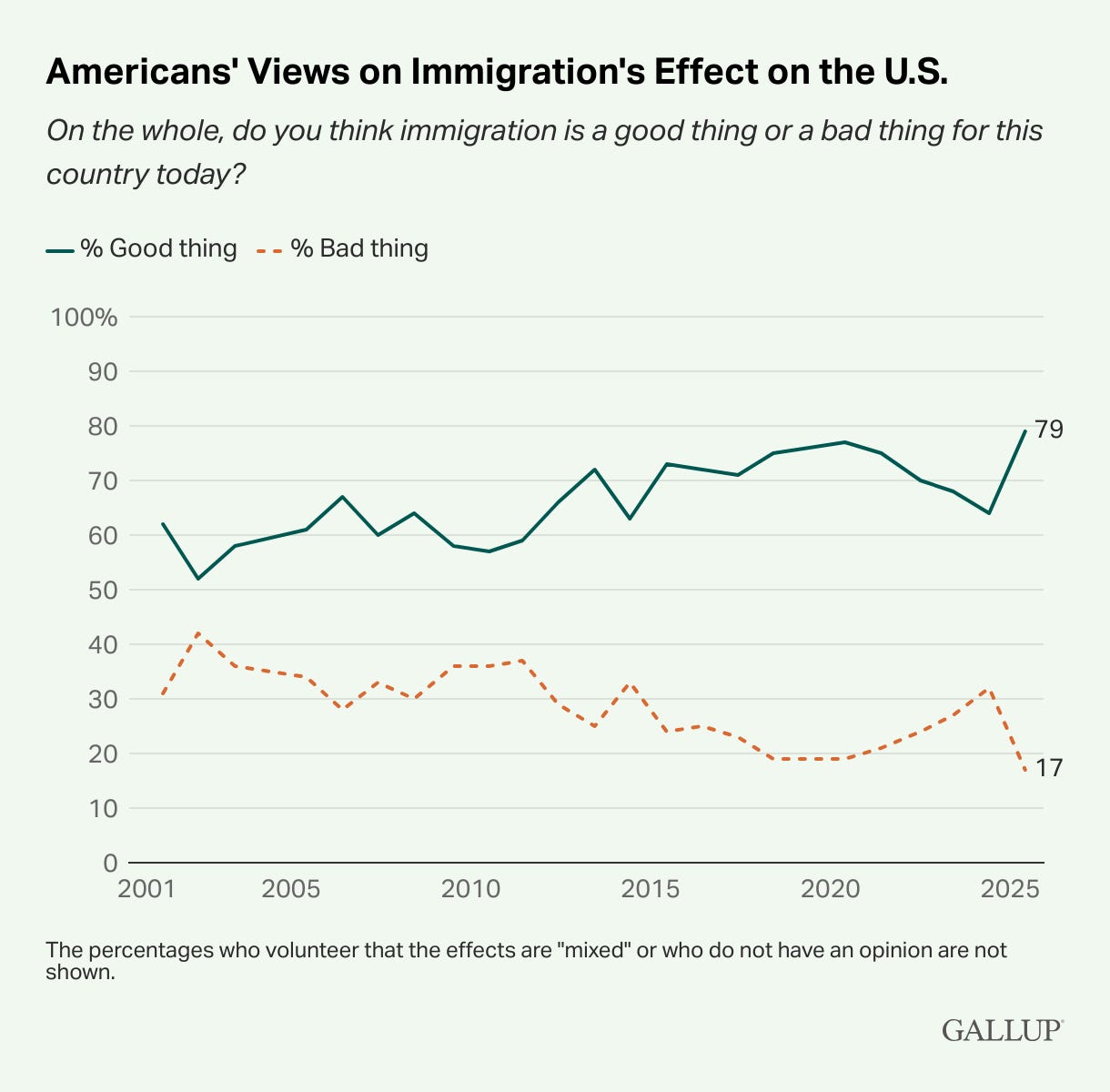
An earlier Gallup poll (June 2-26, 2025), similarly found that Americans’ attitudes toward immigration were becoming increasingly more positive. “Americans have grown markedly more positive toward immigration over the past year, with the share wanting immigration reduced dropping from 55 percent in 2024 to 30 percent today,” Gallup reported. “At the same time, a record-high 79 percent of U.S. adults say immigration is a good thing for the country.”
Disapproval of current administration policies on immigration have continued to rise. A February 26 National Public Radio/PBS News/Marist survey showed 62 percent of Americans believing that Immigration Control (ICE) raids have made the country less safe.
A Morris Predictive Insights survey carried out in early February focused on voters defecting from Trump found immigration enforcement issues to be a major factor behind their disenchantment. ICE deployments to cities were the third highest (32 percent) reason they cited, followed closely by immigration enforcement and deportation policies (27 percent).
As you can see, American attitudes on immigration as a “threat” are increasingly at odds with the White House’s crackdown.
Some initial estimates have been coming out about the economic impact of White House immigration rhetoric and policy. In coming installments, I’ll be sharing those along with some other data and analysis on immigration. Stay tuned, and thank you for reading!
Comments
Nothing yet. Say the first thing.
Sign in to join the conversation.